
Affiliate Disclosure: Some links in this guide are affiliate links. If you purchase through them, we may earn a small commission at no extra cost to you. Read our full affiliate disclaimer here.
By King James Adjei — Researcher and Goldendoodle enthusiast, founder of GoldendoodleReport.com. Every guide on this site is carefully researched and written to give owners reliable, clearly organised information — updated regularly and honest about uncertainty. → About this site
📖 7-minute read | Last updated April 2026 | Reviewed for accuracy
Choosing the best clippers for Goldendoodles is not the same as choosing clippers for most other breeds. The Goldendoodle coat — particularly wavy and curly types — is dense, multi-layered, and continuous-growing. It places demands on a clipper that expose the limitations of most consumer-grade products within the first few uses. Understanding what those demands are, and which clipper specifications address them, is what separates a home grooming setup that works from one that overheats, stalls, or produces a stressed dog and an uneven cut.
👤 Who This Guide Is For
- You want to cut your Goldendoodle’s coat at home and need to know which clippers will actually work
- Your current clippers overheat, stall, or pull the coat rather than cutting cleanly
- You want to understand the specifications that matter for Goldendoodle coat before spending money on the wrong product
- You want to know the difference between consumer and professional clippers for this specific coat type
⚡ Quick Summary
The best clippers for a Goldendoodle are professional or prosumer clippers with a rotary motor, variable speed, low vibration, and low noise. Consumer clippers — the kind marketed for general home pet use — are typically insufficient for Goldendoodle coat density. The rotary motor specification is the most important single criterion: rotary motors maintain cutting power through dense coat without overheating the way the magnetic motors in consumer clippers do. Blade speed, heat management, and noise level all affect both cut quality and the dog’s willingness to tolerate the clippers over repeated sessions.
For the trimming technique see How to Trim a Goldendoodle at Home. For the complete tools list see Goldendoodle Grooming Tools Checklist.
Why Most Consumer Clippers Fail on Goldendoodle Coats
Consumer pet clippers are typically designed and tested on short-coated or single-coated breeds — dogs whose coat offers minimal resistance to the blade. The Goldendoodle coat is fundamentally different: dense, multi-layered, and — if not recently brushed — potentially tangled at the base layer. When a consumer clipper encounters this coat, it reveals its limitations almost immediately.
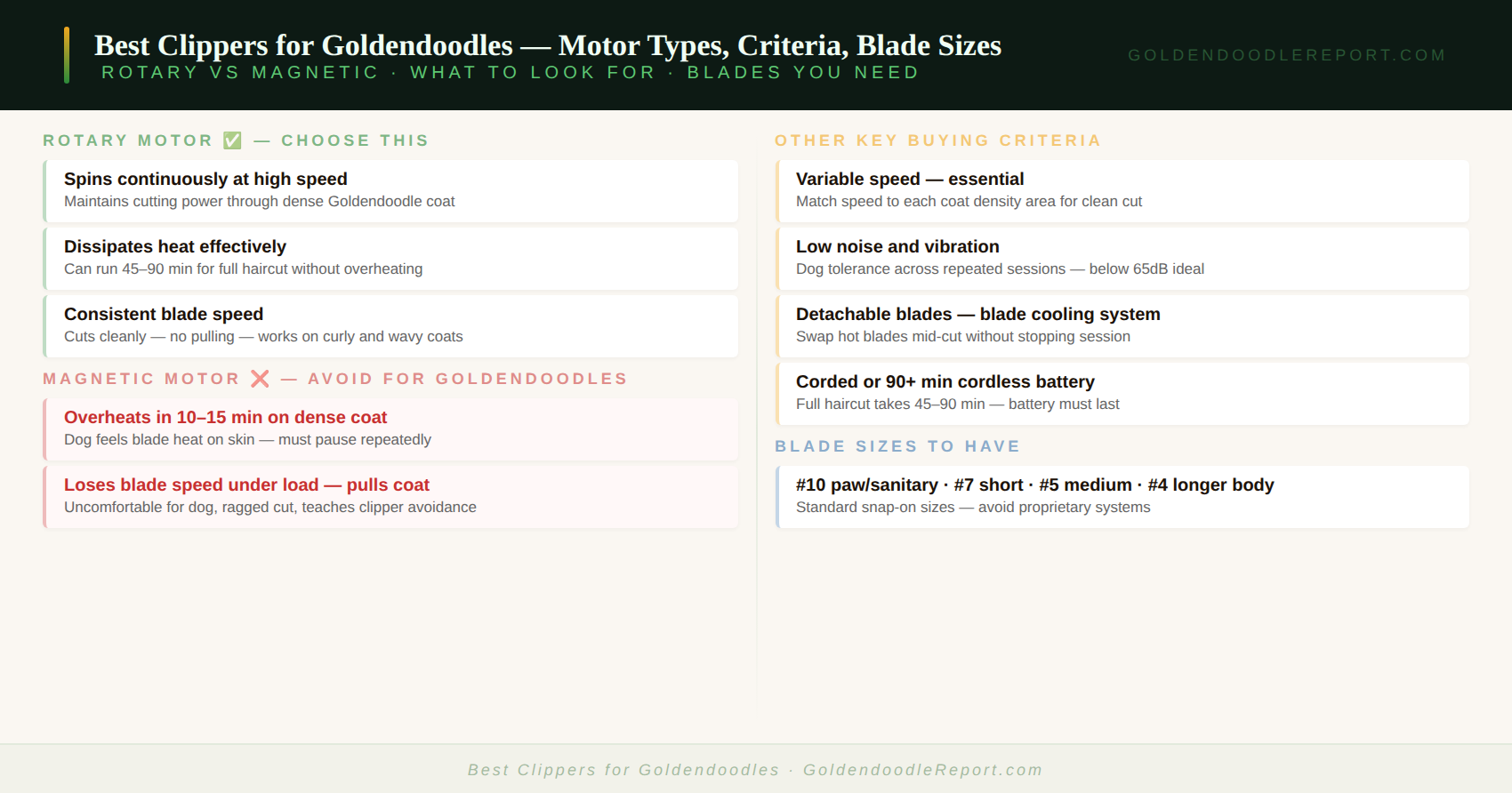
Magnetic motors overheat on dense coats. Most consumer clippers use magnetic motors — lighter, quieter at low speeds, and less expensive to manufacture. Under low-resistance conditions they work adequately. Under the sustained pressure of cutting through a dense Goldendoodle coat, the magnetic motor generates heat faster than it dissipates it. The blade becomes uncomfortable to the touch within 10 to 15 minutes. The dog feels this heat on their skin. The clipper must be paused repeatedly to cool — which makes the haircut take significantly longer and creates an unpleasant experience for the dog.
Low blade speed causes pulling rather than cutting. Consumer clippers typically operate at a single fixed blade speed. When that speed is insufficient for the coat density being cut, the blade does not cut cleanly — it catches individual hairs and pulls before cutting. Pulling is uncomfortable, creates a ragged cut, and teaches the dog that clippers are an unpleasant experience. Variable speed clippers allow the operator to match cutting speed to coat density, producing a clean cut at every thickness.
Vibration and noise cause anxiety. Consumer clippers are not engineered for low vibration or consistent low noise output. Dogs who are initially tolerant of clippers often become resistant after several sessions with high-vibration, loud consumer models — particularly around sensitive areas like the face, ears, and paws. Professional clippers are significantly quieter and lower-vibration, producing a better response from the dog across the lifetime of the tool.
Motor Types — The Most Important Specification
Rotary motors are the correct motor type for Goldendoodle coats. Rotary motors spin continuously at high speed, generating consistent cutting power regardless of coat density. They dissipate heat more effectively than magnetic motors under sustained load and maintain blade speed through thick, dense coat without bogging down. Professional and prosumer clippers use rotary motors. They are heavier than magnetic motor clippers and more expensive, but for a Goldendoodle coat they are the appropriate tool.
Magnetic motors operate at one or two fixed speeds by vibrating the blade back and forth rather than spinning continuously. They are lighter and initially quieter than rotary motors, but they lose cutting power under sustained load, generate heat faster, and are not designed for the kind of extended use a full Goldendoodle haircut requires. They are the correct tool for light trimming on short-coated breeds — they are not the correct tool for cutting a Goldendoodle coat.
Pivot motors sit between rotary and magnetic in power output. They are faster than magnetic motors and handle medium-density coats adequately, but they still fall short of rotary power for very dense curly Goldendoodle coats. A pivot motor clipper may work adequately for wavy-coated Goldendoodles but will struggle with dense curly coats.
Best Clippers for Goldendoodles — Complete Buying Criteria
Rotary motor — non-negotiable for curly and wavy coats
The motor type is the most important single specification. For any Goldendoodle owner who wants to cut the coat at home, a rotary motor clipper is the correct starting point. Do not compromise on this specification to save cost — a cheaper magnetic motor clipper will fail on a Goldendoodle coat and need replacing. Invest once in the correct tool.
Variable speed
Variable speed allows the cutting speed to be matched to the coat density at different body areas. The body coat, leg coat, and face area all have different densities and respond to different blade speeds. A single fixed speed is always a compromise — either too slow for the dense areas or too fast and aggressive for sensitive areas. Two-speed clippers are the minimum; infinitely variable speed clippers offer the most control.
Blade heat management
Even rotary motor clippers generate heat during extended use. Look for clippers with a detachable blade system — this allows the hot blade to be swapped for a cool spare mid-haircut without stopping the session significantly. Alternatively, keep a blade cooling spray available. A clipper that cannot be used continuously for 30 to 45 minutes without uncomfortably hot blades is not adequate for a full Goldendoodle haircut.
Noise level
A quieter clipper produces a less anxious dog across repeated sessions. Professional clippers are consistently quieter than consumer clippers due to superior motor engineering and vibration damping. If the dog has existing clipper anxiety, a low-noise model is a priority — anxious dogs make every aspect of home grooming harder. Measure noise level in decibels if possible — below 65dB is the target range for clipper-sensitive dogs.
Corded vs cordless
Corded clippers deliver consistent power output throughout the session without the risk of the battery running low mid-cut. Cordless clippers offer mobility and are more practical for owners who groom in areas without convenient power access. For most home grooming setups, a corded clipper is the more reliable choice for power-demanding Goldendoodle coats. If choosing cordless, look for a lithium-ion battery with at least 90 minutes of run time and a rapid charge function.
Blade compatibility
The clipper should use a widely available blade system — ideally compatible with standard snap-on blade sizes (such as the #10, #7, #5, #4 blades common to professional grooming). This ensures blades are easy to replace, sharpen, and supplement without being locked into a proprietary system. A clipper that uses a proprietary blade size becomes difficult and expensive to maintain when blades dull.
Weight and balance
A full Goldendoodle haircut takes 45 to 90 minutes for most owners. A clipper that is too heavy causes hand fatigue that results in inconsistent technique in the final sections of the cut. Professional clippers are heavier than consumer models due to the rotary motor — look for models with ergonomic balance that distributes the weight through the handle rather than concentrating it at the head.
For authoritative guidance on dog grooming see the AKC dog grooming guide.
⚠️ Before You Start Cutting at Home
- Always brush thoroughly and confirm mat-free with the metal comb before clipping — clippers on a matted coat cause pain and damage blades
- Introduce the clippers over multiple sessions before attempting a full cut — run the clipper near the dog without cutting, then touch it to the coat briefly, building tolerance gradually
- Keep blade cooling spray available and check blade temperature on your own wrist regularly during the cut
- The first home haircut will take significantly longer than subsequent ones — allow at least 90 minutes and do not rush
✅ Your Next Step
If your current clippers overheat or pull the coat, they are the wrong tool for a Goldendoodle. A rotary motor clipper with variable speed is the correct investment — buy it once and it will last years of regular use. Pair it with the correct technique and the preparation steps above. For the trimming technique see How to Trim a Goldendoodle at Home. For the complete grooming guide see Goldendoodle Grooming Guide.
🔑 Key Takeaways
- Rotary motor clippers are the only correct type for Goldendoodle coat density — magnetic motor consumer clippers overheat, lose power, and pull rather than cut cleanly
- Variable speed is essential — different coat density areas require different blade speeds for a clean, comfortable cut
- Blade heat management — detachable blade system or cooling spray — is required for 45 to 90 minute full haircuts
- Quieter, lower-vibration clippers produce a more tolerant dog over repeated sessions — professional clippers are significantly better on this dimension than consumer models
- Use a widely available blade system — proprietary blade sizes become expensive and difficult to maintain over time
- Always brush and comb check to confirm mat-free before clipping — clippers on matted coat cause pain and damage blades
📚 Continue Learning
- Goldendoodle Grooming Guide — complete grooming authority guide
- How to Trim a Goldendoodle at Home — the trimming technique
- Goldendoodle Haircut Styles — which style to aim for at home
- Goldendoodle Grooming Tools Checklist — where clippers fit in the full kit
- Best Brush for Goldendoodles — brush before every clipping session
- Professional vs DIY Goldendoodle Grooming — is home clipping right for your situation?
↑ Back to: Goldendoodle Grooming Tools Checklist | Goldendoodle Grooming Guide | Goldendoodle Grooming — All Articles
Frequently Asked Questions
What are the best clippers for Goldendoodles?
Professional or prosumer clippers with a rotary motor, variable speed, low noise, and a widely available blade system. The rotary motor is the most important single specification — it maintains cutting power through dense Goldendoodle coat without overheating the way the magnetic motors in consumer clippers do. Consumer pet clippers are generally not sufficient for Goldendoodle coat density and will overheat, lose power, or pull the coat rather than cutting cleanly.
Can I use regular pet clippers on my Goldendoodle?
In most cases, no — not for a full haircut. Regular consumer pet clippers use magnetic motors designed for light-resistance coats. The dense, multi-layered Goldendoodle coat overpowers these motors quickly, causing overheating, loss of blade speed, and pulling. They may work for very light trimming on specific areas, but for a full Goldendoodle haircut at home, professional or prosumer clippers with a rotary motor are the correct tool.
What clipper blade sizes do I need for a Goldendoodle?
The most useful blades for a Goldendoodle home haircut are a #10 blade (very short, used for paw pads and sanitary areas), a #7 blade (short body cut approximately 3mm), a #5 blade (medium body cut approximately 6mm), and a #4 blade (longer body cut approximately 9mm). A #30 or #40 blade is used for very close work by professionals and is generally not required for home use. Snap-on comb attachments over a #10 blade allow a wider range of lengths without purchasing multiple blades.
How do I stop my Goldendoodle from being scared of clippers?
Introduce the clippers gradually over multiple sessions before attempting any cutting. Session one: turn the clippers on in the same room without approaching the dog — treat and praise. Session two: run the clippers near the dog’s body without contact — treat. Session three: touch the running clippers to the coat briefly — treat. Continue building from there over days or weeks. Never force through the first full cut if the dog is highly anxious — a bad first experience with clippers at home creates resistance that takes months to resolve. Quieter, lower-vibration professional clippers produce significantly better tolerance than loud consumer models.
Disclaimer: The information in this article is provided for general educational purposes only. King James Adjei is a researcher and enthusiast, not a veterinarian or certified groomer. Home grooming results vary by dog, coat type, and owner experience — for complex cuts or the first attempt at home clipping, consider a session with a professional groomer to learn the technique in person.