
Affiliate Disclosure: Some links in this guide are affiliate links. If you purchase through them, we may earn a small commission at no extra cost to you. Read our full affiliate disclaimer here.
By King James Adjei — Researcher and Goldendoodle enthusiast, founder of GoldendoodleReport.com. Every guide on this site is carefully researched and written to give owners reliable, clearly organised information — updated regularly and honest about uncertainty. → About this site
📖 6-minute read | Last updated April 2026 | Reviewed for accuracy
Choosing the best brush for Goldendoodles is not about finding the most expensive brush, the most popular brush, or the one with the most reviews. It is the brush that reaches the skin — the one that works through the dense, layered Goldendoodle coat to the base layer where mats actually form. Most brushes sold for dogs do not meet this standard for a Goldendoodle coat specifically. Understanding what the correct brush does, and why, is what separates a brushing routine that prevents mats from one that looks thorough while leaving the real problem untouched.
👤 Who This Guide Is For
- You are buying your first brush for a Goldendoodle and want to know what to look for
- You have been brushing regularly but still get mats and suspect your brush may be the problem
- You want to understand what makes a brush right or wrong for a Goldendoodle coat specifically
- You want to understand the criteria before buying rather than relying on generic reviews
⚡ Quick Summary
The best brush for a Goldendoodle is a slicker brush with flexible pins — specifically, a slicker brush where the pins are mounted in a cushioned or flexible rubber base that allows them to flex slightly under pressure. This flexibility is what allows the pins to penetrate the dense Goldendoodle coat and work through it to the skin without scratching. Stiff-pin slicker brushes, bristle brushes, and pin brushes are not appropriate primary tools for Goldendoodle coat management. The slicker brush is always used in combination with a metal comb — the comb confirms the brush reached the skin.
For how to use the brush correctly see How to Brush a Goldendoodle and How to Line Brush a Goldendoodle. For the complete tools checklist see Goldendoodle Grooming Tools Checklist.
Why the Best Brush for Goldendoodles Is Always a Slicker
The Goldendoodle coat presents a specific set of requirements that narrow the correct brush type to one category: the slicker brush. To understand why, it helps to understand what the coat requires.
A Goldendoodle’s coat — particularly wavy and curly types — is dense, multi-layered, and grows continuously. Mat formation happens at the base layer, closest to the skin. A brushing tool that stays in the top layer does not reach the mat formation zone and therefore does not prevent matting regardless of how frequently or thoroughly it is applied. The effective brush must penetrate the full depth of the coat to the skin with every stroke.
The slicker brush achieves this because of its pin design. Short, angled wire pins set closely together in a flexible base can be worked through the coat section by section, reaching the skin with short strokes when the line brushing technique is applied. No other brush type — bristle, paddle, pin brush — penetrates a Goldendoodle coat effectively enough to reach the base layer as a primary grooming tool.
Flexible Pins vs Stiff Pins — The Critical Distinction
Not all slicker brushes are equal. The most important specification when choosing a slicker brush for a Goldendoodle is pin flexibility — and this distinction is rarely explained clearly in product descriptions or reviews.
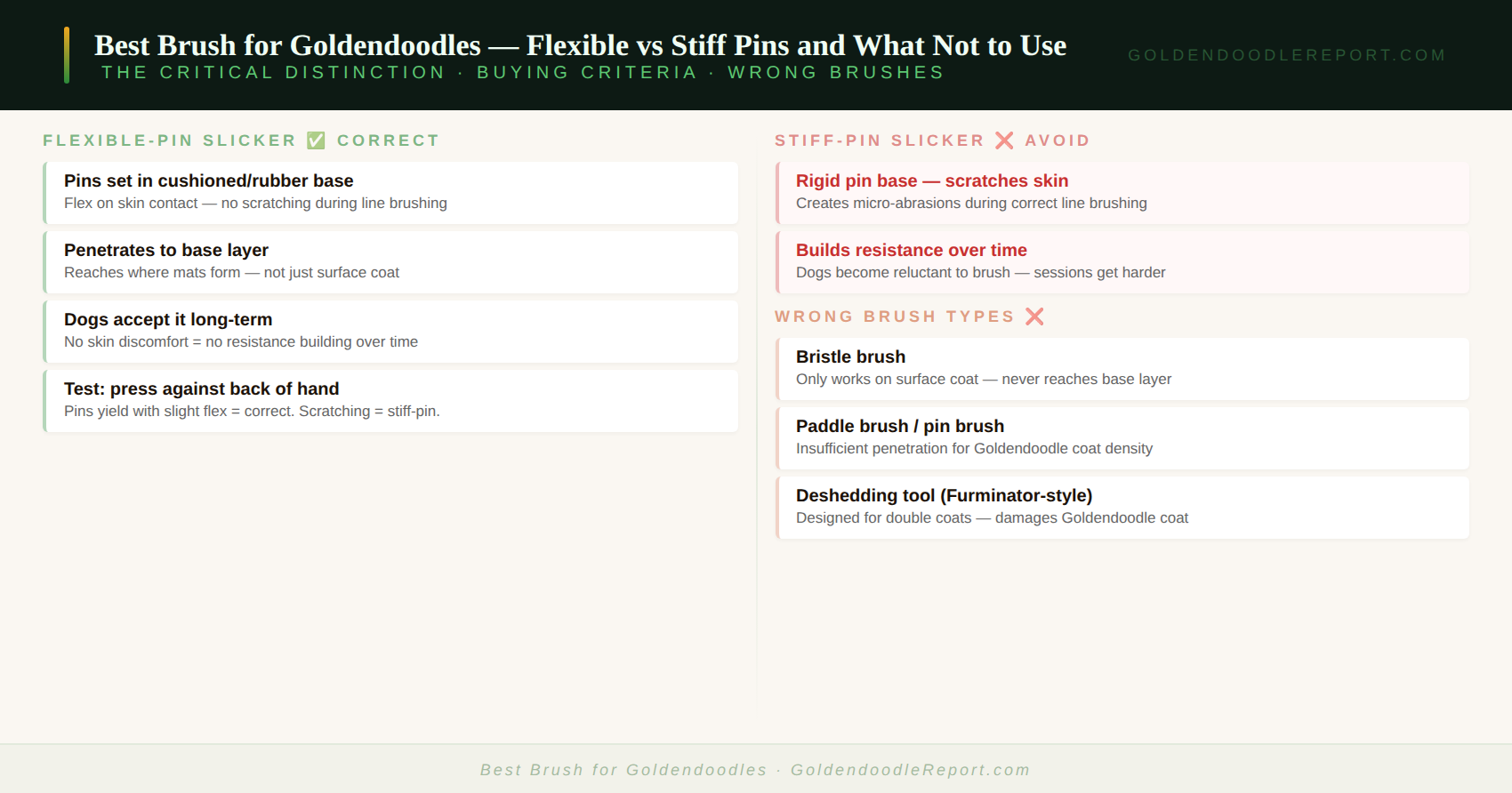
Flexible-pin slicker brushes have pins mounted in a cushioned or rubber-padded base that allows each pin to flex slightly when it meets resistance. When the brush presses against the skin during line brushing, the pins yield and spring back rather than scratching. The coat can be brushed all the way to the skin without causing discomfort. Dogs accept flexible-pin brushing significantly better than stiff-pin brushing and are less likely to develop resistance to the grooming routine over time.
Stiff-pin slicker brushes have pins mounted in a rigid base with no flex. When these pins contact the skin — which they do during correct line brushing — they scratch. This creates low-level discomfort that accumulates over sessions. Dogs who are brushed regularly with stiff-pin slicker brushes typically become resistant to brushing within weeks, making the grooming routine progressively more difficult. Additionally, the scratching at skin level can cause micro-abrasions that create skin irritation over time.
The practical test for pin flexibility: press the pin side of the brush firmly against the back of your own hand. If you feel the pins pressing against the skin with some yield, it is a flexible-pin brush. If you feel scratching or sharp pressure, it is a stiff-pin brush.
Best Brush for Goldendoodles — What to Look for When Buying
Pin flexibility
The non-negotiable specification. Look for descriptions that mention “cushioned base,” “flexible base,” “comfort-tip pins,” or a visible rubber/foam pad beneath the pin array. Avoid brushes described as “firm grip pins,” “heavy-duty pins,” or where the pin base is clearly rigid plastic.
Pin density
Higher pin density — more pins per square inch — is generally better for Goldendoodle coats because more pins means more surface area contacting the coat per stroke and more effective loose hair removal. Very low pin density leaves significant gaps between pins and requires many more passes to achieve the same coverage. Medium-high to high pin density is the target range.
Brush size
Match brush size to dog size and coat density. For standard Goldendoodles (45 to 75 pounds): a medium to large brush head — approximately 3 to 4 inches wide — covers sufficient area per stroke without becoming unmanageable. For mini Goldendoodles (15 to 35 pounds): a small to medium brush head — approximately 2 to 3 inches wide — allows better manoeuvrability in tight areas. A brush that is too large becomes difficult to use on legs, face, and the five high-risk mat areas.
Handle ergonomics
Brushing sessions last 15 to 30 minutes for a Goldendoodle in good coat condition — and longer during coat blow and mat-prone periods. A brush with an uncomfortable handle causes hand fatigue that leads to shorter, less thorough sessions. Look for a handle that fits comfortably in the palm with a non-slip grip. Curved or ergonomic handles that reduce wrist extension are worth the small additional cost for owners who brush daily.
Self-cleaning mechanism
Slicker brushes fill with loose hair quickly during a Goldendoodle brushing session. A self-cleaning mechanism — typically a button that retracts the pins and releases the collected hair — significantly reduces the time spent cleaning the brush between passes and between sessions. Not essential, but genuinely useful for the volume of hair a Goldendoodle produces during brushing.
What Is Not the Best Brush for Goldendoodles
Bristle brush: Designed for smooth, short-coated breeds. Does not penetrate a Goldendoodle coat below the surface layer. Ineffective as a primary grooming tool for this coat type.
Paddle brush: Large surface area but shallow penetration. Works on the surface coat and is useful for finishing and detangling very loose tangles, but does not reach the base layer. Not a mat prevention tool for Goldendoodles.
Pin brush: Longer, widely-spaced pins. Better than a bristle brush for coat penetration but still insufficient for dense Goldendoodle coats. Sometimes used as a secondary tool after thorough slicker brushing — not as a primary tool.
Deshedding tools (like the Furminator-style): Designed for double-coated breeds to remove undercoat. Not appropriate for Goldendoodle coats — these tools can damage the single coat structure and are not designed for the mat prevention work the slicker brush performs.
Using the Brush With a Metal Comb — Why Both Are Required
The slicker brush and the metal comb work together — they are not alternatives. The slicker brush performs the brushing work: removing loose hair, working through tangles, and reaching the base layer with line brushing technique. The metal comb performs the quality check: run through each section from skin to tip after brushing, it reveals any mat the brush missed. A section where the comb passes freely is genuinely mat-free. A section where the comb catches still has a developing mat that the brush has not cleared.
Many owners use the slicker brush and skip the comb check — and then wonder why they still develop mats despite daily brushing. The brush alone is not sufficient. The comb check is what makes the brushing routine complete. See Best Comb for Goldendoodles for the correct comb selection.
For authoritative guidance on dog grooming tools see the AKC dog grooming guide.
✅ Your Next Step
Test your current brush using the criteria above — specifically the flexible pin test against the back of your hand. If the pins scratch, your brush is causing low-level discomfort that may be contributing to your dog’s resistance to brushing. Replace it with a flexible-pin slicker brush of appropriate size for your dog. Combined with the metal comb and correct line brushing technique, the right brush is the foundation of a grooming routine that prevents mats rather than just managing them. For the complete grooming guide see Goldendoodle Grooming Guide.
🔑 Key Takeaways
- The only correct primary brush for a Goldendoodle is a slicker brush with flexible pins — no other brush type penetrates the coat to the base layer where mats form
- Flexible pins (cushioned base) are non-negotiable — stiff-pin slicker brushes scratch the skin during line brushing and cause resistance to grooming over time
- Match brush head size to dog size — medium/large for standard Goldendoodles, small/medium for minis
- A self-cleaning mechanism is genuinely useful for the volume of hair a Goldendoodle produces during brushing sessions
- The slicker brush and metal comb are used together — the brush grooms, the comb confirms the brush reached the skin
- Deshedding tools, bristle brushes, and paddle brushes are not appropriate primary grooming tools for Goldendoodle coats
📚 Continue Learning
- Goldendoodle Grooming Guide — complete grooming authority guide
- How to Brush a Goldendoodle — how to use the brush correctly
- How to Line Brush a Goldendoodle — the technique that reaches the skin
- Best Comb for Goldendoodles — the quality check tool used after brushing
- Best Detangler Spray for Goldendoodles — used with the brush every session
- Goldendoodle Grooming Tools Checklist — complete tool list
- Goldendoodle Matting Prevention — the full prevention protocol
↑ Back to: Goldendoodle Grooming Tools Checklist | Goldendoodle Grooming Guide | Goldendoodle Grooming — All Articles
Frequently Asked Questions
What is the best brush for Goldendoodles and why?
A slicker brush with flexible pins — specifically, one where the pins are set in a cushioned or rubber base that allows the pins to flex when they contact the skin. This type of slicker brush penetrates the dense Goldendoodle coat to the base layer where mats form, while the flexible pins prevent the skin scratching that makes dogs resistant to brushing over time. It is used in combination with a metal comb — the brush grooms, the comb confirms the brush reached the skin.
Can I use a regular brush on my Goldendoodle?
It depends on what you mean by “regular.” A slicker brush with flexible pins is the correct choice. A bristle brush, paddle brush, or pin brush does not penetrate a Goldendoodle coat effectively enough to reach the base layer where mats form — these brushes work only on the surface and will not prevent matting regardless of how frequently they are used. Deshedding tools designed for double-coated breeds are also not appropriate for Goldendoodle coat management.
How do I know if my brush is right for my Goldendoodle?
Press the pin side of the brush firmly against the back of your hand. If the pins flex and yield with some give — it is a flexible-pin brush appropriate for Goldendoodle coat management. If the pins scratch or feel rigid with no yield — it is a stiff-pin brush that will cause discomfort during line brushing. Also confirm it is a slicker brush (short, densely set angled wire pins) rather than a pin brush (longer, widely spaced rounded pins) or bristle brush (natural or synthetic fibres).
Do I need a special brush for a curly-coated Goldendoodle vs a wavy-coated one?
The same brush type — flexible-pin slicker — is correct for both. The differences are in usage rather than tool: curly coats typically need daily brushing with the slicker brush, slightly higher pin density is more effective for curly coats, and a medium brush head rather than large is more manageable for working through dense curly sections. Wavy coats can be brushed with the same brush on a slightly less frequent schedule and allow a slightly larger brush head without losing manoeuvrability.
Disclaimer: The information in this article is provided for general educational purposes only. King James Adjei is a researcher and enthusiast, not a veterinarian or certified groomer. Product recommendations are based on research and community experience — always review current options and consult your groomer’s advice for your specific dog’s coat type.