Affiliate Disclosure: Some links in this guide are affiliate links. If you purchase through them, we may earn a small commission at no extra cost to you. Read our full affiliate disclaimer here.
By King James Adjei — Researcher and Goldendoodle enthusiast, founder of GoldendoodleReport.com. Every guide on this site is carefully researched and written to give owners reliable, clearly organised information — updated regularly and honest about uncertainty. → About this site
📖 6-minute read | Last updated April 2026 | Reviewed for accuracy
A nail grinder is one of the most underused home grooming tools for Goldendoodles — particularly for dogs who resist clipping. Many owners assume that nail trimming resistance is simply a personality trait of their dog. In a large proportion of cases, it is a response to the specific sensation of clipping — the pressure-and-snap that is applied to the nail regardless of how quickly it happens. A nail grinder removes nail gradually by abrasion rather than cutting — a fundamentally different sensation that most dogs who resist clipping will accept with proper introduction. This guide explains why, what to look for when buying, and the safety considerations that matter specifically for Goldendoodle nails.
👤 Who This Guide Is For
- Your Goldendoodle resists or panics during nail clipping and you want a better-tolerated alternative
- You want to understand the difference between clipping and grinding before deciding which to use
- You want to know what specifications matter when buying a nail grinder for a dog
- You want to understand the safety considerations — particularly around the quick — for home nail grinding
⚡ Quick Summary
A nail grinder removes nail material by abrasion — rotating at speed against the nail surface rather than cutting through it. This produces a gradual, smooth result rather than the sudden pressure-and-snap of clipping, and is better tolerated by most dogs who resist clipper-based nail trimming. The key buying criteria for a Goldendoodle nail grinder are: variable speed (at least two speeds), low noise, rechargeable battery, a drum or band grinding head (not a disc), and a guard or port that prevents the grinding head from contacting the skin or coat. Introduce the grinder over multiple sessions before attempting to grind — the sound alone needs to be accepted before the contact.
For the nail trimming technique see Goldendoodle Nail Trimming Guide. For nail trimming frequency see How Often to Trim Goldendoodle Nails. For the complete tools list see Goldendoodle Grooming Tools Checklist.
Best Nail Grinder for Goldendoodles — Grinder vs Clipper
Understanding why a nail grinder produces a different response in dogs than a clipper requires understanding what each tool does to the nail at the sensation level.
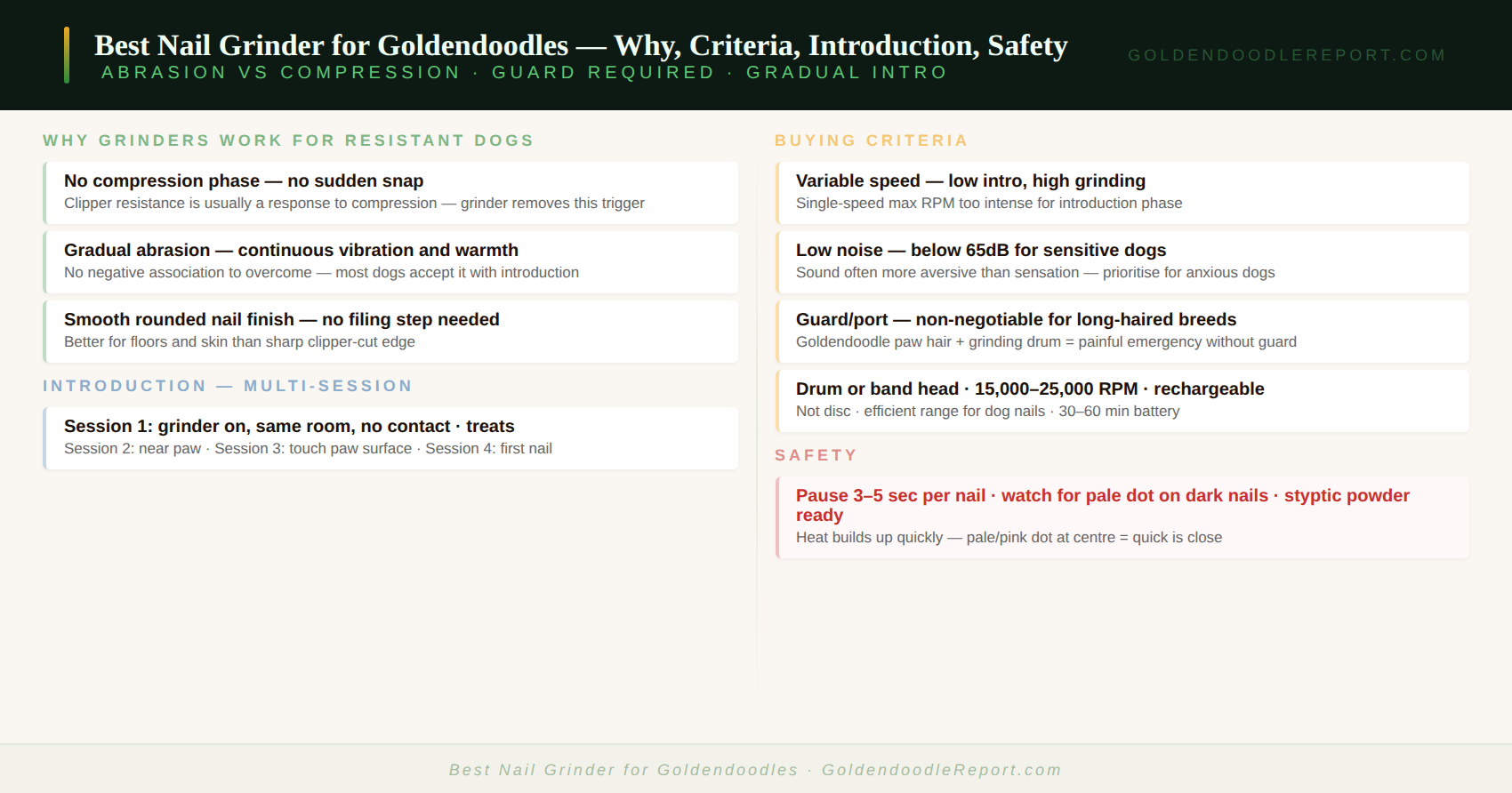
A nail clipper applies force across the full width of the nail in a single rapid motion — compressing the nail material from both sides and then cutting through it. The compression force is felt through the entire nail before the cut happens. For dogs with sensitive feet or a history of a quick cut, this compression signal is associated with the discomfort that follows or the memory of discomfort, and resistance develops. The speed of the cut does not eliminate the compression phase that precedes it.
A nail grinder removes nail material gradually by abrasion — the grinding band or drum rotates at high speed and removes a small amount of nail surface with each contact. There is no compression phase and no sudden event. The sensation is continuous vibration and mild warmth rather than pressure-and-snap. Dogs who have associated clippers with discomfort have no equivalent association with the grinder — and most accept it significantly more readily, particularly when introduced gradually.
The additional benefit of grinding is the finish quality. Clipper-cut nails have a flat, sharp edge that can scratch floors and skin. Ground nails are smoothed progressively and produce a rounded, smooth tip without requiring a separate filing step. For Goldendoodles who are active indoors, this makes a noticeable difference to the surfaces they move across.
When Clipping Is Still Appropriate
Nail clippers are not wrong — they are faster than grinding for dogs who tolerate them well, and they require less session time per nail. For a dog who accepts nail clipping calmly and has no history of quick cuts, clippers are a perfectly effective tool. The grinder’s advantage is specifically for dogs who resist clipping or whose nails are being managed back from excessive length gradually — grinding allows very small amounts to be removed per session without the single-event risk of cutting too close to the quick.
Buying Criteria — Best Nail Grinder for Goldendoodles
Variable speed — at least two settings
A lower speed is appropriate for the introduction period — building the dog’s tolerance to the sensation before the full grinding speed is used. A higher speed is more efficient for the actual grinding once the dog is comfortable. Single-speed grinders at maximum RPM are often too intense for the introduction phase and produce resistance that defeats the purpose of switching to a grinder. Look for grinders with at least a low and high speed setting; variable speed dials offer even more control.
RPM range appropriate for dog nails
Dog nail grinders typically operate between 5,000 and 35,000 RPM. For Goldendoodle nails — which are medium to large in thickness depending on the dog’s size — a grinder that reaches 15,000 to 25,000 RPM at high speed is the practical range. Below 10,000 RPM, grinding is slow and requires more passes per nail. Above 30,000 RPM, heat generation increases and requires more pauses per nail to prevent the nail warming uncomfortably.
Low noise — critical for introduction
The single most common reason dogs reject nail grinders even after accepting clippers is the whirring sound at high speed. A quieter grinder in the 50 to 65dB range is significantly easier to introduce than a louder model — the dog’s acoustic sensitivity means noise is often felt as more aversive than the physical sensation of grinding. Noise level is usually listed in decibels in product specifications — prioritise lower dB for dogs with existing tool anxiety.
Rechargeable battery — cordless operation
A cordless grinder is significantly more practical for nail grinding than a corded one. The cord limits position options during the session and adds a distraction element — dogs tend to investigate or react to cords during grooming. A rechargeable lithium-ion battery with sufficient run time for a full nail session (typically 30 to 60 minutes of total run time) is the correct specification. Check charge time — some budget grinders require 4 to 6 hours to charge for a 30-minute run time, which is impractical for regular use.
Drum or band grinding head — not a disc
Drum or band-style grinding heads are the correct format for dog nails — they provide a consistent grinding surface around the circumference of the drum, allowing the nail to be angled against the grinding surface easily from multiple directions. Disc-style grinding heads are less versatile for the curved nail surface and more prone to catching on the skin near the nail edge. Most quality pet nail grinders use drum or band heads — confirm before purchasing.
Guard or port — prevents coat contact
Goldendoodles have significant hair around their paws and between their toes. A grinding head that contacts this hair wraps it around the drum — a painful and potentially dangerous situation. A grinding guard or port narrows the opening so the grinding head can contact the nail without the surrounding hair being pulled in. This is one of the most practically important safety features for any long-haired breed. Confirm the grinder has a guard and that it is removable for cleaning.
Introducing the Grinder to a Resistant Dog
The introduction process for a nail grinder is the same as for any noisy grooming tool: gradual, treat-based, and unhurried.
Session one: turn the grinder on in the same room as the dog at a distance. No contact. High-value treats throughout. End the session while the dog is still calm.
Session two: grinder on, held near the dog’s paw without touching. Treats. Session three: grinder touching the paw surface (not the nail) briefly. Session four: first nail briefly. The number of sessions required before a full nail grind is tolerated varies by dog — some accept the grinder within two to three sessions, others take two to three weeks. The investment in gradual introduction produces a dog that accepts nail grinding for life. Rushing the process and creating a negative association with the grinder produces the same resistance pattern as clippers.
For the full nail trimming technique and the quick anatomy see Goldendoodle Nail Trimming Guide.
For authoritative guidance on dog nail care see the AKC nail trimming guide.
⚠️ Heat and the Quick — Safety Notes
- Grinding generates heat — pause every 3 to 5 seconds per nail to allow the nail to cool, particularly in the early stages when you are working close to the quick
- The quick recedes as nails are trimmed regularly — grinding small amounts every 2 to 3 weeks encourages the quick to recede in long nails more reliably than infrequent larger cuts
- On dark nails where the quick is not visible, grind in very small increments and watch for a pale grey or pink dot appearing at the centre of the freshly ground surface — this indicates the quick is close
- Even with a grinder, styptic powder should be on hand — the quick can be reached by grinding just as by clipping
✅ Your Next Step
If your Goldendoodle resists nail clipping, a grinder with gradual introduction is the correct next step — not forcing through clipper resistance. Buy a low-noise, variable-speed grinder with a guard and rechargeable battery. Start the introduction process at your next session without attempting to grind any nails at all. The investment in the introduction period is what makes the tool work for the lifetime of the dog. For the complete grooming guide see Goldendoodle Grooming Guide.
🔑 Key Takeaways
- A nail grinder removes nail by abrasion rather than cutting — no compression phase, no sudden event — fundamentally different sensation that most clipper-resistant dogs accept
- Variable speed (at least two settings) is essential — low speed for introduction, high speed for efficient grinding
- Low noise is the most important buying criterion for dogs with existing tool anxiety — prioritise dB rating over RPM when the dog is sound-sensitive
- A guard or port is non-negotiable for any long-haired breed — Goldendoodle paw hair wrapped in a grinding drum is a painful emergency
- Drum or band grinding head — not a disc — for the curved nail surface
- Introduce over multiple sessions before grinding any nails — the introduction investment is what makes the tool work for life
📚 Continue Learning
- Goldendoodle Grooming Guide — complete grooming authority guide
- Goldendoodle Nail Trimming Guide — the complete nail care technique
- How Often to Trim Goldendoodle Nails — trimming frequency
- How to Trim Goldendoodle Paw Pads — the rest of paw maintenance
- Goldendoodle Grooming Tools Checklist — full kit overview
↑ Back to: Goldendoodle Grooming Tools Checklist | Goldendoodle Grooming Guide | Goldendoodle Grooming — All Articles
Frequently Asked Questions
What is the best nail grinder for Goldendoodles?
A rechargeable, low-noise nail grinder with variable speed (at least low and high settings), a drum or band grinding head, and a guard or port that prevents long coat from contacting the grinding head. For standard Goldendoodles, a grinder that reaches 15,000 to 25,000 RPM at high speed provides efficient grinding without excessive heat. Noise level below 65dB is the target for dogs with existing tool anxiety. Confirm a lithium-ion rechargeable battery with at least 30 to 60 minutes of run time per charge.
Is a nail grinder better than clippers for Goldendoodles?
For dogs who resist clipping — yes, in most cases. The grinding sensation (gradual abrasion, continuous vibration, mild warmth) is fundamentally different from the clipper sensation (compression and snap) and does not carry the same association with discomfort for dogs who have had negative clipping experiences. For dogs who accept clipping calmly and without resistance, clippers are faster and equally effective — the grinder’s advantage is specifically for sensitive or clipper-resistant dogs and for the smoother nail finish it produces.
How long does it take to grind a Goldendoodle’s nails?
5 to 15 minutes for a full set of nails once the dog is comfortable with the process — slightly longer than clipping due to the abrasion approach. During the introduction period, sessions are intentionally shorter and may not include grinding any nails at all. The introduction phase adds time upfront but produces a dog that accepts nail grinding calmly for life, which reduces total grooming time across the dog’s lifetime significantly.
Can a nail grinder hurt my Goldendoodle?
Risks exist — the same quick-related risks as clipping, plus heat generation from sustained grinding on one nail, and hair-wrapping if the guard is not used. All three are manageable: grind in small increments with pauses between (3 to 5 seconds per nail), watch for the pale dot that signals proximity to the quick on dark nails, and always use the guard with a long-haired breed. Styptic powder should be on hand regardless of the method used.
Disclaimer: The information in this article is provided for general educational purposes only. King James Adjei is a researcher and enthusiast, not a veterinarian or certified groomer. For dogs with existing nail injuries or conditions, consult a veterinarian before attempting home nail grinding.