Affiliate Disclosure: Some links in this guide are affiliate links. If you purchase through them, we may earn a small commission at no extra cost to you. Read our full affiliate disclaimer here.
By King James Adjei — Researcher and Goldendoodle enthusiast, founder of GoldendoodleReport.com. Every guide on this site is carefully researched and written to give owners reliable, clearly organised information — updated regularly and honest about uncertainty. → About this site
📖 5-minute read | Last updated April 2026 | Reviewed for accuracy
Tear stain wipes are one of the most searched-for Goldendoodle grooming products — and one of the most oversold. The honest picture is this: wipes manage the visible staining and keep the eye area clean, which is genuinely valuable and worth doing consistently. They do not address the underlying cause of tear staining, which may be dietary, structural, or health-related. Understanding what wipes can and cannot do is what allows owners to use them effectively as part of a complete tear stain management approach, rather than as a standalone solution that eventually disappoints.
👤 Who This Guide Is For
- Your Goldendoodle has visible rust or brown staining below the eyes and you want to manage it
- You want to know which wipes to buy and what formulation criteria matter
- You want an honest assessment of what wipes can and cannot do before purchasing
- You want to understand the difference between daily maintenance wipes and treatment-focused products
⚡ Quick Summary
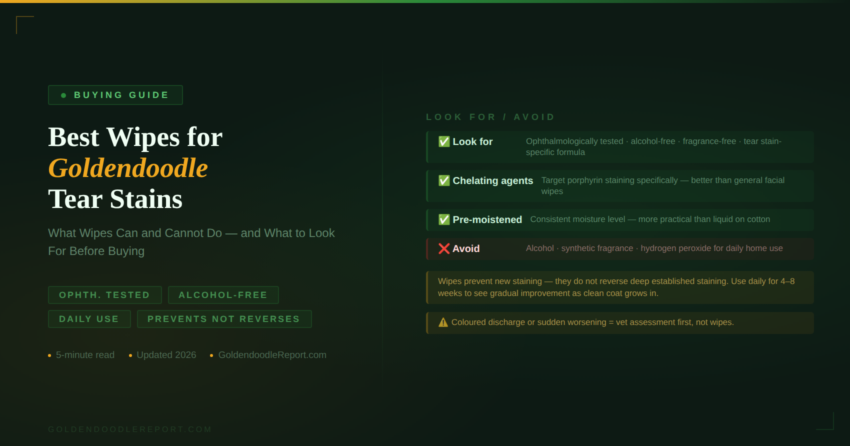
The best wipes for Goldendoodle tear stains are pre-moistened, ophthalmologically tested wipes formulated specifically for the eye area — free of alcohol, strong fragrances, and hydrogen peroxide. Used daily, they remove accumulated discharge and prevent the oxidised pigment from building up into visible staining. They do not bleach or reverse existing deep staining — they prevent new staining from accumulating. For established deep staining, consistent daily use over 4 to 8 weeks gradually replaces stained coat with clean coat as normal coat growth occurs.
For the complete tear stain management guide see Goldendoodle Tear Stains Guide. For eye discharge causes see Goldendoodle Eye Discharge Causes. For the complete tools list see Goldendoodle Grooming Tools Checklist.
What Tear Stain Wipes Actually Do — and What They Don’t
Tear staining in Goldendoodles — the rust or brown discolouration below the eyes — is caused by porphyrins, iron-containing compounds found in tears that oxidise when exposed to air. When tear production is excessive, or when tears overflow the tear duct and run down the face, these porphyrins deposit on the coat fibres below the eye. As they oxidise over hours and days, they produce the distinctive reddish-brown staining.
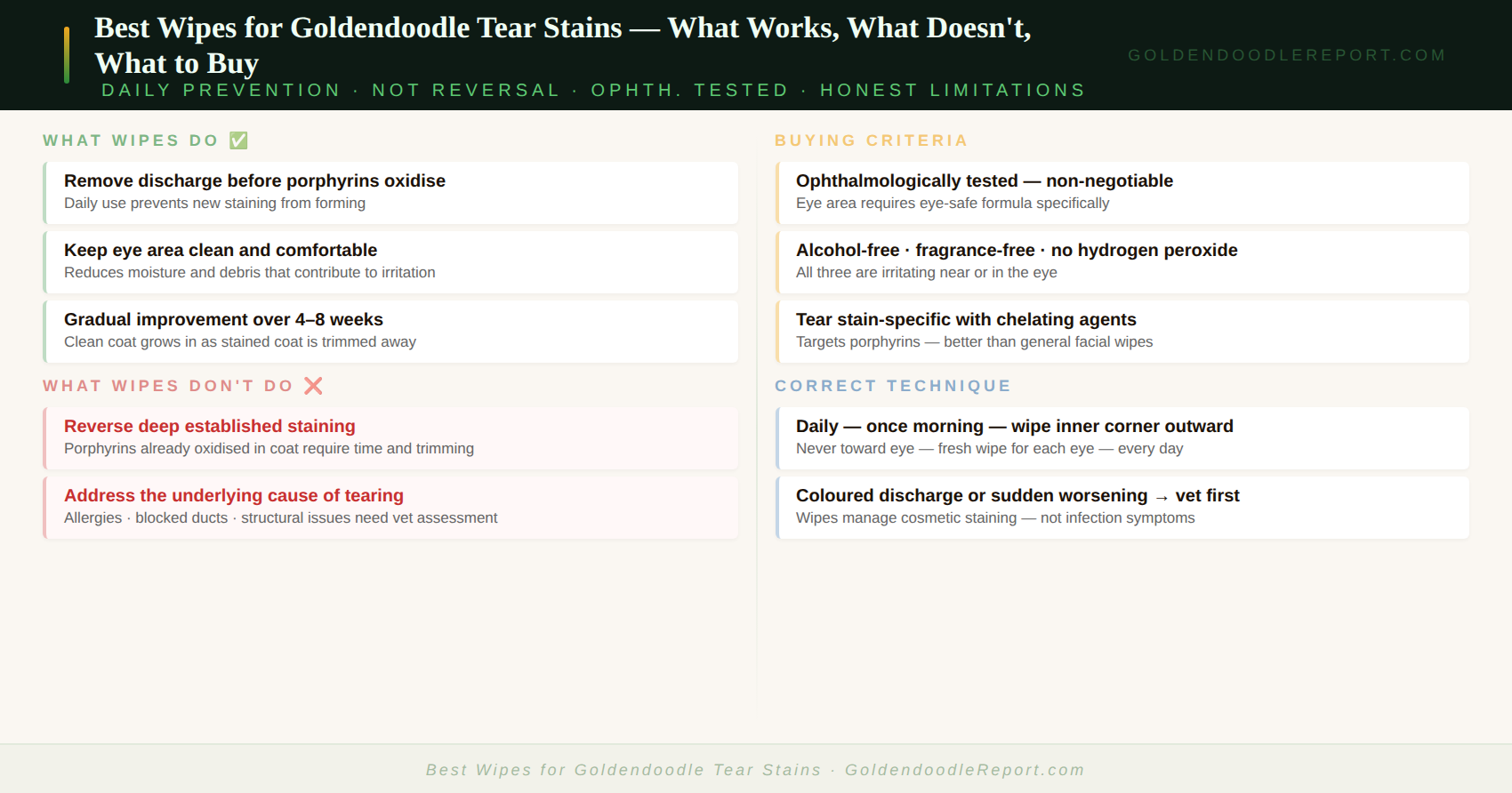
What wipes do: A properly formulated tear stain wipe removes accumulated tear discharge from around the eye area before the porphyrins oxidise fully and deposit on the coat. Used daily, this prevents new staining from forming. Some wipes also contain mild ingredients that help break down existing light staining over time. Regular use keeps the eye area clean, reduces the moisture and debris that can contribute to skin fold irritation, and is a genuinely effective maintenance tool.
What wipes do not do: Wipes cannot reverse deep, established staining that is already embedded in the coat. This type of staining requires either time — growing out as the coat is trimmed regularly and new unstained coat replaces it — or professional treatment options. Wipes also do not address the underlying cause of excessive tearing. If the tear production is caused by allergies, blocked tear ducts, entropion, or other health conditions, wipes manage the symptom while the cause continues untreated. For persistent or worsening tear staining, a veterinary assessment of the cause is appropriate before focusing entirely on cosmetic management.
Best Wipes for Goldendoodle Tear Stains — Buying Criteria
Ophthalmologically tested — non-negotiable for eye area use
Any product used near a dog’s eyes should be ophthalmologically tested — tested for safety in contact with or near the eye. This confirms the product has been evaluated for pH and ingredient safety in the eye area at the concentration used. Products without this designation may contain ingredients that are safe on skin elsewhere on the body but irritating to the sensitive eye area or the eye itself if the wipe contacts the eye surface during use.
Alcohol-free
Alcohol dries the delicate skin around the eye and is irritating if it contacts the eye surface. Any tear stain wipe containing isopropyl or ethyl alcohol near the top of the ingredient list is inappropriate for daily use in the eye area. Some products use very small amounts of alcohol as a preservative — these are generally acceptable at low concentrations, but avoid any product where alcohol is a primary active ingredient.
Fragrance-free or very lightly fragranced
Synthetic fragrances are one of the most common causes of skin and eye irritation in dogs. The eye area is particularly sensitive. A fragrance-free product is the safest choice for daily use around the eyes. If a product contains fragrance, confirm it is at a minimal level and from natural rather than synthetic sources.
No hydrogen peroxide
Hydrogen peroxide is used in some tear stain removal products for its bleaching effect on porphyrin staining. At diluted concentrations it can help lighten existing staining. However, hydrogen peroxide near the eye carries an irritation and potential injury risk if it contacts the eye surface — particularly in a home use context where exact distance from the eye is not controlled. For daily maintenance wipes, hydrogen peroxide-free formulas are the appropriate choice. Hydrogen peroxide treatments are sometimes appropriate for specific staining situations under groomer guidance — not as a daily home maintenance wipe.
Pre-moistened and appropriately sized
Pre-moistened wipes are significantly more practical than liquids applied by cotton ball for daily use — they are consistent in moisture level, gentle in texture, and convenient for a daily routine. Look for wipes that are large enough to clean the full under-eye area in a single pass without folding excessively. Textured wipes provide slightly more cleaning action than plain smooth wipes.
Tear stain-specific formula vs general facial wipes
General dog facial wipes are formulated for cleaning the face broadly — they may be appropriate near the eye area but are not optimised for the specific porphyrin deposit that causes tear staining. Tear stain-specific wipes contain chelating agents or mild ingredients that specifically target porphyrin staining rather than simply cleaning the surface. For owners dealing with significant staining, tear stain-specific formulas produce measurably better results than general facial wipes.
How to Use Tear Stain Wipes Effectively
Daily use is the correct frequency — not weekly or as-needed. Porphyrins oxidise within hours of tear production. A daily wipe removes the overnight accumulation before oxidisation produces new staining. Weekly use only removes surface discharge — the daily oxidisation happens between sessions and deposits staining regardless.
Technique: gently wipe from the inner corner of the eye outward along the stained area. Do not wipe toward the eye — always away from the inner corner and down along the stained track. Use a fresh wipe for each eye. Do not reuse wipes between sessions — a used wipe that has collected discharge from one eye should not contact the other eye.
For the complete eye area cleaning technique see How to Clean Goldendoodle Eyes Safely.
For authoritative guidance on dog eye care see the AVMA eye care guide for dogs.
⚠️ When Tear Staining Needs Vet Attention
- Staining that has appeared suddenly or worsened rapidly — this may indicate a new health issue rather than cosmetic staining
- Green, yellow, or thick discharge — this is not normal tear overflow and indicates infection or inflammation requiring veterinary assessment
- One eye staining significantly more than the other — asymmetric staining often indicates a structural issue with the tear duct on the affected side
- Dog rubbing or pawing at the eye area persistently — indicates discomfort that wipes will not resolve
✅ Your Next Step
Choose an ophthalmologically tested, alcohol-free, fragrance-free tear stain wipe. Start daily use — once every morning to remove overnight accumulation before the day’s tear production adds to it. Give consistent use 4 to 8 weeks before assessing the improvement — results are gradual as clean coat grows in and replaces stained coat. For the complete tear stain management guide see Goldendoodle Tear Stains Guide. For the complete grooming guide see Goldendoodle Grooming Guide.
🔑 Key Takeaways
- Wipes prevent new staining by removing tear discharge before porphyrins oxidise — they do not reverse deep established staining already embedded in the coat
- Daily use is required — porphyrins oxidise within hours, making weekly use insufficient to prevent new staining
- Non-negotiable: ophthalmologically tested, alcohol-free, fragrance-free, no hydrogen peroxide for daily home use
- Tear stain-specific formulas with chelating agents produce better results than general facial wipes for dogs with significant staining
- Always wipe from inner corner outward — never toward the eye — fresh wipe for each eye
- Persistent, sudden, or asymmetric staining, or any coloured discharge, requires veterinary assessment — wipes manage symptoms, not causes
📚 Continue Learning
- Goldendoodle Grooming Guide — complete grooming authority guide
- Goldendoodle Tear Stains Guide — complete tear stain management
- Goldendoodle Eye Discharge Causes — understanding what causes staining
- How to Clean Goldendoodle Eyes Safely — the correct technique
- Goldendoodle Grooming Tools Checklist — full kit overview
↑ Back to: Goldendoodle Grooming Tools Checklist | Goldendoodle Grooming Guide | Goldendoodle Grooming — All Articles
Frequently Asked Questions
What are the best wipes for Goldendoodle tear stains?
Ophthalmologically tested, alcohol-free, fragrance-free wipes formulated specifically for tear stains — ideally containing chelating agents that target porphyrin staining rather than simply cleaning the surface. Pre-moistened wipes are more practical for daily use than liquid products applied by cotton ball. Tear stain-specific formulas produce better results than general dog facial wipes for dogs with significant staining. Use daily, wipe from inner corner outward, fresh wipe for each eye.
Do tear stain wipes actually work on Goldendoodles?
Yes — for prevention and ongoing management. Used daily, wipes remove tear discharge before porphyrins fully oxidise and deposit on the coat, effectively preventing new staining from forming. For existing deep staining already embedded in the coat, wipes alone will not reverse it — improvement comes gradually over 4 to 8 weeks as normal coat growth replaces stained coat. Wipes work best when combined with managing the underlying cause of excessive tearing — they are a management tool, not a cure for the cause.
How often should I use tear stain wipes on my Goldendoodle?
Daily — once every morning is the most practical frequency. Overnight accumulation of tear discharge is removed before the day’s production adds to it and before oxidisation produces new staining. Less frequent use allows porphyrins to oxidise and deposit between cleaning sessions, reducing effectiveness significantly. Consistency over weeks is what produces visible improvement in staining.
Why does my Goldendoodle have tear stains?
Tear staining in Goldendoodles is caused by porphyrins — iron-containing compounds in tears that oxidise to produce the reddish-brown discolouration. The cause of excessive tearing that leads to overflow can be structural (shallow eye sockets, hair irritating the eye, blocked tear duct), dietary (some ingredients are associated with increased porphyrin production), or health-related (allergies, eye irritation, infection). For persistent or worsening staining, veterinary assessment of the underlying cause is appropriate. See Goldendoodle Tear Stains Guide for the complete management guide.
Disclaimer: The information in this article is provided for general educational purposes only. King James Adjei is a researcher and enthusiast, not a veterinarian. For persistent, sudden, asymmetric, or coloured eye discharge or staining, always consult a veterinarian before relying on home management products.