Affiliate Disclosure: Some links in this guide are affiliate links. If you purchase through them, we may earn a small commission at no extra cost to you. Read our full affiliate disclaimer here.
By King James Adjei — Researcher and Goldendoodle enthusiast, founder of GoldendoodleReport.com. Every guide on this site is carefully researched and written to give owners reliable, clearly organised information — updated regularly and honest about uncertainty. → About this site
📖 7-minute read | Last updated April 2026 | Reviewed for accuracy
Goldendoodle eye discharge causes range from completely normal to conditions requiring urgent veterinary attention — and the most reliable way to tell them apart is by the colour, consistency, and quantity of the discharge combined with any other symptoms the dog shows. Most owners who notice eye discharge in their Goldendoodle are understandably concerned, and the answer to whether that concern is warranted depends entirely on what type of discharge it is. This guide gives you a practical framework for identifying the most common discharge types and knowing what each one means.
👤 Who This Guide Is For
- You have noticed discharge from your Goldendoodle’s eyes and want to understand what it indicates
- You want a practical framework for deciding whether eye discharge requires a vet visit or home monitoring
- You want to understand the difference between normal eye discharge and discharge that signals a problem
- You have a recurring eye discharge issue and want to understand the possible underlying causes
⚡ Quick Summary
Normal Goldendoodle eye discharge is clear or slightly whitish, watery or very slightly mucous, and present in small amounts — particularly noticeable after sleep. This is the eye’s normal self-cleaning mechanism. Discharge that is yellow, green, thick, or present in large quantities is not normal and warrants a vet check. Discharge accompanied by redness, squinting, swelling, or the dog pawing at their eyes always requires veterinary attention regardless of the colour.
✅ Quick Answer — Eye Discharge Triage by Colour
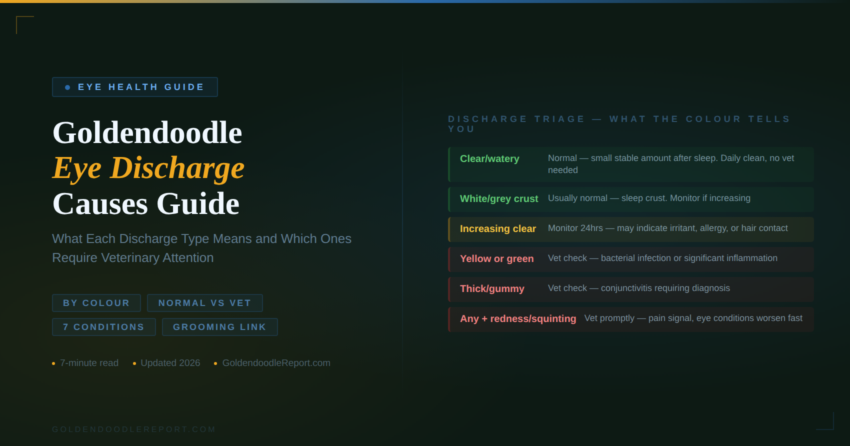
- Clear, watery, small amount: Normal — monitor, clean gently, no vet needed unless increasing
- Clear to white, slightly mucous after sleep: Normal — sleep crust, clean with damp cloth
- Reddish-brown (staining only, no discharge): Tear staining from porphyrins — see tear stains guide
- Yellow or green, any quantity: Vet check — may indicate bacterial infection
- Thick, gummy, or crust-forming in large amounts: Vet check — conjunctivitis or other condition
- Any discharge + redness, squinting, or pawing: Vet check promptly — eye conditions worsen quickly
For tear staining specifically see Goldendoodle Tear Stains Guide. For safe eye cleaning see 👉 How to Clean Goldendoodle Eyes Safely — coming soon. For the complete grooming overview see Goldendoodle Grooming Guide.
Normal Goldendoodle Eye Discharge — What It Looks Like
All dogs produce some eye discharge as part of the eye’s normal self-cleaning process. The eye produces tears continuously to keep the cornea moist and to flush debris from the eye surface. Excess tears and the debris they carry drain through the nasolacrimal (tear) duct into the nasal passages — or, when this drainage is incomplete, collect in the corner of the eye as visible discharge.
Normal eye discharge in a Goldendoodle is characteristically: clear or very slightly white in colour, watery to very lightly mucous in consistency, small in quantity — typically only a small accumulation in the inner corner of the eye, most noticeable after sleep when the dog has been still for several hours, and not accompanied by any sign of eye discomfort. This is sleep crust — the dog equivalent of what humans call “sleep in the eyes” — and requires only gentle daily cleaning to remove.
Goldendoodle Eye Discharge Causes — By Type
Clear, watery discharge — normal to mildly concerning
A small amount of clear, watery discharge is the most common and most normal type. It represents normal tear overflow — tears that did not fully drain through the nasolacrimal duct and have collected in the eye corner. In Goldendoodles with flatter facial structure, this is particularly common because the slightly compressed tear drainage anatomy reduces drainage efficiency. Small, stable, clear watery discharge with no other symptoms is a normal finding that requires daily cleaning but not veterinary attention.
An increase in watery discharge beyond the normal baseline — more volume than usual, or discharge running down the face — can indicate eye irritation from environmental allergens, dust, smoke, or a minor foreign body (such as a grass seed near the eye). If the increase is recent and accompanied by mild squinting, check around the eye for any visible foreign material and monitor for 24 hours. If it persists or increases, contact your vet.
White to pale grey mucous discharge — monitor
A small amount of white or pale grey slightly mucous discharge — particularly after sleep — is at the boundary of normal. This type forms when the normal tear protein content dries slightly. In small, stable quantities with a comfortable, clear eye, it is typically not a concern. In increasing quantities, or if the eye looks even mildly uncomfortable, a vet check is appropriate. This type of discharge is often associated with mild environmental allergies or dry eye (keratoconjunctivitis sicca) in susceptible dogs.
Yellow or green discharge — vet check required
Yellow or green discharge is not normal regardless of quantity and warrants a veterinary appointment. The colour indicates the presence of neutrophils — immune cells that accumulate in response to bacterial infection or significant inflammation. Common causes include bacterial conjunctivitis, a secondary infection following a minor eye injury, or infection associated with a foreign body. Yellow-green discharge does not resolve on its own — it requires diagnosis and appropriate antibiotic treatment. Do not attempt to treat yellow or green discharge with home cleaning alone.
Thick, gummy, or heavily crusting discharge — vet check required
Thick discharge that crusts heavily around the eye, particularly if it causes the eyelids to stick together after sleep or if significant crusting accumulates throughout the day, indicates a more significant condition. Conjunctivitis — inflammation of the conjunctiva, the membrane lining the inner eyelid — is the most common cause. Conjunctivitis in dogs can be allergic, bacterial, or viral in origin and requires veterinary diagnosis to determine the correct treatment. Thick discharge is often accompanied by redness of the eye and is frequently uncomfortable — the dog will typically show some sign of eye discomfort.
Reddish-brown discharge or staining — usually tear staining
Reddish-brown discolouration below the eye without additional discharge is typically tear staining from porphyrins rather than a pathological discharge. For a complete explanation of this specific presentation see Goldendoodle Tear Stains Guide. However, if the reddish-brown staining is accompanied by actual discharge — watery, mucous, or otherwise — assess the discharge separately from the staining and apply the triage criteria above.
When to Contact Your Vet — Discharge Decision Guide
Contact your vet promptly if the discharge is yellow or green. Contact your vet if discharge has increased significantly from the dog’s normal baseline. Contact your vet if any discharge is accompanied by redness of the white of the eye or inner eyelid. Contact your vet if the dog is squinting, keeping an eye partially closed, or pawing at their eye — these signs indicate pain or significant discomfort that requires investigation. Contact your vet if the eyelids are sticking together or if thick crusting is forming throughout the day rather than just after sleep.
Eye conditions in dogs can deteriorate quickly — what begins as mild conjunctivitis can progress to a corneal ulcer within days if untreated. When in doubt about whether a vet visit is needed, err on the side of booking the appointment. Eye conditions are one area where monitoring at home for too long creates a risk of escalation.
The Grooming Connection — How Coat Management Affects Eye Discharge
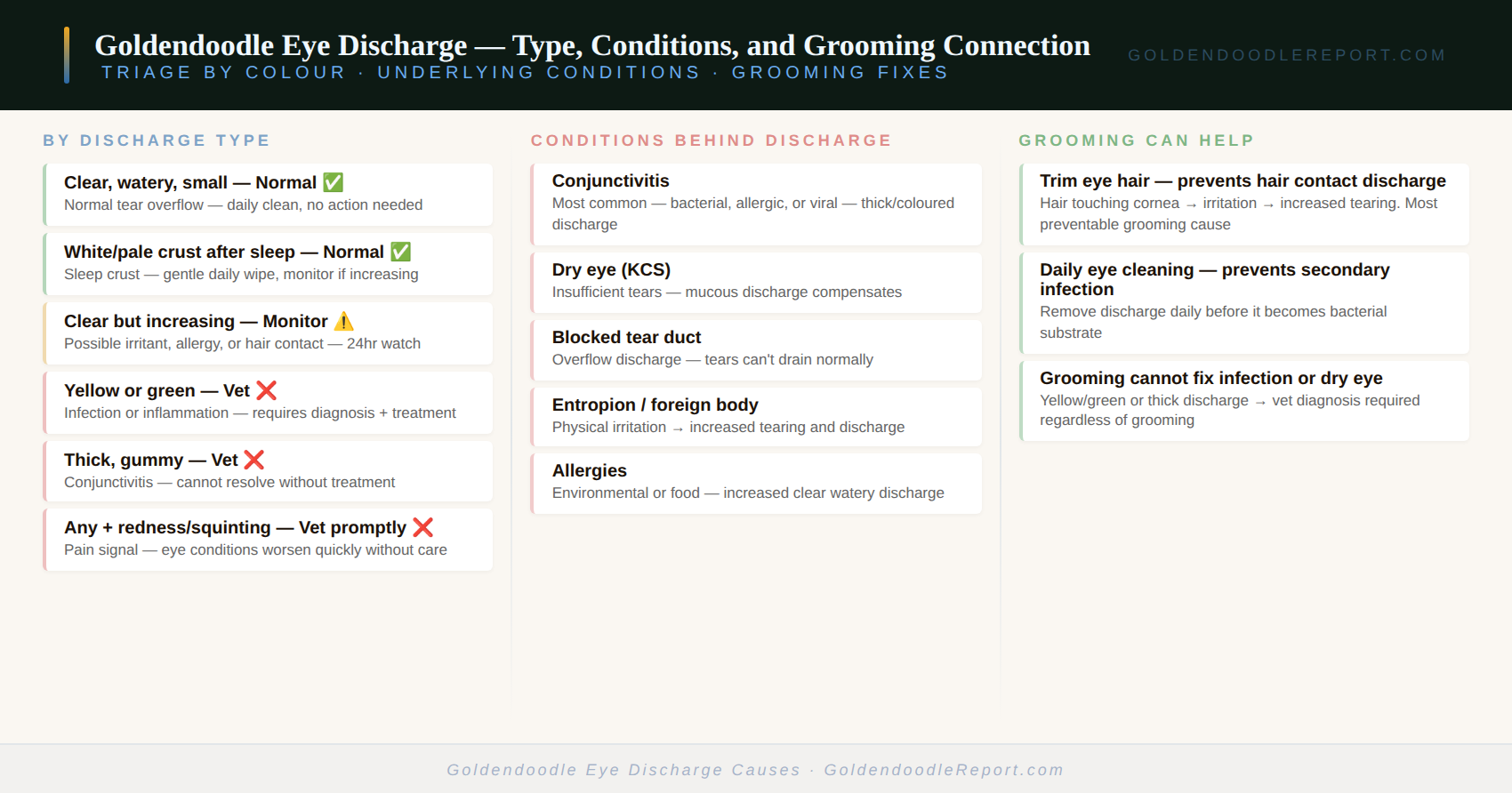
Coat management directly affects eye discharge in two ways. First, hair growing over or near the eye surface irritates the cornea continuously — this corneal irritation stimulates increased tear production, which increases eye discharge. Keeping the eye area hair trimmed short enough that no hair contacts the eye surface is the single most effective grooming intervention for reducing tear-related discharge. For the correct technique see 👉 How to Trim Hair Around Goldendoodle Eyes — coming soon.
Second, accumulated eye discharge that is not cleaned daily creates a moist, warm environment in the fur below the eye that encourages bacterial growth. Regular daily cleaning of the eye area — with a damp cloth or eye wipe — removes the substrate that secondary infections develop from. For the complete eye cleaning protocol see 👉 How to Clean Goldendoodle Eyes Safely — coming soon.
For authoritative guidance on dog eye health see the AVMA pet care resources.
🩺 Conditions That Cause Eye Discharge in Goldendoodles
- Conjunctivitis — inflammation of the inner eyelid lining — bacterial, allergic, or viral
- Dry eye (KCS) — insufficient tear production causing mucous discharge to compensate
- Blocked nasolacrimal duct — tear drainage obstruction causing overflow discharge
- Entropion — eyelid rolling inward, causing eyelashes to contact the cornea
- Foreign body — grass seed, dust, or debris in or near the eye
- Corneal ulcer — scratch or injury to the cornea surface
- Allergies — environmental or food allergies causing increased tear production
Most of these conditions require veterinary diagnosis. The discharge type and accompanying symptoms are the primary diagnostic indicators — a vet will examine the eye with an ophthalmoscope and may use fluorescein dye to check for corneal ulcers.
✅ Your Next Step
Look at the discharge carefully — colour, consistency, and quantity. Compare to the triage guide above. If it is clear and small in quantity with a comfortable eye — establish a daily cleaning habit and trim the eye area hair. If anything in the guide above applies — yellow, green, increasing, accompanied by redness or squinting — book a vet appointment today. For the complete grooming guide see Goldendoodle Grooming Guide.
🔑 Key Takeaways
- Normal eye discharge is clear to slightly white, watery to lightly mucous, and small in quantity — most visible after sleep. This is the eye’s normal self-cleaning mechanism
- Yellow or green discharge is never normal and always requires a vet check — it indicates bacterial infection or significant inflammation
- Thick, gummy, or heavily crusting discharge warrants a vet check — typically conjunctivitis requiring diagnosis and treatment
- Any discharge accompanied by redness, squinting, or the dog pawing at their eye requires prompt veterinary attention — eye conditions deteriorate quickly
- Hair contacting the eye surface is the most common grooming-related cause of increased discharge — keep eye area hair trimmed short enough that no hair touches the eye
- Daily cleaning of the eye area removes accumulated discharge before it becomes a substrate for secondary infection
📚 Continue Learning
- Goldendoodle Grooming Guide — complete grooming authority guide
- Goldendoodle Tear Stains Guide — reddish-brown staining from porphyrins
- How to Trim a Goldendoodle at Home — keeping eye area hair from contacting the eye
- 👉 How to Clean Goldendoodle Eyes Safely — coming soon
- 👉 How to Trim Hair Around Goldendoodle Eyes — coming soon
↑ Back to: Goldendoodle Grooming Guide | Goldendoodle Grooming — All Articles
Frequently Asked Questions
What causes eye discharge in Goldendoodles?
The most common causes of Goldendoodle eye discharge are normal tear overflow (clear, watery, small quantity — normal), conjunctivitis (inflammation of the inner eyelid — causes thick or yellow-green discharge), dry eye or KCS (insufficient tear production causing mucous discharge), environmental allergies (causes increased clear tearing), hair irritating the cornea (causes increased watery discharge), blocked tear duct (causes overflow discharge), and foreign bodies near the eye. The discharge colour and consistency, combined with any accompanying symptoms, identifies the most likely cause.
Is eye discharge normal in Goldendoodles?
A small amount of clear or slightly white discharge — particularly after sleep — is completely normal. It is the dog’s eye self-cleaning mechanism and does not indicate illness. It requires only gentle daily cleaning to manage. Yellow or green discharge, thick or gummy discharge, heavy crusting throughout the day, or any discharge accompanied by redness, squinting, or eye pawing is not normal and warrants veterinary attention.
When should I take my Goldendoodle to the vet for eye discharge?
Contact your vet if: the discharge is yellow or green; discharge has significantly increased from the dog’s normal baseline; the eye appears red; the dog is squinting or keeping an eye partially closed; the dog is pawing at their eye; the eyelids are sticking together; or thick crusting is forming throughout the day. Eye conditions deteriorate quickly — when in doubt, book the appointment. A vet check for an eye that turns out to be normal costs much less than treating an escalated condition that was monitored too long at home.
Can grooming help with Goldendoodle eye discharge?
For discharge caused by hair irritating the eye surface — yes, significantly. Hair growing over or contacting the eye stimulates increased tear production and discharge. Keeping the eye area hair trimmed so no hair touches the eye surface reduces this type of discharge directly. For discharge caused by other conditions (infection, dry eye, blocked duct) grooming helps manage the accumulated discharge through daily cleaning but does not address the underlying cause — that requires veterinary diagnosis.
Disclaimer: The information in this article is provided for general educational purposes only. King James Adjei is a researcher and enthusiast, not a veterinarian. For any eye symptoms beyond minor normal discharge, always consult a qualified veterinarian. Eye conditions in dogs can deteriorate quickly — do not delay veterinary care for concerning symptoms.