Affiliate Disclosure: Some links in this guide are affiliate links. If you purchase through them, we may earn a small commission at no extra cost to you. This does not influence our recommendations. Read our full affiliate disclaimer here.
By King James Adjei — Researcher and Goldendoodle enthusiast, founder of GoldendoodleReport.com. Every guide on this site is carefully researched and written to give owners reliable, clearly organised information. → About this site
⚠️ Safety note: Never let your Goldendoodle off-leash in an unfenced or unsafe area until recall is genuinely reliable — including around distractions. Use a long line as the bridge between leash and full off-leash freedom, covered in detail below.
📖 10-minute read | Last updated May 2026 | Reviewed for accuracy
Learning how to teach a Goldendoodle to come reliably is arguably the single most important thing you’ll ever train — more than sit, more than stay, this is the command that can genuinely keep your dog safe in a moment that matters. It’s also the one owners most commonly report struggling with, because unlike sit or stay, recall is competing directly against everything else in the environment that your dog might find more interesting in that exact moment: a squirrel, another dog, an open field to explore.
This guide covers the standard reliable-recall method, what to do specifically if your dog already ignores the word “come” from prior repetition without consequence, a genuine breed-specific distraction Goldendoodles inherit from their Golden Retriever lineage, and the long-line bridging step most owners skip too early.
✅ Quick Answer
To teach a Goldendoodle to come, start in a low-distraction indoor space, say your recall word once in a happy tone, and reward enthusiastically the instant your dog reaches you — never punish a slow or hesitant arrival. Build reliability gradually: indoors first, then in a fenced yard, then on a long line in more distracting environments, only removing the leash entirely once recall holds up consistently around real distractions. If your dog already ignores “come” from repeated unrewarded use, switch to a fresh, uncontaminated word like “here” and start over — this works faster than trying to repair an already-ignored cue. Never call your dog for anything unpleasant, and if you’re not confident they’ll come, go get them instead of calling and being ignored.
👤 Who This Guide Is For
- Your Goldendoodle already knows sit and stay and you’re ready for recall
- Your dog comes reliably indoors but ignores you outside or around distractions
- Your dog has already learned to ignore “come” and you’re not sure how to fix that
- You want to eventually let your dog off-leash safely and need a genuinely reliable recall first
📊 Quick Facts — Teaching a Goldendoodle to Come
- Recall training can begin as early as 8 weeks old, using the same basic principles as adult recall training
- A controlled study published in Frontiers in Veterinary Science compared dogs trained with electronic collars against dogs trained by professional trainers using positive reinforcement, and found the positive-reinforcement group achieved significantly better recall and sit responses with shorter response times
- A recall word that’s been repeated and ignored without consequence multiple times becomes “burned” — many experienced trainers find it faster to switch to a completely new word than to repair the old one
- Standard Goldendoodles inherit a strong scent-and-exploration drive from Golden Retriever lineage — a real, breed-specific distraction category distinct from generic “other dogs” or “food” distractions
- A long line (15-50 feet) is the standard bridging tool between leash walking and genuine off-leash freedom — skipping this step is one of the most common causes of recall failures in unfenced areas
🔍 Quick Diagnosis — What’s Actually Going Wrong?
- If your dog comes indoors but not outside → this is a proofing gap, not disobedience — the same pattern covered in our Sit and Stay guides; practice deliberately outdoors with low distractions first
- If your dog has heard “come” repeated many times with no consequence for ignoring it → the word is likely burned; switch to a new cue and start fresh rather than trying to repair the old one
- If your dog comes but stops just out of arm’s reach → you may be reaching for the collar too quickly or too eagerly; practice a separate “gotcha” collar-touch exercise, covered below
- If your dog only ignores recall around other dogs or strong scents → this is likely the breed-specific exploration drive covered below, and needs dedicated distraction-proofing at that specific trigger, not general practice
📋 Table of Contents
The Basic Recall Method
Your Goldendoodle should already have a solid sit before starting recall training — if not, start with how to teach a Goldendoodle to sit first.
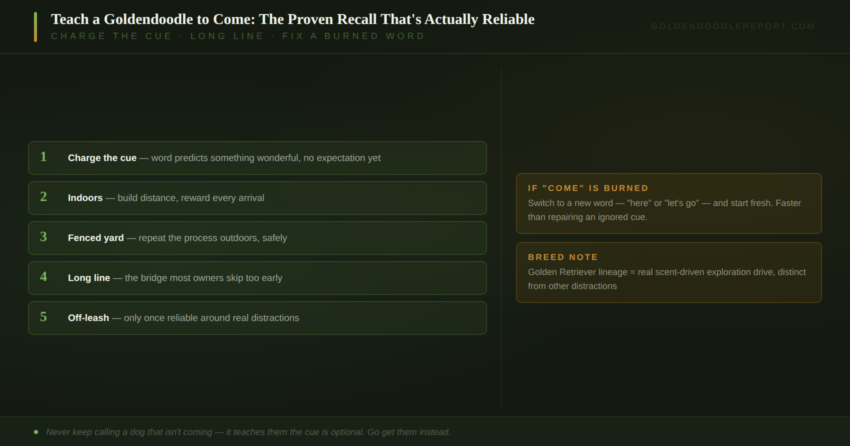
- Charge the cue first. Before using your recall word functionally, build a positive association with it using classical conditioning — the same principle behind Pavlov’s famous experiments, where a neutral signal comes to predict something good. Say the word in a happy, excited tone, then immediately give a high-value treat — repeated with no expectation attached, this teaches your dog the word itself predicts something wonderful, before it’s ever used as an instruction.
- Start indoors, low distraction. Say your recall word once, in an upbeat tone. If your dog is already moving toward you, mark the moment and reward generously the instant they arrive.
- Never punish a slow or hesitant arrival. Even if your dog took their time, or you’re frustrated after multiple attempts — the moment they reach you, it’s reward and praise, not correction. Punishing an arrival teaches a dog that coming to you is risky.
- Add distance gradually, indoors first. Call from across a room, then from another room entirely, turning it into a hide-and-seek game.
- Move to a fenced yard. Repeat the same process outdoors in a safe, enclosed space before introducing any real-world unpredictability.
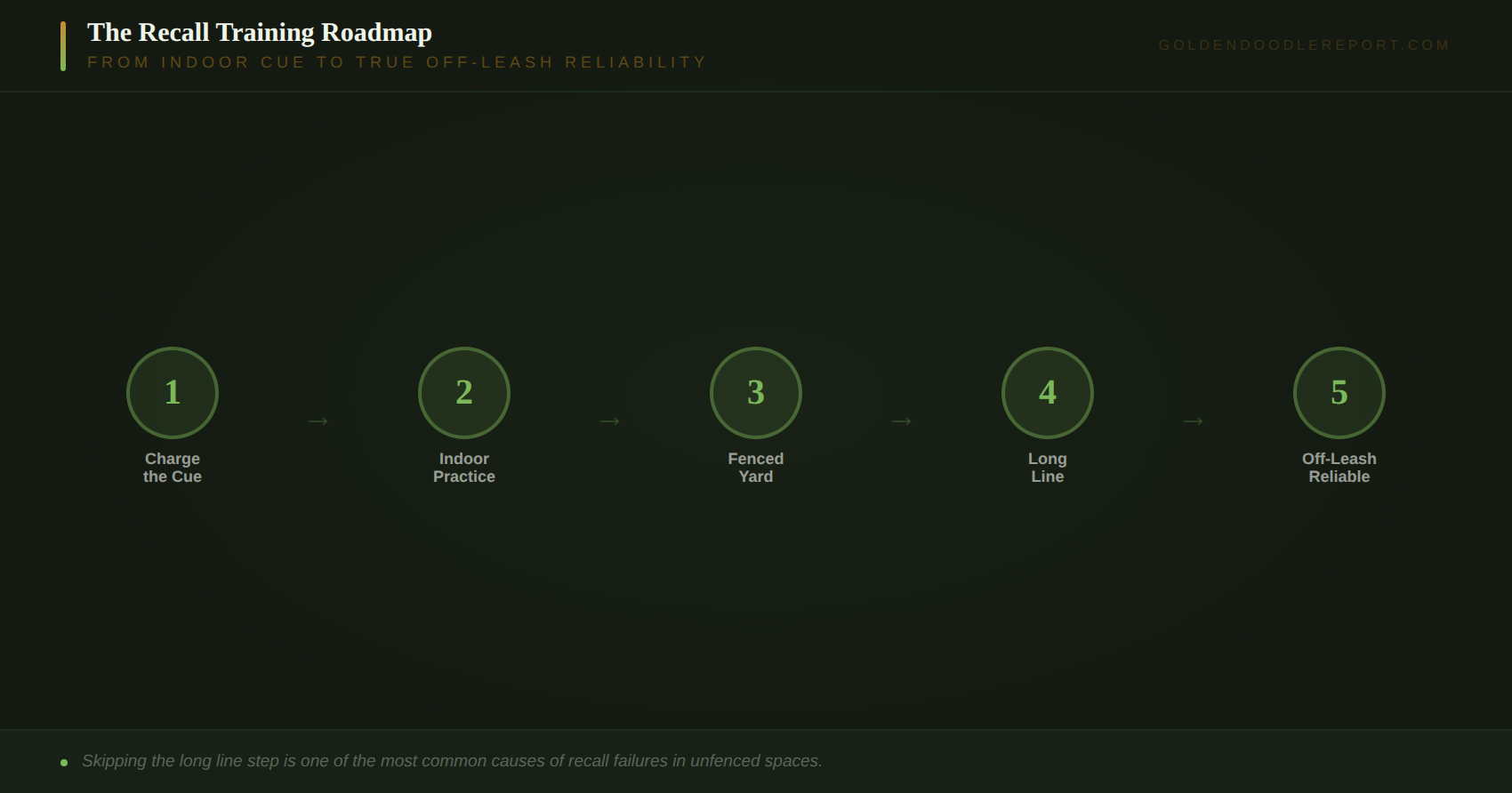
- Practice with a long line before removing it entirely. Covered in detail below — this step is frequently skipped, and it’s one of the most common reasons recall training that looked solid in the yard falls apart in an unfenced space.
📖 Real Scenario
A Standard Goldendoodle owner takes their 3-year-old dog to visit family in the countryside and lets him off-leash for the first time, assuming his generally obedient nature at home means he’ll come when called. He immediately becomes absorbed in exploring the property — sniffing everything, disappearing into the treeline — and completely ignores every call. The owner keeps calling, louder and more frequently, with no result. What happened here wasn’t a training failure exactly — it was a skill that was never actually taught in this context. The dog had a reasonable indoor recall, built entirely in low-distraction settings, that had never been proofed against real outdoor exploration triggers, and had never been practiced on a long line as a safety bridge before full off-leash freedom. Every repeated, ignored call in that moment made the next call weaker, since the dog learned in real time that ignoring the cue carried no consequence. The fix afterward required starting over with a completely new recall word and rebuilding gradually through a long line before any further off-leash attempts — a longer path than if the long-line step had been used from the start.
If “Come” Is Already Burned: Starting Fresh
Every generic recall guide assumes you’re starting with a blank slate — usually a young puppy who’s never heard the word “come” before. In reality, a huge number of owners searching for recall help are in a different situation entirely: their dog already knows the word and has learned, through repetition without consequence, that it’s optional.
This happens more easily than most owners realize. Every time “come” is said and the dog doesn’t come — and nothing happens as a result — the word loses a small amount of meaning. After enough repetitions, the word becomes what trainers sometimes call “burned”: technically known, functionally ignored.
If this describes your situation, the fastest fix documented across real trainer and owner experience isn’t to keep drilling the same burned word — it’s to abandon it and start fresh with a new one. Pick a word your dog has no history with — “here,” “let’s go,” or even a name-based variant work well — and treat it exactly like teaching a brand-new command from the beginning, following the full method above. The clean slate matters more than the specific word chosen.
⚠️ The single most damaging habit: continuing to call a dog that has already decided not to come. Every ignored, repeated call actively teaches your dog that the cue carries no real consequence. If you’re not confident your dog will come, don’t call — walk over and get them instead. This one adjustment, more than almost any other single tip, is what real owner accounts consistently point to as the turning point in fixing a broken recall.
The Goldendoodle-Specific Distraction: Scent and Exploration Drive
Goldendoodles are, on balance, an easier breed to recall-train than many — their strong food and people motivation (inherited from both parent breeds) genuinely works in your favor here. But there’s a specific flip side worth planning for rather than being surprised by: Golden Retriever lineage carries a strong scent-driven exploration instinct, originally bred for retrieving work that rewards independent nose-led investigation over constant handler focus.
In practice, this shows up as a distinct distraction category from generic “other dogs” or “food” — a Goldendoodle that reliably ignores other dogs and passing distractions can still completely check out the moment they catch an interesting scent trail, disappearing into exploration mode in a way that’s genuinely different from simple excitement-based distraction. This isn’t disobedience or a training failure — it’s a real, breed-inherited behavioral tendency worth specifically proofing against, not just lumping into general “distraction training.”
Practically, this means dedicating specific practice sessions in scent-rich environments (wooded areas, parks with varied terrain) rather than assuming success in a flat, low-scent yard will transfer automatically.
The Long Line — Bridging Leash to Off-Leash
A long line — typically 15 to 50 feet of lightweight rope or webbing attached to a harness — is the standard tool professional trainers use to safely bridge the gap between leash walking and genuine off-leash freedom. It’s frequently skipped, and that’s one of the most common reasons a recall that looked solid on a 6-foot leash or in a fenced yard falls apart the first time a dog is genuinely off-leash in an open space.
How to use it
- Attach to a well-fitted harness, not a collar, to distribute any sudden pressure safely
- Let your dog range out to explore while you hold or trail the line
- Call your recall word; if your dog doesn’t respond, you have physical backup to guide them back without a full correction or chase
- Gradually increase the environments and distraction levels you practice in while still on the line
- Only remove the line once recall is consistently reliable across multiple different distracting environments — not just one
The “Gotcha” Exercise — Completing the Recall
A dog that comes when called but stops just out of arm’s reach, or darts away the moment you try to grab their collar, hasn’t actually completed a full recall — and this is a specific, teachable gap most basic recall guides skip entirely.
Practice a dedicated collar-touch exercise separately from recall itself: lure your dog to you with a treat, let them nibble it without releasing the whole thing, say a cue word like “gotcha,” gently take hold of the collar, then release the treat fully. Repeated regularly, this removes the association some dogs develop between a collar grab and something unpleasant (like the leash going back on, ending playtime), which is often the real reason behind a dog who “almost” completes a recall but won’t let you actually touch them.
💡 What This Guide Adds That Most Others Don’t
Nearly every recall guide, including the one Goldendoodle-specific article found in research for this piece, assumes a fresh start and gives generic location-based tips. This guide adds three things that specifically address real, documented owner situations: what to do when a recall word is already burned rather than assuming a blank slate, the breed-specific scent-and-exploration distraction inherited from Golden Retriever lineage, and the “gotcha” collar-touch exercise that completes a recall most guides leave half-finished.
What Most People Get Wrong
- Continuing to call a dog that isn’t coming — as covered above, this is the single most damaging habit, actively teaching a dog the cue is optional
- Calling a dog to do something unpleasant — using recall to end playtime, get a bath, or come inside teaches a dog to associate the word with something they’d rather avoid
- Skipping the long line — going straight from fenced-yard success to full off-leash freedom removes the safety net that catches recall failures before they become dangerous or reinforcing
- Punishing a slow or eventual arrival — even a hesitant, delayed recall should be rewarded, not scolded; punishing it teaches a dog that coming to you carries risk
- Assuming indoor or yard success transfers automatically outdoors — recall needs to be proofed in genuinely distracting, scent-rich environments specifically, not just varied rooms
✔️ Action Plan — Your First Two Weeks
- Decide if your current recall word is “clean” or burned — if burned, choose a new one now
- Spend the first few days charging the cue with no expectation attached
- Practice indoors with increasing distance for the first week
- Move to a fenced yard once indoor recall is consistently strong
- Introduce a long line before attempting any distracting or unfenced environment
- Practice the “gotcha” collar-touch exercise separately, a few times per week
⏱️ What to Expect
A solid indoor recall typically develops within 1-2 weeks of short daily sessions. Reliable recall in a fenced yard with mild distractions usually takes an additional 2-3 weeks. Genuinely trustworthy off-leash recall around real distractions — other dogs, strong scents, unfamiliar environments — is a longer-term skill some trainers suggest may take hundreds of successful repetitions across different settings to fully generalise, often several months of consistent practice rather than weeks. This isn’t a sign of doing something wrong — recall is simply one of the highest-stakes, most heavily-competing-against-distraction commands a dog learns, and building it properly takes real time.
✅ Your Next Step
Once basic recall is developing, Down is a natural next command to add to your Goldendoodle’s foundation — a dedicated guide is coming soon in this category. If your Goldendoodle’s recall specifically breaks down around distractions from other dogs, our upcoming Dog-to-Dog Play Manners Training guide will cover that scenario in more depth.
🔑 Key Takeaways
- Charge your recall word with positive association before using it functionally, and never punish a slow or hesitant arrival
- If “come” is already ignored consistently, switch to a fresh, uncontaminated cue rather than trying to repair the burned one
- Never continue calling a dog that isn’t coming — this is the single most damaging habit for recall reliability
- Goldendoodles carry a real, breed-specific scent-and-exploration distraction from Golden Retriever lineage, distinct from general distractions, and worth proofing against specifically
- A long line is the essential bridge between leash walking and true off-leash freedom — skipping it is one of the most common causes of recall failures
- A dog that comes but won’t let you touch their collar hasn’t finished the recall — practice the “gotcha” exercise separately
📚 More Goldendoodle Training & Behavior Guides
- Teach a Goldendoodle to Sit: The Exact Method That Actually Works
- Teach a Goldendoodle to Stay: The Real Method That Actually Sticks
- How to Teach a Goldendoodle Down — coming soon
- Goldendoodle Recall Training Guide (advanced/long-form) — coming soon
- Goldendoodle Dog-to-Dog Play Manners Training — coming soon
- Goldendoodle Training Guide (complete pillar) — coming soon
Browse all guides: Goldendoodle Training & Behavior category
🔗 Related Guides Across the Site
- Goldendoodle Treats Guide — high-value rewards worth reserving specifically for recall training
- Goldendoodle Puppy Socialization Checklist — building focus and engagement around new environments
Frequently Asked Questions
How do I teach a Goldendoodle to come?
Start in a low-distraction indoor space, say your recall word once in a happy tone, and reward enthusiastically the instant your dog reaches you. Gradually build distance indoors, then move to a fenced yard, then a long line in more distracting settings, only removing the leash entirely once recall is consistently reliable. Never punish a slow or hesitant arrival — this teaches a dog that coming to you carries risk.
My dog already ignores “come” — how do I fix it?
The fastest fix is usually to abandon the old word and start fresh with a new one your dog has no history with, like “here” or “let’s go.” A recall word that’s been repeated and ignored without consequence multiple times becomes functionally meaningless to the dog. Starting over with a clean cue and following the full training method from the beginning typically works faster than trying to repair an already-burned word.
Why does my Goldendoodle ignore recall specifically outdoors or in wooded areas?
Standard Goldendoodles inherit a strong scent-driven exploration instinct from Golden Retriever lineage — a real, breed-specific distraction distinct from general excitement or other-dog distractions. This needs dedicated proofing in scent-rich environments specifically, not just general distraction training in a flat, low-scent yard.
What is a long line and do I actually need one?
A long line is 15-50 feet of lightweight rope or webbing attached to a harness, used as a safety bridge between leash walking and full off-leash freedom. It’s strongly recommended before any off-leash attempt in an unfenced area — skipping this step is one of the most common causes of recall failures, since it removes the safety net that would otherwise catch and correct a missed recall before it becomes dangerous.
How long does it take to train a reliable recall?
A solid indoor recall typically develops within 1-2 weeks. Reliable recall in a fenced yard with mild distractions usually takes an additional 2-3 weeks. Genuinely trustworthy off-leash recall around real distractions is a longer-term skill, often taking several months of consistent, varied practice to fully generalise — this is normal given how much recall competes against everything else in a dog’s environment.
Disclaimer: The information in this article is provided for general educational purposes only. King James Adjei is a researcher and enthusiast, not a professional dog trainer or veterinarian. Never allow your dog off-leash in an unfenced or unsafe area until recall is genuinely reliable, including around real-world distractions. Training methods should always be force-free and adjusted to your individual dog’s comfort and pace.