Affiliate Disclosure: Some links in this guide are affiliate links. If you purchase through them, we may earn a small commission at no extra cost to you. This does not influence our recommendations. Read our full affiliate disclaimer here.
By King James Adjei — Researcher and Goldendoodle enthusiast, founder of GoldendoodleReport.com. Every guide on this site is carefully researched and written to give owners reliable, clearly organised information. → About this site
🩺 Veterinary guidance note: This guide provides a general orientation to Goldendoodle nutrition across all life stages. It is not a substitute for individualised veterinary or veterinary nutritionist advice, particularly for dogs with diagnosed health conditions. Always confirm major dietary decisions with your vet.
📖 14-minute read | Last updated May 2026 | Reviewed for accuracy
This Goldendoodle nutrition guide exists because “just feed a good dog food” turns out to be far less straightforward advice than it sounds once you actually own one. Between puppy formulas split by size, adult maintenance, senior transitions that arrive at wildly different ages depending on whether your dog is a 20 lb Mini or a 65 lb Standard, and the special-case detours — allergies, weight, grain-free debates — there’s a real landscape to navigate here, not a single answer. This guide maps that landscape completely, then routes you to the specific, evidence-based article for whichever stage or situation actually applies to your dog right now.
👤 Who This Guide Is For
- You just brought home a Goldendoodle puppy and want to understand the full nutritional picture before diving into any one topic
- You’ve been feeding your Goldendoodle for a while but want to check you’re not missing anything as they move through life stages
- You’re troubleshooting a specific issue — weight, allergies, digestion — and want the landscape before going deep into one guide
- You want one place that maps every nutrition decision a Goldendoodle owner will face, from puppy to senior years
📋 Quick Summary
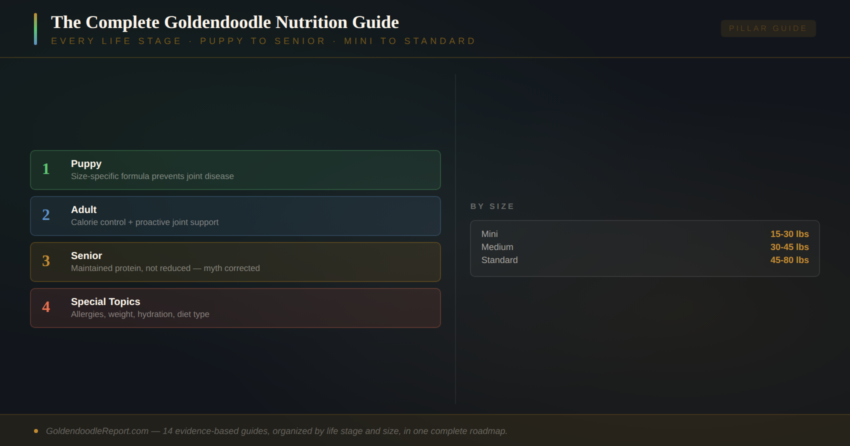
Goldendoodle nutrition changes meaningfully across four life stages — puppy, adult, senior, and any special-condition detour along the way — and the right choice at each stage depends heavily on whether your dog is Mini, Medium, or Standard. Puppies need size-appropriate formulas (large breed for Standards, standard formula for Minis) to prevent developmental joint disease. Adults need calorie control and joint-support ingredients started before problems appear. Seniors need maintained protein, not reduced protein — a specific piece of outdated advice worth unlearning. Grain-inclusive food remains the more cautious default at every stage given the breed’s inherited cardiac considerations. This guide orients you to all of it, then routes you to the dedicated guide for whichever stage or issue applies right now.
Every Goldendoodle owner eventually asks some version of the same question: am I feeding this dog correctly? The honest answer is that “correctly” changes constantly — what’s right for an 8-week-old Mini puppy is actively wrong for a 7-year-old Standard adult, and what’s right for a healthy dog at any age can be completely wrong for one with allergies, a sensitive stomach, or a weight problem.
Most nutrition content treats “dog food” as one topic. It isn’t. It’s a moving target that changes shape at every life stage, and the shape it takes depends heavily on whether your Goldendoodle is a 20 lb Mini or a 65 lb Standard — two dogs that share a breed name but have meaningfully different calorie needs, joint risks, and lifespans. This guide is built to be the map, not the destination: it orients you to the complete landscape, then hands you off to the specific, evidence-based guide for whatever stage or situation you’re actually navigating right now.
📊 Quick Facts — Goldendoodle Nutrition
- Goldendoodles range from roughly 15 lbs (Mini) to 80 lbs (Standard) as adults — a wider size range than almost any other single “breed” name, which is why one-size-fits-all feeding advice consistently fails this breed
- Standard Goldendoodles require a large breed puppy formula specifically to control calcium and phosphorus during growth — feeding regular puppy food to a Standard is one of the most common preventable causes of developmental joint disease in the breed
- The FDA’s investigation into diet-associated heart disease (DCM) never proved grain-free food causes the condition, but the evidence points to legume concentration as the more precise concern — relevant because Goldendoodles inherit cardiac considerations from both parent breeds
- Senior onset varies by nearly 3 years within the breed alone — Standard Goldendoodles typically reach the senior life stage around 6-7 years, while Minis often don’t reach it until 8-9
- Treats are the most commonly untracked source of excess calories in Goldendoodles — the 10% rule (treats under 10% of daily calories) is one of the simplest, most overlooked weight-management levers available
🔍 Quick Diagnosis — Where Should You Start?
- If your Goldendoodle is under 12-18 months → start with Best Puppy Food for Goldendoodles and How Much to Feed a Goldendoodle
- If your Goldendoodle is a healthy adult (1-6/7 years depending on size) → start with Best Food for Adult Goldendoodles
- If your Goldendoodle is showing signs of slowing down or aging → start with Best Senior Dog Food for Goldendoodles
- If you’re dealing with a specific issue (weight, allergies, digestion, hydration) → jump straight to the relevant section-4 sub-topic guide below
📖 Real-Life Scenario
A first-time Goldendoodle owner brings home a Standard puppy and, following advice from a well-meaning friend with a small-breed dog, buys a regular puppy formula. The puppy grows quickly and seems healthy for the first year. At the 14-month check-up, X-rays reveal early signs of a developmental joint issue linked to the calcium imbalance in a formula that wasn’t designed for a large breed’s controlled growth rate. The fix wasn’t complicated — a large breed puppy formula from day one would have prevented the entire situation — but it required knowing that “Goldendoodle” isn’t one nutritional category. This is precisely the gap this guide, and the site’s puppy food guide specifically, exists to close.
📋 Table of Contents
- Goldendoodle Nutrition Guide: The Complete Overview
- Why Size Matters More Than “Breed” Here
- The Four Life Stages — What Changes at Each
- Special Topics — Allergies, Weight, Digestion, Diet Type
- What Most Goldendoodle Owners Get Wrong
- Signs Your Approach Is Working
- When to Involve Your Vet or a Nutritionist
- Frequently Asked Questions
Goldendoodle Nutrition Guide: The Complete Overview
A genuine goldendoodle nutrition guide has to start from an uncomfortable truth: this breed spans a size range wide enough that identical feeding advice can be right for one Goldendoodle and actively harmful for another. A Mini at 20 lbs and a Standard at 65 lbs are both correctly called “Goldendoodle,” but their calorie needs, growth timeline, joint risk, and lifespan all diverge meaningfully — which is why this guide organizes around size and life stage together, not around the breed name alone.
At every stage, four things matter consistently: matching the food to the correct life stage and size category, controlling calories relative to actual activity level, supporting joints proactively rather than reactively, and choosing grain-inclusive formulas given the breed’s inherited cardiac considerations from both Golden Retriever and Poodle lineage. Everything else — brand selection, specific supplement choices, meal timing — sits underneath those four fundamentals.
The WSAVA calorie formula most guides skip
Most Goldendoodle nutrition content gives feeding charts with rough cup ranges by weight. A more precise starting point comes from the WSAVA Global Nutrition Guidelines, which use the Resting Energy Requirement (RER) formula: RER = 70 × (body weight in kg)^0.75. For a 20 kg (44 lb) Goldendoodle, that’s roughly 70 × 20^0.75 ≈ 663 kcal at complete rest — then multiplied by an activity factor (typically 1.2-1.6 for adult dogs, higher for growth) to get the actual daily requirement. This is the same calculation veterinary nutritionists use, and it’s a meaningfully more precise starting point than a generic weight-based chart, though body condition scoring should always confirm the final number for your individual dog.
Why Size Matters More Than “Breed” Here
| Size | Adult Weight | Typical Lifespan | Key Nutritional Difference |
|---|---|---|---|
| Mini | 15-30 lbs | 12-16 years | Standard puppy formula fine; higher metabolic rate per lb; senior stage arrives later |
| Medium | 30-45 lbs | 11-14 years | Large breed puppy formula recommended; moderate joint risk |
| Standard | 45-80 lbs | 10-13 years | Large breed puppy formula required; highest joint risk; earliest senior onset; bloat-risk feeding practices matter |
This size variation is the organizing principle behind why Best Puppy Food for Goldendoodles splits its recommendation by size rather than giving one universal answer, and why senior onset timing (covered in Best Senior Dog Food for Goldendoodles) varies by nearly three years across the breed.
The Four Life Stages — What Changes at Each
Stage 1 — Puppy (8 weeks to 12-18 months, depending on size)
The single highest-stakes nutritional decision in a Goldendoodle’s life happens here: Standard puppies require a large breed puppy formula with controlled calcium and phosphorus to prevent developmental joint disease, while Minis can use a standard puppy formula. Portion needs are driven by rapid growth and are meaningfully higher per pound than adult requirements. Full breakdown, including the exact AAFCO label language to check for: Best Puppy Food for Goldendoodles. For daily portion amounts and feeding frequency during this stage: How Much to Feed a Goldendoodle and Goldendoodle Feeding Schedule.
Stage 2 — Adult (1 year to 6-7/8-9 years, depending on size)
The longest life stage, and the one where calorie control and proactive joint support matter most. Protein needs moderate slightly from puppy levels; joint-support ingredients (glucosamine, chondroitin, omega-3s) become relevant well before any clinical signs appear; neutering-related metabolic changes require an immediate portion reassessment, not a wait-and-see approach. Complete framework: Best Food for Adult Goldendoodles, building on the foundational criteria in Best Food for Goldendoodles.
Stage 3 — Senior (variable onset by size — see table above)
The most commonly mishandled transition. The outdated advice to reduce protein for seniors has been specifically revised by veterinary nutrition — healthy seniors need maintained or higher protein, not less, to prevent age-related muscle loss. Joint support, calorie reduction (typically 20-30% lower needs), and cognitive-support ingredients become the four priorities. Complete guide, including the exact AAHA framework for determining when your specific dog enters this stage: Best Senior Dog Food for Goldendoodles.
Stage 4 — Special conditions (can occur at any stage)
Food allergies, sensitive stomachs, weight problems, and hydration issues aren’t tied to a specific age — they can emerge at any point and require a different approach than standard life-stage feeding. See the Special Topics section below for the complete map of these situations.
Special Topics — Allergies, Weight, Digestion, and Diet Type
Beyond the four life stages, several situations cut across age and size, each with its own dedicated guide:
Food allergies and sensitivities
True food allergies are less common than owners often assume, and the far more common issue — a sensitive stomach without true allergy — requires different management. Both are covered separately: Goldendoodle Food Allergies for the immune-mediated version (skin symptoms, elimination trials) and Goldendoodle Sensitive Stomach for digestive-only symptoms.
Weight management
Overweight Goldendoodles are extremely common, partly because the breed’s thick coat masks weight gain visually, and partly because treats are rarely tracked as part of the daily calorie budget. Full framework: Goldendoodle Weight Management. For the specific treat-calorie budget and safe treat options: Goldendoodle Treats Guide.
Hydration
Water intake is an underdiscussed piece of Goldendoodle nutrition, particularly relevant for hot climates and active dogs: How Much Water Should a Goldendoodle Drink.
Diet type — kibble, raw, grain-free
Three diet-type questions come up repeatedly. Whether raw feeding is appropriate: Raw Diet for Goldendoodles covers the evidence honestly, including the 2025-2026 research on measurable benefits and the real bacterial and nutritional-balance risks. Whether grain-free food is dangerous: Grain-Free Food for Goldendoodles corrects the common oversimplified “grain-free causes heart disease” narrative with the actual FDA investigation record. And whether specific human foods are safe: Can Goldendoodles Eat Chicken? covers the most commonly asked version of this question.
What Most Goldendoodle Owners Get Wrong
- Treating “Goldendoodle” as one nutritional category — the size range within this single breed name is wide enough that puppy formula choice, senior onset timing, and calorie needs all vary meaningfully by Mini vs Standard, yet most generic advice ignores this entirely
- Reducing senior protein preemptively — this specific piece of advice has been revised by veterinary nutrition; healthy seniors need maintained or higher protein, not less, unless a kidney condition is diagnosed
- Not adjusting portions after neutering — spaying/neutering reduces calorie needs by roughly 20-25%, and continuing pre-neuter portions is one of the most common causes of adult weight gain in this breed
- Panic-switching diets based on headlines — the 2018-2019 grain-free media cycle caused widespread unnecessary diet switching; the actual evidence is more nuanced than either “grain-free is dangerous” or “the FDA never proved anything”
- Not tracking treat calories — treats are the single most commonly untracked source of excess calories in this food-motivated breed
- Using regular puppy food for a Standard Goldendoodle — one of the most preventable causes of developmental joint disease in large-breed puppies specifically
Signs Your Approach Is Working
- Body condition score sits at 4-5 out of 9 — ribs easily felt without pressing hard, visible waist tuck from above
- Coat has a healthy sheen, without excessive dryness, dullness, or shedding beyond what’s normal for the coat type
- Stool is consistently firm and well-formed, without recurring loose stool or excessive gas
- Energy level is appropriate and consistent for age and size — not lethargic, not unusually ravenous
- No recurring digestive upset, skin irritation, or ear infections that might signal an undiagnosed food sensitivity
When to Involve Your Vet or a Nutritionist
This guide — and every guide it links to — is designed for healthy dogs navigating normal life-stage nutrition. Several situations call for professional input beyond what any general guide can safely provide:
- Any diagnosed health condition — kidney disease, heart disease, diabetes, confirmed food allergy — requires a therapeutic diet specific to that condition, not general life-stage guidance
- Persistent digestive symptoms lasting more than 48 hours, or any blood in the stool, warrant veterinary assessment before any dietary change
- Significant unexplained weight change in either direction should be evaluated medically before assuming it’s purely a feeding issue
- Considering a home-prepared or raw diet long-term is best done with a board-certified veterinary nutritionist formulating the specific recipe, given how frequently home-prepared diets are found to be nutritionally incomplete
According to the general overview of commercial dog food formulation on Wikipedia, complete and balanced commercial diets are formulated to meet established nutrient profiles precisely because getting this balance right at home, without professional formulation, is genuinely difficult to do consistently — which is part of why AAFCO-validated commercial food remains the practical default for most owners across every life stage covered in this guide.
🔑 Key Takeaways
- Goldendoodle nutrition has to be organized around size and life stage together — the same guidance rarely applies equally to a Mini and a Standard
- The WSAVA RER formula (70 × body weight in kg^0.75) gives a more precise calorie starting point than generic weight charts, adjusted by activity level and confirmed with body condition scoring
- Standard Goldendoodles need a large breed puppy formula from day one — this single decision prevents one of the most common preventable joint conditions in the breed
- The old advice to reduce protein for senior dogs has been specifically revised — healthy seniors need maintained or higher protein unless a kidney condition is diagnosed
- Grain-inclusive food remains the more cautious default at every life stage, given the breed’s inherited cardiac considerations from both parent lines — though the evidence never established grain-free food as inherently dangerous
- Every specific situation — puppy, adult, senior, allergies, weight, hydration, diet type — has a dedicated, evidence-based guide linked throughout this pillar
🚀 Start Here — The Essential Guides
- How Much to Feed a Goldendoodle: Amounts by Age + Weight — the portion-calculation foundation for every stage
- Best Food for Goldendoodles: What Vets Recommend (2026) — the universal brand-evaluation framework
- Best Puppy Food for Goldendoodles: Large vs Small Breed — the single highest-stakes early decision
- Best Food for Adult Goldendoodles: Vet-Backed Guide (2026) — the longest life stage, done right
- Best Senior Dog Food for Goldendoodles: The Real Priorities That Get It Right — the most commonly mishandled transition
- Goldendoodle Weight Management: How to Help Safely — addressing the breed’s most common preventable health issue
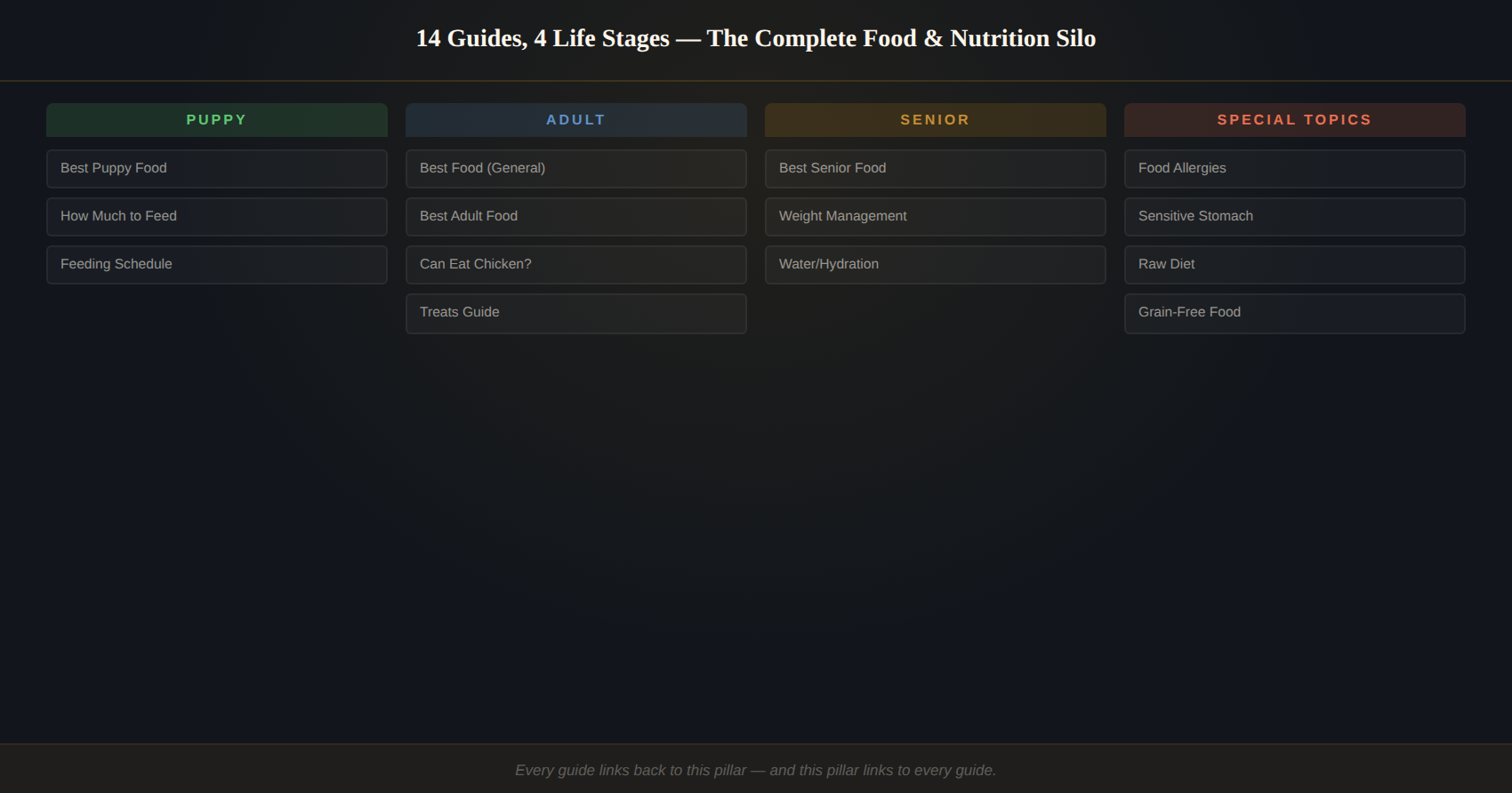
📚 Every Goldendoodle Food & Nutrition Guide
- How Much to Feed a Goldendoodle: Amounts by Age + Weight
- Goldendoodle Feeding Schedule: Meal Timing by Age (2026)
- Best Food for Goldendoodles: What Vets Recommend (2026)
- Best Puppy Food for Goldendoodles: Large vs Small Breed
- Best Food for Adult Goldendoodles: Vet-Backed Guide (2026)
- Goldendoodle Food Allergies: Signs, Triggers + What to Feed
- Goldendoodle Sensitive Stomach Food: The 5 Types That Help
- Goldendoodle Weight Management: How to Help Safely (2026)
- How Much Water Should a Goldendoodle Drink? (2026 Guide)
- Can Goldendoodles Eat Chicken? Safe vs Dangerous (2026)
- Goldendoodle Treats Guide: Best Options + What to Avoid
- Raw Diet for Goldendoodles: Benefits, Risks + Honest Guide
- Grain-Free Food for Goldendoodles: The Real Evidence That Keeps Them Safe
- Best Senior Dog Food for Goldendoodles: The Real Priorities That Get It Right
🔗 Related Topics Across the Site
- Goldendoodle Coat Types Explained — how nutrition affects coat health and texture
- Goldendoodle Exercise Needs by Age — activity level’s direct effect on calorie requirements
- Goldendoodle Puppy Care Guide — the broader first-year context nutrition sits within
- Goldendoodle Puppy First Vet Visit — where nutrition planning formally begins
Browse the full Goldendoodle Food & Nutrition category: goldendoodlereport.com/category/food/
Frequently Asked Questions
What is the best overall approach to Goldendoodle nutrition?
The best approach matches food to size and life stage together rather than treating “Goldendoodle” as one category. Standard puppies need large breed puppy formula; Minis can use standard formula. Adults need calorie control and proactive joint support. Seniors need maintained protein, not reduced protein. At every stage, a grain-inclusive food with a named protein first, from a WSAVA-meeting manufacturer, is the evidence-based default. For the complete brand-evaluation framework: Best Food for Goldendoodles.
Do Mini and Standard Goldendoodles really need different food?
Yes, particularly during the puppy stage. Standard Goldendoodles (45-80 lbs adult weight) require a large breed puppy formula with controlled calcium and phosphorus to prevent developmental joint disease during rapid growth. Mini Goldendoodles (15-30 lbs) can use a standard puppy formula without this restriction. The size difference also affects when each reaches the senior life stage — Standards around 6-7 years, Minis often not until 8-9 — and how many calories they need per pound of body weight throughout adulthood.
How do I calculate how much to feed my Goldendoodle?
The most precise starting point is the WSAVA Resting Energy Requirement formula: RER = 70 × (body weight in kg)^0.75, then multiplied by an activity factor (roughly 1.2-1.6 for adults, higher during growth). This gives a more accurate baseline than generic weight-based charts, though body condition scoring should always confirm the final amount for your individual dog. Full calculation walkthrough with worked examples by size: How Much to Feed a Goldendoodle.
Is grain-free food safe for Goldendoodles?
The FDA’s investigation into diet-associated heart disease never established that grain-free food itself causes the condition — the evidence points more precisely to legume concentration, which happens to occur more often in grain-free formulas. Given Goldendoodles’ inherited cardiac considerations from both parent breeds, a grain-inclusive food remains the more cautious, equally nutritious default choice. Full evidence-based breakdown: Grain-Free Food for Goldendoodles.
What’s the biggest nutrition mistake Goldendoodle owners make?
Treating this breed’s wide size range as if it were nutritionally uniform. A single piece of generic feeding advice that works for a 20 lb Mini can be actively wrong for a 65 lb Standard — different puppy formula requirements, different senior onset timing, different calorie needs relative to body weight. The second most common mistake is not adjusting portions after neutering, which reduces calorie needs by roughly 20-25% and is one of the most common causes of adult weight gain in this breed.
Disclaimer: The information in this guide is provided for general educational purposes only. King James Adjei is a researcher and enthusiast, not a veterinarian or certified veterinary nutritionist. This pillar guide orients healthy dogs through normal life-stage nutrition; it is not a substitute for individualised veterinary guidance, particularly for dogs with diagnosed health conditions. Always consult your veterinarian for your Goldendoodle’s specific nutritional needs.