Affiliate Disclosure: Some links in this guide are affiliate links. If you purchase through them, we may earn a small commission at no extra cost to you. This does not influence our recommendations. Read our full affiliate disclaimer here.
By King James Adjei — Researcher and Goldendoodle enthusiast, founder of GoldendoodleReport.com. Every guide on this site is carefully researched and written to give owners reliable, clearly organised information. → About this site
🩺 Veterinary guidance note: A calm refusal to lie down during training is normal and covered in this guide. However, if your Goldendoodle appears unable to settle, paces restlessly, seems distressed, or shows a swollen abdomen alongside an inability to lie down, this can be an early warning sign of bloat (gastric dilatation-volvulus) in large, deep-chested breeds — Standard Poodles specifically are among the documented at-risk breeds, relevant given Standard Goldendoodle lineage. This is a medical emergency requiring immediate veterinary attention, not a training issue. This guide is not a substitute for veterinary assessment of sudden distress.
📖 9-minute read | Last updated May 2026 | Reviewed for accuracy
Learning to teach a Goldendoodle to lie down builds directly on the sit command, and it’s genuinely one of the most useful cues for everyday calm — a solid down is what lets your dog settle at a café table, during a vet visit, or while guests are over, instead of staying keyed up and mobile. Most owners find the basic teaching process straightforward, but two specific things trip people up: the “push-up problem,” where a dog lies down for a split second and immediately pops back up, and a distinct Goldendoodle behavior pattern where the dog uses lying down as a stubborn protest tactic rather than a trained response — two very different things that call for different fixes.
This guide covers the lure and shaping methods for teaching a genuine down cue, the specific fix for the push-up problem, the real reasons a dog might refuse to lie down at all, and how to tell a trained-down situation apart from a Goldendoodle-specific “I’m not moving” protest.
✅ Quick Answer
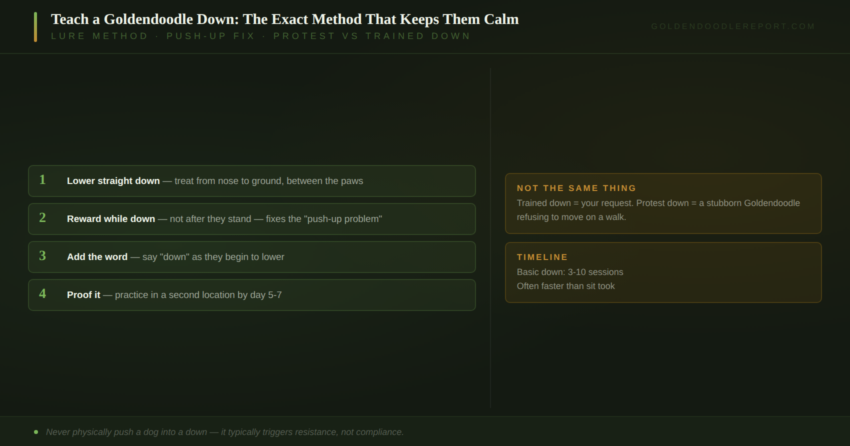
To teach a Goldendoodle to lie down, start from a sit, hold a treat at their nose, and slowly lower it straight to the ground between their front paws — as their head follows the treat down, their body should lower into a down position. Mark and reward the instant their elbows touch the floor, and make sure the reward arrives while they’re still down, not after they pop back up. Most Goldendoodles learn a basic down within 3-10 short training sessions. If your dog already knows sit well, down typically comes faster than sit did, since the physical movement builds on a position they already understand.
👤 Who This Guide Is For
- Your Goldendoodle already knows sit and you’re ready for the next foundational command
- Your dog lies down for a second, then immediately pops back up before you can reward properly
- Your dog seems to refuse lying down altogether, especially on certain surfaces or in certain places
- Your Goldendoodle plants themselves and lies down mid-walk, refusing to continue, and you’re not sure if that’s a training gap or something else
📊 Quick Facts — Teaching a Goldendoodle Down
- Down builds directly on sit and is typically faster to teach once sit is already solid — most dogs learn a reliable down within 3-10 short sessions
- The “push-up problem” — lying down briefly then immediately standing back up — usually happens because the reward arrives after the dog has already stood, accidentally reinforcing the pop-up rather than the down itself
- Some behaviorists believe the instinct to turn or circle before lying down is a holdover from wild canine ancestors preparing uneven ground to be more comfortable
- Reasons a dog refuses to lie down include surface discomfort (cold, hot, or hard ground), joint pain, or feeling vulnerable in a busy or unfamiliar space — not stubbornness by default
- Goldendoodles inherit a documented stubborn streak from both Golden Retriever and Poodle lineage, which can show up specifically as planting themselves in a down position mid-walk as a refusal tactic — a distinct behavior from the trained down cue this guide teaches
🔍 Quick Diagnosis — What’s Actually Going Wrong?
- If your dog lies down then instantly pops back up → this is the classic push-up problem; reward while they’re still down, not after they’ve stood, covered in detail below
- If your dog won’t lie down on certain surfaces → check if the ground is too hot, cold, or hard; offer a mat or towel during training
- If your dog refuses to lie down in busy or unfamiliar spaces → this may be a vulnerability response, not defiance; don’t force it, build confidence gradually in that environment first
- If your Goldendoodle drops into a down and refuses to get up mid-walk → this is likely the breed-specific protest behavior covered below, not a training gap — different fix entirely
📋 Table of Contents
The Lure Method — Step by Step
Your Goldendoodle should already know sit before starting down training — if not, start with how to teach a Goldendoodle to sit first.
- Start from a sit. Ask your dog to sit, then hold a treat at their nose.
- Lower the treat straight down. Move it slowly from their nose down to the ground, directly between their front paws — not out and away, straight down.
- Let their body follow. As their head lowers to track the treat, their front end should follow, bringing their elbows and chest to the ground.
- Mark the instant they’re fully down. Elbows and chest on the floor — not a half-crouch — is the target position.
- Reward while they’re still down. This is the single most important detail, and it’s covered in more depth in the push-up problem section below.
- Add the word. Say “down” right as they begin to lower, once the lure motion alone is reliably working.
- Fade the lure into a hand signal. Repeat the same downward hand motion without a treat in hand, rewarding from your other hand instead.
📖 Real Scenario
A Goldendoodle owner spends a full week practicing down, and their dog reliably drops into position every time — but the owner is confused and frustrated because the dog pops back up within a second, every single time, before the treat can be delivered. It looks like the dog “isn’t getting it,” but the dog has actually learned the down motion perfectly. What’s happening is a timing issue, not a comprehension issue: the owner has been rewarding a beat too late, after the dog has already started standing back up — which means the dog has been rewarded, again and again, for the pop-up, not the down itself. Once the owner starts having the treat ready in hand before asking for the down, delivering it the instant the elbows touch the floor rather than reaching for a treat afterward, the pop-up disappears within a handful of sessions. Nothing about the dog’s understanding changed — only the timing of the reward did.
The Shaping Method — A No-Lure Alternative
If luring isn’t working well for your dog, shaping breaks the down into smaller, gradual sub-steps, rewarding closer approximations of the final behavior at each stage rather than showing the finished position from the start.
- Reward looking at the ground. Any downward head movement toward the floor gets marked and rewarded.
- Reward bending the elbows. Once looking down is reliable, only reward when the front legs start to bend.
- Reward the full down. Finally, only reward once elbows and chest are fully on the ground.
This granular, step-by-step version of shaping tends to work well for dogs who get “stuck” partway through the lure motion — hovering in a half-crouch without fully committing to the ground — since it explicitly rewards and builds on each intermediate step rather than expecting the full behavior at once.
Fixing the “Push-Up Problem”
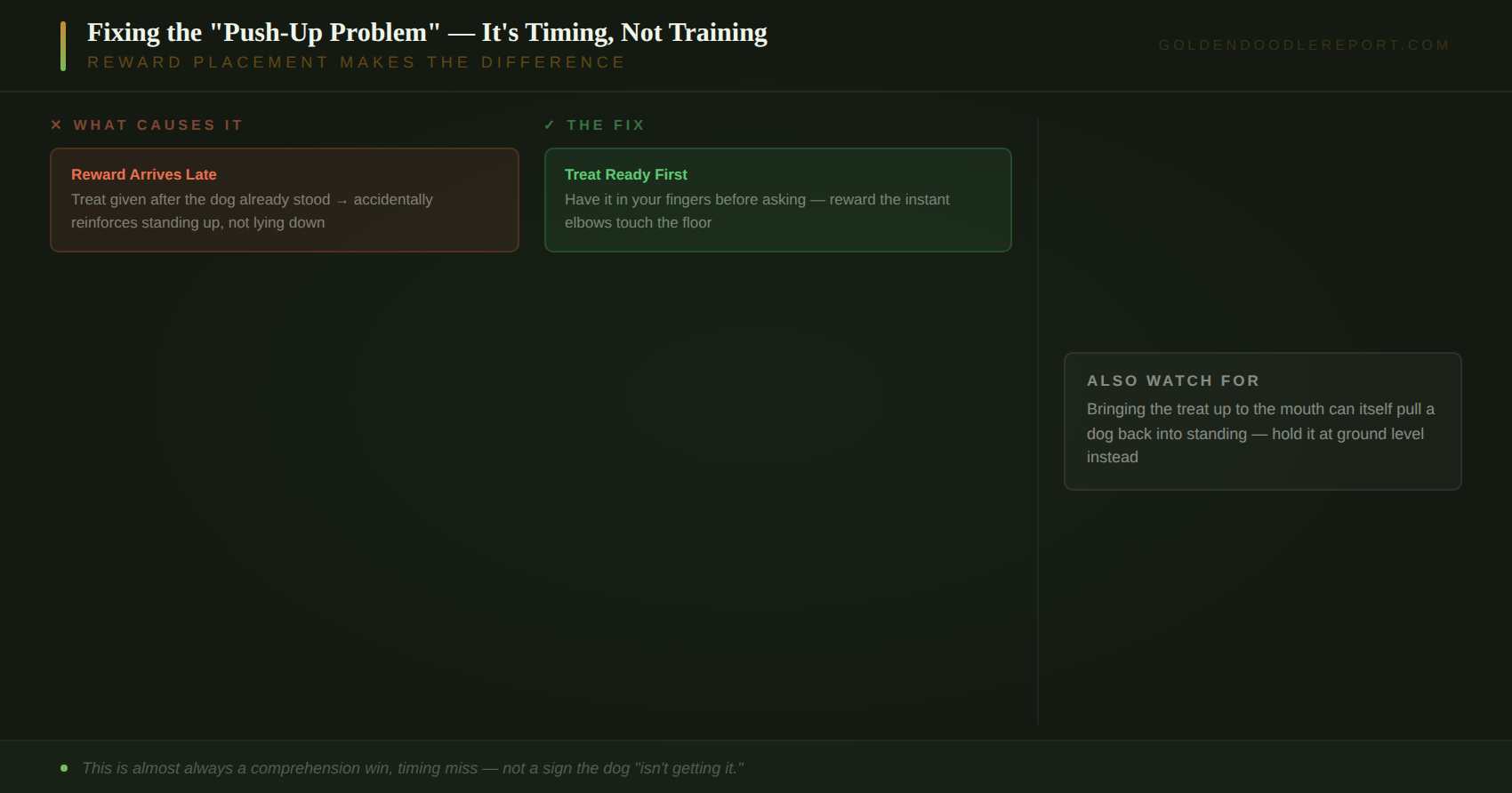
The American Kennel Club specifically names this the “push-up problem” — a dog lying down for a split second before immediately standing back up. It’s one of the most common and most misunderstood issues in down training. It’s rarely a comprehension problem. It’s almost always a timing problem.
If your dog is consistently rewarded only after standing back up (because that’s when the treat happened to be ready), you’ve accidentally taught them that standing up is what earns the reward, not lying down. The fix is straightforward but requires deliberate attention: have the treat literally in your fingers, ready to deliver, before you ask for the down, and reward the instant the elbows touch the ground — not a half-second later. If needed, briefly hold the reward at ground level rather than bringing it up to your dog’s mouth, which can itself pull them back into a standing position before you intend.
Why Some Dogs Refuse to Lie Down
A dog that won’t lie down isn’t automatically being stubborn — there are usually specific, identifiable reasons worth checking before assuming it’s a training gap:
- Surface discomfort: hot pavement, cold tile, or hard ground can all make a dog reluctant to lie down; offering a mat or towel during training often resolves this immediately
- Joint discomfort: particularly relevant for Standard Goldendoodles given inherited hip and joint considerations from both parent breeds — persistent reluctance to lie down, especially alongside stiffness or reluctance to sit, is worth a vet mention rather than more training pressure
- Feeling vulnerable: lying down puts a dog in a physically exposed position, which some dogs are reluctant to do in busy, loud, or unfamiliar spaces until they feel more confident there
Never physically push or fold a dog into a down position. This is outdated advice most modern trainers have moved away from — it can cause confusion, mild intimidation, and in some cases resistance, since applying downward pressure often triggers a dog’s instinct to push back against it rather than comply.
Trained Down vs. the Goldendoodle “Refusal to Move” Protest
This is a distinction worth understanding clearly, because it’s easy to confuse with a training issue when it’s really something else entirely. Both Golden Retrievers and Poodles are documented as carrying a real stubborn streak, and Goldendoodles inherit this from both sides. In practice, this sometimes shows up as a specific, recognisable behavior: a dog that simply lies down and refuses to move — often mid-walk — when they’ve decided they don’t want to do something, using their size and stillness as passive resistance rather than active defiance.
This is genuinely different from the trained down cue covered throughout this guide. A trained down is a response to your request. A protest down is the dog making their own decision, usually in a specific recurring context (not wanting to leave an interesting spot, not wanting to continue past a certain point on a walk). The fix isn’t more down training — it’s addressing the underlying motivation. Common approaches include calmly waiting the behavior out without engaging or scolding (which can inadvertently provide the attention the dog is seeking), redirecting with something more interesting than the current standoff, or in some documented cases, simply distracting the dog’s attention elsewhere until they get up on their own and continue.
💡 What This Guide Adds That Most Others Don’t
Every generic down-training guide treats “won’t lie down” and “already lying down and won’t move” as the same category of problem. They’re not. Real owner accounts specifically describe Goldendoodles using a down position as a deliberate protest tactic on walks — a genuine, breed-linked behavior pattern distinct from the taught cue this guide is primarily about. No competitor guide, including the one Goldendoodle-specific training resource found in research for this piece, draws this distinction clearly.
What Most People Get Wrong
- Rewarding after the dog stands back up — this is the root cause of the push-up problem, covered in detail above
- Physically pushing a dog into position — outdated and often counterproductive; most dogs push back against applied pressure instinctively
- Assuming refusal is always stubbornness — surface discomfort, joint pain, and vulnerability are all legitimate reasons worth ruling out first
- Treating a walk-protest down as a training failure — as covered above, this is a different behavior entirely, and more down-cue practice won’t fix it
- Training only in one location — the same proofing gap covered throughout this series; a down learned only indoors needs deliberate practice elsewhere too
✔️ Action Plan — Your First Training Week
- Confirm your dog has a solid sit before starting down training
- Have treats literally ready in hand before each rep, to avoid the push-up problem from the start
- Try the lure method first; switch to shaping if your dog gets stuck in a half-crouch
- Add the verbal cue once the lure motion is reliably working
- Practice in a second location by day 5-7 to begin proofing the command
⏱️ What to Expect
Most Goldendoodles learn the basic down motion within 3-10 short sessions, often faster than sit took since the movement builds on an already-known position. The push-up problem, when present, typically resolves within a few sessions once reward timing is corrected. Full proofing across different locations and distraction levels follows the same 2-4 week timeline covered in our Sit and Stay guides. If your dog seems to understand the motion but consistently refuses full commitment to the ground, revisit the surface and vulnerability considerations above before assuming it’s a training gap.
✅ Your Next Step
Once down is solid, Leave It is a natural next command — a dedicated guide is coming soon in this category. Down also pairs naturally with the Place Command (coming soon), which builds duration and location-specificity on top of the down position you’ve just taught.
🔑 Key Takeaways
- Down builds directly on sit — lower the treat straight to the ground between the front paws, rewarding the instant elbows touch down
- The “push-up problem” is almost always a reward-timing issue, not a comprehension issue — have the treat ready before asking, and reward while your dog is still down
- Refusal to lie down often has a specific cause — surface discomfort, joint pain, or feeling vulnerable — rather than being default stubbornness
- Goldendoodles carry a documented stubborn streak that can show up as a distinct “protest down” mid-walk — genuinely different from the trained cue, and requiring a different fix
- Never physically push a dog into a down — this typically triggers resistance rather than compliance
- Persistent, distressed inability to settle alongside pacing in a large breed warrants a vet check, not more training — this can be an early bloat warning sign
📚 More Goldendoodle Training & Behavior Guides
- Teach a Goldendoodle to Sit: The Exact Method That Actually Works
- Teach a Goldendoodle to Stay: The Real Method That Actually Sticks
- Teach a Goldendoodle to Come: The Proven Recall That’s Actually Reliable
- How to Teach a Goldendoodle Leave It — coming soon
- Goldendoodle Place Command Guide — coming soon
- Goldendoodle Training Guide (complete pillar) — coming soon
Browse all guides: Goldendoodle Training & Behavior category
🔗 Related Guides Across the Site
- Goldendoodle Treats Guide — choosing the right training rewards
- Goldendoodle Puppy Care Guide — where training fits into overall first-year care
Frequently Asked Questions
How do I teach a Goldendoodle to lie down?
Start from a sit, hold a treat at your dog’s nose, and slowly lower it straight down to the ground between their front paws. As their head follows the treat, their body should lower into a down position. Mark and reward the instant their elbows touch the floor, making sure the reward arrives while they’re still down. Most Goldendoodles learn a basic down within 3-10 short sessions, often faster than sit did.
Why does my dog lie down and then immediately pop back up?
This is known as the “push-up problem,” and it’s almost always a reward-timing issue, not a comprehension problem. If the treat consistently arrives after your dog has already started standing, you’ve accidentally reinforced the pop-up rather than the down. Have the treat ready in hand before asking for the down, and reward the instant elbows touch the ground, not after.
Why does my Goldendoodle refuse to lie down sometimes?
Common reasons include surface discomfort (hot, cold, or hard ground), joint discomfort, or feeling vulnerable in a busy or unfamiliar space — not automatic stubbornness. Offering a mat during training and being patient in new environments usually resolves this. Persistent refusal alongside stiffness or reluctance to sit is worth mentioning to your vet.
My Goldendoodle lies down on walks and refuses to move — is this a training problem?
This is likely a different behavior than the trained down cue — Goldendoodles carry a documented stubborn streak from both Golden Retriever and Poodle lineage that can show up as using a down position as passive protest, usually in a specific recurring context. More down-cue training typically won’t fix this; addressing the underlying motivation (redirecting attention, calmly waiting it out without extra engagement) is usually more effective.
When should I be worried about my dog not lying down?
A calm refusal during training is normal and not a medical concern. However, if your dog appears unable to settle, paces restlessly, seems distressed, or shows abdominal swelling alongside an inability to lie down, seek veterinary attention immediately — in large, deep-chested breeds this combination can be an early sign of bloat, a medical emergency, not a training issue.
Disclaimer: The information in this article is provided for general educational purposes only. King James Adjei is a researcher and enthusiast, not a professional dog trainer or veterinarian. If your Goldendoodle shows signs of distress, restlessness, or inability to settle alongside physical symptoms, consult your veterinarian promptly rather than relying on training advice. Training methods should always be force-free and adjusted to your individual dog’s comfort and pace.