Affiliate Disclosure: Some links in this guide are affiliate links. If you purchase through them, we may earn a small commission at no extra cost to you. This does not influence our recommendations. Read our full affiliate disclaimer here.
By King James Adjei — Researcher and Goldendoodle enthusiast, founder of GoldendoodleReport.com. Every guide on this site is carefully researched and written to give owners reliable, clearly organised information. → About this site
📖 9-minute read | Last updated May 2026 | Reviewed for accuracy
Learning to teach a Goldendoodle to leave it might be the single most safety-relevant command on this entire list — it’s the cue that stands between your dog and a dropped medication, a piece of trash on a walk, or a hazard you spot half a second too late to physically intervene. Goldendoodles in particular have a well-earned reputation for treating socks, tissues, and random street finds as fair game, which makes this command less of a nice-to-have and more of an essential.
This guide covers the standard closed-fist method, a genuine mix-up that can happen if your dog was trained using the lure method on other commands, the companion “take it” cue most guides skip, and why saving leave it only for real emergencies actually backfires.
✅ Quick Answer
To teach a Goldendoodle to leave it, hold a low-value treat in your closed fist and let your dog sniff, lick, or paw at it without opening your hand. The instant they stop trying and pull back or look away, mark the moment and reward from your other hand with a higher-value treat — never the one in your fist. Once this is reliable, add the verbal cue, then progress to a treat on an open palm, then on the floor, gradually building distance and real-world distractions. Most Goldendoodles grasp the basic concept within a handful of sessions, though full reliability around genuinely tempting distractions takes several weeks of consistent, varied practice.
👤 Who This Guide Is For
- Your Goldendoodle already knows sit and down and you’re ready for a safety-focused command
- Your dog picks up socks, tissues, or food off the ground and street on walks
- You’ve tried leave it but your dog seems confused, following the treat instead of ignoring it
- You want to understand the difference between “leave it” and “drop it,” and whether you need both
📊 Quick Facts — Teaching a Goldendoodle Leave It
- “Leave it” means don’t approach or pick something up; “drop it” means release something already in the mouth — two related but distinct commands
- Give the cue as early as possible, before your dog is already fixated on something — impulse control gets significantly harder once a dog has locked onto a target
- Practicing leave it only during genuine emergencies, rather than regularly in low-stakes situations, tends to make the cue less reliable over time, not more
- The reward for leaving something must be higher value than what was left behind — asking a Goldendoodle to ignore a squirrel for a plain dry biscuit is set up to fail from the start
- Dogs trained on other commands using the lure method (where following a treat is rewarded) can genuinely get confused when leave it asks for the opposite response — this is a documented, real training snag, not a sign something is wrong with your dog
🔍 Quick Diagnosis — What’s Actually Going Wrong?
- If your dog keeps trying to follow the treat with their nose or paw at your closed fist → this is completely normal in early sessions; keep the fist closed and wait it out, don’t open early
- If your dog seems confused about whether to approach or back away from your hand → this may be the lure-method mix-up covered below, especially if you taught sit or down using a lure recently
- If leave it works at home but fails on walks → the same proofing gap covered throughout this series; deliberately practice with mild real-world distractions before expecting reliability with high-value ones
- If your dog leaves the item but then goes back for it a moment later → the reward may not have been delivered fast enough, or wasn’t higher value than the item itself
📋 Table of Contents
The Basic Method — Step by Step
“Leave it” is one of the most safety-relevant commands you can teach, and it functions as a genuine impulse control exercise — asking your dog to override an instinctive urge in favor of your direction. The American Kennel Club’s training guidance specifically recommends starting with the closed-fist method before progressing to floor-level and real-world practice.
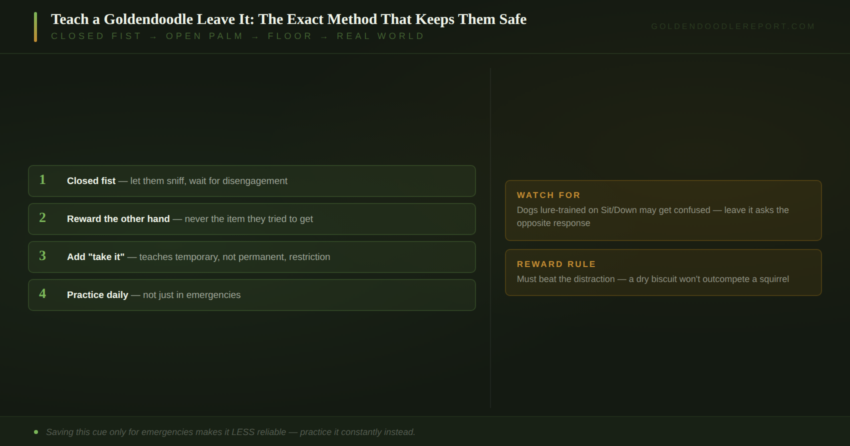
- Start with a closed fist. Place a low-value treat in your closed hand and let your dog sniff, lick, or paw at it. Say nothing yet — just wait.
- Wait for disengagement. Eventually your dog will pause, pull back, or look away. This is the moment you’re waiting for.
- Mark and reward from the other hand. The instant they disengage, mark it and immediately give a higher-value treat from your other hand — never the one they were trying to get.
- Add the verbal cue. Once your dog reliably backs off your closed fist, say “leave it” right before presenting your hand.
- Progress to an open palm. Place the treat on your open palm; if your dog goes for it, close your fist again and wait, same as before.
- Move to the floor. Place a low-value treat on the ground and cover it with your hand or foot if needed, repeating the same wait-and-reward pattern.
- Build distance and real-world practice. Once reliable up close, practice walking your dog past a row of low-value treats on the ground, rewarding generously for ignoring each one.
📖 Real Scenario
A Goldendoodle owner has already taught sit and down successfully using the lure method — treat at the nose, dog follows it into position. When they start leave it training, they instinctively hold the treat out in an open hand the same way, and their puppy immediately tries to follow and take it, exactly like every other command so far. The owner assumes the puppy is being difficult or not understanding, when actually the puppy is doing exactly what it’s been consistently taught: follow the treat, you get rewarded. Leave it is the first command in the sequence that asks for the opposite response, and that mismatch causes real, understandable confusion. Once the owner switches specifically to a closed fist for leave it — a visually and physically distinct starting position from the open-hand lure used for sit and down — the confusion clears up within a session or two. The dog isn’t slow to learn; the training context simply needed to look different enough from the lure pattern to signal that a different rule applied here.
The Lure-Training Mix-Up — What to Watch For
This is worth naming explicitly, because it’s a real pattern documented in owner discussions, and it’s directly relevant if you’ve followed our Sit and Down guides in order, both of which teach the lure method — treat at the nose, dog follows it, dog gets rewarded for following.
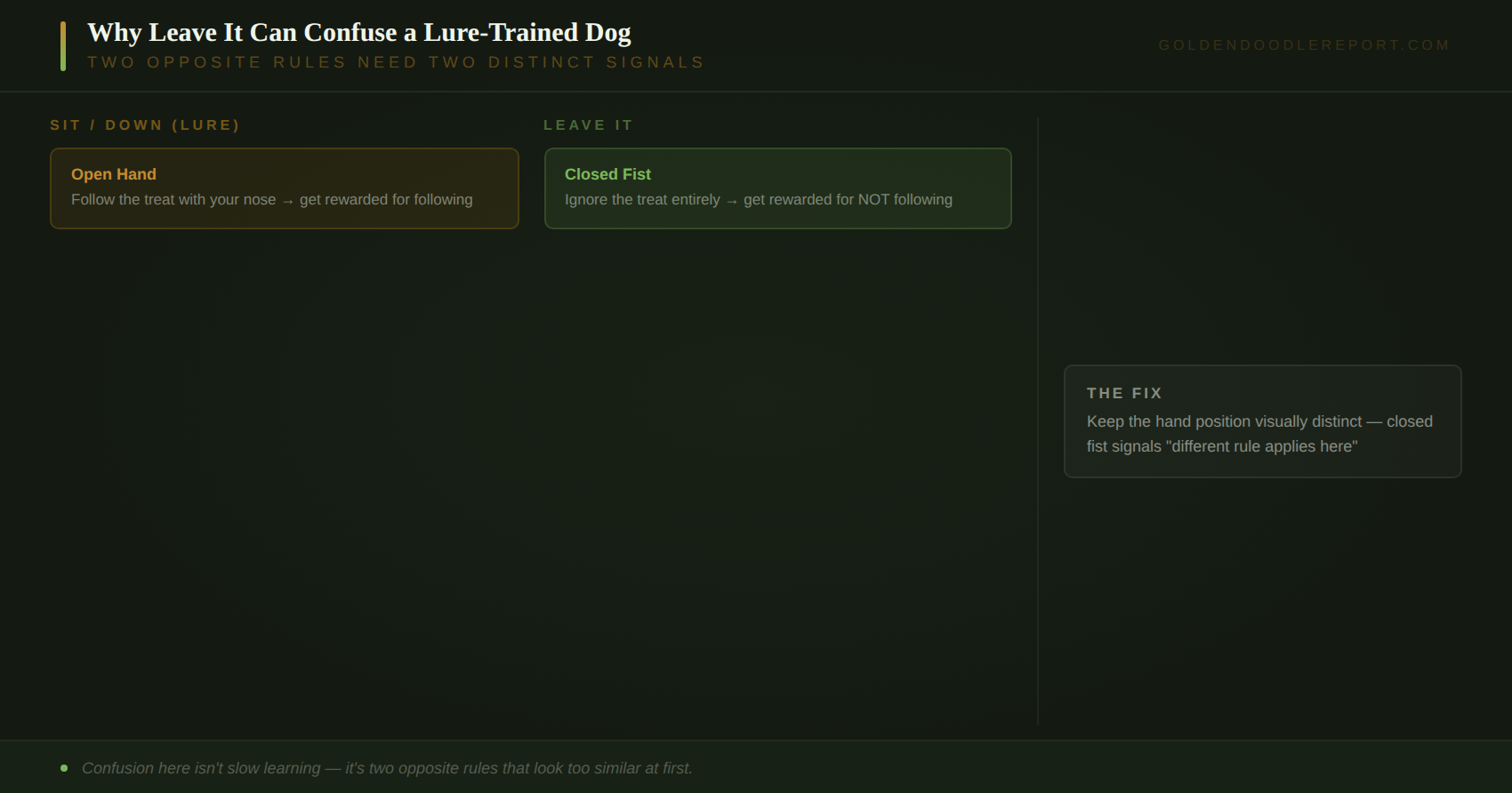
Leave it is the first command in a typical training sequence that requires the opposite response: ignoring the treat rather than following it. Dogs that have been thoroughly and successfully lure-trained on other commands can genuinely get confused when the rules suddenly reverse, sometimes hesitating, pawing at the closed fist, or looking back and forth between your hand and your face as if trying to figure out which rule applies.
The fix is straightforward: make the leave it training context visually and physically distinct from your lure training context. A closed fist, rather than an open palm with a visible treat, is a clear physical signal that this is a different kind of exercise. If your dog still seems confused after a few sessions, it isn’t a sign of slow learning — it’s a sign the two contexts still look too similar, and worth exaggerating the difference further (a different hand position, a different starting cue word, or training leave it in a different location than where lure commands were taught).
The “Take It” Companion Cue
Most leave it guides teach the command in isolation, but pairing it with a “take it” cue genuinely strengthens the whole concept. “Take it” means permission granted — your dog may now have the thing. Teaching both together helps your dog understand that leave it isn’t a permanent denial, it’s a temporary hold pending your decision.
Practically, this means every leave it repetition should eventually end with either “take it” (if the item is safe and you want to release it to your dog) or a reward from your other hand (if the item stays off-limits). This distinction matters most for genuinely food-motivated, food-focused dogs — which describes most Goldendoodles — since it gives them a clear, learnable rule rather than an arbitrary-feeling restriction.
Leave It vs. Drop It — Do You Need Both?
These are related but genuinely distinct commands, and yes, most trainers recommend teaching both. “Leave it” means don’t approach or pick up something — used before your dog has the item. “Drop it” means release whatever is already in your dog’s mouth — used after the fact, when leave it wasn’t given in time or wasn’t heeded. A dedicated Drop It training guide is coming soon in this category, covering that command specifically.
💡 What This Guide Adds That Most Others Don’t
Nearly every leave it guide, including the Goldendoodle-specific resources found in research for this piece, teaches the closed-fist method well but stops there. This guide adds the lure-training confusion most relevant to readers who’ve already learned sit and down via lure method on this site, the “take it” companion cue that clarifies leave it as temporary rather than absolute, and the counterintuitive reason saving this cue only for emergencies actually weakens it, covered next.
Why Saving This Cue Only for Emergencies Backfires
It’s tempting to think of leave it as an emergency-only command — something you save for genuinely dangerous situations rather than “wasting” on everyday moments. This instinct is backwards. A cue that only ever shows up during high-stakes, high-pressure moments gets far less practice than one used regularly in low-stakes situations, and dogs — like anyone — perform less reliably on a skill they rarely practice, especially when it’s only ever tested under pressure.
The more useful approach is the opposite: use leave it constantly, in genuinely low-pressure everyday moments — a dropped piece of kibble, an uninteresting toy on the floor, a boring household item. This builds a dog that’s genuinely fluent in the behavior, which is exactly what you want available in the rare moment it actually matters for safety.
What Most People Get Wrong
- Using a reward that’s lower value than the distraction — asking your dog to leave a squirrel for a plain dry biscuit sets the exercise up to fail; match reward value to the difficulty of what’s being asked
- Giving the cue too late — impulse control gets significantly harder once a dog is already fixated on something; cue as early as possible
- Only practicing in emergencies — as covered above, this makes the cue less reliable, not more
- Using an open hand for both lure commands and leave it — this is the source of the genuine confusion covered above; keep leave it visually and physically distinct
- Rewarding with the exact item that was left — this can teach a dog that “leaving” something is just a longer path to still getting it, rather than genuinely reinforcing self-control
✔️ Action Plan — Your First Training Week
- Start with the closed-fist exercise, using a low-value treat and a higher-value reward from your other hand
- Keep sessions short and don’t rush to the verbal cue until the closed-fist version is reliable
- Progress to an open palm, then the floor, once each stage is solid
- Introduce “take it” alongside leave it so your dog understands the distinction between temporary and permanent restriction
- Begin practicing in everyday low-stakes moments, not just formal sessions, to build genuine fluency
⏱️ What to Expect
Most Goldendoodles grasp the basic closed-fist concept within a handful of sessions, often within the first day or two. Progressing to an open palm and floor-level items typically takes another week of short, consistent practice. Full reliability around genuinely tempting real-world distractions — food on the sidewalk, a squirrel, another dog’s toy — is a longer-term skill, often taking several weeks of varied practice across different locations and distraction levels, similar to the timelines covered in our Stay and Recall guides.
✅ Your Next Step
Drop It is the natural companion command to learn next, covering what to do once something is already in your dog’s mouth rather than before — a dedicated guide is coming soon in this category. Together, Leave It and Drop It cover both sides of the same safety-relevant skill set.
🔑 Key Takeaways
- Start with a closed fist, wait for your dog to disengage, and reward from your other hand — never the item they tried to get
- Dogs trained via the lure method on other commands can genuinely get confused when leave it asks for the opposite response — keep the training context visually distinct
- Pair leave it with “take it” so your dog understands the restriction is temporary and conditional, not absolute
- Leave it and drop it are related but distinct — leave it applies before your dog has the item, drop it after
- Practicing leave it constantly in low-stakes situations makes it more reliable in genuine emergencies, not less
- Match the reward value to the difficulty of the distraction — a boring treat won’t beat a squirrel
📚 More Goldendoodle Training & Behavior Guides
- Teach a Goldendoodle to Sit: The Exact Method That Actually Works
- Teach a Goldendoodle to Stay: The Real Method That Actually Sticks
- Teach a Goldendoodle to Come: The Proven Recall That’s Actually Reliable
- Teach a Goldendoodle to Lie Down: The Exact Method That Keeps Them Calm
- How to Teach a Goldendoodle Drop It — coming soon
- Goldendoodle Training Guide (complete pillar) — coming soon
Browse all guides: Goldendoodle Training & Behavior category
🔗 Related Guides Across the Site
- Goldendoodle Treats Guide — finding genuinely high-value rewards for difficult exercises like this one
- Can Goldendoodles Eat Chicken? — one example of the food-safety questions leave it training helps prevent
Frequently Asked Questions
How do I teach a Goldendoodle to leave it?
Hold a low-value treat in your closed fist and let your dog sniff or paw at it without opening your hand. The instant they stop trying and disengage, mark the moment and reward from your other hand with a higher-value treat. Once reliable, add the verbal cue, then progress to an open palm, then the floor, gradually building distance and real-world distractions.
Why does my dog seem confused by leave it when they know sit and down well?
This can happen if sit and down were taught using the lure method, which trains a dog to follow a treat with their nose. Leave it asks for the opposite response — ignoring the treat — which can genuinely confuse a dog used to the follow-the-treat pattern. Using a closed fist rather than an open palm, visually distinct from lure training, usually resolves this within a few sessions.
What’s the difference between leave it and drop it?
“Leave it” means don’t approach or pick up an item — used before your dog has it. “Drop it” means release something already in the mouth — used after the fact. Both are useful and most trainers recommend teaching each separately, since they apply to different moments.
Should I save “leave it” only for emergencies?
No — this is a common but backwards instinct. A cue only practiced under high-pressure, rare situations gets far less overall practice and tends to become less reliable, not more. Using leave it regularly in everyday, low-stakes moments builds genuine fluency, which is exactly what you want available in the rare moment it actually matters.
Why won’t my Goldendoodle leave something alone even after training?
Check whether the reward you’re offering is actually higher value than what you’re asking them to leave — a plain treat won’t compete with a squirrel or exciting food. Also confirm the command has been proofed outside the house; a leave it that only works at home hasn’t been tested against real distractions yet.
Disclaimer: The information in this article is provided for general educational purposes only. King James Adjei is a researcher and enthusiast, not a professional dog trainer or veterinarian. If your dog has ingested something potentially toxic or dangerous, contact your veterinarian or an emergency animal poison control service immediately rather than relying on training. Training methods should always be force-free and adjusted to your individual dog’s comfort and pace.