Affiliate Disclosure: Some links in this guide are affiliate links. If you purchase through them, we may earn a small commission at no extra cost to you. Read our full affiliate disclaimer here.
By King James Adjei — Researcher and Goldendoodle enthusiast, founder of GoldendoodleReport.com. Every guide on this site is carefully researched and written to give owners reliable, clearly organised information — updated regularly and honest about uncertainty. → About this site
📖 7-minute read | Last updated April 2026 | Reviewed for accuracy
Preventing ear infections in Doodles is achievable for most owners who understand all the contributing factors and address them consistently. The challenge is that ear infection prevention is not a single habit — it is a system of several habits working together. Missing any one of them consistently creates a gap that infections develop from. This guide consolidates every prevention factor into one complete protocol so owners can establish the full system rather than addressing only the most commonly mentioned elements.
👤 Who This Guide Is For
- Your Doodle has had one or more ear infections and you want the complete prevention protocol
- You are a new owner wanting to establish the right habits before ear infections become a problem
- You have addressed some prevention factors but infections are still recurring
- You want a single reference that covers every prevention factor in one place
⚡ Quick Summary
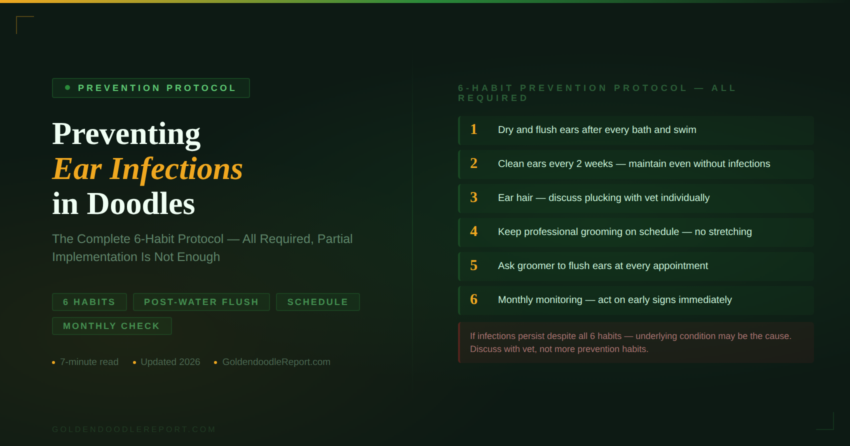
Preventing ear infections in Doodles requires six consistent habits: drying the ear canal after every water exposure, regular scheduled ear cleaning, appropriate ear hair management, maintaining the grooming schedule, monitoring and acting on early signs, and discussing susceptibility with your vet if infections recur despite all prevention habits. Every single one of these is required — partial implementation reduces frequency but rarely eliminates infections completely in susceptible dogs.
✅ Complete Prevention Protocol — All Six Habits
- Dry and flush the ears after every bath and every swim — no exceptions
- Clean ears on schedule — every 2 weeks for infection-prone dogs
- Manage ear hair — discuss plucking with your vet based on your dog’s specific history
- Keep professional grooming appointments on schedule — do not stretch intervals
- Ask your groomer to flush ears at every appointment as standard
- Monitor early warning signs monthly and act immediately — do not wait
For the ear cleaning protocol see Goldendoodle Ear Cleaning Guide. For the grooming-infection connection see Goldendoodle Ear Infections and Grooming.
Why Doodles Are Especially Prone to Ear Infections
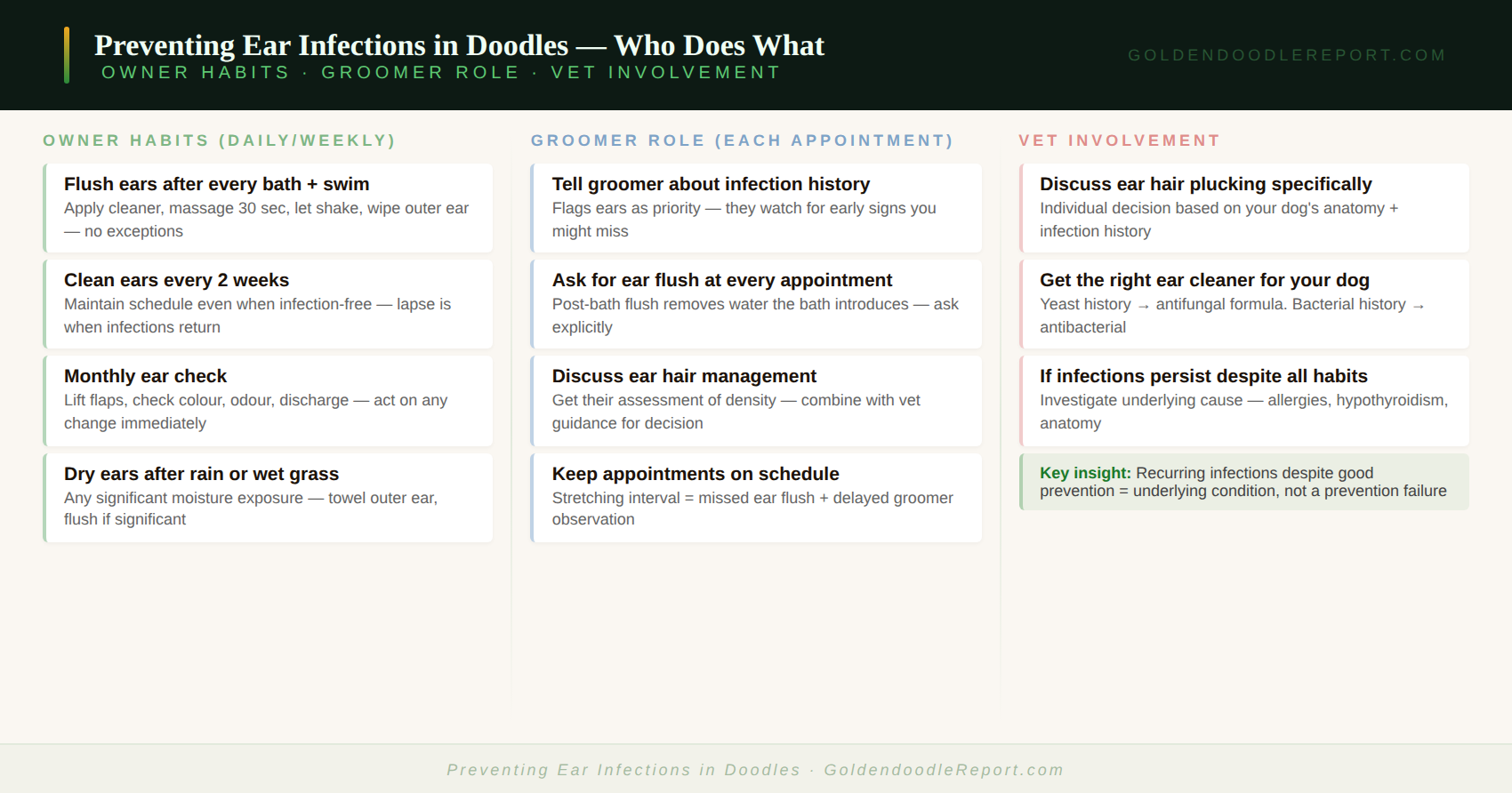
The Doodle ear infection problem is anatomical. Floppy ear flaps seal the ear canal, creating a warm, moist, low-oxygen environment. Combined with the ear hair that many Doodles inherit from the Poodle parent — which reduces airflow further and traps debris — the result is an ear environment that is consistently close to the conditions bacterial and yeast infections require to establish. A Doodle whose owner does everything right will still have naturally higher infection risk than a breed with upright ears and no ear hair. The goal of prevention is not to eliminate the biological susceptibility — it is to manage the environmental factors enough to keep infections from developing in a canal that is always one missed step from the optimal infection conditions.
The Six Prevention Habits — Complete Protocol
Habit 1 — Dry and flush after every water exposure
This is the most important single prevention habit and the one most consistently associated with reduced infection frequency in susceptible dogs. Every bath and every swim introduces water into the ear canal. The water does not need to be in large volume to create a problem — residual moisture after a bath is enough to tip the ear environment toward infection conditions in a dog that is already close to that threshold.
The correct protocol: immediately after bathing or swimming, towel-dry the outer ear thoroughly. Then apply vet-approved ear cleaner to the ear canal opening and massage the ear base for 30 seconds. Allow the dog to shake. Wipe the outer ear with a cotton ball. The ear cleaner contains drying agents that remove residual moisture from the canal that the towel cannot reach. This single post-water step prevents more ear infections than any other single intervention available. For the complete technique see Goldendoodle Ear Cleaning Guide.
Habit 2 — Regular scheduled ear cleaning
For dogs with a history of ear infections: every 2 weeks without exception. For dogs without an infection history: every 3 to 4 weeks. The schedule must be maintained even when the dog has had no recent infections — this is precisely the period when owners tend to let the schedule lapse, and the lapse is what allows the accumulation to reach the level at which infections develop.
Use a vet-recommended ear cleaner formulated for your dog’s specific infection history. Dogs with a yeast infection history benefit from formulations containing antifungal agents. Dogs with a bacterial infection history benefit from antibacterial formulations. Discuss the most appropriate product with your vet — a generic ear cleaner from a pet store is better than nothing but may not be optimally targeted for your dog’s specific susceptibility.
Habit 3 — Ear hair management
Whether to pluck ear hair is a genuine debate in veterinary circles and does not have a universal answer. The assessment that matters is your specific dog’s ear anatomy, hair density, and infection history — assessed by your veterinarian. Some dogs have minimal ear hair and plucking is irrelevant. Some dogs have very dense ear hair that demonstrably traps moisture and debris, and plucking improves outcomes. Some dogs develop micro-trauma from plucking that increases their infection risk. The individual assessment is what guides the decision — not general advice either way.
The practical recommendation: at your dog’s next vet visit, specifically ask about ear hair management for your dog’s ears. Show the vet the ear hair density, describe the infection history, and make the decision collaboratively based on that specific assessment.
Habit 4 — Keep professional grooming appointments on schedule
Stretching professional grooming intervals is a consistent contributor to ear infection frequency in groomed breeds. Professional grooming involves a bath — which introduces moisture — followed (ideally) by ear drying and flushing. When grooming appointments are delayed, the bath still happens eventually but the interval between cleanings has stretched. More importantly, the groomer is a trained second set of eyes on the ears at every appointment. Early signs of developing infection — slight redness, minimal discharge, very early odour — are often noticed by groomers before owners recognise them.
For correct grooming intervals see How Often to Groom a Goldendoodle. For the grooming schedule that builds in ear care see Goldendoodle Grooming Schedule.
Habit 5 — Ask your groomer to flush ears at every appointment
Not all groomers flush ears as standard practice. For a dog with a history of ear infections, explicitly requesting this at every booking takes ten seconds and provides meaningful ongoing protection. Tell the groomer your dog’s ear infection history and ask them to flush the ear canal with ear cleaner after the bath as part of the appointment. Most groomers are happy to do this — they simply need to be asked.
Habit 6 — Monthly monitoring and early action
Lift both ear flaps and check the ears at least once a month outside of cleaning sessions. You are looking for the early warning signs: slight increase in odour beyond the dog’s normal baseline, very early reddening of the inner ear skin, or a small change in the colour or quantity of visible wax. Catching an infection at the earliest possible stage means treatment is faster, simpler, and less expensive. An infection caught at day 3 responds to a short treatment course. An infection that has been developing for 3 weeks requires a more intensive intervention.
The key behaviour change: act immediately on early signs. Book the vet appointment the same day you notice something different. Do not wait to see if it resolves — ear infections do not resolve on their own.
When Prevention Is Not Enough — Underlying Susceptibility
Some Doodles develop ear infections despite consistent application of every prevention habit. If this describes your dog — infections recurring every 2 to 3 months despite thorough prevention — the cause is likely an underlying condition that requires veterinary investigation rather than further prevention habit improvement.
Conditions that cause persistent ear infections despite good prevention include allergies (food or environmental) that cause chronic inflammation in the ear canal, hypothyroidism (which affects immune response and skin health), or anatomical factors that make certain dogs simply more susceptible than average. A vet consultation specifically focused on recurrent ear infections — not just treatment of the current infection — may involve allergy testing, thyroid assessment, or referral to a veterinary dermatologist.
For authoritative guidance on dog ear health see the AVMA pet care resources.
✅ Your Next Step
Review the six habits above and identify which ones are not currently consistent in your routine. Post-water flushing is the most commonly missing habit and the highest-impact single change. If all six are already in place and infections still recur, book a vet appointment specifically to discuss whether an underlying condition may be driving the susceptibility — not just to treat the current infection. For the complete grooming guide see Goldendoodle Grooming Guide.
🔑 Key Takeaways
- Preventing ear infections in Doodles requires all six habits working together — partial implementation reduces frequency but rarely eliminates infections in susceptible dogs
- Post-water ear flushing is the single highest-impact prevention habit — every bath and every swim must be followed by ear cleaner application
- Ear cleaning every 2 weeks must be maintained even when infections are absent — the absence of infections is the result of the routine, not a sign the routine is no longer needed
- Ear hair management is individual — discuss with your vet based on your dog’s specific anatomy and history, not as a universal practice
- Ask your groomer explicitly to flush ears at every appointment — most will do it when asked
- If infections persist despite all six habits, an underlying condition may be the cause — discuss with your vet rather than continuing to improve prevention habits that are already complete
📚 Continue Learning
- Goldendoodle Grooming Guide — complete grooming authority guide
- Goldendoodle Ear Cleaning Guide — the correct cleaning technique and frequency
- Goldendoodle Ear Infections and Grooming — why most infections are grooming-preventable
- How Often to Groom a Goldendoodle — grooming interval guidance
- Goldendoodle Grooming Schedule — building ear care into the routine
- → Best Ear Cleaner for Goldendoodles — coming soon
↑ Back to: Goldendoodle Grooming Guide | Goldendoodle Grooming — All Articles
Frequently Asked Questions
How do I prevent ear infections in my Goldendoodle?
Preventing ear infections in Doodles requires six consistent habits: flush the ears with vet-approved ear cleaner after every bath and swim, clean ears on schedule every 2 to 4 weeks, manage ear hair based on your vet’s guidance for your specific dog, keep professional grooming appointments on schedule, ask your groomer to flush ears at every appointment, and monitor the ears monthly for early warning signs. All six habits must be maintained consistently — the most common reason prevention fails is that one habit lapses while the others continue.
How often should I clean my Doodle’s ears to prevent infections?
Every 2 weeks for dogs with a history of ear infections. Every 3 to 4 weeks for dogs with consistently healthy ears. Post-bath and post-swim cleaning is required regardless of the routine schedule — these are additional sessions triggered by water exposure, not substitutes for the regular schedule. The schedule must be maintained even during infection-free periods — the absence of infections is a consequence of the routine, not a sign it can be relaxed.
Does swimming cause ear infections in Doodles?
Swimming is a significant ear infection trigger in susceptible Doodles because it introduces substantial water into the ear canal. It does not cause infections directly — it creates the moisture environment that allows infections to develop. The prevention is straightforward: dry the outer ear immediately after swimming and flush with ear cleaner at the earliest opportunity. Doodles who swim frequently — multiple times per week — benefit from ear flushing after every swim session.
Should I pluck my Doodle’s ear hair to prevent infections?
This is genuinely debated and does not have a universal answer. Plucking can improve airflow and reduce debris trapping in dogs with very dense ear hair — but it can also cause micro-trauma in the ear canal that increases infection risk in susceptible dogs. The correct approach is to discuss your specific dog’s ear anatomy, hair density, and infection history with your veterinarian and make the decision based on that individual assessment rather than applying a blanket practice either way.
Disclaimer: The information in this article is provided for general educational purposes only. King James Adjei is a researcher and enthusiast, not a veterinarian. For ear infection treatment or persistent recurrence despite prevention habits, always consult a qualified veterinarian.