Affiliate Disclosure: Some links in this guide are affiliate links. If you purchase through them, we may earn a small commission at no extra cost to you. Read our full affiliate disclaimer here.
By King James Adjei — Researcher and Goldendoodle enthusiast, founder of GoldendoodleReport.com. Every guide on this site is carefully researched and written to give owners reliable, clearly organised information — updated regularly and honest about uncertainty. → About this site
📖 7-minute read | Last updated April 2026 | Reviewed for accuracy
Goldendoodle ear infections are among the most common health problems in the breed — and the majority of them are directly connected to grooming decisions that owners and groomers make. This is not widely understood. Most owners treat ear infections as a medical problem to be resolved at the vet and then repeat the grooming habits that caused or contributed to the infection. Understanding the specific grooming factors that drive Goldendoodle ear infections — and what to change — breaks the cycle far more effectively than repeated vet visits alone.
👤 Who This Guide Is For
- Your Goldendoodle has had one or more ear infections and you want to understand the grooming connection
- You want to know what changes to your grooming routine would reduce infection risk
- You want to understand what professional groomers do about ear hair and whether it affects infection risk
- You are trying to break a cycle of recurring ear infections
⚡ Quick Summary
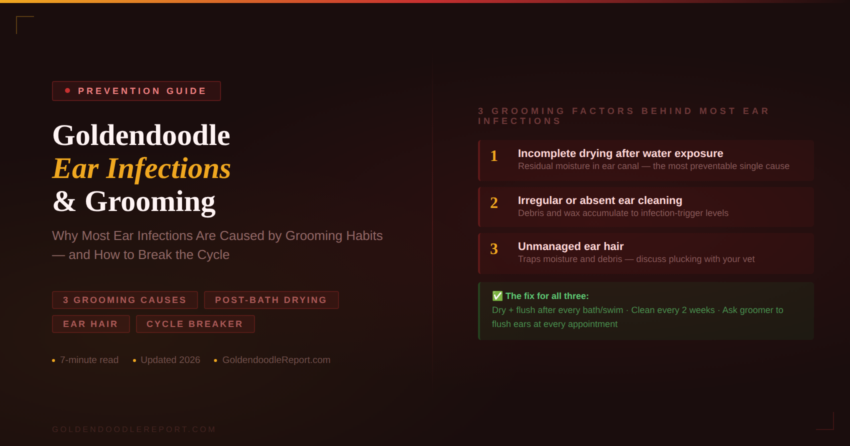
The three grooming factors most responsible for Goldendoodle ear infections are: incomplete drying after baths and swimming, irregular ear cleaning, and insufficient ear hair management. Moisture in the ear canal that is not removed promptly creates the environment infections need to develop. Changing these three grooming habits — drying thoroughly after every water exposure, cleaning ears on schedule, and managing ear hair appropriately — prevents most recurrent ear infections in Goldendoodles without requiring any change in veterinary treatment.
For the ear cleaning protocol see Goldendoodle Ear Cleaning Guide. For the complete grooming overview see Goldendoodle Grooming Guide.
Why Goldendoodles Are So Prone to Ear Infections
The Goldendoodle’s susceptibility to ear infections comes from anatomy inherited from the Poodle parent. The floppy ear flap creates a sealed, warm, moist environment inside the ear canal with minimal air circulation. This environment is ideal for the bacteria and yeast that cause the two most common Goldendoodle ear infection types — bacterial otitis externa and yeast (Malassezia) otitis. Both types thrive in warm, moist, low-oxygen environments and both are direct consequences of the Goldendoodle’s ear anatomy combined with grooming habits that allow moisture to persist.
The additional factor is ear hair. Goldendoodles — particularly those with more Poodle genetics — grow significant amounts of hair inside and around the ear canal. This hair traps additional moisture, reduces airflow further, and provides a substrate for debris and wax accumulation. The combination of floppy ear flap, warm moist canal, and hair-filled opening creates what is genuinely the most infection-prone ear environment of any popular breed.
The Three Grooming Factors That Drive Ear Infections
Factor 1 — Incomplete drying after water exposure
This is the single most preventable grooming cause of Goldendoodle ear infections. Every time a Goldendoodle is bathed or swims, water enters the ear canal. Left in place, this water creates the optimal infection environment — warm, moist, dark, and sealed by the ear flap. The water does not need to be in large amounts to create a problem. Residual moisture from a bath that the owner believes was adequately dried is frequently enough to trigger an infection in a susceptible dog.
The correct post-water protocol: dry the outer ear thoroughly with a towel immediately after any water exposure. For baths, follow with an ear cleaner flush — the cleaner has a drying agent that removes residual moisture the towel cannot reach. For swimming, dry the outer ear with a towel at the earliest opportunity and flush with ear cleaner as soon as practical. See Goldendoodle Ear Cleaning Guide for the correct flush technique.
Factor 2 — Irregular or absent ear cleaning
Regular ear cleaning removes the wax, debris, and moisture that accumulate in the ear canal between baths and outdoor activity. In a dog with healthy ears, this is a maintenance routine. In a dog with a history of ear infections, it is a critical intervention that removes the substrate infections develop from.
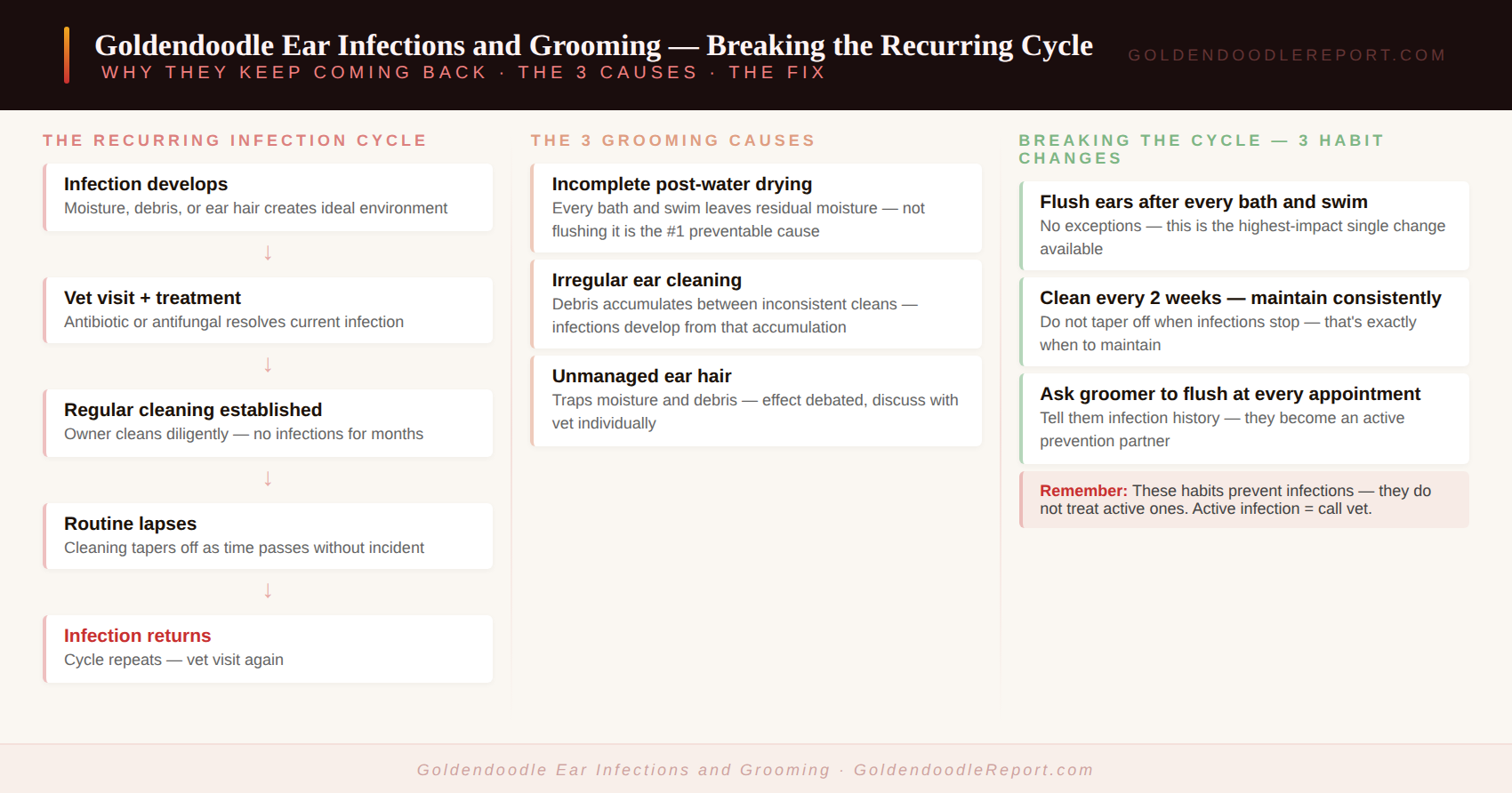
Many owners establish a cleaning routine after an ear infection and then gradually let it lapse as the months pass without incident. The pattern that results is predictable: regular cleaning → no infections → cleaning tapers off → infection returns → vet visit → regular cleaning → no infections → cleaning tapers off → infection returns. The routine must be maintained consistently to prevent the recurrence pattern.
Factor 3 — Ear hair management
Ear hair management is the most debated grooming factor in Goldendoodle ear health. The practical question is whether to pluck hair from inside the ear canal, and the honest answer is that professional opinion is divided.
The argument for plucking: removing hair from the ear canal improves airflow and reduces the debris trap that the hair creates. Groomers who advocate plucking argue it reduces infection risk.
The argument against plucking: the plucking process creates micro-trauma in the ear canal — small tears in the delicate skin — that can actually increase infection risk in some dogs. Veterinary dermatologists have become increasingly sceptical of routine plucking for this reason.
The most defensible current position is: discuss ear hair management with your veterinarian specifically, who can assess whether your dog’s ear anatomy, infection history, and current ear hair density suggest plucking is beneficial or counterproductive. Do not assume either way — the individual dog’s history and anatomy should guide the decision.
Grooming Habits That Break the Infection Cycle
For Goldendoodles with recurring ear infections, three grooming habit changes have the most significant impact on infection frequency:
Consistent post-water ear care. Every bath and every swim must be followed by drying and ear cleaner application. No exceptions. This is the habit most consistently correlated with reduced infection frequency in dogs with a history of recurrent infections. Missing a single post-swim ear flush is not catastrophic — the pattern of consistently missing it is what allows infections to develop.
Regular scheduled cleaning. Booking ear cleaning into the regular grooming schedule — every 2 weeks for infection-prone dogs — removes the accumulation before it reaches the level at which infections develop. Use a vet-recommended ear cleaner rather than a general pet store product. Discuss the appropriate cleaner for your dog’s specific infection history with your vet — dogs with yeast infection history benefit from different formulations than dogs with bacterial infection history.
Drying the ear canal area after grooming appointments. Professional grooming involves significant water exposure during bathing. Ask your groomer to flush the ears with ear cleaner and dry the ear canal area thoroughly as part of the grooming appointment. Many groomers do this as standard practice; some do not. A short conversation when booking the appointment ensures this step is included.
Working With Your Groomer on Ear Health
Your professional groomer is a key partner in Goldendoodle ear health. They see the ears at each appointment and can provide early warning of developing problems. Three conversations with your groomer significantly improve ear health outcomes for infection-prone dogs:
Tell them your dog has a history of ear infections. This flags the ears as a priority area at every appointment. A groomer who knows about ear infection history will examine the ears more carefully and flag any early signs they notice.
Ask them to flush the ears at every appointment. Post-bath ear cleaning during the grooming appointment removes the moisture that the bath introduces. This is one of the highest-value single interventions available at the professional level.
Discuss ear hair with them and with your vet. Get their view on your specific dog’s ear hair density and whether they recommend plucking. Then discuss the same question with your vet. Make the decision based on both perspectives and the specific infection history.
For authoritative guidance on dog ear infections see the AVMA pet care resources.
🩺 Important — Grooming Cannot Treat an Active Infection
The grooming habits described in this guide prevent ear infections — they do not treat them. If your Goldendoodle currently has signs of an ear infection (strong odour, dark discharge, redness, scratching, head shaking, head tilting), contact your veterinarian for diagnosis and appropriate treatment. Do not clean an infected ear — cleaning an active infection causes pain and may worsen the condition. Grooming habit changes are prevention tools, not treatments.
✅ Your Next Step
Review the three grooming factors above and identify which ones apply to your current routine. If post-water ear drying is inconsistent, make it non-negotiable. If ear cleaning has lapsed, re-establish the schedule. If ear hair has never been discussed with your vet or groomer, have that conversation at the next appointment. For the complete grooming guide see Goldendoodle Grooming Guide.
🔑 Key Takeaways
- The majority of Goldendoodle ear infections are directly connected to preventable grooming habits — primarily incomplete drying after water exposure, irregular cleaning, and unmanaged ear hair
- The single most preventable cause is residual moisture after bathing and swimming — every water exposure must be followed by outer ear drying and ear cleaner application
- Regular scheduled ear cleaning every 2 weeks removes the substrate infections develop from before accumulation reaches the critical level
- Ear hair plucking is debated — discuss with your vet based on your specific dog’s ear anatomy and infection history, not as a blanket practice
- Tell your groomer about your dog’s ear infection history — ask them to flush the ears at every appointment as a standard step
- Grooming changes prevent infections — they do not treat active ones. Current infection symptoms require veterinary diagnosis and treatment
📚 Continue Learning
- Goldendoodle Grooming Guide — complete grooming authority guide
- Goldendoodle Ear Cleaning Guide — the correct home cleaning protocol
- How to Bathe a Goldendoodle — post-bath ear care protocol
- How to Dry a Goldendoodle Coat — thorough drying reduces infection risk
- Goldendoodle Grooming Schedule — building ear cleaning into the routine
- 👉 Preventing Ear Infections in Doodles — coming soon
- 👉 Best Ear Cleaner for Goldendoodles — coming soon
↑ Back to: Goldendoodle Grooming Guide | Goldendoodle Grooming — All Articles
Frequently Asked Questions
Why does my Goldendoodle keep getting ear infections?
Recurring ear infections in Goldendoodles are almost always connected to one or more grooming habits: incomplete drying after baths or swimming that leaves residual moisture in the ear canal; irregular ear cleaning that allows wax and debris to accumulate; or unmanaged ear hair that traps additional moisture and debris. Identifying which of these applies to your routine and changing it consistently reduces infection frequency significantly. If infections persist after addressing all three factors, discuss with your vet whether there is an underlying skin or immune condition contributing.
How does bathing cause Goldendoodle ear infections?
Water enters the ear canal during bathing regardless of how carefully the owner tries to prevent it. Left in place, this water creates the warm, moist, low-oxygen environment that bacterial and yeast infections thrive in. The infection does not develop from the bath itself — it develops from the residual moisture that persists after the bath because the ear was not properly dried and flushed. Drying the outer ear and applying ear cleaner (which contains a drying agent) after every bath removes this moisture before infections can establish.
Should my groomer pluck my Goldendoodle’s ear hair?
This is a genuinely debated question in veterinary and grooming circles. Plucking can improve airflow and reduce debris accumulation — but it also creates micro-trauma in the ear canal that some veterinary dermatologists believe increases infection risk in susceptible dogs. The most defensible approach is to discuss it specifically with your veterinarian based on your dog’s ear anatomy, hair density, and infection history, rather than adopting either plucking or non-plucking as a blanket policy. Individual assessment produces better outcomes than generalised advice.
What should I ask my groomer to do for my Goldendoodle’s ear health?
Tell them your dog has a history of ear infections. Ask them to flush the ears with ear cleaner as a standard step at every appointment — not all groomers do this automatically, and asking takes two seconds but provides significant ongoing benefit. Ask them to note any changes in the ears they observe during the appointment. Discuss ear hair management based on your vet’s guidance. A groomer who is informed about your dog’s ear health history is a significantly more valuable partner than one who is not.
Disclaimer: The information in this article is provided for general educational purposes only. King James Adjei is a researcher and enthusiast, not a veterinarian. For ear infection diagnosis, treatment, or concerns about recurring infections, always consult a qualified veterinarian. Do not attempt to treat suspected ear infections at home.