Affiliate Disclosure: Some links in this guide are affiliate links. If you purchase through them, we may earn a small commission at no extra cost to you. Read our full affiliate disclaimer here.
By King James Adjei — Researcher and Goldendoodle enthusiast, founder of GoldendoodleReport.com. Every guide on this site is carefully researched and written to give owners reliable, clearly organised information — updated regularly and honest about uncertainty. → About this site
📖 6-minute read | Last updated April 2026 | Reviewed for accuracy
Conditioner is not optional for a curly or wavy Goldendoodle coat — it is the step that makes every other part of the grooming process after a bath work correctly. Without it, shampooing leaves the coat in a higher-friction state than before the bath. With it, the coat emerges softer, more manageable, and significantly easier to brush and dry. This guide explains exactly what conditioner does to the coat, why the Goldendoodle coat needs it more than most, what to look for when buying, and how the two main conditioner types — rinse-out and leave-in — serve different purposes in the grooming routine.
👤 Who This Guide Is For
- You bathe your Goldendoodle at home and want to know which conditioner to buy and why
- You currently use shampoo without conditioner and want to understand what you are missing
- You want to understand the difference between rinse-out and leave-in conditioner for Goldendoodles
- You want to know what to look for in a conditioner formulation before buying
⚡ Quick Summary
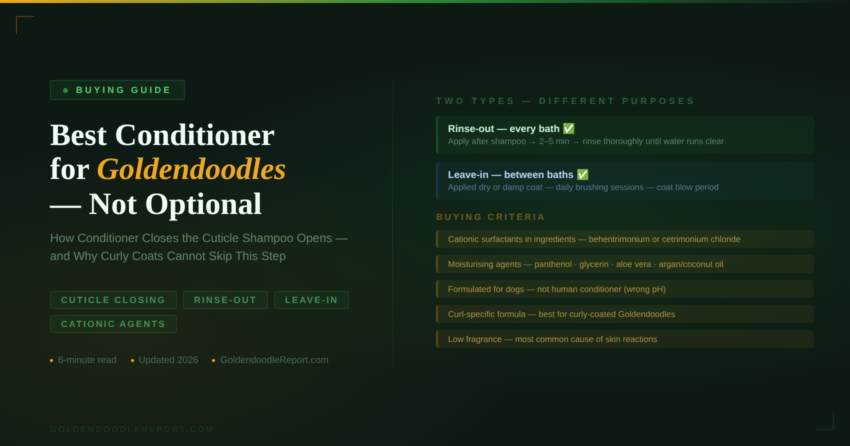
The best conditioner for a Goldendoodle is a moisturising, detangling rinse-out conditioner used after every bath — applied to the coat after shampooing, left on for 2 to 5 minutes, then rinsed thoroughly. For between-bath maintenance and daily brushing sessions on dense curly coats, a leave-in conditioner or detangling spray supplements the rinse-out. The conditioner closes the coat cuticle that shampoo opens — a coat with a closed cuticle is smooth, low-friction, and significantly easier to brush than one with an open cuticle. For curly-coated Goldendoodles, this is the single most impactful step in the bathing routine for post-bath coat manageability.
For the shampoo guide see Best Shampoo for Goldendoodles. For the bathing technique see How to Bathe a Goldendoodle. For the complete tools list see Goldendoodle Grooming Tools Checklist.
What Conditioner Does — The Cuticle Mechanism
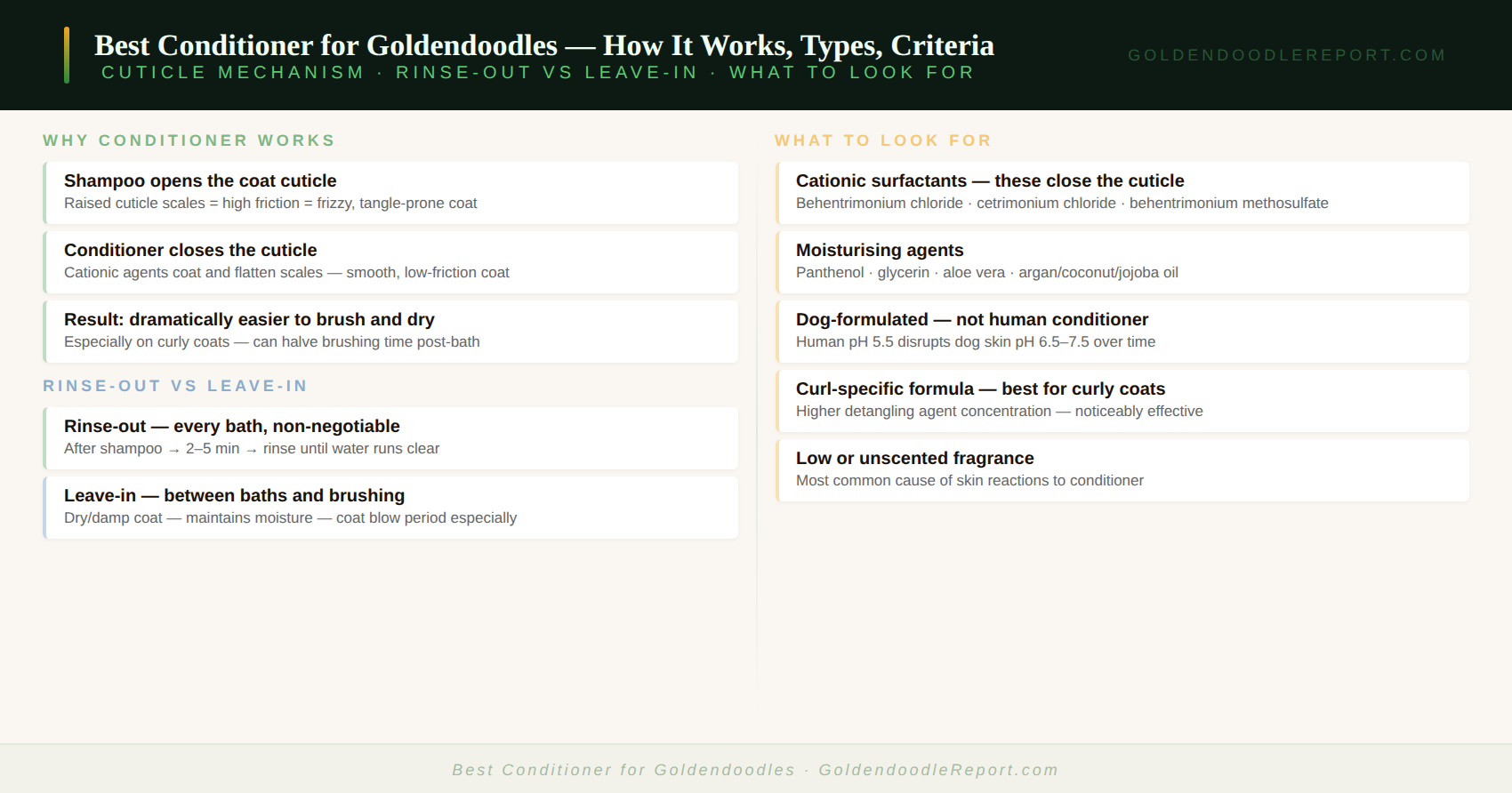
Each hair shaft in the Goldendoodle coat is surrounded by a cuticle — a layer of overlapping scales that, when lying flat, create a smooth, low-friction surface. Shampoo, by design, opens these cuticle scales to allow cleaning agents to penetrate the hair shaft and remove dirt and oil. This is how shampoo works. The problem is that a coat whose cuticles are open has high fibre-to-fibre friction — the raised scales catch against each other, making the coat frizzy, more prone to tangling, and harder to brush.
Conditioner closes the cuticle. The conditioning agents in a correctly formulated product — typically cationic surfactants like behentrimonium chloride or cetrimonium chloride — are attracted to the negatively charged open cuticle scales and coat them, causing the scales to lie flat. A coat with flat, closed cuticles has significantly lower friction, is noticeably smoother to the touch, and is dramatically easier to brush and force-dry than an unconditioned coat.
For a straight-coated Goldendoodle, this difference is real but moderate. For a curly-coated Goldendoodle — where the tight curl structure already creates significant fibre-to-fibre contact — the cuticle open/closed difference is dramatic. A curly coat shampooed without conditioning can take twice as long to brush as the same coat properly conditioned. The conditioner step is not a luxury for curly coats — it is infrastructure.
Rinse-Out vs Leave-In Conditioner — Different Tools for Different Purposes
Rinse-out conditioner — used at every bath
Rinse-out conditioner is applied after shampooing, worked through the coat from roots to tips, left for 2 to 5 minutes to allow the conditioning agents to bind to the cuticle, then rinsed thoroughly. This is the primary conditioning step — the one that closes the cuticle after shampooing and sets up the coat for force drying and brushing. Every Goldendoodle bath should include a rinse-out conditioner. There is no correct substitution for this step.
Thorough rinsing after the leave-in time is important — conditioner left in the coat can attract dirt, create buildup, and paradoxically make the coat harder to manage over subsequent days. Rinse until the water runs clear and the coat no longer feels slippery.
Leave-in conditioner — used between baths and during brushing
Leave-in conditioner or detangling spray is applied to the coat between baths — either during daily brushing sessions or when the coat has become dry or frizzy from outdoor exposure. Unlike rinse-out conditioner, leave-in products are formulated to remain in the coat and provide ongoing moisture and friction reduction without requiring rinsing. They are lighter formulations that do not build up with repeated use.
Leave-in conditioner is particularly useful during the coat blow transition — when the mixed puppy and adult coat creates maximum friction and tangle formation — and during dry weather periods when the coat loses moisture more quickly. See → Best Detangler Spray for Goldendoodles for the complete guide to between-bath coat conditioning products.
Best Conditioner for Goldendoodles — Buying Criteria
Detangling agents — the primary function for Goldendoodles
Look for conditioners with cationic surfactants — behentrimonium chloride, cetrimonium chloride, or behentrimonium methosulfate — in the ingredient list. These are the agents that physically flatten the cuticle and reduce friction. A conditioner without these agents may moisturise but will not produce the detangling effect that makes post-bath brushing manageable. “Detangling conditioner” descriptions are useful marketing signals but check the ingredient list to confirm cationic surfactants are present.
Moisturising agents — for long-term coat health
Beyond the cuticle-flattening function, good conditioners also contain humectants and emollients that improve long-term coat moisture and elasticity. Useful moisturising ingredients include: panthenol (Vitamin B5 — attracts and retains moisture), glycerin (humectant — draws moisture from the environment), aloe vera (soothing and hydrating), and natural oils such as argan, coconut, or jojoba oil (emollients that soften coat fibres). A conditioner that combines cationic surfactants with these moisturising agents produces both the immediate detangling benefit and long-term coat condition improvement.
Formulated for dogs — not human conditioner
The same pH reasoning that applies to shampoo applies to conditioner. Human hair conditioner is formulated for human skin and hair pH — using it on a Goldendoodle can cause skin irritation over time. Use conditioner specifically formulated for dogs. Professional grooming-grade dog conditioners are the most effective option, but quality retail dog conditioners work well for home bathing use.
Fragrance — low or unscented
Fragrance is the most common cause of skin reactions to conditioners as well as shampoos. Unscented or lightly fragranced formulas are the safer choice, particularly for dogs with sensitive skin or known product sensitivities.
Curl-specific formulas
As with shampoo, some manufacturers produce conditioners specifically formulated for curly or wavy coats. These typically have higher concentrations of detangling agents and moisturising ingredients than general dog conditioners. Worth seeking out for curly-coated Goldendoodles — not essential, but noticeably effective.
Application — Getting the Most from Conditioner
Apply rinse-out conditioner generously after fully rinsing out the shampoo. Work it through the coat from skin to tip — including the legs, ears, and tail — not just the body surface. Avoid the eye area. Leave for a full 2 to 5 minutes — shorter contact time produces less effective cuticle closure. Rinse very thoroughly until the water runs completely clear.
For particularly dense or long coats, a wide-tooth comb can be gently run through the coat during the leave-in time to help distribute the conditioner evenly through the base layer — the layer that matters most for mat prevention.
For authoritative guidance on dog grooming see the AKC dog grooming guide.
✅ Your Next Step
If you currently bathe your Goldendoodle without conditioner, add it at the next bath and compare the post-bath brushing and drying experience directly. The difference on a curly coat is immediately apparent — less friction, less frizz, significantly faster brushing. For the complete grooming guide see Goldendoodle Grooming Guide.
🔑 Key Takeaways
- Conditioner closes the coat cuticle that shampoo opens — a closed cuticle is smooth and low-friction; an open cuticle is frizzy and tangles faster
- For curly-coated Goldendoodles, conditioner is not optional — it is the step that makes post-bath brushing and drying manageable
- Rinse-out conditioner is used after every bath — leave on 2 to 5 minutes, then rinse thoroughly until water runs clear
- Leave-in conditioner supplements the rinse-out — used between baths and during brushing sessions to maintain moisture and reduce friction
- Look for cationic surfactants (behentrimonium chloride, cetrimonium chloride) in the ingredient list — these are the agents that actually flatten the cuticle
- Use dog-formulated conditioner only — human conditioner pH causes skin irritation over time regardless of how gentle the formula is by human standards
📚 Continue Learning
- Goldendoodle Grooming Guide — complete grooming authority guide
- Best Shampoo for Goldendoodles — the step that comes before conditioner
- How to Bathe a Goldendoodle — shampoo and conditioner in the full bathing sequence
- How to Dry a Goldendoodle Coat — the step after conditioner
- Best Detangler Spray for Goldendoodles — leave-in conditioning between baths
- Goldendoodle Grooming Tools Checklist — full kit overview
↑ Back to: Goldendoodle Grooming Tools Checklist | Goldendoodle Grooming Guide | Goldendoodle Grooming — All Articles
Frequently Asked Questions
What is the best conditioner for Goldendoodles?
A moisturising, detangling rinse-out conditioner formulated for dogs, with cationic surfactants (behentrimonium chloride or cetrimonium chloride) in the ingredient list. These are the agents that physically flatten the coat cuticle after shampooing, reducing friction and making post-bath brushing and drying significantly easier. Curl-specific dog conditioners produce the best results for curly-coated Goldendoodles. Always follow the rinse-out conditioner with thorough rinsing — leave-in conditioner buildup attracts dirt and makes the coat harder to manage over time.
Do Goldendoodles need conditioner after every bath?
Yes — particularly for curly and wavy coats. Shampoo opens the coat cuticle during cleaning. Conditioner closes it. A curly coat that is shampooed without conditioning has significantly higher friction, more frizz, and is dramatically harder to brush and dry than a conditioned coat. Skipping conditioner after bathing is one of the most common causes of post-bath tangling and frizz. It is not a skippable step for this coat type.
What is the difference between rinse-out and leave-in conditioner for Goldendoodles?
Rinse-out conditioner is used at every bath — applied after shampooing, left for 2 to 5 minutes, then rinsed thoroughly. It closes the cuticle that shampoo opened and sets up the coat for drying and brushing. Leave-in conditioner is used between baths — applied to a dry or damp coat to maintain moisture and reduce friction during daily brushing sessions. The two products are not interchangeable — rinse-out is heavier and will cause buildup if left in; leave-in is lighter and formulated to remain in the coat without rinsing.
Can I use human conditioner on my Goldendoodle?
No — human conditioner is formulated for human skin pH (approximately 5.5), while dog skin sits at 6.5 to 7.5. Using human conditioner disrupts the skin’s acid mantle over time, causing progressive irritation. This applies even to gentle, natural, or fragrance-free human conditioners — the pH mismatch exists regardless of the formula’s gentleness by human standards. Use conditioner specifically formulated for dogs.
Disclaimer: The information in this article is provided for general educational purposes only. King James Adjei is a researcher and enthusiast, not a veterinarian or certified groomer. Dogs with skin conditions should use veterinarian-recommended products — consult your vet before changing conditioner formulas if your dog has ongoing skin issues.