Affiliate Disclosure: Some links in this guide are affiliate links. If you purchase through them, we may earn a small commission at no extra cost to you. Read our full affiliate disclaimer here.
By King James Adjei — Researcher and Goldendoodle enthusiast, founder of GoldendoodleReport.com. Every guide on this site is carefully researched and written to give owners reliable, clearly organised information — updated regularly and honest about uncertainty. → About this site
📖 6-minute read | Last updated April 2026 | Reviewed for accuracy
Finding the best shampoo for Goldendoodles means looking past the marketing — it is a moisturising formulation specifically appropriate for a continuous-growing, dense coat that loses manageability when stripped of its natural oils. Most generic pet shampoos are formulated primarily for cleaning, with moisture retention as a secondary consideration. For a Goldendoodle coat — particularly curly types — this priority is reversed. A shampoo that cleans thoroughly but dries out the coat leaves a frizzy, high-friction coat that is significantly harder to brush, significantly more prone to tangling, and visibly duller than a coat washed with the correct formulation.
👤 Who This Guide Is For
- You bathe your Goldendoodle at home and want to know which shampoo is right for this coat type
- Your Goldendoodle’s coat is frizzy, dry, or harder to manage after bathing
- You want to understand what to look for in a shampoo formulation before buying
- You want to understand why human shampoo is not appropriate for Goldendoodle skin and coat
⚡ Quick Summary
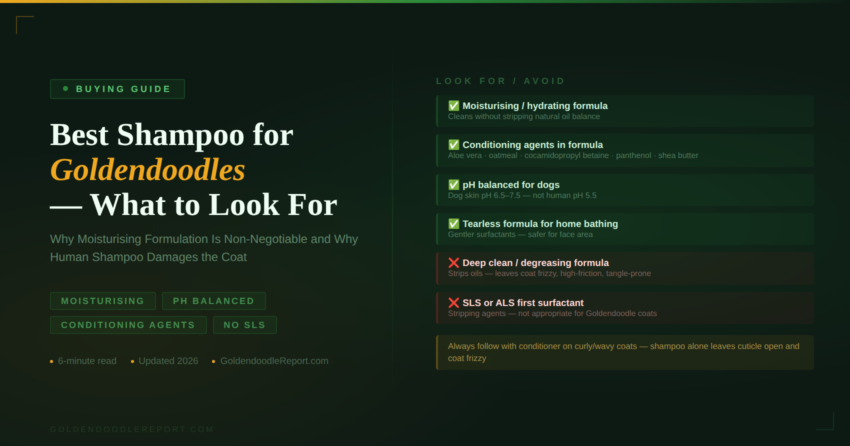
The best shampoo for a Goldendoodle is a moisturising, pH-balanced dog shampoo — one that cleans effectively without stripping the coat’s natural oils. For curly and wavy Goldendoodle coats, a shampoo with conditioning agents (such as aloe vera, oatmeal, or coconut-derived emollients) is the correct starting point. Tearless formulas are appropriate for dogs bathed regularly at home. Human shampoo is never appropriate — the pH difference causes skin irritation and coat damage over time. Shampoo should always be followed by conditioner for curly coats — shampoo alone on a curly coat leaves the coat dry, frizzy, and significantly harder to manage.
For the bathing technique see How to Bathe a Goldendoodle. For the conditioner guide see Best Conditioner for Goldendoodles. For the complete tools list see Goldendoodle Grooming Tools Checklist.
Best Shampoo for Goldendoodles — Why Formulation Matters
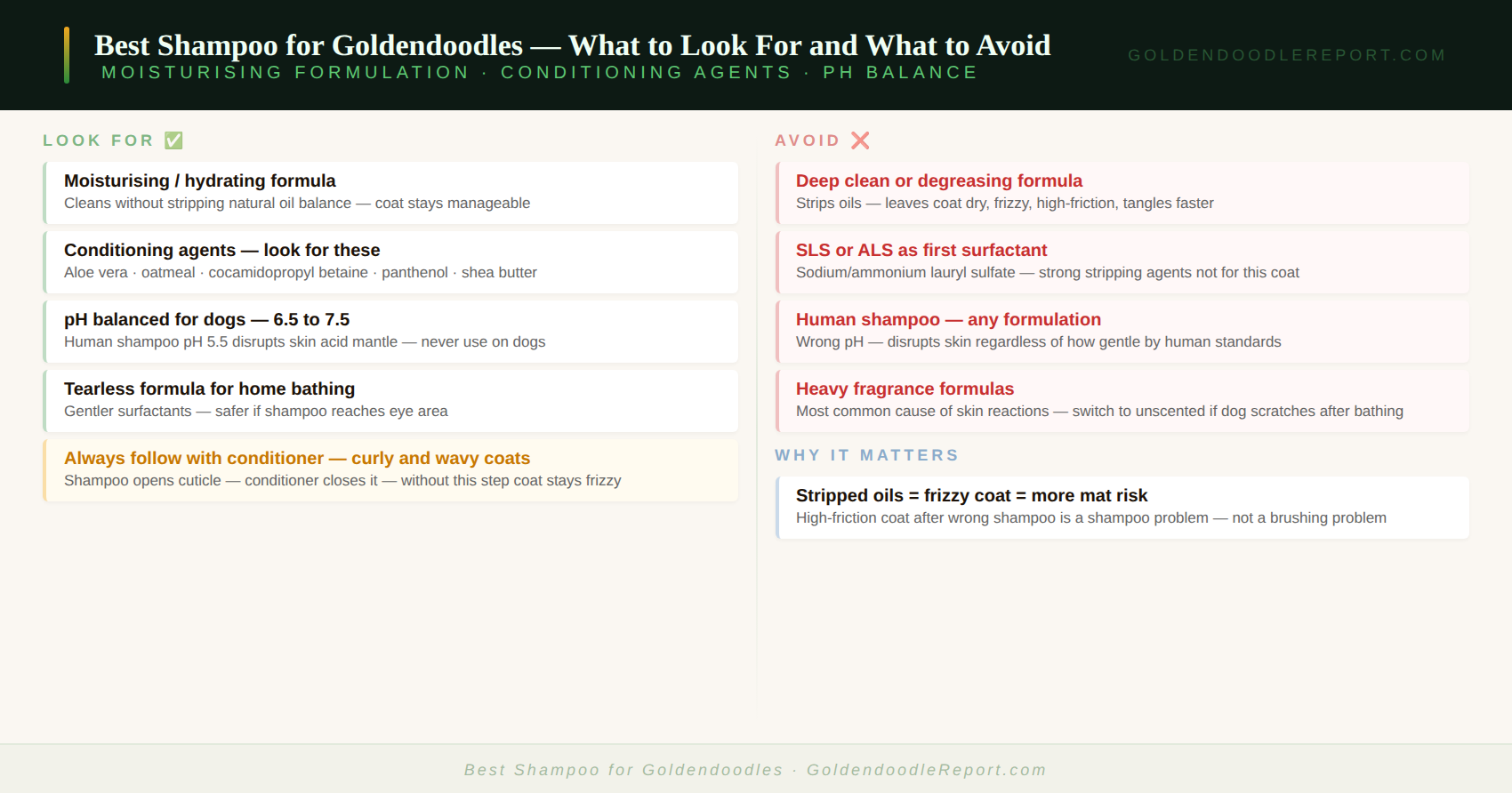
The Goldendoodle coat’s natural oil balance — the sebum produced by the skin — is what keeps coat fibres lubricated, reduces friction between fibres, and makes the coat manageable and resistant to tangling. A shampoo that strips this oil balance leaves coat fibres dry and high-friction. High-friction coat tangles faster, is harder to brush through, and produces the frizzy appearance that many Goldendoodle owners notice after bathing with an unsuitable shampoo.
This is particularly pronounced in curly-coated Goldendoodles. The tight curl structure already creates more fibre-to-fibre contact and more friction than straight or wavy coats. Removing the natural oil buffer from a curly coat exaggerates this friction dramatically — the difference between a well-conditioned curly coat and a stripped curly coat is immediately visible and immediately felt during brushing.
The correct shampoo cleans the coat — removing dirt, bacteria, and odour — without removing the sebum that makes the coat manageable. Moisturising formulations achieve this by using gentler surfactants and including conditioning agents that replace or supplement the natural oils during the wash process.
pH Balance — Why Human Shampoo Is Never Appropriate
Dog skin has a pH of approximately 6.5 to 7.5 — slightly less acidic than human skin, which sits around 5.5. Human shampoos are formulated for human skin pH. When used on dog skin, the pH mismatch disrupts the dog’s skin acid mantle — the protective barrier that keeps skin healthy and resistant to bacteria and irritants. Repeated use of human shampoo on a dog causes progressive skin irritation, dryness, and in some dogs, dandruff and dermatitis. The coat also suffers — human shampoo formulated for human pH strips dog coat fibres more aggressively than a correctly pH-balanced dog shampoo.
This applies equally to “natural” or “gentle” human shampoos — the pH issue exists regardless of how gentle the formula is by human standards. Only shampoos specifically formulated for dogs are appropriate for a Goldendoodle’s skin and coat.
Best Shampoo for Goldendoodles — Complete Buying Criteria
Moisturising formulation — the primary requirement
Look for shampoos described as “moisturising,” “hydrating,” or “conditioning” rather than “deep clean,” “degreasing,” or “whitening.” Deep clean and degreasing formulas are specifically designed to strip oils — exactly what a Goldendoodle coat does not need from a shampoo. Moisturising formulas clean effectively while maintaining the coat’s natural oil balance.
Conditioning agents in the formula
The following ingredients in a shampoo formulation indicate a moisturising rather than stripping product: aloe vera (soothes skin, adds moisture), oatmeal (colloidal oatmeal relieves dryness and irritation), coconut-derived emollients (such as cocamidopropyl betaine — a gentle surfactant that cleans without stripping), shea butter, and panthenol (Vitamin B5 — a humectant that attracts and retains moisture). Avoid formulas where the first listed surfactant is sodium lauryl sulfate (SLS) or ammonium lauryl sulfate — these are strong stripping surfactants appropriate for very oily coats, not Goldendoodle coats.
pH balanced for dogs — stated on packaging
Many quality dog shampoos state “pH balanced for dogs” on the packaging — this is a useful indicator but not universal. A shampoo that does not state this is not necessarily wrong, but one that does state it demonstrates the manufacturer is aware of and addressing the pH consideration. When in doubt, choose a formula from a brand that specialises in professional dog grooming products rather than general pet care.
Tearless formula — for regular home bathing
Tearless formulas are appropriate for owners who bathe their Goldendoodle at home and are not professional groomers. They use surfactants and pH adjustments that are gentle enough for the eye area, making the bathing process more manageable and reducing irritation risk if shampoo reaches the face. Professional-grade formulas that are not tearless produce better results but require more careful application technique to keep away from the eyes.
Fragrance — low or unscented
Fragrance is the most common cause of skin reactions to dog shampoos. A dog who develops itching, redness, or skin irritation after bathing should be switched to an unscented or minimally fragranced formula first before assuming the issue is an allergy to a specific ingredient. For dogs with no known sensitivity, light fragrance is acceptable — heavy fragrance indicates a formula with a higher chemical load than necessary for an effective clean.
Coat-type specific formulas
Some manufacturers produce shampoos specifically formulated for curly or wavy coats — these are worth seeking out for Goldendoodle owners. Curl-specific shampoos typically have higher conditioning agent concentrations and gentler surfactant systems than general dog shampoos. They are not essential — a good general moisturising dog shampoo works well — but coat-specific formulas can produce noticeably better results for curly-coated Goldendoodles specifically.
Best Shampoo for Goldendoodles Is Only Half the Bath
Shampoo alone — even an excellent moisturising shampoo — is not sufficient for a curly Goldendoodle coat. Shampoo opens the coat cuticle during the wash process to allow cleaning. Conditioner closes the cuticle after washing, sealing in moisture and smoothing the fibre surface. A curly coat washed with shampoo and not conditioned comes out of the bath with open cuticles — which means high friction, frizz, and a coat that is significantly harder to brush and dry than one that has been properly conditioned.
Conditioner is the step that makes post-bath brushing manageable for curly coats. For wavy coats, conditioner is highly beneficial. For straight-coated Goldendoodles, it is still useful but less critical. See Best Conditioner for Goldendoodles for the full guide.
For authoritative guidance on dog grooming see the AKC dog grooming guide.
✅ Your Next Step
Check your current shampoo label — if the first surfactant listed is sodium lauryl sulfate, or if the formula is described as “deep clean” or “degreasing,” it is too stripping for a Goldendoodle coat. Switch to a moisturising, pH-balanced dog shampoo with conditioning agents and follow every bath with conditioner for curly and wavy coats. The difference in post-bath coat manageability will be immediately visible. For the complete grooming guide see Goldendoodle Grooming Guide.
🔑 Key Takeaways
- A moisturising, pH-balanced dog shampoo is the correct formulation for Goldendoodle coats — not a deep clean or degreasing formula
- Stripping natural oils increases coat friction, producing a frizzy, harder-to-manage coat that tangles faster — this is a shampoo problem, not a brushing problem
- Human shampoo is never appropriate — the pH difference disrupts the skin acid mantle and damages the coat over time regardless of how gentle the formula is by human standards
- Look for conditioning agents in the formula — aloe vera, oatmeal, coconut-derived emollients, shea butter, or panthenol
- Avoid formulas where the first surfactant is SLS or ALS — these are stripping agents appropriate for oily coats, not Goldendoodle coats
- Shampoo alone is not sufficient for curly coats — always follow with conditioner to close the coat cuticle and reduce post-bath friction
📚 Continue Learning
- Goldendoodle Grooming Guide — complete grooming authority guide
- How to Bathe a Goldendoodle — the complete bathing technique
- Best Conditioner for Goldendoodles — the essential follow-up step
- How to Dry a Goldendoodle Coat — completing the bath correctly
- Best Dog Dryer for Goldendoodles — preventing post-bath tangles
- Goldendoodle Grooming Tools Checklist — full kit overview
↑ Back to: Goldendoodle Grooming Tools Checklist | Goldendoodle Grooming Guide | Goldendoodle Grooming — All Articles
Frequently Asked Questions
What is the best shampoo for Goldendoodles?
A moisturising, pH-balanced dog shampoo with conditioning agents in the formula — such as aloe vera, oatmeal, coconut-derived emollients, or panthenol. The shampoo should clean effectively without stripping the coat’s natural oils. For curly-coated Goldendoodles, a curl-specific dog shampoo produces the best results. Always follow shampoo with conditioner for curly and wavy coats — shampoo alone leaves the cuticle open and the coat frizzy and high-friction.
Can I use human shampoo on my Goldendoodle?
No — human shampoo is not appropriate for dogs. Human skin has a pH of approximately 5.5, while dog skin sits at 6.5 to 7.5. Using human shampoo on a dog disrupts the skin’s protective acid mantle, causing progressive irritation, dryness, and coat damage over time. This applies to all human shampoos — including gentle, natural, or baby formulas — because the pH mismatch exists regardless of the formula’s gentleness by human standards.
Why is my Goldendoodle’s coat frizzy after a bath?
Most commonly caused by one of three things: a shampoo that is too stripping for the coat type, not using conditioner after shampooing, or air-drying rather than force drying. Start by checking whether your shampoo is a moisturising formula with conditioning agents or a deep-clean formula with strong surfactants. If the formula is correct, add conditioner after the shampoo step and switch to force drying or using a brush with a human dryer on cool setting. All three changes together typically eliminate post-bath frizziness entirely.
How often should I bathe my Goldendoodle?
Every 4 to 6 weeks is appropriate for most Goldendoodles — aligning with the professional grooming schedule. Bathing more frequently than every 3 weeks increases the risk of stripping natural oils even with a moisturising shampoo. Bathing less frequently than every 6 to 8 weeks allows odour, dirt, and skin debris to accumulate at the coat base. Dogs who swim frequently or roll in mud may need more frequent bathing — use a gentle, highly moisturising formula if bathing more than monthly.
Disclaimer: The information in this article is provided for general educational purposes only. King James Adjei is a researcher and enthusiast, not a veterinarian or certified groomer. Dogs with skin conditions or allergies should be bathed with veterinarian-recommended products — consult your vet before changing shampoo formulas if your dog has ongoing skin issues.