Affiliate Disclosure: Some links in this guide are affiliate links. If you purchase through them, we may earn a small commission at no extra cost to you. Read our full affiliate disclaimer here.
By King James Adjei — Researcher and Goldendoodle enthusiast, founder of GoldendoodleReport.com. Every guide on this site is carefully researched and written to give owners reliable, clearly organised information — updated regularly and honest about uncertainty. → About this site
📖 6-minute read | Last updated April 2026 | Reviewed for accuracy
Finding the best ear cleaner for Goldendoodles starts with understanding that Goldendoodles are one of the most ear-infection-prone breeds — a direct consequence of their floppy ears, dense ear canal hair, and the moisture-trapping conditions that result from both. For a breed where ear infections are not an occasional problem but a recurring maintenance concern, the ear cleaner used matters significantly. The wrong product can irritate a healthy ear canal, fail to dry moisture effectively, or — in the case of owners who confuse maintenance cleaners with treatment products — mask an active infection rather than clearing it. This guide covers what a maintenance ear cleaner needs to do, what to look for, and what to avoid.
👤 Who This Guide Is For
- You want to establish a regular ear cleaning routine and need to know which product to buy
- Your Goldendoodle has a history of ear infections and you want the most appropriate maintenance cleaner
- You want to understand the difference between a maintenance ear cleaner and a veterinary treatment product
- You want to understand what the key formulation criteria are before choosing a product
⚡ Quick Summary
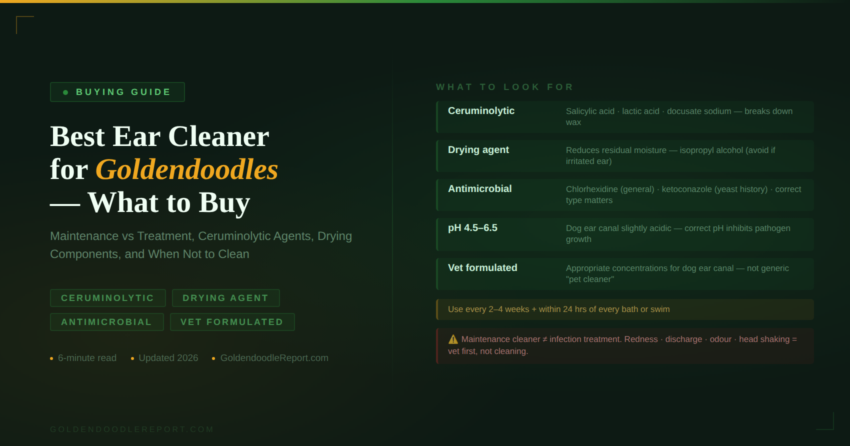
The best ear cleaner for a Goldendoodle is a veterinarian-formulated maintenance cleaner with ceruminolytic agents (to break down wax), drying agents (to reduce residual moisture), and an appropriate antimicrobial component. For dogs with no infection history, a gentle all-purpose maintenance cleaner used every 2 to 4 weeks and after every bath and swim is the correct protocol. For dogs with a history of yeast infections, an antifungal-containing cleaner is the more appropriate maintenance choice. For dogs with active ear infections, a veterinary-diagnosed treatment is required — a maintenance cleaner is not a treatment and will not clear an infection.
For the ear cleaning technique see Goldendoodle Ear Cleaning Guide. For ear infection causes and management see Goldendoodle Ear Infections and Grooming. For the complete tools list see Goldendoodle Grooming Tools Checklist.
Best Ear Cleaner for Goldendoodles — Why This Breed Needs It Most
Three structural factors make Goldendoodles significantly more susceptible to ear infections than many other breeds. First, floppy ears cover the ear canal opening — reducing airflow and creating the warm, moist environment that bacteria and yeast thrive in. Second, the Goldendoodle’s Poodle genetics produce dense hair growth inside the ear canal — this hair traps wax, debris, and moisture against the canal wall rather than allowing it to migrate outward naturally. Third, many Goldendoodles swim or are bathed frequently — water that enters the ear canal during these activities adds to the moisture problem and is slow to evaporate given the reduced airflow.
Regular maintenance cleaning addresses all three factors: it removes accumulated wax and debris, helps dry residual moisture, and maintains the ear canal environment at a pH that is less hospitable to infection-causing organisms. For Goldendoodles, this is not optional grooming — it is an essential health maintenance routine. See Preventing Ear Infections in Doodles for the full prevention protocol.
Maintenance Cleaner vs Treatment Product — Critical Distinction
This is the most important distinction in the ear cleaner category and the one most commonly confused by owners.
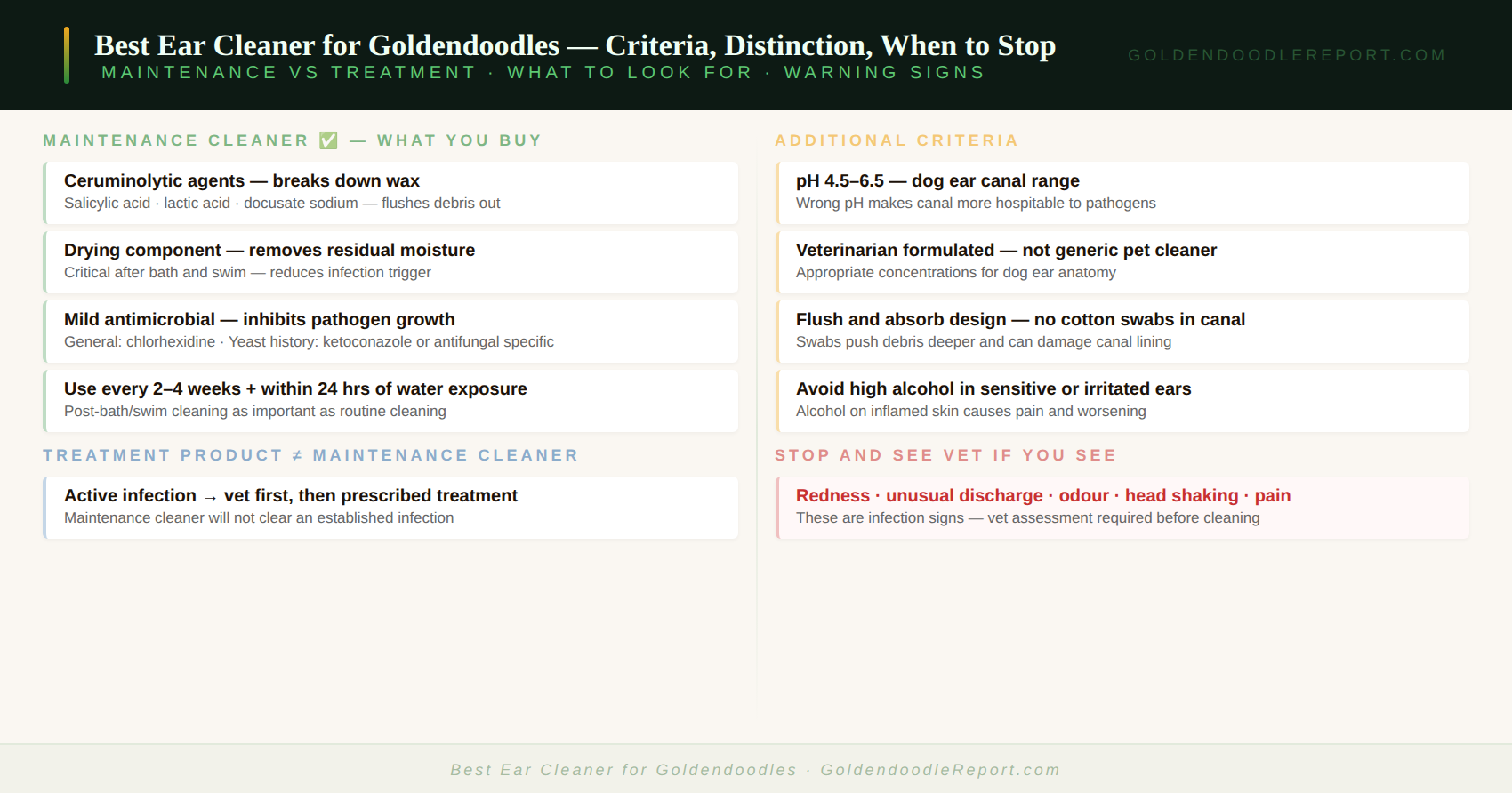
Maintenance ear cleaners are preventive products designed for use on healthy ears or mildly dirty ears without active infection. They clean the canal, remove wax and debris, and help maintain a healthy ear environment. They are not designed to treat bacterial or yeast infections — they do not contain the antibiotic or antifungal concentrations required to clear an established infection. Using a maintenance cleaner on an actively infected ear may provide temporary symptom relief while the infection continues to progress untreated.
Veterinary treatment products are prescription or over-the-counter treatments containing specific antibiotic, antifungal, or anti-inflammatory agents at concentrations designed to clear a specific type of infection. These require a veterinary diagnosis to select correctly — yeast infections require antifungal treatment, bacterial infections require appropriate antibiotics, and mixed infections may require combination products. Using the wrong treatment product for an infection type can be ineffective and delay resolution.
The correct approach: if the ear is red, smells unusually, produces dark or coloured discharge, or causes the dog to shake their head or scratch their ear persistently — this is a veterinary appointment, not a maintenance cleaning. Use maintenance cleaners to prevent infections; use veterinary-diagnosed treatment products to treat them.
Best Ear Cleaner for Goldendoodles — Complete Buying Criteria
Ceruminolytic agents — wax breakdown
Ceruminolytic agents break down the waxy cerumen that accumulates in the ear canal, allowing it to be flushed out during the cleaning process. Without this component, the cleaner primarily moves debris around rather than dissolving it. Look for ingredients such as salicylic acid, lactic acid, or docusate sodium — these are the most common ceruminolytic agents in over-the-counter dog ear cleaners.
Drying agents — moisture management
A drying component in the ear cleaner helps evaporate residual moisture from the canal after cleaning. This is particularly important after bathing and swimming, where significant water can enter the ear canal. Isopropyl alcohol is the most common drying agent in ear cleaners. However, alcohol is irritating to inflamed or broken skin — an ear cleaner with high alcohol content should never be used in an ear that shows any signs of irritation or active infection. For dogs with sensitive ear canals or a history of frequent infections, a lower-alcohol or alcohol-free formula with an alternative drying mechanism is the more appropriate choice.
Antimicrobial component
A mild antimicrobial agent provides ongoing inhibition of bacterial and yeast growth between cleaning sessions. Common antimicrobial agents in maintenance ear cleaners include chlorhexidine (broad-spectrum antibacterial and antifungal at low concentrations), ketoconazole (antifungal), and various plant-based antimicrobials such as tea tree oil derivatives at diluted concentrations. For Goldendoodles with a history of yeast infections specifically, a maintenance cleaner with an antifungal antimicrobial component is more appropriate than a general antibacterial one — yeast is a fungus and does not respond to antibacterial agents.
Appropriate pH
The healthy dog ear canal has a slightly acidic pH — approximately 4.5 to 6.5. A cleaner formulated within this range maintains the natural environment that inhibits pathogen growth. Cleaners with a neutral or alkaline pH disrupt this environment and can actually make the canal more hospitable to infection. pH of the ear cleaner is not always stated on packaging — products from reputable veterinary brands are generally formulated to the correct range.
No cotton swabs required — flush and absorb design
The best maintenance ear cleaners are designed to be applied generously to the canal, massaged at the base of the ear, and then allowed to be shaken out by the dog followed by wiping the outer ear with a cotton ball. They do not require cotton swabs inserted into the canal — cotton swabs can pack debris deeper and damage the delicate canal lining. Confirm the product is a flush-and-absorb design rather than a swab-based protocol.
Veterinarian recommended or formulated
For an ear health product, “veterinarian recommended” or “veterinarian formulated” on the packaging is a meaningful differentiator — it indicates the formulation has been reviewed for appropriateness in the dog ear environment. Generic “pet ear cleaners” without this designation may use inappropriate concentrations of active ingredients or include components that are technically safe but suboptimal for the Goldendoodle’s specific ear conditions.
For authoritative guidance on dog ear health see the AVMA ear care guide for dogs.
⚠️ When Not to Clean — Signs That Need Vet Attention First
- Redness, swelling, or heat in or around the ear
- Dark brown, black, or coloured discharge from the ear canal
- Unusual or strongly unpleasant odour from the ear
- Dog shaking head persistently, scratching the ear, or showing pain when the ear is touched
- Visible sores, scabs, or hair loss around the ear
Any of these signs indicate an active infection requiring veterinary diagnosis before cleaning. Cleaning an actively infected ear with a maintenance product can push infection material deeper and delay appropriate treatment.
✅ Your Next Step
Choose a veterinarian-formulated maintenance cleaner appropriate for your dog’s ear infection history — general formula for dogs with no history, antifungal formula for dogs with yeast infection history. Use every 2 to 4 weeks and within 24 hours of every bath or swim. For the complete grooming guide see Goldendoodle Grooming Guide.
🔑 Key Takeaways
- Goldendoodles are structurally predisposed to ear infections — floppy ears, dense ear canal hair, and frequent water exposure make regular maintenance cleaning an essential health routine, not optional grooming
- Maintenance cleaners prevent infections — they do not treat them — using a maintenance cleaner on an active infection delays appropriate veterinary treatment
- Look for ceruminolytic agents (wax breakdown), drying agents (moisture management), and a mild antimicrobial component
- For dogs with yeast infection history, choose a cleaner with an antifungal antimicrobial component specifically — yeast does not respond to antibacterial agents
- Avoid high-alcohol formulas in any ear showing signs of irritation — alcohol on broken or inflamed skin causes pain and worsening
- Any sign of active infection — redness, unusual discharge, odour, pain, head shaking — requires vet assessment before cleaning
📚 Continue Learning
- Goldendoodle Grooming Guide — complete grooming authority guide
- Goldendoodle Ear Cleaning Guide — the complete ear cleaning technique
- Goldendoodle Ear Infections and Grooming — why infections happen and how to manage them
- Preventing Ear Infections in Doodles — the full prevention protocol
- Goldendoodle Grooming Tools Checklist — full kit overview
↑ Back to: Goldendoodle Grooming Tools Checklist | Goldendoodle Grooming Guide | Goldendoodle Grooming — All Articles
Frequently Asked Questions
What is the best ear cleaner for Goldendoodles?
A veterinarian-formulated maintenance cleaner with ceruminolytic agents for wax breakdown, a drying component for moisture management, and a mild antimicrobial. For dogs with no infection history, a general-purpose veterinary ear cleaner is appropriate. For dogs with a history of yeast infections, choose a formula specifically containing an antifungal antimicrobial component — yeast does not respond to antibacterial agents and a general formula is less effective for yeast-prone dogs. Use every 2 to 4 weeks and within 24 hours of every bath or swim.
How often should I clean my Goldendoodle’s ears?
Every 2 to 4 weeks as a maintenance routine, plus within 24 hours of every bath, swim, or significant water exposure. The post-water cleaning is as important as the routine cleaning — water trapped in the ear canal after a bath or swim is one of the primary triggers for infection. Goldendoodles who swim regularly may need post-swim ear cleaning after every swim session. See Goldendoodle Ear Cleaning Guide for the complete technique.
Can I use a human ear cleaner on my Goldendoodle?
No — human ear cleaners are formulated for human ear canal anatomy, pH, and microbiome. The dog ear canal has a different pH range, different flora, and a different structural path (it has an L-shaped canal rather than a straight one). Human ear cleaners may contain ingredients at concentrations appropriate for human ears but inappropriate for the more sensitive dog ear canal. Use only products specifically formulated for dogs.
What is the difference between an ear cleaner and an ear infection treatment?
An ear cleaner is a maintenance product that cleans, dries, and mildly inhibits pathogen growth in a healthy ear canal. It is preventive, not therapeutic. An ear infection treatment contains antibiotic, antifungal, or anti-inflammatory agents at concentrations designed to clear an established infection of a specific type. Ear infection treatments require a veterinary diagnosis to select correctly — using the wrong type for the infection type present is ineffective and delays appropriate treatment. If your Goldendoodle’s ear shows signs of infection, the first step is a vet visit, not a product purchase.
Disclaimer: The information in this article is provided for general educational purposes only. King James Adjei is a researcher and enthusiast, not a veterinarian. For dogs with active ear infections, recurring infections, or unusual ear symptoms, always consult a veterinarian before selecting or changing ear care products.