Affiliate Disclosure: Some links in this guide are affiliate links. If you purchase through them, we may earn a small commission at no extra cost to you. This does not influence our recommendations. Read our full affiliate disclaimer here.
By King James Adjei — Researcher and Goldendoodle enthusiast, founder of GoldendoodleReport.com. Every guide on this site is carefully researched and written to give owners reliable, clearly organised information. → About this site
📖 9-minute read | Last updated May 2026 | Reviewed for accuracy
Once you teach a Goldendoodle to stay reliably, you’ve unlocked one of the most practically useful commands in everyday life — keeping your dog safely out of the road while you grab the mail, holding position while guests come through the door, or staying put at the vet’s office instead of pulling toward every new smell. Most owners get the basic idea, then hit the same wall: the dog holds for a few seconds, then breaks position the moment attention shifts elsewhere, or seems to understand stay at home but forgets it completely anywhere else.
This guide covers the standard method professional trainers use — built around what’s known as the three Ds — plus a distinction most guides skip entirely that genuinely confuses a lot of owners, a way to predict a break before it happens, and specific fixes for the most common stay problems.
✅ Quick Answer
To teach a Goldendoodle to stay, first ask your dog to sit, then say “stay” once while showing an open-palm hand signal. Wait just 2-3 seconds, then reward while they’re still in position and release with a consistent word like “okay” or “free.” Build the command by increasing duration, distance, and distractions separately, one at a time, never all three together. Most Goldendoodles learn a basic 10-15 second stay within a week of short daily sessions, though a fully reliable stay that holds up around real distractions typically takes 4-6 weeks of consistent practice.
👤 Who This Guide Is For
- Your Goldendoodle already knows sit and you’re ready to teach the next command
- Your dog holds a stay for a second or two, then breaks position before you release them
- Your dog stays reliably at home but ignores the command anywhere else
- You’re unsure whether you actually need both a “stay” and a “wait” command, or if that’s overcomplicating things
📊 Quick Facts — Teaching a Goldendoodle to Stay
- Stay training is built around three separate variables — Distance, Duration, and Distraction — and should always be increased one at a time, never combined early in training
- Stepping backward away from your dog can actually pull them out of position, since dogs are used to following you when you move away — sidestepping instead is a small but genuinely effective adjustment
- A dog is usually giving a visible warning before breaking a stay — a subtle weight shift in the back legs — that’s worth learning to spot
- “Okay” is one of the most common release words used, but it’s also a word people say constantly in everyday conversation, which risks accidentally releasing your dog at the wrong moment
- Goldendoodles are a food-motivated, people-focused breed, which makes them fast learners for stay but also means they’re easily lured out of position by visible treats moving away with you — a detail worth being deliberate about
🔍 Quick Diagnosis — What’s Actually Going Wrong?
- If your dog breaks stay the instant you move away → you’re likely combining distance and duration too early; go back to close-range, very short stays before adding space
- If your dog holds for a few seconds then pops up right before you return → they may be anticipating the release rather than staying calm; reward before they show signs of breaking, not after
- If your dog stays at home but not anywhere else → the command hasn’t been proofed in new locations yet — this is the exact same issue covered in our Sit training guide, and the fix is identical: practice deliberately in new places
- If your dog seems to only “sort of” stay, moving around without fully getting up → your criteria may be too loose; only reward a fully still, four-paws-planted stay, not a wandering one
📋 Table of Contents
The Basic Stay Method
Your Goldendoodle should already know how to sit reliably before starting stay training — if not, start with how to teach a Goldendoodle to sit first, since stay builds directly on top of that foundation.
- Ask your dog to sit. Stay always starts from an already-known position — sit is the most common starting point, though down works too.
- Give the stay cue once. Say “stay” clearly, paired with an open-palm hand signal (like a stop gesture) facing your dog. Say it only once — repeating the word teaches your dog to ignore it until said multiple times.
- Wait just 2-3 seconds initially. This is intentionally short. The goal at this stage is success, not endurance.
- Reward while they’re still in position. This is critical — the treat needs to arrive while your dog is still sitting, not after you’ve released them, or you’ll accidentally reward the release instead of the stay itself.
- Use a consistent release word. Something like “okay,” “free,” or “release” — said in an upbeat tone — tells your dog the stay is over and they’re free to move. The American Kennel Club’s training guidance specifically recommends avoiding an overly excited tone for the release word, since this can cause a dog to start anticipating it during the stay itself.
📖 Real Scenario
An 11-week-old Goldendoodle puppy is doing well with sit and down, but stay isn’t going anywhere — the owner can occasionally get 5 feet of distance and 15 seconds of duration, but most attempts end with the puppy jumping up and following before the release word is even given. Frustrated, the owner starts to wonder if the puppy is simply too young. What’s actually happening is a classic case of combining distance and duration before either is solid on its own — the puppy is being asked to do two hard things at once. Once the owner separates the two, first building duration up to 15-20 seconds at zero distance, then building distance in single steps at minimal duration, progress resumes almost immediately. Within two more weeks, the same distance and duration that felt impossible together become manageable once trained as two separate skills.
The Three Ds — Building a Genuinely Reliable Stay
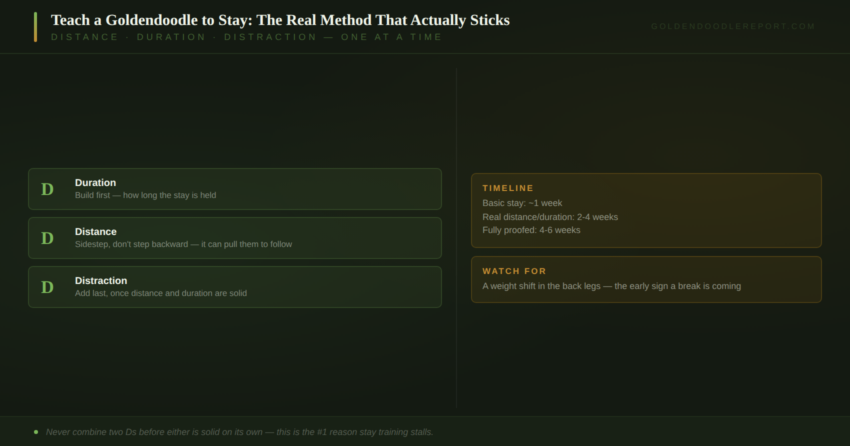
Professional trainers build stay around three separate variables, commonly called the three Ds — a structured application of operant conditioning principles, where a behavior is shaped gradually by controlling exactly which variable changes at each step. The single most important rule: increase only one D at a time. Combining two or more before either is solid is the single most common reason stay training stalls.
| The D | What It Means | How to Build It |
|---|---|---|
| Duration | How long the stay is held | Add 5-10 seconds only after consistent success at the current duration |
| Distance | How far you move away | Start with a sidestep, not stepping backward — moving away directly can pull your dog to follow you |
| Distraction | What’s happening around your dog | Add small distractions first (a hand clap, a dropped object) before working up to real-world triggers like the doorbell |
Build each D to a reasonably solid level on its own — most trainers suggest a dog should hold a stay for around 30 seconds at zero distance and no distractions before starting to layer distance on top. Only once two Ds are each individually solid should you start combining them.
Stay vs. Wait — Do You Need Both?
This is a distinction most training guides skip, and it genuinely confuses a lot of owners — searching real owner discussions on this exact question turns up recurring confusion about whether “stay” and “wait” are the same thing or need to be taught separately.
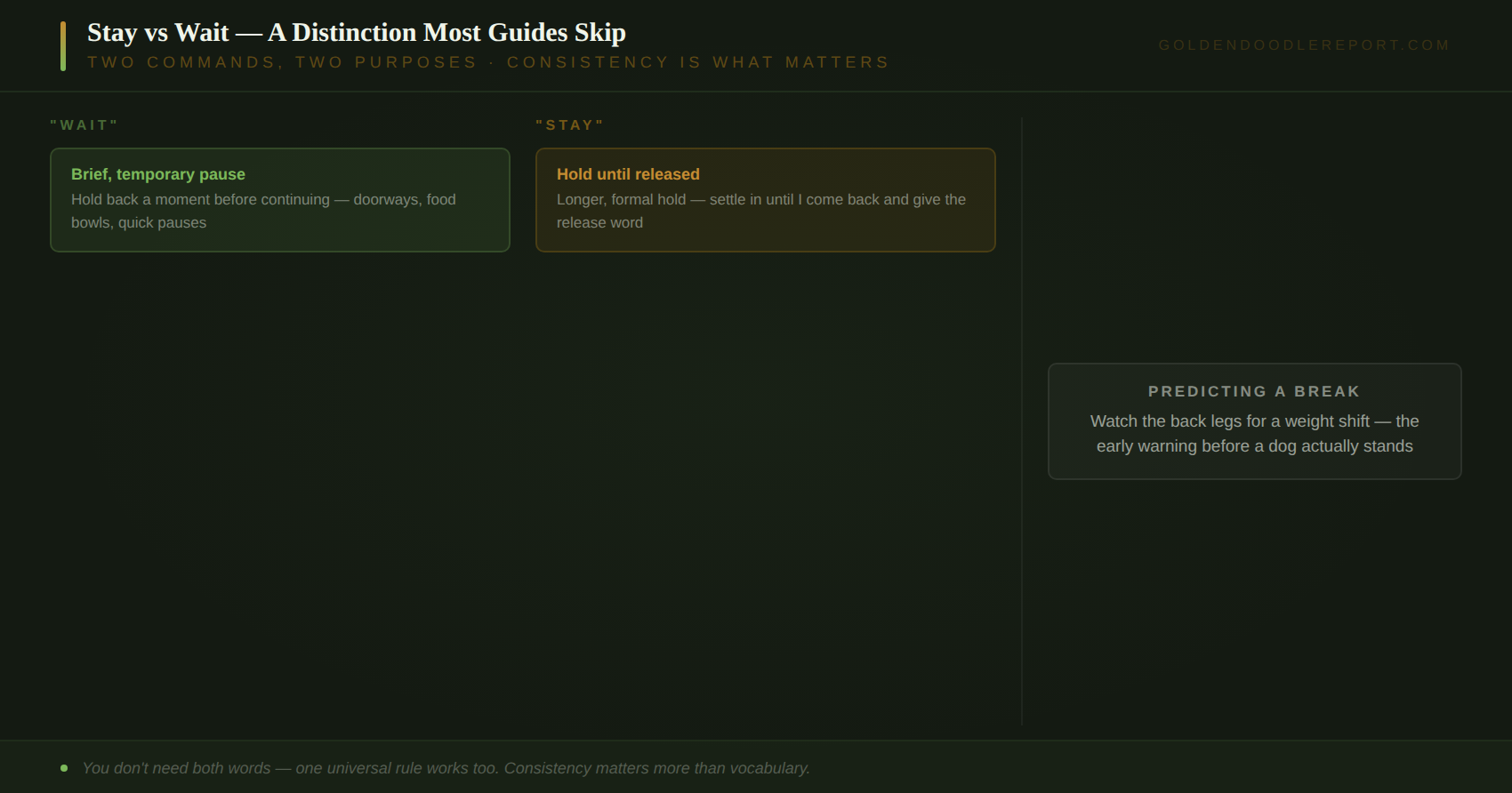
The practical distinction used by many professional trainers: “wait” means a brief, temporary pause — hold back for a moment before continuing, useful for situations like not bolting out the front door or waiting a beat before a food bowl goes down. “stay” means hold this exact position until I come back and release you — used for longer, more formal holds like sitting calmly while guests arrive or staying put while you cross a room.
You don’t strictly need both — some experienced owners use only one broad “stay means stay until released” rule for every position, arguing that a second word is redundant. Others find having both genuinely useful, since it lets a dog understand the difference between “pause a second” and “settle in, I’ll be a while.” Neither approach is wrong. What matters is being consistent with whichever system you choose — inconsistency between the words, not the number of words, is what actually confuses dogs.
Reading Your Dog: Predicting a Break Before It Happens
Most stay training advice is reactive — what to do after your dog breaks position. A more useful skill is learning to read the early signs that a break is coming, so you can reward or reset before it happens rather than after.
Watch your dog’s back legs and weight distribution specifically. A dog that’s about to break a stay will typically shift their weight forward or to one side before actually standing — a subtle pre-movement cue that’s easy to miss if you’re not looking for it. If you notice this weight shift, you have a brief window to either quickly reward the current position (reinforcing that staying still pays off) or calmly reset before the break fully happens. Over time, this becomes second nature, and it meaningfully speeds up training since you’re catching and rewarding good behavior instead of only correcting failures after the fact.
💡 What This Guide Adds That Most Others Don’t
The Goldendoodle-specific stay guides that exist online cover the basics of distance and duration training well, but none address the stay-vs-wait confusion that shows up repeatedly in real owner discussions, and none teach the proactive skill of reading a dog’s body language to predict a break before it happens. Both are covered here specifically because they come up as genuine, recurring points of confusion — not because they’re commonly covered training theory padded out for length.
What Most People Get Wrong
- Combining distance and duration too early — as shown in the Real Scenario above, this is the single most common reason stay training feels impossibly hard when it isn’t
- Stepping straight backward instead of sidestepping — moving directly away can pull a dog to follow, especially early in training
- Rewarding after the release instead of during the stay — this accidentally reinforces the release, not the stay itself, and can teach a dog that getting up is what earns the treat
- Using “okay” as a release word — since it’s a word used constantly in everyday speech, dogs can be accidentally released at the wrong moment; a less common word like “free” or “release” avoids this
- Repeating the stay command multiple times — say it once; repeating teaches a dog the word doesn’t matter until said several times
- Punishing a broken stay — calmly resetting your dog to position without reward teaches the lesson more effectively than scolding, which can create anxiety around the command instead of clarity
Troubleshooting Specific Problems
| Problem | Likely Cause | Fix |
|---|---|---|
| Breaks the instant you move | Distance added before duration was solid | Return to zero-distance duration training first |
| Fine for 5 seconds, fails past that | Duration increased in jumps too large | Add only 5-10 seconds at a time, tracked consistently |
| Stays at home, not elsewhere | Command never proofed in new locations | Practice deliberately in 2-3 new places per week |
| Gets up right before release | Anticipating the release rather than staying calm | Reward before signs of breaking appear, per the body-language section above |
✔️ Action Plan — Your First Training Week
- Decide whether you’ll use both “stay” and “wait,” or one universal rule — commit to your choice before starting
- Build duration first, at zero distance, working toward a solid 15-30 second stay
- Introduce distance separately, starting with a sidestep, not stepping backward
- Once both are individually solid, begin combining small amounts of each together
- Add mild distractions last, and only once distance and duration are both reliable
⏱️ What to Expect
A basic 10-15 second stay at close range typically develops within a week of short daily sessions. Building genuine distance (5-10 feet) and longer duration (1-2 minutes) usually takes 2-4 additional weeks. A fully reliable stay that holds up around real distractions — visitors, other dogs, dropped food — is a longer-term skill, often taking 4-6 weeks of consistent, deliberately varied practice. If progress stalls at any point, the most common fix is simply returning to an easier level of whichever D was increased most recently.
✅ Your Next Step
Once stay is solid, Come (recall) is a natural next command — it uses a similar release-based structure but adds motion instead of stillness. A dedicated Recall Training guide is coming soon in this category. In the meantime, weave stay into daily routines — doorways, mealtimes, and greeting guests are all natural, low-pressure opportunities to reinforce the command outside of formal training sessions.
🔑 Key Takeaways
- Build stay around three separate variables — Distance, Duration, Distraction — and increase only one at a time
- Sidestep rather than stepping backward when adding distance — moving directly away can pull your dog to follow
- Reward while your dog is still in the stay position, never after the release, to avoid accidentally reinforcing getting up
- “Stay” and “wait” can be taught as distinct commands (brief pause vs. hold until released) or unified into one rule — either works, as long as you’re consistent
- Watch for a weight shift in your dog’s back legs as an early warning sign a stay is about to break, so you can reward or reset proactively
- A basic stay develops within about a week; a fully reliable one around real distractions typically takes 4-6 weeks
📚 More Goldendoodle Training & Behavior Guides
- Teach a Goldendoodle to Sit: The Exact Method That Actually Works
- How to Teach a Goldendoodle to Come — coming soon
- Positive Reinforcement Training for Goldendoodles — coming soon
- Goldendoodle Puppy Training Timeline — coming soon
- Goldendoodle Place Command Guide — coming soon
- Goldendoodle Training Guide (complete pillar) — coming soon
Browse all guides: Goldendoodle Training & Behavior category
🔗 Related Guides Across the Site
- Goldendoodle Treats Guide — choosing the right high-value rewards for training
- Goldendoodle Puppy Care Guide — where training fits into overall first-year care
- Goldendoodle Puppy Socialization Checklist — proofing new behaviors around new people and places
Frequently Asked Questions
How do I teach a Goldendoodle to stay?
Ask your dog to sit, then say “stay” once while showing an open-palm hand signal. Wait just 2-3 seconds initially, reward while they’re still in position, then release with a consistent word like “okay” or “free.” Build duration, distance, and distractions separately over time, never combining more than one at a time. Most Goldendoodles learn a basic stay within a week, though full reliability around real distractions takes 4-6 weeks.
What’s the difference between stay and wait?
Many trainers use “wait” for a brief, temporary pause — useful for not bolting through a door — and “stay” for a longer, formal hold until you return and release. You don’t strictly need both; some owners use one universal “stay means stay until released” rule instead. What matters is being consistent with whichever system you choose, since inconsistency is what actually confuses dogs, not the number of words used.
Why does my Goldendoodle break their stay right before I release them?
This usually means your dog is anticipating the release rather than staying calm in the moment. Watch for an early warning sign — a subtle weight shift in the back legs — and reward or reset before that shift turns into a full break. Rewarding consistently while your dog is still in position, not after release, also helps address this over time.
How long should a Goldendoodle be able to stay?
There’s no universal number, but most trainers suggest working toward a solid 30-second stay at close range with no distractions before adding significant distance. From there, distance and duration can be built up gradually and combined once each is individually reliable — some dogs eventually hold a stay for several minutes or more.
My Goldendoodle stays at home but not on walks or at the park — why?
This is a proofing issue, not disobedience — the same pattern covered in our Sit training guide. A command practiced only in one environment gets learned as specific to that environment. Deliberately practice stay in new locations, starting with low-distraction settings and working up to busier ones, to generalise the command.
Disclaimer: The information in this article is provided for general educational purposes only. King James Adjei is a researcher and enthusiast, not a professional dog trainer or veterinarian. Training methods should always be force-free and adjusted to your individual dog’s comfort and pace.