Affiliate Disclosure: Some links in this guide are affiliate links. If you purchase through them, we may earn a small commission at no extra cost to you. This does not influence our recommendations. Read our full affiliate disclaimer here.
By King James Adjei — Researcher and Goldendoodle enthusiast, founder of GoldendoodleReport.com. Every guide on this site is carefully researched and written to give owners reliable, clearly organised information. → About this site
📖 8-minute read | Last updated May 2026 | Reviewed for accuracy
Learning to teach a Goldendoodle to sit is usually the very first real training milestone a new owner and puppy hit together, and it’s a genuinely good place to start — it’s fast to teach, sets up nearly every other command that follows, and gives your dog a calm, socially useful way to ask for things instead of jumping or barking. Most owners get the basic idea right but stall out on a handful of predictable snags: the dog pops back up the instant they sit, backs up instead of sitting, or seems to “forget” the command the moment you leave the living room.
This guide walks through the standard, most effective method step by step, a genuine no-treat alternative for owners who don’t want to start with a food dependency, the specific fixes for the most common problems, and one consideration that’s particularly relevant for this breed: joint comfort during the sit position itself.
✅ Quick Answer
To teach a Goldendoodle to sit, hold a small treat close to their nose and slowly move it up and back over their head — as their nose tracks the treat upward, their rear end naturally lowers to the ground. The instant their bottom touches down, mark the moment with a clicker or the word “yes” and reward immediately. Repeat 8–10 times per short session, then add the verbal cue “sit” right as they begin to lower. Most Goldendoodle puppies learn a reliable sit within 3–7 days of short, daily 5-minute sessions. Puppies can start as young as 8 weeks old, though very young or small Mini puppies may need extra patience with balance.
👤 Who This Guide Is For
- You have a new Goldendoodle puppy and want to teach the first real obedience command correctly from day one
- Your dog keeps popping back up the instant they sit, or won’t hold the position
- You’ve tried pushing your dog’s rear down and want a better, force-free method
- You want an alternative to constant treat luring, or a plan for weaning off treats once the behavior is learned
📊 Quick Facts — Teaching a Goldendoodle to Sit
- Puppies can begin simple sit training as young as 8 weeks old — there is no need to wait until a puppy is older to start basic obedience work
- Most dogs learn a reliable sit faster than almost any other command — typically within 3–7 days of short, consistent daily sessions
- A dog that has only practiced “sit” in one room (like the living room) has not actually generalised the command — this is one of the most common reasons a well-trained-looking dog “ignores” sit outside the house
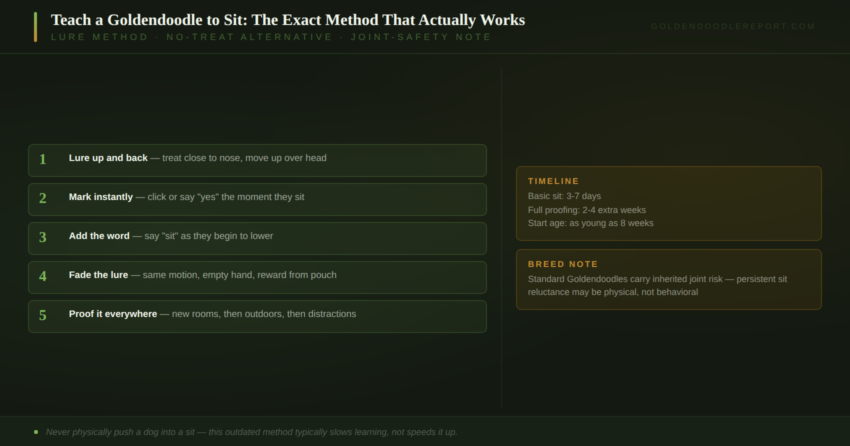
- Never physically push a dog’s hindquarters down to force a sit — this can cause confusion, mild intimidation, and in some cases physical discomfort, and it typically slows learning rather than speeding it up
- Standard Goldendoodles carry inherited hip and joint considerations from both Golden Retriever and Poodle lineage, which is worth factoring into how sit is taught and reinforced over a lifetime — covered in detail below
🔍 Quick Diagnosis — What’s Actually Going Wrong?
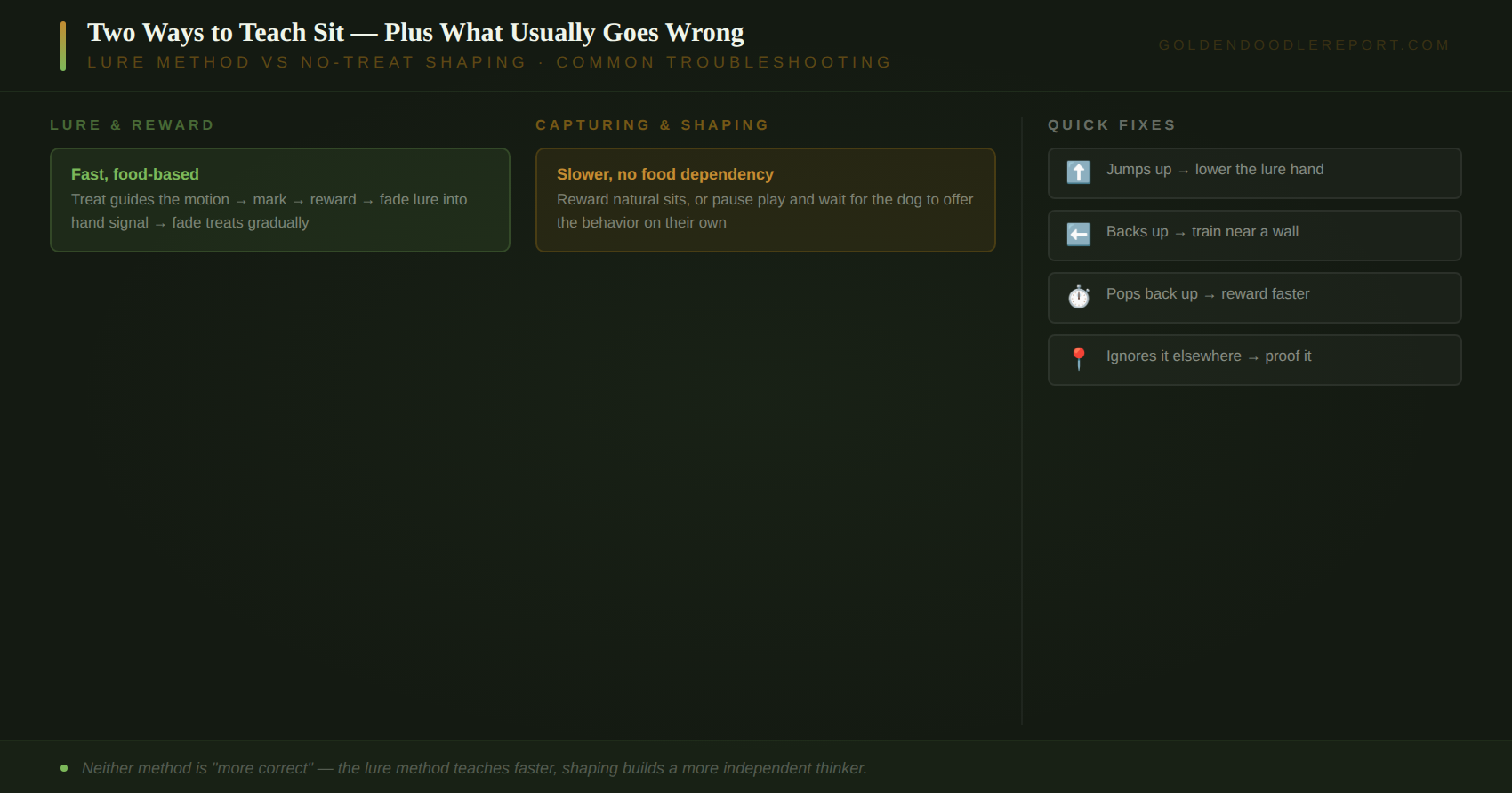
- If your dog jumps up toward the treat instead of sitting → the lure is being held too high above their nose; lower your hand so it stays close to their muzzle throughout the motion
- If your dog backs away instead of sitting → your luring hand is moving too fast, or there’s nothing behind them to stop the backward step; try training with your dog’s back against a wall or the corner of a room
- If your dog pops back up the instant they sit → you are likely marking (clicking or saying “yes”) and then taking too long to deliver the treat; reward faster, and gradually add duration only once the sit itself is solid
- If your dog sits at home but ignores the command outside → the behavior was never “proofed” in different locations; this is not disobedience, it’s an incomplete training step — see the Proofing section below
📋 Table of Contents
The Lure-and-Reward Method — Step by Step
This is the fastest, most reliable way to teach a Goldendoodle to sit, and it’s the method most professional trainers default to for a first command.
What you need
- A quiet, low-distraction space — not the yard, not near other pets, not during a walk
- 10–15 small, soft training treats (pea-sized, so your dog doesn’t need to stop and chew)
- A clicker, if you plan to use one — optional but useful for precise timing
The steps
- Get your dog’s attention. With your dog standing in front of you, hold a treat between your fingers close to their nose.
- Lure upward and back. Slowly move the treat up and slightly back over your dog’s head, staying close to their nose the entire time. As their head tilts up to follow it, their rear should naturally lower toward the ground.
- Mark the exact moment. The instant their bottom touches the floor, click (or say “yes”) and deliver the treat immediately.
- Repeat 8–10 times. Do this in short bursts — a full session should run 3–5 minutes, not longer. Puppies especially lose focus quickly.
- Add the word. Once your dog is sitting smoothly and predictably from the lure alone, start saying “sit” right as they begin to lower into position — not before, or the word risks becoming associated with the wrong movement.
- Fade the lure. After several successful sessions, start using the same hand motion without a treat actually in your hand. Reward from your other hand or a treat pouch instead. This becomes your hand signal.
- Fade the treats gradually. Move to rewarding every other sit, then every third, using praise alone the rest of the time — this is what builds a genuinely reliable, not just food-motivated, response.
📖 Real Scenario
A 10-week-old Mini Goldendoodle puppy learns to sit for a treat lure within the first two sessions — no problem there. But three weeks later, the owner is frustrated: the puppy sits perfectly in the kitchen but completely ignores the cue at the front door, on walks, or when guests arrive. The owner assumes the puppy is being stubborn or “forgetting.” What’s actually happened is straightforward: every single training rep happened in the kitchen, with no food or people around.
The puppy learned “sit means sit, in the kitchen, when it’s quiet” — not a general, portable command. Once the owner starts deliberately practicing sit in 2–3 new locations per week, starting with easy, low-distraction spots and working up to the front door, the command becomes reliable everywhere within about three additional weeks. Nothing was wrong with the puppy — the training simply hadn’t been proofed yet.
A No-Treat Alternative: Capturing and Shaping
The lure method above works well for most owners, but it isn’t the only legitimate way to teach a Goldendoodle to sit — and it’s worth knowing the alternative, particularly if you’d rather not start training with a food dependency that has to be faded out later.
Capturing — the simplest version
Dogs sit on their own dozens of times a day without being asked. Capturing means rewarding the behavior every time it happens naturally, rather than luring it into existence.
- Keep a few treats in your pocket during normal daily activity
- Every time your dog sits on their own — waiting for food, greeting you, pausing during play — mark it immediately (“yes!”) and reward
- After enough repetitions, your dog starts offering sits deliberately, hoping to earn a reward — at that point, add the verbal cue right as they begin to sit
Shaping with games — a more structured version
A more deliberate no-lure approach uses shaping — a behavior science technique where a target behavior is built gradually by reinforcing successive steps that move closer to the final goal. In practice, this means using short pauses in play to shape the behavior. Play a brief game of tug or fetch, then stop and hold still. Most dogs will offer several behaviors trying to restart the game — barking, pawing, bouncing. Wait it out calmly.
The moment your dog sits, even briefly, mark it and immediately restart the game as the reward. This teaches sit as something the dog chooses in order to get what they want, rather than a response to a visible treat — which some trainers argue produces a more thoughtful, engaged dog than pure luring.
Neither approach is “more correct” than the other — the lure method is faster to teach initially, while capturing and shaping can produce a dog that offers behaviors more independently. Many experienced owners end up using a blend of both over time.
A Goldendoodle-Specific Consideration: Joint Comfort
This is a detail that generic dog training guides don’t address, because it’s specific to breeds with elevated joint risk — and Goldendoodles, particularly Standards, are exactly that.
Standard Goldendoodles inherit hip and elbow dysplasia risk from both parent breeds — Golden Retrievers carry a well-documented predisposition, and Standard Poodles have their own tracked joint health considerations. Breed-wide hip health in dogs is tracked by organisations like the Orthopedic Foundation for Animals (OFA), a nonprofit that has maintained hip and joint health databases for companion dogs since 1966.
This matters for basic obedience training in a specific, practical way: a dog that is reluctant to sit, sits unevenly, or seems uncomfortable holding the position for more than a second or two may not be “distracted” or “stubborn” — they may be physically uncomfortable.
🩺 When to involve your vet: If your Goldendoodle consistently avoids sitting, sits with one hip noticeably off to the side, yelps or flinches when sitting, or seems reluctant to hold the position even briefly, this is worth mentioning at your next vet visit rather than pushing through it as a training issue. This is especially relevant during the rapid growth phase in large-breed puppies, where joint development is still underway. This guide is not a substitute for veterinary assessment of a physical discomfort concern.
For healthy puppies with no discomfort, this isn’t something to worry about — it’s simply worth knowing as a distinguishing factor if your dog’s sit training seems to be going unusually poorly despite a good training approach.
Proofing — Making the Command Actually Reliable
As shown in the Real Scenario above, teaching the initial behavior is only half the job. Proofing is the process of teaching your dog that “sit” means the same thing everywhere, not just in the room where it was first learned.
How to proof the sit command
- Change one variable at a time. Once sit is solid in one room, move to a different room in the house before introducing outdoor distractions — don’t jump straight from kitchen to dog park.
- Increase distance gradually. Start close to your dog, then slowly add space between you before giving the cue.
- Add real-world distractions deliberately. Practice with a family member walking past, then with the doorbell, then eventually with genuine outdoor distractions like other dogs at a distance.
- Change who’s asking. If multiple people live in the household, have each person practice the cue — a dog that only responds to one person hasn’t fully generalised the command either.
Expect proofing to take longer than the initial teaching phase — often 2–4 additional weeks of scattered practice across different locations and situations, compared to the few days it typically takes to get the first reliable sit.
💡 What This Guide Adds That Most Others Don’t
Nearly every popular “teach your dog to sit” guide online teaches the lure method exclusively and stops there. This guide adds two things most competitors skip entirely: a genuine no-treat alternative (capturing and shaping) for owners who want to avoid building a food dependency from the start, and a breed-specific joint-comfort consideration that matters specifically for Goldendoodles given their inherited hip and joint risk — a detail no generic dog training resource would think to include.
What Most People Get Wrong
- Physically pushing the dog’s rear to the ground — this is outdated advice that most modern trainers have moved away from; it can confuse or mildly intimidate a dog and often slows learning rather than speeding it up
- Repeating the command multiple times — saying “sit, sit, SIT” repeatedly teaches your dog that the word doesn’t mean anything until it’s said several times; say it once, then help guide the behavior if needed
- Training only in one location — as covered above, this is the single most common reason a “trained” dog appears to ignore the command elsewhere
- Removing treats too early — fading the lure and fading treats are two different steps; many owners stop rewarding altogether the moment the hand signal works, which can cause the behavior to weaken
- Training sessions that run too long — puppies especially have short attention spans; 3–5 minute sessions, several times a day, outperform one long 20-minute session every time
Troubleshooting Specific Problems
| Problem | Likely Cause | Fix |
|---|---|---|
| Jumps instead of sitting | Lure held too high above the nose | Keep your hand low and close to the muzzle throughout the motion |
| Backs up instead of sitting | Hand moving too fast, or no barrier behind the dog | Slow the motion down; train with the dog’s back near a wall |
| Pops back up immediately (“jack-in-the-box”) | Reward delivered too slowly after the mark | Reward within 1 second of marking; add duration later, gradually |
| Ignores the cue outside the house | Behavior was never proofed in other locations | Work through the proofing steps above systematically |
| Sits unevenly or seems reluctant | Possible joint discomfort, not a training issue | Mention to your vet — see the joint comfort section above |
✔️ Action Plan — Your First Training Week
- Gather small treats and pick a quiet room with no distractions
- Run 2–3 short (3–5 minute) lure-and-reward sessions per day for the first 3 days
- Add the verbal “sit” cue once the lure alone is producing a smooth sit
- Begin fading the lure into a hand signal around day 4–5
- Start proofing in a second room by day 5–7, then gradually expand to outdoor, low-distraction settings
⏱️ What to Expect
Most Goldendoodle puppies learn the basic sit motion within 2–3 sessions on day one. A reliable response to the verbal cue alone, without a visible lure, typically takes 3–7 days of consistent short sessions. Full proofing — a sit that holds up reliably in new locations, around distractions, and with different people — usually takes an additional 2–4 weeks of scattered practice. If your dog hasn’t shown any progress on the basic motion after a full week of consistent daily practice, that’s a signal to revisit your technique (check the troubleshooting table above) rather than assume something is wrong with your dog.
✅ Your Next Step
Once sit is solid, the natural next command to teach is Stay — building duration and distance on top of a behavior your dog already understands. A dedicated Stay training guide is coming soon in this category. In the meantime, apply the same lure-and-fade principles from this guide to your dog’s daily routine — mealtimes, doorways, and greetings are all natural opportunities to reinforce sit without a formal training session.
🔑 Key Takeaways
- The lure-and-reward method is the fastest way to teach a Goldendoodle to sit — hold a treat close to the nose, move it up and back, mark and reward the instant the rear touches down
- Capturing and shaping offer a genuine no-treat alternative for owners who want to avoid a food-dependent start
- Never physically push a dog into a sit — this is outdated advice that typically slows learning
- A dog that sits at home but ignores the cue elsewhere isn’t being stubborn — the behavior simply hasn’t been proofed across locations yet
- Standard Goldendoodles carry inherited joint risk that can occasionally make sitting physically uncomfortable — persistent reluctance or uneven sitting is worth a vet mention, not just more training
- Most puppies learn the basic sit within days; full reliability across locations and distractions takes several additional weeks
📚 More Goldendoodle Training & Behavior Guides
- How to Teach a Goldendoodle to Stay — coming soon
- Positive Reinforcement Training for Goldendoodles — coming soon
- Goldendoodle Puppy Training Timeline — coming soon
- Clicker Training a Goldendoodle — coming soon
- Best Training Treats for Goldendoodles — coming soon
- Goldendoodle Training Guide (complete pillar) — coming soon
Browse all guides: Goldendoodle Training & Behavior category
🔗 Related Guides Across the Site
- Goldendoodle Treats Guide — choosing the right training treats and tracking treat calories
- Goldendoodle Puppy Care Guide — where training fits into overall first-year care
- Goldendoodle Puppy Socialization Checklist — introducing your puppy to new people, places, and experiences
- Goldendoodle Puppy First Vet Visit — discussing joint health and development with your vet early
Frequently Asked Questions
How do I teach a Goldendoodle to sit?
Hold a small treat close to your dog’s nose, then slowly move it up and slightly back over their head. As their nose tracks the treat, their rear will naturally lower to the ground. The instant they sit, mark the moment (click or say “yes”) and reward immediately. Repeat 8–10 times per short session, then add the verbal cue “sit” once the motion is smooth and predictable. Most Goldendoodle puppies learn a reliable sit within 3–7 days of consistent daily practice.
At what age can I start teaching my Goldendoodle puppy to sit?
Puppies can begin simple sit training as young as 8 weeks old. There’s no need to wait until a puppy is older — basic obedience work at this age helps establish early communication and sets the foundation for further training. Keep sessions especially short (2–3 minutes) for very young puppies, since attention spans are limited.
Why does my Goldendoodle sit at home but not anywhere else?
This is almost always a proofing issue, not disobedience. If every training repetition happened in the same room, your dog learned “sit means sit, in this specific place” rather than a general command. Deliberately practice the cue in different rooms, then outdoors in low-distraction settings, gradually working up to busier environments. This typically takes 2–4 weeks of scattered practice to fully generalise.
Should I push my dog’s bottom down to teach sit?
No. Physically pushing a dog into position is outdated advice most modern trainers have moved away from. It can confuse or mildly intimidate a dog, and it typically slows learning rather than speeding it up. The lure-and-reward method, or the no-treat capturing and shaping approach covered in this guide, are both more effective and don’t carry that risk.
My Goldendoodle seems reluctant to sit or sits unevenly — is this a training problem?
It might not be. Standard Goldendoodles carry inherited hip and joint considerations from both Golden Retriever and Poodle lineage. Persistent reluctance to sit, sitting with one hip noticeably off to the side, or any sign of discomfort when sitting is worth mentioning to your vet rather than treating purely as a training issue, particularly during the rapid growth phase in large-breed puppies. For a healthy dog with no discomfort, this isn’t a concern — it’s simply worth ruling out if training seems to be going unusually poorly.
Disclaimer: The information in this article is provided for general educational purposes only. King James Adjei is a researcher and enthusiast, not a professional dog trainer or veterinarian. If your Goldendoodle shows signs of physical discomfort, pain, or persistent reluctance during training, consult your veterinarian before continuing training focused on that behavior. Training methods should always be force-free and adjusted to your individual dog’s comfort and pace.