Affiliate Disclosure: Some links in this guide are affiliate links. If you purchase through them, we may earn a small commission at no extra cost to you. This does not influence our recommendations. Read our full affiliate disclaimer here.
By King James Adjei — Researcher and Goldendoodle enthusiast, founder of GoldendoodleReport.com. Every guide on this site is carefully researched and written to give owners reliable, clearly organised information. → About this site
📖 8-minute read | Last updated May 2026 | Reviewed for accuracy
✅ Quick Answer
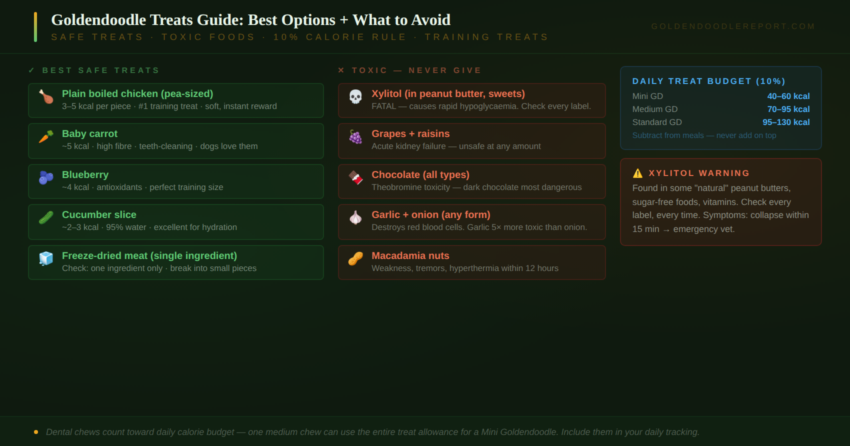
The best treats for Goldendoodles are small, soft, high-value, and low in calories. For training: tiny pieces of plain boiled chicken, freeze-dried meat treats, or small commercial treats under 5 kcal each work best. For daily treats: baby carrots, blueberries, cucumber, and apple slices (no seeds) are safe, low-calorie, and most Goldendoodles love them. The critical rule: treats should account for no more than 10% of daily calorie intake — untracked treats are the single most common cause of unexplained weight gain in Goldendoodles. And the most important item on the avoid list: xylitol — a sweetener found in some commercial treats, peanut butters, and sugar-free products that is rapidly fatal to dogs.
Goldendoodle treats are central to training, enrichment, and the relationship between owner and dog. Used correctly, they are one of the most effective training tools available. Used incorrectly — given too freely, from the wrong foods, or without tracking calories — they are the most consistent cause of unexplained weight gain, digestive problems, and inadvertently trained bad habits in this breed.
This guide covers every category of Goldendoodle treats: training treats, daily reward treats, dental chews, fruit and vegetables, homemade options, and the complete list of toxic foods that should never be given regardless of how much your dog wants them.
👤 Who This Guide Is For
- You use treats in training and want to know which ones are most effective without adding excess calories
- Your Goldendoodle is gaining weight and you suspect treats may be contributing
- You want to know which human foods are safe to share as occasional treats
- You want a clear, complete list of foods that are toxic so you can avoid them with confidence
📊 Quick Facts — Goldendoodle Treats
- Studies of dog owner behaviour consistently find that owners underestimate daily treat calorie contributions by 30–40% — the most commonly untracked source of excess calories in dogs
- Xylitol — a sugar alcohol sweetener — is rapidly and severely toxic to dogs, causing sudden hypoglycaemia and liver failure. It appears in some peanut butters, sugar-free foods, dental products, vitamins, and certain commercial treats. Always check the label.
- Goldendoodles are highly food-motivated and will maintain enthusiasm for even low-value treats when given consistently — training effectiveness does not require high-calorie premium treats
- The “10% rule” — treats account for no more than 10% of daily calories — means a 50 lb Goldendoodle eating 1,100 kcal per day has a treat budget of approximately 110 kcal per day
- Grapes and raisins are toxic to dogs at unknown, potentially small doses — the exact mechanism and toxic threshold vary between individual dogs, making them unsafe at any amount
📋 Table of Contents
The 10% Rule — Why It Matters
Treats should account for no more than 10% of your Goldendoodle’s daily calorie intake. This is not a vague guideline — it is a specific calculation that, when ignored, directly causes weight gain.
What 10% actually means in practice
| Goldendoodle Size | Daily Calorie Need | Max Treat Budget (10%) | Equivalent In Treats |
|---|---|---|---|
| Mini (15–25 lbs) | 400–600 kcal | 40–60 kcal | ~1 medium biscuit OR 8–10 small training treats |
| Medium (30–45 lbs) | 700–950 kcal | 70–95 kcal | ~2 medium biscuits OR 15–20 small training treats |
| Standard (45–65 lbs) | 950–1,300 kcal | 95–130 kcal | ~2–3 medium biscuits OR 20–30 small training treats |
The critical rule: Subtract treat calories from the main meal allowance — do not add treats on top of full meal portions. If you gave 100 kcal of treats during a training session, reduce the evening meal by the equivalent cup amount. For how to calculate daily calorie needs: How Much to Feed a Goldendoodle.
📖 Real Scenario
A 55 lb Standard Goldendoodle owner is baffled — she feeds the exact portion recommended on the bag and her dog is gaining about 0.5 lbs per month. At the vet’s suggestion she tracks everything for one week. The main meals are correct. But she also gives: 3 medium dog biscuits per day (150 kcal), 1 dental chew per day (80 kcal), and approximately 15 small training treats across the day (50 kcal). Total untracked treats: 280 kcal per day — more than 25% of the dog’s maintenance requirement. The “correct” main meal portions were being negated completely by untracked treats. This scenario repeats itself constantly in Goldendoodle households. Full treat calorie tracking is not optional during weight management.
Best Training Treats for Goldendoodles
Effective training treats share four characteristics: small (pea-sized or smaller), soft (consumed in one bite without chewing), high-value (the dog finds them exciting), and low-calorie. These properties allow for rapid reward delivery, high repetition training sessions, and meaningful variety without significant calorie accumulation.
Top training treat options
- Plain boiled chicken breast — pea-sized pieces: The gold standard. Roughly 3–5 kcal per piece, soft, consumed instantly, almost universally loved by Goldendoodles. Prepare in batches, store in the fridge for up to 3 days. The same preparation used in the bland diet. See our Can Goldendoodles Eat Chicken guide for the correct preparation method.
- Commercial training treats (small soft variety): Look for treats under 5 kcal each with a short ingredient list, no artificial colours or preservatives, and a size under 1cm. Many pet shops and Amazon carry appropriate options — compare labels. Soft texture is critical for rapid training delivery.
- Freeze-dried meat treats (broken into small pieces): Single-ingredient freeze-dried chicken, beef, or salmon. Break a full piece into 4–6 smaller pieces for training use. High value, low mess, shelf-stable. Check the label: only one ingredient.
- Small pieces of plain cooked turkey or fish: Same principles as chicken — plain, boneless, unseasoned, pea-sized. Turkey breast and plain cooked salmon (no seasoning, no skin, no bones) are both excellent alternatives for dogs with chicken sensitivities.
- Your dog’s own kibble: Underrated and underused. Many Goldendoodles will work just as enthusiastically for pieces of their regular kibble when training in a low-distraction environment. Zero additional calories, already in the daily meal budget. Reserve higher-value treats for high-distraction environments where kibble may not be motivating enough.
⚠️ Training session treat management: For a 15-minute training session using 30 treat repetitions at 4 kcal each, that is 120 kcal — a significant portion of the daily treat budget. Plan training sessions and reduce the corresponding meal portion accordingly. Alternatively, do your training sessions just before mealtimes and feed a reduced meal immediately after — this makes the meal itself the final reward for the session.
Best Daily Reward Treats
Beyond structured training, many owners give their Goldendoodle treats throughout the day — for greeting them, for settling calmly, or simply as expressions of affection. Choosing the right daily treats prevents these moments from becoming a significant calorie problem.
Commercial treat criteria
For commercial treats given daily, look for:
- Under 25 kcal per treat for Standard Goldendoodles; under 15 kcal for Minis
- No artificial colours (Red 40, Yellow 5, Blue 2)
- No BHA, BHT, or ethoxyquin as preservatives
- Named meat protein as the first ingredient
- No xylitol — check the label, especially for “natural flavour” and “sugar-free” products
- No propylene glycol (used in soft treats to retain moisture — generally safe but worth avoiding)
Safe Fruits and Vegetables as Treats
Many Goldendoodles enjoy fruit and vegetables, and most common produce is safe for dogs in moderate amounts. These make excellent low-calorie alternatives to commercial treats — particularly during weight management programmes. See our Goldendoodle Weight Management guide for the full context.
| Food | Calories | Safe Amount | Benefits / Notes |
|---|---|---|---|
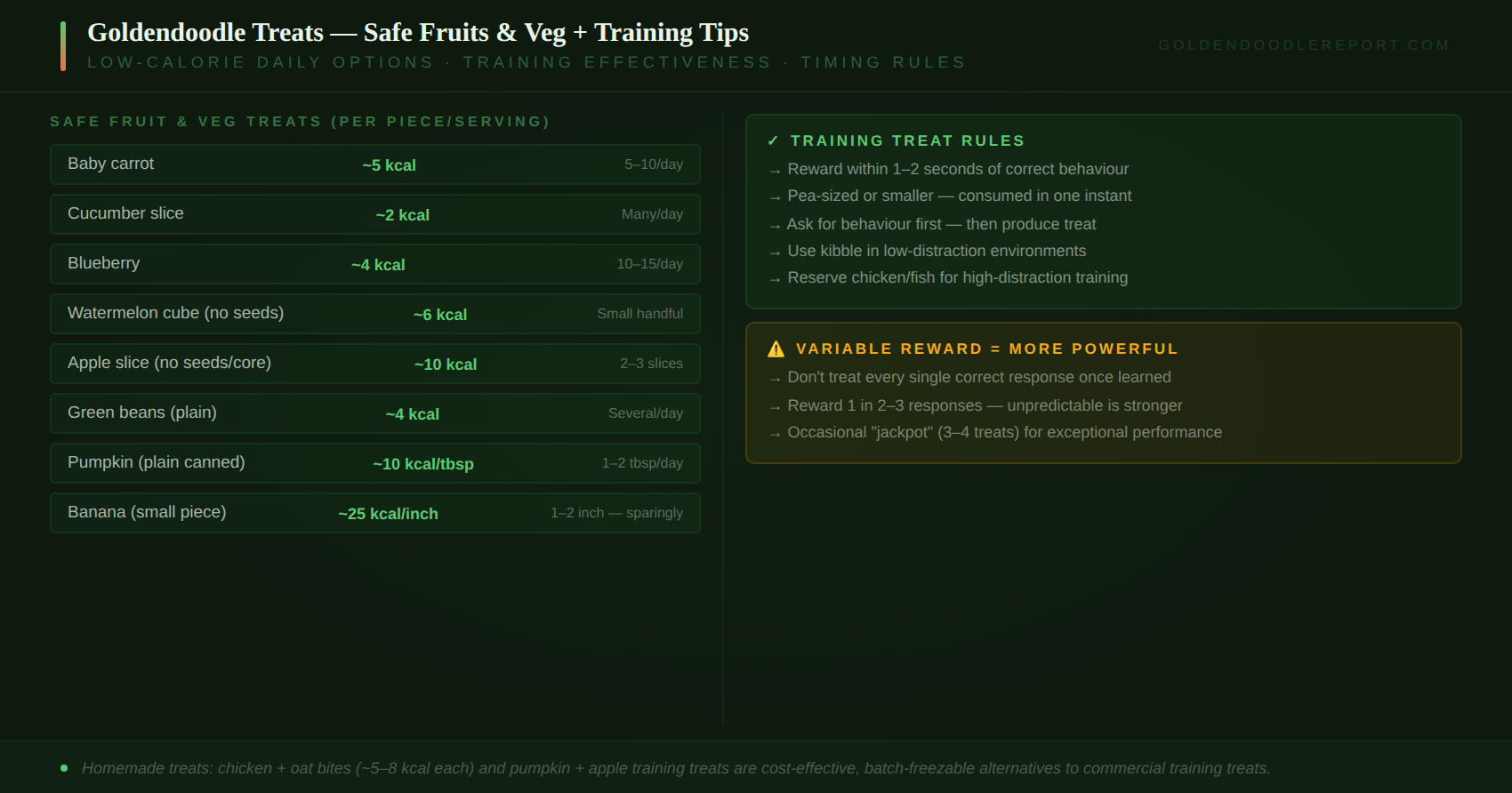
| Baby carrot | ~5 kcal | 5–10 per day | High fibre, crunchy, natural teeth cleaning, widely loved |
| Cucumber slice | ~2–3 kcal | Several per day | 95% water — excellent for hydration; very low calorie |
| Blueberry | ~4 kcal | 10–15 per day | Antioxidant-rich; good size for training; most dogs love them |
| Watermelon (seedless, no rind) | ~5–8 kcal/cube | Small handful | High water content; cooling in hot weather; remove all seeds |
| Apple slice (no seeds/core) | ~8–12 kcal/slice | 2–3 slices | Good fibre; remove all seeds (contain cyanogenic compounds) |
| Green beans (plain) | ~4 kcal | Several per day | Filling, low calorie, excellent weight management treat |
| Plain canned pumpkin | ~10 kcal/tbsp | 1–2 tbsp/day | Soluble fibre aids digestion; helps firm loose stool; dogs love it |
| Banana (small amount) | ~25 kcal per inch | 1–2 inch piece | Higher sugar — use sparingly; good occasional treat |
Dental Chews — What to Choose
Treats are not required to be AAFCO-validated the way complete diets are, but choosing brands that follow AAFCO’s ingredient labelling standards makes it far easier to verify what is actually in the product before giving it to your Goldendoodle.
Dental chews serve a legitimate purpose — the mechanical action of chewing removes plaque and tartar buildup from teeth, reducing the risk of periodontal disease. However, they are often overlooked as calorie contributors and are frequently over-used.
What to look for
- VOHC (Veterinary Oral Health Council) seal: The gold standard for dental efficacy claims. Products with this seal have been independently tested and proven to reduce plaque or tartar. Products without it make dental claims that have not been independently verified.
- Appropriate size: Dental chews come in size-graded options — always use the size appropriate to your dog’s weight. A dental chew designed for a 60 lb dog will be difficult for a 20 lb Mini to manage safely.
- Calorie content: Check the kcal per chew and include it in the daily treat budget. Many popular dental chews contain 50–100 kcal — the equivalent of an entire treat allowance for a Mini Goldendoodle.
- Supervision required: Dogs that eat aggressively can bite off large pieces and swallow them, creating choking or obstruction risk. Supervise during dental chew sessions.
What to avoid in dental chews
- Rawhide: indigestible, can form compacted masses in the digestive tract, often processed with chemical bleaching. Not recommended.
- Real bones (cooked): dangerous regardless of dental intent — see our Can Goldendoodles Eat Chicken article for the cooked bone hazard explanation.
- Very hard chews (antlers, bison horns, hard nylon chews): can cause tooth fractures in strong-jawed dogs — the “sore thumb test” applies: if you press your thumbnail against the chew and it does not give at all, it is too hard for dog teeth.
Homemade Treat Ideas
Homemade treats give you complete control over ingredients, are usually cheaper than commercial alternatives, and can be made in batches and frozen. These three recipes use only dog-safe ingredients.
Frozen peanut butter and banana bites
Important: Check the peanut butter label for xylitol before using — it must not contain xylitol, which is toxic to dogs. Use unsalted, natural peanut butter with the only ingredients being peanuts (and possibly salt — low sodium is preferable). Mix 2 tablespoons natural peanut butter with one small mashed banana. Spoon into an ice cube tray or silicone mould. Freeze for 3 hours. These are higher calorie and best as an occasional reward rather than a daily treat.
Chicken and oat training bites
Blend 100g plain boiled chicken breast with 50g plain oats and one egg. Mix into a stiff dough, roll thin, and cut into small squares (approximately 1cm). Bake at 180°C (350°F) for 12–15 minutes until firm. Store in the fridge for up to 5 days or freeze in batches. These are approximately 5–8 kcal per piece and ideal for high-repetition training sessions.
Pumpkin and apple training treats
Mix 4 tablespoons plain canned pumpkin with 1 cup wholemeal flour and half a grated apple (core and seeds removed). Add enough water to form a firm dough. Roll thin, cut into small shapes, bake at 170°C (340°F) for 20 minutes until hard. Low calorie, digestive-friendly, shelf-stable for up to 2 weeks in an airtight container.
Toxic Foods — Never Give These to Your Goldendoodle
Xylitol, a sugar substitute increasingly common in “natural” and reduced-sugar products, is safe for human consumption but triggers a rapid, dangerous insulin release in dogs — making label-checking a genuine safety habit, not an overcautious one.
🚨 The following foods are toxic to dogs. Some are rapidly fatal at small doses. This list must be known by every person in your household who interacts with your Goldendoodle.
| Toxic Food | Why Dangerous | If Consumed |
|---|---|---|
| Xylitol (peanut butter, gum, sweets, vitamins) |
Causes sudden severe hypoglycaemia and liver failure within 15–30 minutes of ingestion | Emergency vet immediately — do not wait for symptoms |
| Grapes and raisins | Cause acute kidney failure — toxic threshold varies between individual dogs, making any amount unsafe | Contact vet immediately even if only a few were consumed |
| Chocolate (all types — dark most toxic) |
Theobromine and caffeine cause vomiting, seizures, cardiac arrhythmia, death. Dark chocolate is the most dangerous. | Contact vet immediately — describe the type and amount consumed |
| Garlic and onion (all forms including powder) |
Thiosulfate compounds destroy red blood cells. Garlic is 5× more toxic per weight than onion. Cumulative with repeated small doses. | Contact vet — symptoms may appear 1–5 days after ingestion |
| Macadamia nuts | Cause weakness, hyperthermia, vomiting, tremors within 12 hours — mechanism not fully understood | Contact vet — typically recovers with treatment within 48 hrs |
| Alcohol | Far more toxic to dogs than humans, weight-for-weight. Ethanol poisoning causes CNS depression, respiratory failure. | Emergency vet immediately |
| Avocado | Persin (in flesh, skin, and pit) causes vomiting, diarrhoea, and fluid accumulation around heart | Contact vet — monitor for respiratory difficulty |
| Caffeine (coffee, tea, energy drinks) |
Causes rapid heart rate, tremors, seizures, collapse | Emergency vet immediately |
| Cooked bones | Splinter into sharp fragments — GI perforation risk | Monitor 48 hrs — vet if any GI symptoms appear |
| Nutmeg | Myristicin causes hallucinations, increased heart rate, disorientation at moderate doses | Contact vet if more than a trace amount consumed |
Note on peanut butter and xylitol: Standard peanut butter (Skippy, Jif, Adams) does not contain xylitol and is safe in small amounts. However, some brands of “natural,” “reduced sugar,” and “diet” peanut butters do contain xylitol. Always read the ingredient label before giving any peanut butter product to your dog — every single time, not just once when you buy a new jar.
How to Use Treats Effectively in Training
Treats are the most powerful training tool available for Goldendoodles — but the effectiveness depends almost entirely on how you use them, not how much you give.
Timing is everything
A treat delivered within 1–2 seconds of the correct behaviour reinforces that behaviour. A treat delivered 5 seconds later reinforces whatever the dog was doing 2 seconds ago — which is rarely what you intended. Always have treats immediately accessible during training. A treat pouch worn on the body solves the 3-second fumble-in-pocket problem that undermines most home training attempts.
Vary the reward — unpredictable is more powerful
Research on reward schedules shows that variable reinforcement (sometimes a treat, sometimes praise, occasionally a jackpot of multiple treats) is more powerful for maintaining behaviour than predictable every-time reinforcement. Once a behaviour is established, vary your reward pattern — give a treat for 1 in every 2 or 3 correct responses rather than every single one. Reserve high-value treats (chicken, cheese) for difficult environments or particularly fast learning moments.
Use treats to build associations, not to bribe
The most common training mistake: showing the dog the treat before asking for the behaviour. This teaches the dog to perform only when the treat is visible. Ask for the behaviour first — give the cue, wait for the response, then produce the reward. This is the difference between a dog that obeys and a dog that only performs when food is visible. For the full training framework: our How to Train a Goldendoodle guide is available in the Training category.
Treats for Goldendoodle Puppies
Puppies need treats for training but have specific considerations that differ from adult Goldendoodles:
- Even smaller pieces: Puppy treats should be even smaller than adult training treats — a rice grain to pea-sized maximum. Puppies eat fast and do not need large pieces to be motivated.
- Soft only: Puppies under 3 months are still developing their bite and jaw strength. Hard treats, biscuits, and dental chews appropriate for adults can cause dental problems in young puppies.
- Stick to simple ingredients: Puppies’ digestive systems are more sensitive than adults. Start with plain boiled chicken, their regular kibble, or simple single-ingredient freeze-dried treats. Introduce new treat ingredients one at a time with a 24-hour observation window.
- No dental chews until 6+ months: Most dental chews are not appropriate for puppies — check the label for minimum age guidance.
- No rawhide at any age.
- Puppy-specific treat budget: Treats for puppies should be included in the daily calorie calculation from day one. For puppy calorie amounts: How Much to Feed a Goldendoodle.
For the best commercial treat options for Goldendoodle puppies specifically: Best Puppy Treats for Goldendoodles.
🔑 Key Takeaways
- Treats should not exceed 10% of daily calorie intake — always subtract treat calories from main meals rather than adding them on top
- The most effective training treats are small (pea-sized), soft, consumed instantly, and high-value — plain boiled chicken pieces and single-ingredient freeze-dried treats are the gold standard
- Baby carrots, cucumber, blueberries, and green beans are excellent low-calorie daily treats that most Goldendoodles enjoy and that add negligible calories
- Check every peanut butter label for xylitol before using — this sweetener is rapidly fatal to dogs and appears in some “natural” and “diet” peanut butters
- Grapes, raisins, chocolate, garlic, onion, and macadamia nuts are toxic at varying doses — all household members must know this list
- Dental chews are useful for oral health but count toward the daily calorie budget — one medium dental chew can use the entire treat allowance for a Mini Goldendoodle
📚 More Goldendoodle Food & Nutrition Guides
- How Much to Feed a Goldendoodle: Amounts by Age + Weight
- Goldendoodle Weight Management: How to Help Safely (2026)
- Can Goldendoodles Eat Chicken? What’s Safe + What to Avoid
- Goldendoodle Food Allergies: Signs, Triggers + What to Feed
- Goldendoodle Sensitive Stomach: 5 Foods That Actually Help
- Raw Diet for Goldendoodles — coming soon
- Goldendoodle Nutrition Guide (complete pillar) — coming soon
Browse all guides: Goldendoodle Food & Nutrition category
🔗 Related Guides Across the Site
- Best Puppy Treats for Goldendoodles — puppy-specific treat recommendations
- Why Is My Goldendoodle Always Hungry? — food motivation and treat behaviour
- Goldendoodle Puppy Biting Phase Guide — using treats correctly in bite inhibition training
- When Do Goldendoodle Puppies Calm Down? — treat-based enrichment during high-energy phases
- Do Goldendoodles Smell Bad? — how treats affect breath and body odour
Frequently Asked Questions
How many treats can I give my Goldendoodle per day?
It depends on the calorie content of the treats and your dog’s daily calorie needs. The 10% rule: treats should account for no more than 10% of daily calories. A 50 lb Standard Goldendoodle eating approximately 1,100 kcal per day has a treat budget of about 110 kcal. That is roughly 2–3 medium commercial biscuits, or 20–25 small training treats (at 4–5 kcal each), or 10+ baby carrots. Track the calories of every treat type you use and calculate accordingly.
Can Goldendoodles eat peanut butter?
Yes — plain, unsalted peanut butter that does not contain xylitol is safe for Goldendoodles in small amounts. The critical step is checking every label every time. Some “natural,” “diet,” and “reduced sugar” peanut butters contain xylitol, which is rapidly fatal to dogs. Standard brands (Skippy, Jif, Adams in the US; standard natural brands in other regions) do not contain xylitol — but verify. Do not assume. Given peanut butter’s relatively high fat content, use it sparingly — a thin smear inside a Kong toy rather than a spoonful as a treat.
What is the best treat to use for training a Goldendoodle?
Plain boiled chicken breast cut into pea-sized pieces is the most consistently effective training treat for Goldendoodles — high value, soft, consumed instantly, low calorie at this portion size, and almost universally motivating. For convenience, single-ingredient freeze-dried chicken or meat treats broken into small pieces work well and are shelf-stable. In low-distraction environments, your dog’s own kibble works perfectly and adds no extra calories. Reserve the highest-value treats (chicken, fish) for high-distraction training environments where motivation needs to be highest.
Are carrots good treats for Goldendoodles?
Yes — baby carrots are one of the best daily treats for Goldendoodles. They are low calorie (approximately 5 kcal each), high in fibre, provide some mechanical teeth-cleaning benefit, and most Goldendoodles enjoy them enthusiastically. The crunch factor helps, and there is essentially no risk of overfeeding given the very low calorie content. They work well as an everyday reward when you want to give something without meaningfully denting the daily calorie budget.
Is it okay to give my Goldendoodle treats every day?
Yes, provided the total treat calories stay within the 10% daily limit and are subtracted from main meal portions rather than added on top. Daily treats are also a normal part of training reinforcement and relationship maintenance. The problem is not frequency — it is untracked quantity. An owner who gives 3 treats per day while tracking them and adjusting meals accordingly is doing everything correctly. An owner who gives 15 treats per day without tracking is inadvertently contributing to weight gain regardless of how good their intentions are.
Disclaimer: The information in this article is provided for general educational purposes only. King James Adjei is a researcher and enthusiast, not a veterinarian. If your Goldendoodle has ingested a potentially toxic food — particularly xylitol, chocolate, grapes, or garlic — contact your veterinarian or an emergency animal poison control service immediately. Do not wait for symptoms to appear before seeking advice for potential toxic ingestion.