Affiliate Disclosure: Some links in this guide are affiliate links. If you purchase through them, we may earn a small commission at no extra cost to you. Read our full affiliate disclaimer here.
By King James Adjei — Researcher and Goldendoodle enthusiast, founder of GoldendoodleReport.com. Every guide on this site is carefully researched and written to give owners reliable, clearly organised information — updated regularly and honest about uncertainty. → About this site
📖 6-minute read | Last updated April 2026 | Reviewed for accuracy
The best comb for Goldendoodles is the most underrated tool in the Goldendoodle grooming kit — and the one that, when absent, most directly explains why regular brushing still produces mats. The comb is not a secondary tool or a finishing touch. It is the quality control step that confirms whether the brushing session actually reached the skin. Without it, there is no reliable way to know. This guide explains exactly what the comb does, what type to buy, and what to look for so the comb check works as it should.
👤 Who This Guide Is For
- You want to know which comb to buy for your Goldendoodle and what to look for
- You have been brushing consistently but still find mats at grooming appointments and want to know what is missing
- You understand the comb check concept and want to choose the right comb to perform it correctly
- You want to understand why the comb and brush are used together rather than either alone
⚡ Quick Summary
The best comb for a Goldendoodle is a stainless steel combination comb — one that has a wide-tooth section on one half and a medium or fine-tooth section on the other. The wide-tooth section is used for the body coat after brushing; the finer section for the face, ears, and legs where coat is denser. Rotating teeth reduce drag significantly and are worth seeking out for dense curly coats. The comb is always used after the slicker brush as a quality check — run from skin to tip through every section. If it passes freely, the section is mat-free. If it catches, continue brushing that area.
✅ Quick Answer — Comb Selection Summary
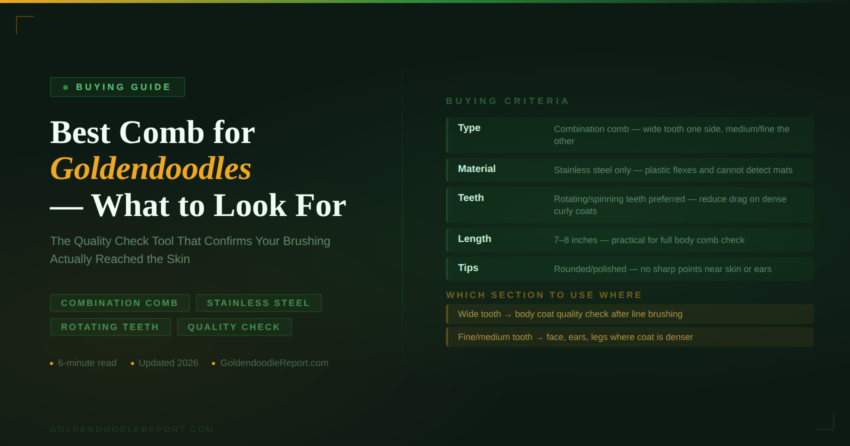
- Type: Stainless steel combination comb — wide tooth one side, medium/fine the other
- Teeth: Rotating teeth preferred — reduce drag on dense curly coats
- Material: Stainless steel only — will not rust, will not flex or bend under pressure
- Length: Medium comb length (approximately 7 to 8 inches) — practical for full body use
- What to avoid: Plastic combs, single-width combs with very fine teeth only, combs with rounded plastic handles that flex
For how to use the comb correctly see How to Brush a Goldendoodle and How to Line Brush a Goldendoodle. For the complete tools checklist see Goldendoodle Grooming Tools Checklist.
Best Comb for Goldendoodles — Why the Comb Is Non-Negotiable
The comb and the slicker brush serve completely different functions — they are not alternatives to each other, and neither is sufficient alone.
The slicker brush performs the brushing work: removing loose hair, working through tangles, and reaching the base layer of the coat when the line brushing technique is applied correctly. But the slicker brush has a limitation — it does not reliably detect whether it has actually reached the base layer everywhere, or whether developing mats at skin level have been fully cleared. The visual appearance of the coat after brushing is not a reliable indicator. A coat that looks smooth can still have significant mat development at skin level.
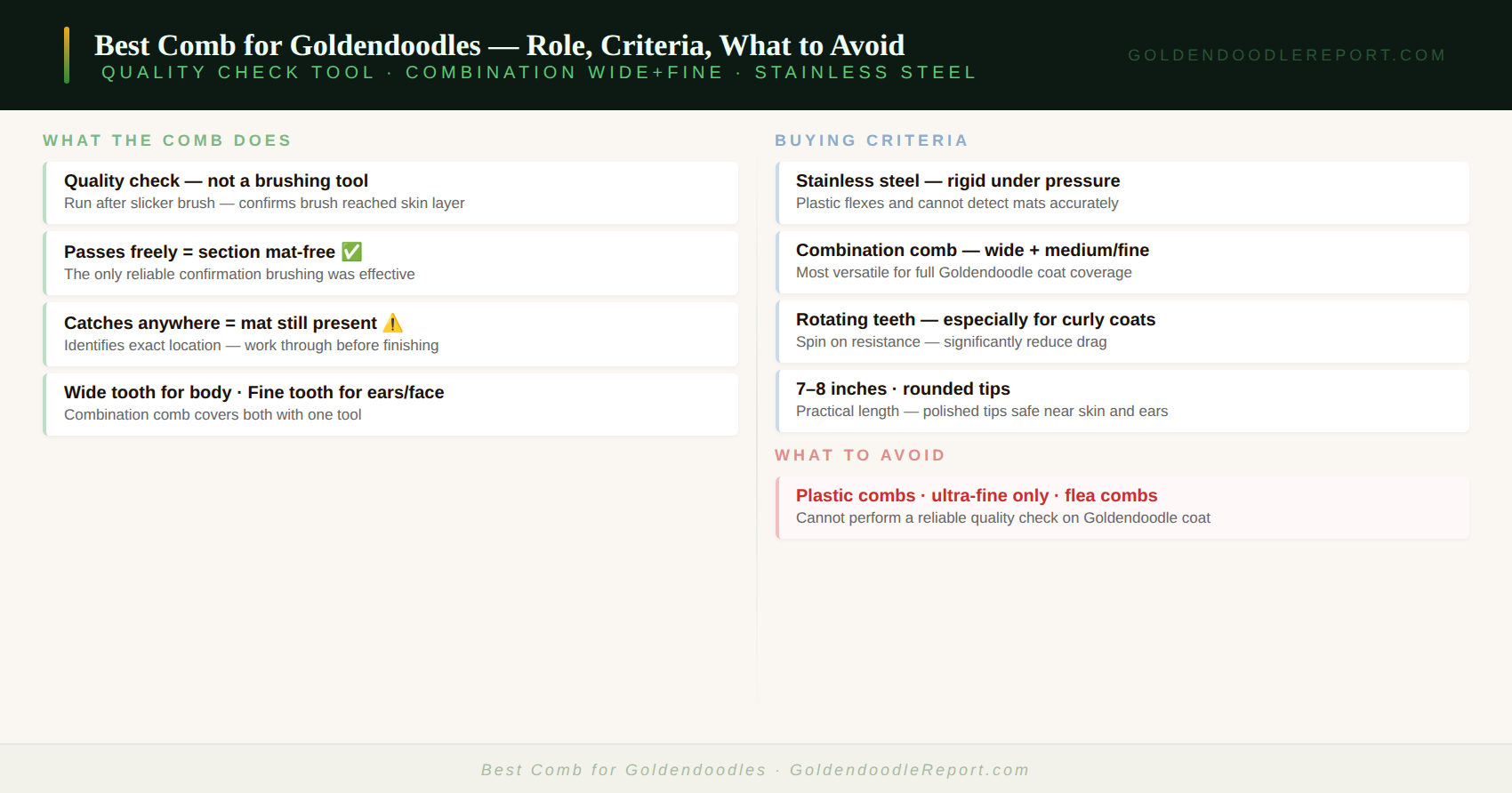
The metal comb is the diagnostic tool that resolves this uncertainty. Run from skin to tip through a brushed section, the comb physically cannot pass through an area that still has a developing mat — the teeth catch. When the comb passes freely through every section from skin to tip, the brushing session is confirmed as effective. When it catches, the location and extent of the remaining mat is immediately identified.
This is why the comb check is not optional — it is the step that converts a brushing routine from one that feels thorough into one that is confirmed thorough. For the full technique see How to Line Brush a Goldendoodle.
Why a Combination Comb Is the Correct Choice
A combination comb has two different tooth spacings on the same comb — typically wide-tooth on one half and medium or fine-tooth on the other. This single tool covers every area of the Goldendoodle coat effectively.
Wide-tooth section (used for body coat): The wider spacing between teeth allows the comb to move through the dense body coat without excessive drag. After thorough line brushing, the body coat should be mat-free — the wide-tooth section confirms this quickly and efficiently. Wide spacing also makes the comb effective for working through early-stage tangles in areas like the neck and back where the coat is thicker but less tightly packed than the curly sections.
Fine or medium-tooth section (used for face, ears, and legs): These areas have denser, shorter coat that requires closer tooth spacing to effectively detect fine mat formation and loose hair accumulation. The ears in particular — which are one of the highest mat-risk areas on a Goldendoodle — require the finer-tooth section to detect developing mats that the wide-tooth section would pass over. See Goldendoodle Ear Cleaning Guide for the full ear protocol.
A single-width comb — whether wide-tooth only or fine-tooth only — forces a compromise. Wide-tooth only means the ear and face areas are not checked effectively. Fine-tooth only means the body coat produces excessive drag and the comb check takes significantly longer than necessary. The combination comb eliminates both problems.
Rotating Teeth — Why They Matter for Goldendoodle Coats
Rotating teeth — sometimes called spinning teeth — are individual comb teeth that rotate freely in their mounting. When the comb meets resistance, rotating teeth spin slightly rather than dragging the coat, significantly reducing the pulling sensation on the dog and making the comb check more comfortable.
For wavy-coated Goldendoodles, rotating teeth are useful but not essential — the coat density is lower and a standard fixed-tooth comb produces manageable drag. For curly-coated Goldendoodles — which have the densest base layer and the most mat risk — rotating teeth make a meaningful difference in the comfort of the comb check and reduce the resistance the owner feels during the pass. Dogs who have previously been resistant to the comb check often accept it significantly better when rotating teeth are used.
Rotating teeth combs are slightly more expensive than fixed-tooth combs but the difference is typically modest. For owners of curly-coated Goldendoodles, this is one of the more worthwhile small upgrades in the grooming kit.
Best Comb for Goldendoodles — Complete Buying Criteria
Material — stainless steel only
The comb must be stainless steel throughout — including the teeth. Stainless steel does not rust, does not flex or bend under the pressure of working through a dense Goldendoodle coat, and maintains consistent tooth spacing over years of use. Combs with plastic handles are acceptable if the teeth are steel, but combs with any plastic teeth are not — plastic teeth flex under pressure and do not provide the firm, consistent pass required for a reliable comb check.
Tooth spacing — combination wide and medium/fine
Look for a combination comb with clearly differentiated sections — typically described as “half and half,” “7/16 and 3/16 inch spacing,” or similar descriptions of the two sections. The widest available spacing for the coarse section and medium (not ultra-fine) for the fine section is the most versatile combination for Goldendoodle coat types.
Comb length — approximately 7 to 8 inches
A medium-length comb (7 to 8 inches total) is the most practical size for a full Goldendoodle body comb check. Shorter combs require too many passes to cover the coat efficiently; longer combs become unwieldy in tight areas. Most professional-quality dog grooming combs fall in this range.
Handle design
A simple straight handle integrated into the comb body — typical of professional dog grooming combs — is the most practical design. Ergonomic or grip-enhanced handles are available and worth considering for owners who find the standard design slippery. Avoid designs where the handle is a separate piece attached to the comb body — these connection points are the first to fail with regular use.
Tooth tip finish
Look for combs with rounded or polished tooth tips. Pointed or rough tooth tips cause discomfort when the comb contacts the skin during the check pass, particularly in sensitive areas like behind the ears and in the armpit region. Most quality stainless steel combs have polished tips — this is usually confirmed in product descriptions.
What Not to Buy
Plastic combs: Do not flex consistently under pressure, lose tooth spacing over time, and cannot be used with enough firm pressure to perform a reliable quality check. Not appropriate for Goldendoodle coat management.
Ultra-fine tooth combs only: Produce excessive drag on the body coat and make the comb check slow and uncomfortable. Use the fine section only for face and ear areas — not as the primary comb for the body coat.
Flea combs: Extremely fine spacing designed to trap parasites — not appropriate for mat detection or routine coat quality checking on a Goldendoodle.
Very short “pocket” combs: Too small to perform a full-body quality check efficiently. Reserve small combs for face and ear work only if the primary comb is too large for those areas.
For authoritative guidance on dog grooming tools see the AKC dog grooming guide.
✅ Your Next Step
If you do not currently own a metal comb — buy one today. It is the single item most likely to be missing from the grooming kit of an owner who brushes regularly but still develops mats. The comb check after every brushing session is what converts a routine that looks thorough into one that is confirmed thorough. For the complete grooming guide see Goldendoodle Grooming Guide.
🔑 Key Takeaways
- The metal comb is the quality check tool — run after every brushing session from skin to tip to confirm the slicker brush reached the base layer where mats form
- A combination comb with wide-tooth on one side and medium/fine on the other covers every coat area — body coat with wide tooth, face and ears with fine tooth
- Rotating teeth reduce drag significantly on dense curly coats and are worth seeking out for curly-coated Goldendoodles
- Stainless steel throughout is non-negotiable — plastic combs flex under pressure and cannot provide a reliable quality check
- 7 to 8 inches total length is the most practical size for full-body use on a standard or mini Goldendoodle
- The comb and brush are used together — the brush grooms, the comb confirms. Neither is sufficient alone.
📚 Continue Learning
- Goldendoodle Grooming Guide — complete grooming authority guide
- How to Brush a Goldendoodle — how brush and comb work together
- How to Line Brush a Goldendoodle — when and how the comb check is performed
- Best Brush for Goldendoodles — the tool used before the comb check
- Goldendoodle Grooming Tools Checklist — the complete tools list
- Goldendoodle Ear Cleaning Guide — why the fine-tooth section matters for ears
- Goldendoodle Matting Prevention — the full mat prevention protocol
↑ Back to: Goldendoodle Grooming Tools Checklist | Goldendoodle Grooming Guide | Goldendoodle Grooming — All Articles
Frequently Asked Questions
What is the best comb for a Goldendoodle coat?
A stainless steel combination comb with wide-tooth spacing on one half and medium or fine-tooth spacing on the other. This single tool covers the full Goldendoodle coat — wide tooth for the body coat quality check after brushing, fine tooth for the face, ears, and legs where the coat is denser. Rotating teeth are a useful upgrade for curly-coated Goldendoodles as they significantly reduce drag during the comb check.
What is a comb used for when grooming a Goldendoodle?
The metal comb performs the quality check after every brushing session — not the brushing itself. Run from skin to tip through each section of the coat after using the slicker brush, the comb reveals any areas where the brush did not fully clear developing mats. If the comb passes freely, that section is confirmed mat-free. If it catches anywhere, there is still a mat at that location that needs to be worked through before the session is complete. Without this check, there is no reliable confirmation that the brushing session was effective.
Do I need both a brush and a comb for my Goldendoodle?
Yes — they serve completely different functions. The slicker brush performs the brushing work: removing loose hair and working through the coat to the base layer. The metal comb performs the quality check: confirming the brush reached the skin layer where mats form. A brush without a comb check produces a grooming routine that feels thorough but cannot be confirmed as thorough. A comb without the brush would produce an extremely slow, uncomfortable session — the brush does the work, the comb verifies it.
Why do I need a metal comb rather than a plastic one?
Plastic comb teeth flex under the pressure of working through a dense Goldendoodle coat — particularly when encountering resistance from a developing mat. A tooth that flexes cannot pass through or accurately detect a mat; it bends around it and continues. The comb check only works correctly when the teeth are rigid and maintain consistent spacing under pressure. Stainless steel provides this — plastic does not. Additionally, plastic combs lose their tooth spacing over time and cannot be kept clean as effectively as stainless steel.
Disclaimer: The information in this article is provided for general educational purposes only. King James Adjei is a researcher and enthusiast, not a veterinarian or certified groomer. Product recommendations are based on research and community experience — always review current options and consult your groomer’s advice for your specific dog’s coat type.