Affiliate Disclosure: Some links in this guide are affiliate links. If you purchase through them, we may earn a small commission at no extra cost to you. Read our full affiliate disclaimer here.
By King James Adjei — Researcher and Goldendoodle enthusiast, founder of GoldendoodleReport.com. Every guide on this site is carefully researched and written to give owners reliable, clearly organised information — updated regularly and honest about uncertainty. → About this site
📖 6-minute read | Last updated April 2026 | Reviewed for accuracy
Finding the best dog dryer for Goldendoodles is one of the most impactful decisions in a home grooming setup — and one of the most overlooked. Most owners bathe their Goldendoodle correctly and then undo much of that work by allowing the coat to air-dry. A Goldendoodle coat left to air-dry compresses as the dog lies down or rests, creating the same mat conditions as an unbrushed coat. The right dog dryer prevents this entirely — and does so faster than most owners expect. This guide explains why, what the two main dryer types do differently, and what to look for when buying.
👤 Who This Guide Is For
- You bathe your Goldendoodle at home and want to know which dryer is worth buying
- Your Goldendoodle develops tangles after bathing despite brushing before the bath
- You currently use a human hair dryer and want to know whether a dedicated dog dryer is worth the investment
- You want to understand the difference between force dryers and stand dryers before purchasing
⚡ Quick Summary
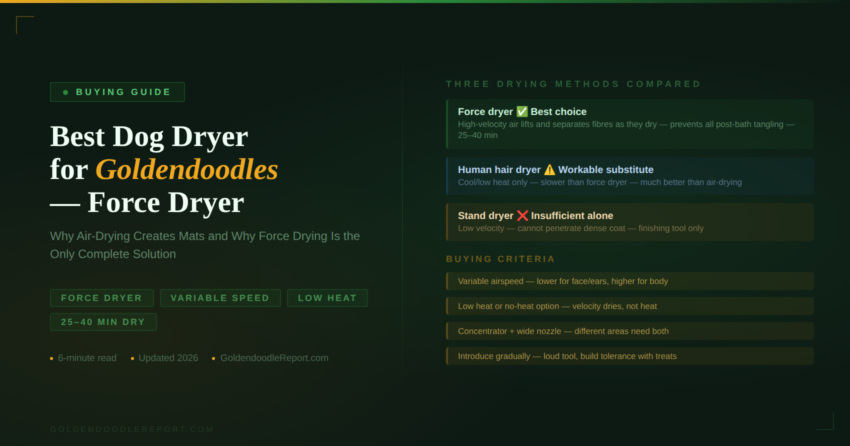
There are two main dog dryer types: force dryers (also called velocity or high-velocity dryers) and stand dryers (also called cage or cabinet dryers). For Goldendoodle coats, a force dryer is the more effective tool — it uses high-velocity airflow to physically push water out of the coat and straighten the coat fibres as it dries, preventing the compressed tangling of air-drying. A stand dryer is a lower-power tool that blows warm air but does not have the velocity to penetrate and straighten the Goldendoodle’s dense coat effectively. For home use, a mid-range force dryer with adjustable airspeed and low heat settings is the correct investment.
For the correct drying technique see How to Dry a Goldendoodle Coat. For the full bathing guide see How to Bathe a Goldendoodle. For the complete tools list see Goldendoodle Grooming Tools Checklist.
Best Dog Dryer for Goldendoodles — Why Force Drying Matters
To understand why a force dryer is the right tool, it helps to understand what happens to a Goldendoodle coat when it air-dries.
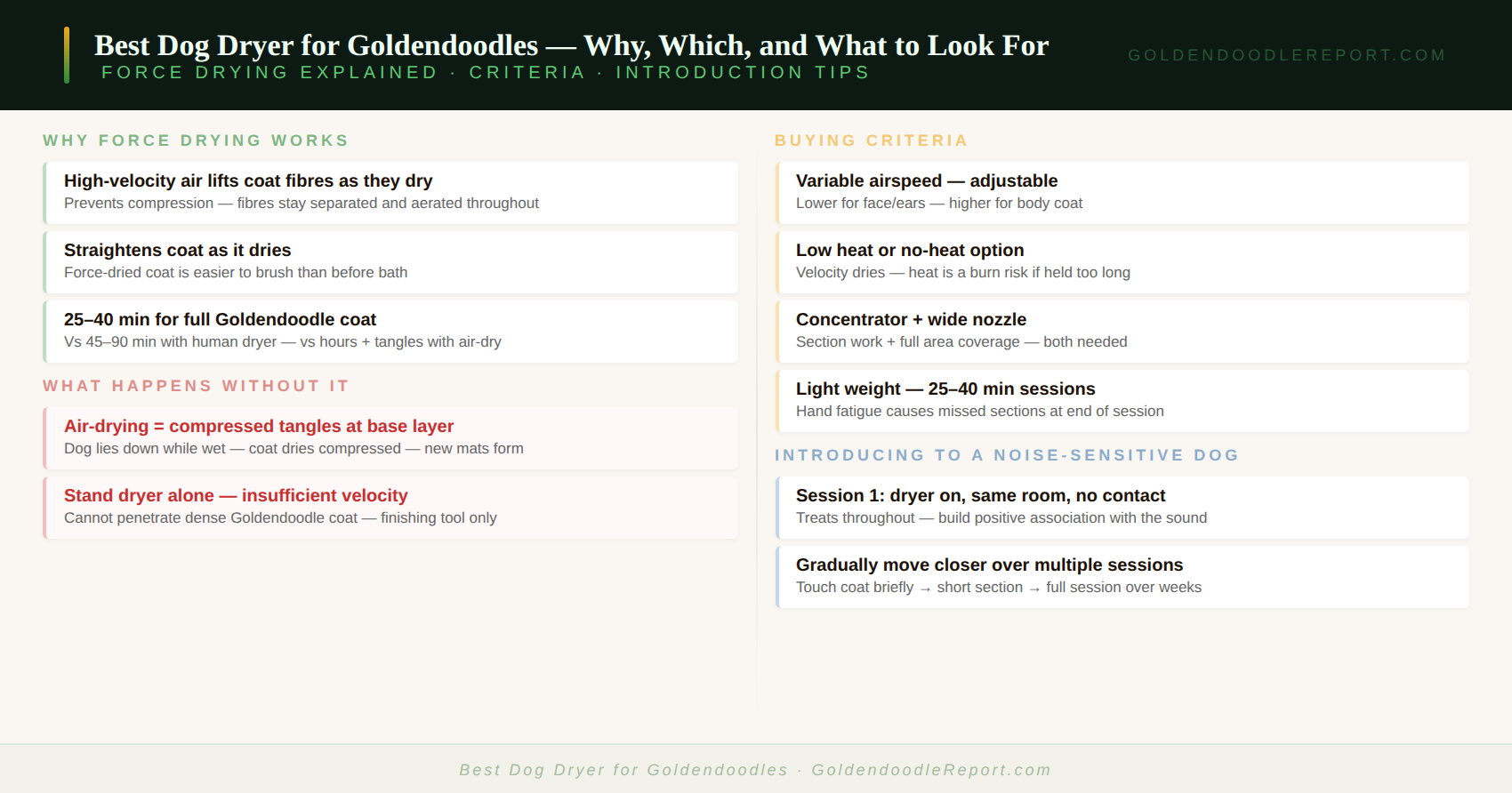
When a Goldendoodle emerges from a bath, the coat is saturated and heavy. As the dog walks, sits, and lies down to dry, the wet coat compresses into whatever position the dog settles in. Wet coat fibres are significantly more susceptible to tangling than dry ones — moisture increases the friction between fibres and makes them stick together. A dog who air-dries on their side will have the coat on that side dry compressed, creating tangles at the base layer across the entire contact area. These are new tangles that were not present before the bath.
A force dryer addresses this problem directly. The high-velocity airflow physically lifts and separates coat fibres as they dry — keeping them moving and aerated rather than compressed. The coat dries evenly, in the correct position, without the fibre-to-fibre friction that creates tangles. The result is a coat that is actually easier to brush after the bath than before it — the force drying process effectively pre-straightens the coat as it removes moisture.
This is why professional groomers use force dryers as a standard tool and almost never allow the Goldendoodle coat to air-dry. The drying method is as important as the bathing method for coat condition outcomes.
Force Dryer vs Stand Dryer — Which Is Right for Goldendoodles
Force dryer (velocity/high-velocity dryer) — the correct primary tool
A force dryer uses a powerful motor to produce high-velocity, room-temperature or low-heat airflow. The velocity — not the heat — is what dries the coat. At professional grade, force dryers can dry a fully wet Goldendoodle coat in 15 to 25 minutes. At home mid-range grade, expect 25 to 40 minutes. The velocity also fluffs and straightens the coat as it dries, producing a properly dried coat that is significantly easier to brush than one that has been air-dried or heat-dried.
Force dryers are loud — typically 70 to 85dB depending on the motor. This is the primary challenge with force dryers for home use: dogs who are sensitive to noise may find the sound stressful. Introduction should be gradual — running the dryer at a distance with treats before bringing it close, building tolerance over several sessions before attempting a full drying session. The long-term payoff is significant: a dog who accepts the force dryer makes home grooming dramatically faster and more effective.
Stand dryer — limited usefulness for dense Goldendoodle coats
A stand dryer (or cage dryer) is a lower-power device that blows heated air at lower velocity. It is designed to work as a finishing tool after initial towel drying or force drying — bringing remaining moisture out of a coat that is already mostly dry. For short-coated or single-coated breeds, stand dryers work adequately as a primary drying method. For the dense, multi-layered Goldendoodle coat, the airflow is insufficient to penetrate to the base layer and straighten the coat effectively.
Stand dryers are also a heat risk — they blow continuous warm air at a stationary dog, which can cause overheating if the dog is left unattended. Professional groomers use them as finishing tools under supervision, not as primary drying devices for dense coats. For home Goldendoodle grooming, a stand dryer alone is not sufficient.
Human hair dryer — a workable substitute with limitations
A human hair dryer on a low heat or cool setting can substitute for a force dryer for owners who are not yet ready to invest in a dedicated dog dryer. It produces lower velocity airflow and requires more passes to achieve the same drying result, making it significantly slower. The heat settings on human hair dryers can also be too high for dog skin — always use the lowest heat setting or cool setting only. A diffuser attachment reduces velocity further and makes it less effective. Despite these limitations, a human hair dryer used correctly — with a brush, low heat, and full coat coverage — is significantly better than air-drying.
Best Dog Dryer for Goldendoodles — Complete Buying Criteria
Airspeed control — adjustable
Variable airspeed is the most important buying criterion for home use. A force dryer at full power is too intense for the face, ears, and sensitive areas. Variable speed allows lower airflow for sensitive areas and higher airflow for the dense body coat. Force dryers with a single fixed maximum speed are significantly harder to use safely around the face and ears.
Heat settings — low heat or no heat
Force dryers should be used at low heat or no heat for Goldendoodle coats. The velocity dries the coat — the heat is not required and creates a burn risk if held too close or too long on any section. Look for dryers with a clearly separated heat control from the airspeed control. Avoid dryers that only offer heated airflow with no cool option.
Noise level
Force dryers are inherently louder than stand dryers and human hair dryers. For dogs who are noise-sensitive, a quieter motor in the 65 to 75dB range is worth seeking out even if it costs more. For dogs who are not particularly noise-sensitive, the standard 75 to 85dB range of most home force dryers is acceptable.
Nozzle and attachment options
A concentrator nozzle that narrows the airflow to a specific direction is useful for working through sections of the coat systematically. A wider diffuser nozzle covers more area per pass for the body coat. A dryer that comes with both nozzle options — or a universal nozzle that can be adjusted — gives the most flexibility for different coat areas.
Weight and cord length
A full Goldendoodle drying session takes 25 to 40 minutes. A heavy dryer causes hand fatigue that results in missed sections in the final stages. Look for the lightest motor design available at the performance level required. Cord length of at least 6 feet is practical for grooming table use without being tethered too close to the outlet.
For authoritative guidance on dog grooming see the AKC dog grooming guide.
✅ Your Next Step
If your Goldendoodle develops tangles after bathing despite correct brushing beforehand, the drying method is almost certainly the cause. A mid-range force dryer with variable airspeed and low-heat option is the correct investment. Introduce it gradually over several sessions with treats before attempting a full drying session. The difference in coat condition after bath — force-dried versus air-dried — is immediately visible. For the correct drying technique see How to Dry a Goldendoodle Coat. For the complete grooming guide see Goldendoodle Grooming Guide.
🔑 Key Takeaways
- Air-drying a Goldendoodle coat allows it to dry compressed and tangled — the drying method is as important as the bathing method for coat condition outcomes
- A force dryer uses high-velocity airflow to physically straighten coat fibres as they dry — preventing the mat conditions that air-drying creates
- Force dryers are loud — introduce gradually with treats over multiple sessions before attempting a full drying session on a noise-sensitive dog
- Stand dryers are insufficient as a primary drying tool for dense Goldendoodle coats — use them as a finishing tool only if at all
- A human hair dryer on cool or low heat is a workable substitute — significantly better than air-drying but slower and less effective than a force dryer
- Variable airspeed and a low-heat or no-heat option are the two most important buying criteria for home use
📚 Continue Learning
- Goldendoodle Grooming Guide — complete grooming authority guide
- How to Dry a Goldendoodle Coat — the correct drying technique
- How to Bathe a Goldendoodle — bathing before drying
- Goldendoodle Matting Prevention — why drying method is part of mat prevention
- Best Shampoo for Goldendoodles — the other bathing tool
- Goldendoodle Grooming Tools Checklist — full kit overview
↑ Back to: Goldendoodle Grooming Tools Checklist | Goldendoodle Grooming Guide | Goldendoodle Grooming — All Articles
Frequently Asked Questions
What is the best dog dryer for Goldendoodles?
A force dryer (also called a velocity or high-velocity dryer) with adjustable airspeed and a low-heat or no-heat option. The force dryer’s high-velocity airflow physically lifts and separates coat fibres as they dry, preventing the compressed tangling that air-drying causes. A mid-range home force dryer with variable speed control and at least two nozzle options is the correct investment for most Goldendoodle owners who bathe at home.
Can I use a human hair dryer on my Goldendoodle?
Yes — as a substitute, not as an equivalent. A human hair dryer on cool or low heat, used with a brush to keep the coat moving as it dries, is significantly better than air-drying. It is slower and less effective than a purpose-built force dryer — a full Goldendoodle coat that a force dryer dries in 25 to 40 minutes may take 45 to 60 minutes or more with a human hair dryer. Never use high heat settings from a human hair dryer on a dog’s coat — the heat is too intense for dog skin and can cause discomfort and coat damage.
Why does my Goldendoodle get tangled after a bath even though I brush before?
Almost certainly because of air-drying. A coat that is fully tangle-free before the bath will develop significant new tangles if it is allowed to air-dry — particularly in the base layer where the dog lies against a surface as the coat dries. Force drying prevents this by keeping the coat fibres separated and moving throughout the drying process. Switching from air-drying to force drying after an otherwise correctly managed bath will typically eliminate post-bath tangling.
Are force dryers safe for Goldendoodles?
Yes — when used correctly. Force dryers should be used at low heat or no heat, at a distance of at least 6 to 8 inches from the coat, with the nozzle kept moving rather than stationary on any section. The high-velocity airflow is not harmful to the coat or skin when used with correct technique. The primary concern for force dryers and sensitive dogs is noise — introduce gradually over multiple sessions with treats before attempting a full drying session.
Disclaimer: The information in this article is provided for general educational purposes only. King James Adjei is a researcher and enthusiast, not a veterinarian or certified groomer. Product recommendations are based on research and community experience — always review current options and consult your groomer’s advice for your specific dog’s coat type.