Affiliate Disclosure: Some links in this guide are affiliate links. If you purchase through them, we may earn a small commission at no extra cost to you. Read our full affiliate disclaimer here.
By King James Adjei — Researcher and Goldendoodle enthusiast, founder of GoldendoodleReport.com. Every guide on this site is carefully researched and written to give owners reliable, clearly organised information — updated regularly and honest about uncertainty. → About this site
📖 7-minute read | Last updated April 2026 | Reviewed for accuracy
The Goldendoodle teddy bear cut is the most requested haircut style for the breed — and for good reason. It produces the rounded, fluffy, stuffed-animal appearance that most people picture when they think of a Goldendoodle. But the teddy bear cut is also the most misunderstood style in terms of what it actually involves, what it looks like on different coat types, and what it demands from the owner between appointments. This guide covers everything: what the teddy bear cut is, how it differs from other styles, how to describe it to your groomer, what to expect on your specific coat type, and how to maintain it.
👤 Who This Guide Is For
- You want the teddy bear cut for your Goldendoodle and need to know exactly how to describe it to your groomer
- Your dog had a teddy bear cut that did not look like expected and you want to understand why
- You want to know what maintaining a teddy bear cut actually involves before committing to it
- You are comparing the teddy bear cut to the puppy cut and need to understand the practical differences
⚡ Quick Summary
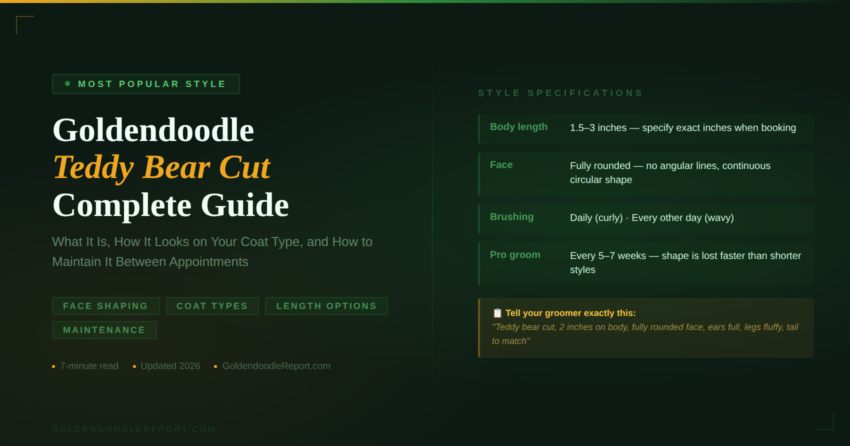
The Goldendoodle teddy bear cut keeps the coat at a medium length — typically 1.5 to 3 inches on the body — with a specifically rounded face trim that creates the stuffed-animal appearance. The ears are left slightly longer and full, the legs are rounded and fluffy, and the tail is trimmed to match or slightly exceed the body length. It is the highest-maintenance standard Goldendoodle style and requires daily brushing for curly coats, every-other-day brushing for wavy coats, and professional grooming every 5–7 weeks to maintain.
✅ Quick Answer — What to Tell Your Groomer
Tell your groomer: “Teddy bear cut, 2 inches on the body, rounded face — I want the face fully rounded with no angular lines, ears left full, legs rounded and fluffy, tail to match the body.” Adjust the body length to your preference — 1.5 inches is tighter and more practical, 2–3 inches gives the fullest teddy bear appearance but requires the most maintenance. Always bring a reference photo — the teddy bear cut varies significantly between groomers in interpretation.
For the complete Goldendoodle haircut styles overview see Goldendoodle Haircut Styles. For grooming frequency with this style see How Often to Groom a Goldendoodle.
What Is the Goldendoodle Teddy Bear Cut?
The teddy bear cut is defined by two specific characteristics that distinguish it from other Goldendoodle styles: a rounded face trim and a medium body length that preserves the coat’s natural fluffiness.
The face is the defining feature. In a teddy bear cut, the groomer uses scissors to create a rounded, circular face shape — trimming the hair around the muzzle, forehead, cheeks, and under the chin into a continuous rounded silhouette with no angular lines or hard edges. The result is the bear-like facial appearance that gives the style its name. This is in contrast to the puppy cut, where the face is trimmed neatly but without the specific rounded shaping.
The body is left at a medium length — typically 1.5 to 3 inches — that preserves the coat’s volume and fluffiness. The legs are left rounded and full, matching or slightly exceeding the body length. The ears are left natural or lightly trimmed to frame the face rather than clipped short. The tail is typically trimmed to match the body length.
How the Teddy Bear Cut Looks on Different Coat Types
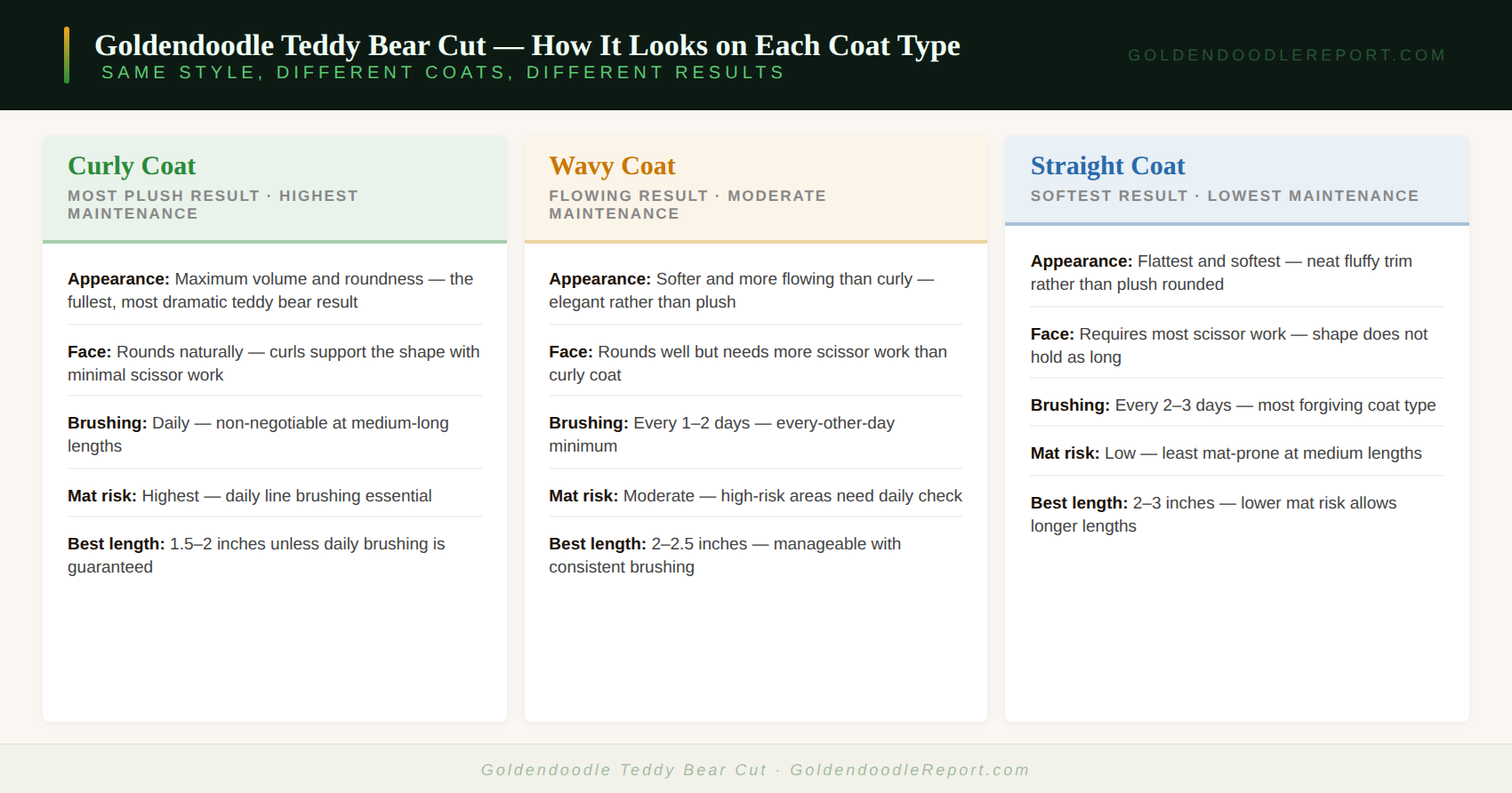
This is the aspect of the teddy bear cut that most surprises owners: the same style on different coat types produces noticeably different results.
Teddy bear cut on a curly coat
A curly coat produces the most dramatic and plush teddy bear cut — the tight curls create maximum volume at the medium length, producing the fullest and most rounded appearance. The face rounds naturally on a curly coat because the curl pattern supports the shape. This is the coat type that most closely matches the reference photos owners typically bring to their groomers.
The maintenance requirement on a curly coat in the teddy bear cut is the highest of any style-coat combination — daily brushing without exception. The medium-to-long length on a high-mat-risk coat produces rapid matting in the high-risk areas. Owners who choose the teddy bear cut on a curly coat and cannot commit to daily brushing consistently find the style impossible to maintain without regular dematting charges at appointments.
Teddy bear cut on a wavy coat
A wavy coat produces a slightly softer and more flowing teddy bear cut than a curly coat — the waves give volume but less density than curls. The face rounds well but may require more scissor work to achieve the same level of rounding as a naturally curly coat. The result is a slightly less plush but often more elegant appearance than the curly version.
Maintenance on a wavy coat in the teddy bear cut is demanding but more manageable than curly — brushing every other day is typically sufficient with consistent technique.
Teddy bear cut on a straight coat
A straight coat in the teddy bear cut produces the softest version of the style — the coat lies flatter and creates less volume than wavy or curly types. The face rounding requires more scissor work to achieve and may not hold its shape as long between appointments. The result can be beautiful but reads as a neat fluffy trim rather than the plush rounded appearance of a curly-coated teddy bear cut.
Maintenance on a straight coat is the most forgiving — brushing every 2–3 days is usually sufficient and matting risk is lower than with wavy or curly types.
Choosing the Right Length
The body length in a teddy bear cut significantly affects both the appearance and the maintenance requirement. Most owners choose between three length ranges:
1.5 inches (shorter teddy bear): Still produces the rounded face and fluffy appearance but with less bulk in the body coat. Lower mat risk than longer lengths. Slightly more practical for active dogs. Grows out faster and may need professional attention at 5–6 weeks.
2 inches (standard teddy bear): The most common length for the teddy bear cut — balances the full fluffy appearance with manageable maintenance. The length most groomers interpret as standard when told “teddy bear cut” without a specific length.
3 inches (longer teddy bear): The fullest, most plush version of the style. Significantly higher maintenance — daily brushing is non-negotiable at this length on any coat type. Professional grooming every 5 weeks minimum for curly coats. Best suited to owners who brush thoroughly every day without exception.
Maintaining the Teddy Bear Cut Between Appointments
The teddy bear cut requires the most consistent home maintenance of any standard Goldendoodle style. At medium-to-long lengths, the coat is in the highest-risk range for mat formation — and the areas that mat fastest are the areas where the teddy bear cut looks best: the full cheeks, the rounded legs, and behind the ears.
Daily brushing with a slicker brush using the line brushing technique — parting the coat and brushing from skin to tip in sections — is the non-negotiable maintenance habit for this style. Surface brushing will not maintain a teddy bear cut regardless of how frequently it is done. For the correct technique see How to Brush a Goldendoodle.
The metal comb check after every brushing session is particularly important with the teddy bear cut because of the volume of coat. The comb catches early-stage mats before they develop — and at the lengths involved in a teddy bear cut, mats develop faster than they do in shorter styles. See Goldendoodle Matting Prevention for the full prevention protocol.
Between appointments, the eye area will need trimming every 2–3 weeks in fast-growing coats — the longer face coat grows over the eyes quickly and needs maintenance between professional appointments. See How to Trim a Goldendoodle at Home for the safe eye trim technique.
Grooming Frequency for the Teddy Bear Cut
The teddy bear cut requires professional grooming every 5–7 weeks for wavy coats and every 5–6 weeks for curly coats. The longer body length grows out faster visibly than shorter styles — a teddy bear cut that has not been professionally trimmed for 8 weeks loses its shape significantly and the mat risk in the high-risk areas increases substantially.
At each appointment, the groomer scissors the face back to its rounded shape, trims the body coat to the target length, blends the leg coat, and addresses any matting that has developed between visits. A dog who arrives with minimal matting after consistent home brushing has a significantly shorter and less expensive appointment than one arriving with mat accumulation. See How Often to Groom a Goldendoodle for the complete frequency guide by coat type.
Teddy Bear Cut vs Puppy Cut — The Practical Difference
The two most common points of confusion between the teddy bear and puppy cuts:
Face shape: The teddy bear cut has a specifically rounded, sculpted face. The puppy cut has a neat, tidy face without the rounded shaping. This is the most visually significant difference between the two styles.
Length: The teddy bear cut is typically longer and more varied in length between body areas. The puppy cut is typically shorter and more uniform. However, both styles can be done at similar lengths — a 2-inch puppy cut and a 2-inch teddy bear cut on the same dog will look similar in the body but completely different in the face.
Maintenance: At the same length, the teddy bear cut requires slightly more maintenance because the fuller face and leg coat creates more mat-risk surface area than the neater puppy cut. The difference is not dramatic at shorter lengths but becomes significant at 2.5 inches and above.
For the puppy cut guide see 👉 Puppy Cut Guide — coming soon.
For authoritative guidance on dog grooming see the AKC dog grooming guide.
✅ Your Next Step
Book your grooming appointment with a specific length in mind — “teddy bear cut at 2 inches” rather than just “teddy bear cut.” Bring a reference photo of the specific look you want. And be honest with yourself about daily brushing commitment — if daily brushing is not realistic for your schedule, the shorter 1.5-inch version of the teddy bear cut will look better consistently than the 2.5-inch version that develops mats between appointments. For the complete grooming guide see Goldendoodle Grooming Guide.
🔑 Key Takeaways
- The Goldendoodle teddy bear cut is defined by a rounded face and medium body length — the face shaping is what distinguishes it from all other styles
- The style looks different on different coat types — curly coats produce the fullest, most plush result; straight coats produce a softer, less dense version
- Always specify the length in inches when booking — “teddy bear at 2 inches” removes groomer interpretation ambiguity
- The teddy bear cut requires daily brushing for curly coats and every-other-day brushing for wavy coats — it is the highest-maintenance standard Goldendoodle style
- Professional grooming every 5–7 weeks is required to maintain the shape — the longer coat loses its rounded silhouette and accumulates mats faster than shorter styles
- Bring a reference photo — the teddy bear cut has more visual variation between groomer interpretations than any other Goldendoodle style
📚 Continue Learning
- Goldendoodle Grooming Guide — the complete grooming authority guide
- Goldendoodle Haircut Styles — all styles compared
- How to Brush a Goldendoodle — the daily maintenance this style requires
- Goldendoodle Matting Prevention — keeping the teddy bear coat mat-free
- How Often to Groom a Goldendoodle — professional grooming frequency for this style
- Goldendoodle Coat Types Explained — how your coat type affects the result
- How to Trim a Goldendoodle at Home — eye trimming between appointments
- 👉 Puppy Cut Guide — coming soon
- 👉 What to Tell Your Groomer About Your Goldendoodle — coming soon
↑ Back to: Goldendoodle Haircut Styles | Goldendoodle Grooming Guide | Goldendoodle Grooming — All Articles
Frequently Asked Questions
What is a Goldendoodle teddy bear cut?
The Goldendoodle teddy bear cut is a medium-length haircut style — typically 1.5 to 3 inches on the body — with a specifically rounded face trim that creates the stuffed-animal appearance the style is named for. The defining feature is the face: scissored into a continuous rounded shape with no angular lines. The ears are left full, the legs are rounded and fluffy, and the tail matches the body length. It is the most popular Goldendoodle haircut style and the one most associated with the breed’s characteristic appearance.
How do I ask for a Goldendoodle teddy bear cut at the groomer?
Specify the style name, the body length, and the face shape: “teddy bear cut, 2 inches on the body, fully rounded face.” Bring a reference photo of the specific look you want — the teddy bear cut varies more between groomer interpretations than any other standard style. Also specify whether you want the ears left full and natural or trimmed, and your preference for tail length.
How often does a Goldendoodle teddy bear cut need grooming?
Every 5–7 weeks for wavy coats and every 5–6 weeks for curly coats. The medium-to-long length of the teddy bear cut grows out visibly faster than shorter styles and accumulates mats in the high-risk areas more quickly. A dog who arrives at each appointment with minimal matting from consistent daily brushing will have a faster and less expensive appointment than one with significant mat accumulation from inconsistent home care.
Is the teddy bear cut high maintenance?
Yes — it is the highest-maintenance standard Goldendoodle style. Daily brushing is required for curly coats and every-other-day brushing for wavy coats. Surface brushing is not sufficient — line brushing technique that reaches the skin is required to prevent matting at the medium-to-long lengths involved. Professional grooming every 5–7 weeks is also required to maintain the rounded face shape and body length. Owners who choose the teddy bear cut without committing to this maintenance routine consistently end up with mats and dematting charges that make the style significantly more expensive than anticipated.
Why does my Goldendoodle teddy bear cut look different from photos?
Three reasons are most common. First, coat type — a wavy or straight coat produces a less plush, less rounded result than the curly coat usually shown in reference photos. Second, length — if the groomer cut slightly shorter than the reference photo, the result will look different regardless of technique. Third, face shaping technique — different groomers interpret the rounded face differently. Bringing a specific reference photo and specifying the exact body length in inches at booking reduces all three sources of variation.
Disclaimer: The information in this article is provided for general educational purposes only. King James Adjei is a researcher and enthusiast, not a veterinarian or certified groomer. For grooming questions specific to your dog’s coat type or condition, consult a qualified professional groomer.