Affiliate Disclosure: Some links in this guide are affiliate links. If you purchase through them, we may earn a small commission at no extra cost to you. This does not influence our recommendations. Read our full affiliate disclaimer here.
By King James Adjei — Researcher and Goldendoodle enthusiast, founder of GoldendoodleReport.com. Every guide on this site is carefully researched and written to give owners reliable, clearly organised information. → About this site
🩺 Veterinary guidance note: If your Goldendoodle has been diagnosed with a confirmed chicken allergy or is currently on an elimination diet trial, do not feed chicken in any form. This guide covers chicken safety for the general Goldendoodle population — it does not apply to dogs with known chicken protein sensitivity. When in doubt about whether a specific food is appropriate for your dog, consult your veterinarian.
📖 7-minute read | Last updated May 2026 | Reviewed for accuracy
✅ Quick Answer
Yes — plain cooked chicken is safe for Goldendoodles and is one of the best lean protein treats available. Plain boiled or baked chicken breast, with no seasoning, no skin, and no bones, can be fed as a treat or food topper. However, chicken bones (especially cooked), seasoned chicken, and fried chicken are all dangerous and should never be given. Chicken is also the most common food allergen in dogs — if your Goldendoodle has recurring skin itching, ear infections, or digestive symptoms, chicken may be a trigger worth investigating with your vet before continuing to feed it.
Can Goldendoodles eat chicken? Yes — chicken is one of the most commonly shared human foods with dogs — it is readily available, high in protein, and most dogs love it. For Goldendoodles, plain cooked chicken serves as an excellent lean protein treat and is the standard ingredient in the bland diet used to settle digestive upsets. Understanding what forms of chicken are safe, what forms are dangerous, and when chicken is the wrong choice for your specific dog prevents the most common chicken-related health incidents.
👤 Who This Guide Is For
- You want to use chicken as a training treat or food topper and want to know the correct way to prepare it
- Your Goldendoodle ate some of your cooked chicken or bones and you want to know if you need to worry
- You want to understand the difference between chicken as a safe food and chicken as a potential allergen
- You are preparing the bland diet for a dog with an upset stomach and need the correct chicken preparation
📊 Quick Facts — Chicken and Goldendoodles
- Plain cooked chicken breast is approximately 165 kcal per 100g (3.5 oz) and contains roughly 31g protein — one of the leanest protein sources available
- Chicken is the most commonly identified food allergen in dogs according to VCA Animal Hospitals — because it is also the most commonly used protein in mainstream dog food, giving the immune system prolonged exposure over years
- Cooked chicken bones are significantly more dangerous than raw chicken bones — cooking makes them brittle, causing them to splinter into sharp fragments that can puncture the gastrointestinal tract
- Garlic and onions — commonly used to season chicken — are toxic to dogs at surprisingly low doses. Garlic is approximately 5× more toxic than onion per pound of body weight. Even small amounts of garlic-flavoured chicken are dangerous.
- Chicken skin is high in fat and commonly seasoned — even “plain” roast chicken skin typically absorbs cooking fats and seasonings. It is not safe to feed and is a common cause of pancreatitis in dogs.
📋 Table of Contents
What Forms of Chicken Are Safe for Goldendoodles
Chicken is one of the most widely used protein sources in commercial and home-prepared dog food globally, prized for its digestibility and lean protein profile when prepared plainly.
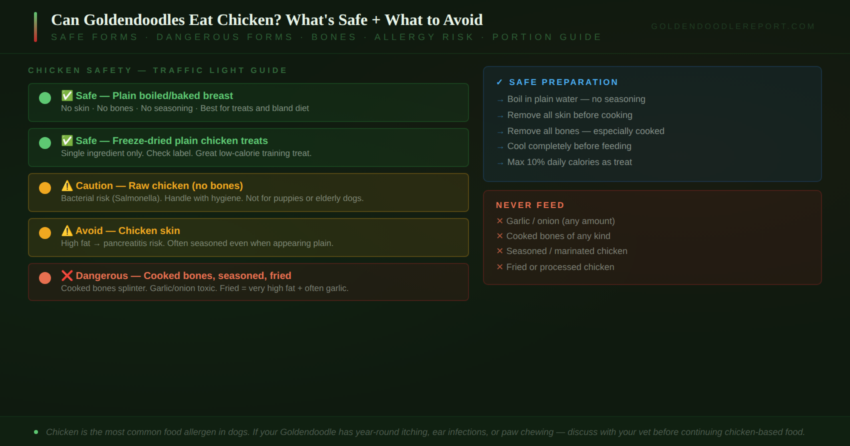
✅ Plain boiled chicken breast
The gold standard. Boil chicken breast in plain water with no seasoning, no oil, no onion, no garlic. Allow to cool completely, then shred or cut into small pieces. This is the safest form of chicken for Goldendoodles and the correct preparation for the bland diet protocol. Low in fat, high in protein, highly digestible.
✅ Plain baked chicken breast
Baked without seasoning, skin removed before cooking, cooked on a plain rack or baking sheet without oil. Allow to cool and shred. Essentially equivalent to boiled in terms of safety — just a different preparation method.
✅ Plain poached chicken
Gently simmered in water or plain unsalted broth (no onion, no garlic in the broth). Produces a slightly more flavourful result than plain boiling while remaining safe.
✅ Freeze-dried plain chicken treats
Single-ingredient freeze-dried chicken treats (available commercially) are a convenient, long shelf-life version of plain chicken. Check the label — the only ingredient should be chicken. No added salt, no preservatives, no flavourings. These make excellent low-calorie training treats for weight-conscious Goldendoodles. See Goldendoodle Weight Management for treat calorie guidelines.
What Forms of Chicken Are Dangerous
| Form of Chicken | Why Dangerous | Action If Eaten |
|---|---|---|
| Cooked chicken bones | Splinter into sharp fragments — can puncture throat, stomach or intestines | Monitor closely for 24–48 hrs. Vomiting, lethargy, bloated abdomen, blood in stool → vet immediately |
| Seasoned / marinated chicken | Garlic and onion are toxic; salt causes sodium toxicity; spices cause GI irritation | If garlic/onion consumed → contact vet. Small amounts of other seasonings → monitor for 12 hrs |
| Chicken skin | High fat — common trigger for pancreatitis. Often seasoned even when appearing plain. | Small amount: monitor for vomiting/lethargy. Large amount or history of pancreatitis → vet |
| Fried chicken | Very high fat, heavily seasoned, often with garlic/onion powder in batter | Contact vet — especially if garlic/onion powder in coating |
| Chicken with onion/garlic | Thiosulfate compounds in garlic/onion destroy red blood cells (haemolytic anaemia) | Contact vet immediately — especially garlic, which is 5× more toxic per weight than onion |
| Processed chicken products (chicken nuggets, deli meat) |
Very high sodium, preservatives, often contain garlic/onion powder | One piece is unlikely to cause serious harm — do not make a habit of it. Large amounts → vet. |
Chicken Bones — The Detail
According to VCA Animal Hospitals, the FDA has documented that bones of any kind can break teeth, injure the mouth and tongue, cause choking, and puncture or block the stomach and intestines — risks that apply whether the bone is raw or cooked.
Chicken bones deserve their own section because the danger is widely misunderstood. Many owners believe that “chicken bones are dangerous” as a general rule — but the reality is more nuanced and important to understand correctly.
Cooked chicken bones — genuinely dangerous
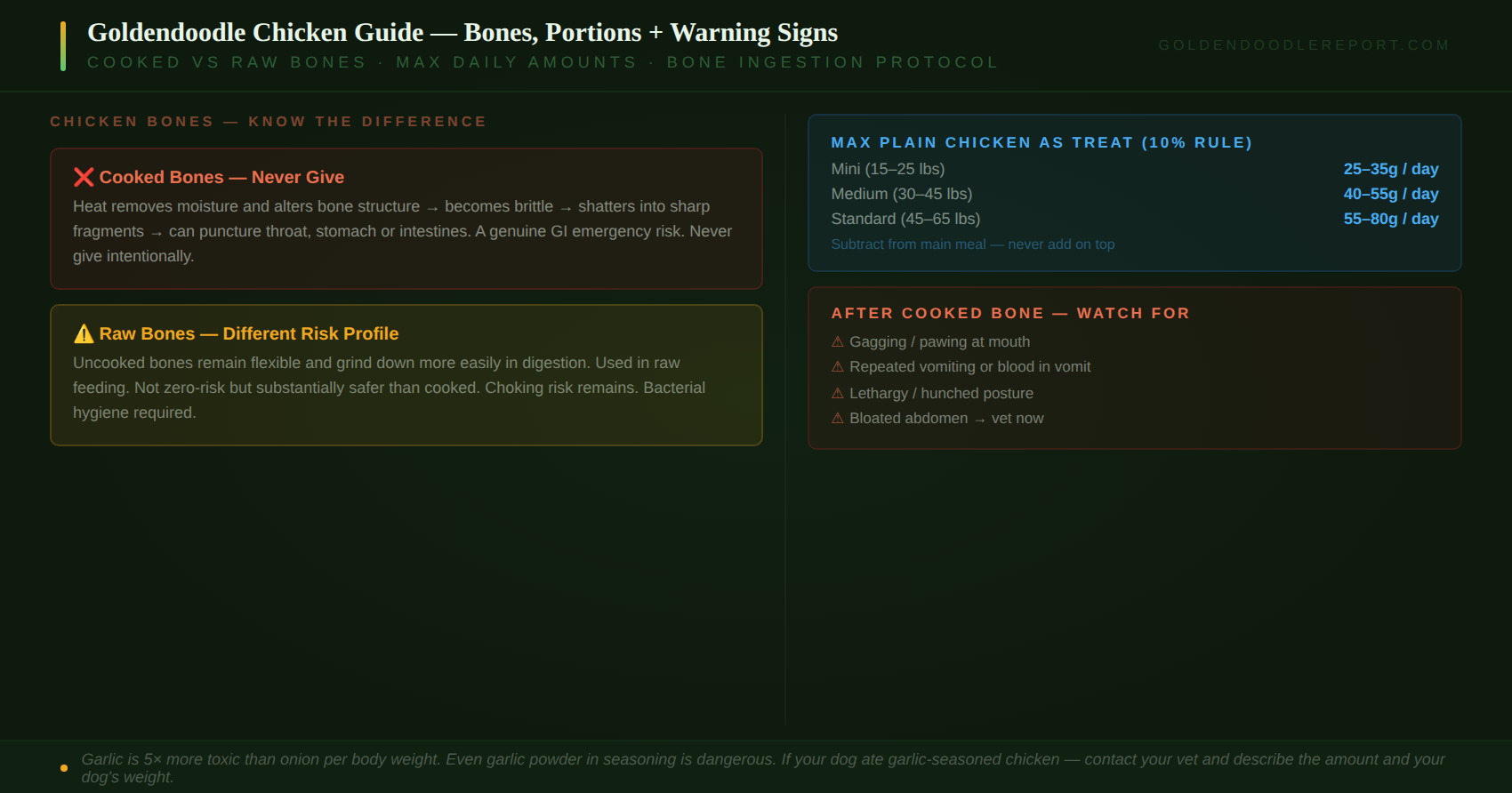
Cooking changes the structure of chicken bones. The heat drives out moisture and alters the collagen matrix, making the bone brittle. Brittle bones do not bend — they snap and splinter into sharp fragments. These fragments can lacerate the mouth and throat, puncture the oesophagus during swallowing, and perforate the stomach or intestines if swallowed. This is not theoretical — cooked chicken bone ingestion is a frequent cause of gastrointestinal emergencies in dogs. Never give cooked chicken bones intentionally, and act quickly if one is accidentally consumed.
Raw chicken bones — a different situation
Raw (uncooked) chicken bones are softer and more flexible than cooked bones. In their raw state they bend more than snap, and are ground down by the dog’s digestive enzymes more effectively. Raw meaty bones (chicken necks, chicken wings) are commonly used in raw feeding protocols. They are not completely without risk — choking and intestinal obstruction remain possible — but the risk profile is substantially different from cooked bones. This is covered in more detail in our Raw Diet for Goldendoodles guide — coming soon in this category.
🚨 If your Goldendoodle ate a cooked chicken bone — watch for these signs and go to the vet immediately if any appear:
- Gagging, retching, or pawing at the mouth (fragment lodged in throat)
- Excessive drooling or difficulty swallowing
- Lethargy or hunched posture (abdominal pain)
- Vomiting — particularly if repeated or if there is blood present
- Bloated or hard abdomen
- Blood in stool or black, tarry stools (indicating internal bleeding)
- Straining to defecate
If there are no symptoms after 48–72 hours and stools remain normal in consistency, the bone has likely passed without incident. If in doubt, call your vet — they can advise based on the size of the dog and the amount consumed.
How Much Chicken Can a Goldendoodle Have
When used as a treat or food topper (not as a primary diet), the guideline is that treats — including chicken — should account for no more than 10% of daily calorie intake, and ideally 5% during weight management programmes.
| Goldendoodle Size | Daily Calorie Need (approx) | Max Plain Chicken as Treat (10%) |
|---|---|---|
| Mini (15–25 lbs) | 400–600 kcal | ~25–35g (0.9–1.2 oz) boiled breast |
| Medium (30–45 lbs) | 700–950 kcal | ~40–55g (1.4–2.0 oz) boiled breast |
| Standard (45–65 lbs) | 950–1,300 kcal | ~55–80g (2.0–2.8 oz) boiled breast |
Subtract the calories from any chicken given as a treat from the day’s main meal allowance — do not add on top. For the full daily calorie and portion framework: How Much to Feed a Goldendoodle.
Chicken in the Bland Diet
Plain boiled chicken and white rice is the standard veterinary-recommended bland diet for dogs with acute digestive upset. The combination of easily digestible lean protein and simple starch allows the gastrointestinal tract to rest and recover while maintaining calorie intake.
Correct preparation for the bland diet:
- Boil plain chicken breast in water — no seasoning, no stock cubes, no oil
- Boil plain white rice (not brown rice — brown rice is higher in fibre and harder to digest during a GI upset)
- Mix in a 1:2 ratio — 1 part chicken to 2 parts rice
- Feed in small, frequent portions — 3–4 times per day rather than 2 normal-sized meals
- Add 1–2 tablespoons of plain canned pumpkin (not pie filling) per serving if available — the soluble fibre helps firm loose stool
- Use for 2–3 days maximum, then transition back to the regular food gradually over 4–5 days
For the complete bland diet protocol including when to use it and when to see the vet instead: Goldendoodle Sensitive Stomach Food.
Chicken vs Chicken Allergy — Knowing the Difference
Chicken is safe for most Goldendoodles. But chicken is also the most common food allergen in dogs — and these two facts need to coexist in your understanding.
The key distinction: Chicken as a protein is not inherently harmful. What causes problems is when a dog’s immune system develops a sensitisation to chicken protein after prolonged exposure — typically over years of eating chicken-based food. A chicken allergy is an immune-mediated response, not a direct toxicity.
If your Goldendoodle currently eats a chicken-based dog food with no symptoms, feeding plain cooked chicken as a treat is fine. If your Goldendoodle has any of the following, discuss with your vet before continuing to feed chicken:
- Recurring itchy paws (licking or chewing year-round, not seasonal)
- Recurring ear infections (3+ per year)
- Chronic loose stool alongside skin symptoms
- Redness or irritation on the belly, groin, or armpits year-round
These signs suggest a possible food allergy, and chicken is the most likely candidate given how widely it is used in dog food. For the full food allergy assessment and elimination trial guide: Goldendoodle Food Allergies.
Raw Chicken — Is It Safe?
Raw chicken is a more complex topic than cooked chicken. The debate around raw chicken specifically — and raw feeding generally — involves several real considerations:
Bacterial contamination risk
Raw chicken commonly carries Salmonella, Campylobacter, and Listeria. Dogs have a shorter, more acidic digestive tract than humans, which offers some natural protection — but it does not eliminate risk entirely. Dogs fed raw chicken can shed Salmonella in their faeces, creating a household contamination risk — particularly relevant in homes with young children, elderly people, or immunocompromised individuals.
Nutritional completeness
Plain raw chicken alone is not nutritionally complete. A raw diet must include appropriate organ meats, bone, and supplementation to meet all nutritional requirements. Raw chicken as an occasional treat is a different situation from raw feeding as a complete dietary approach.
The practical guidance
Plain raw chicken breast as an occasional treat for an otherwise healthy adult Goldendoodle carries low but non-zero risk. The main concerns are bacterial contamination hygiene (handle like human food — wash hands and surfaces after contact) and ensuring the chicken is fresh, high-quality, and not fed in large quantities. For puppies, elderly dogs, and immunocompromised dogs, the risk-benefit balance tilts toward avoiding raw chicken. For the complete raw diet discussion: see our Raw Diet for Goldendoodles guide — coming soon in this category.
Quick Reference — Chicken Safety for Goldendoodles
| Type of Chicken | Safety Status | Notes |
|---|---|---|
| Plain boiled breast (no skin) | ✅ Safe | Best form for treats and bland diet |
| Plain baked breast (no skin) | ✅ Safe | Equivalent to boiled — ensure no seasoning |
| Freeze-dried plain chicken treats | ✅ Safe | Check: single ingredient only |
| Chicken skin | ⚠️ Avoid | High fat → pancreatitis risk |
| Raw chicken (no bones) | ⚠️ Caution | Bacterial risk — handle with hygiene |
| Seasoned/marinated chicken | ❌ Dangerous | Garlic/onion toxic; salt harmful |
| Cooked chicken bones | ❌ Dangerous | Splinters → GI perforation risk |
| Fried chicken | ❌ Dangerous | High fat, often garlic in batter |
| Deli/processed chicken | ❌ Avoid | Very high sodium, often garlic/onion powder |
🔑 Key Takeaways
- Plain boiled or baked chicken breast with no seasoning, no skin, and no bones is safe and nutritious for Goldendoodles as a treat or bland diet ingredient
- Cooked chicken bones are dangerous — they splinter into sharp fragments. Never give them intentionally. If your dog eats one, monitor closely for 48 hours and see a vet immediately if any GI symptoms appear
- Chicken skin is high in fat and commonly seasoned — it is not safe to feed and is a common cause of pancreatitis
- Garlic and onion — used in almost all seasoned chicken preparations — are toxic to dogs. Even small amounts of garlic-flavoured chicken warrant a vet call
- Chicken is the most common food allergen in dogs. If your Goldendoodle has year-round itching, recurring ear infections, or chronic skin issues, discuss with your vet before continuing to feed chicken-based food or treats
- Treats including chicken should account for no more than 10% of daily calories — always subtract them from the main meal allowance rather than adding them on top
📚 More Goldendoodle Food & Nutrition Guides
- How Much to Feed a Goldendoodle: Amounts by Age + Weight
- Best Food for Goldendoodles: What Vets Recommend (2026)
- Goldendoodle Food Allergies: Signs, Triggers + What to Feed
- Goldendoodle Sensitive Stomach: 5 Foods That Actually Help
- Goldendoodle Weight Management: How to Help Safely (2026)
- Goldendoodle Treats Guide: Low-Calorie Options — coming soon
- Raw Diet for Goldendoodles — coming soon
Browse all guides: Goldendoodle Food & Nutrition category
🔗 Related Guides Across the Site
- Goldendoodle Spring Allergies — food vs environmental allergy triggers
- Best Puppy Treats for Goldendoodles — safe treat options for puppies
- Why Is My Goldendoodle Always Hungry? — food motivation and treat management
- Goldendoodle Puppy First Vet Visit — discussing diet with your vet early
Frequently Asked Questions
Can Goldendoodles eat chicken every day?
Plain cooked chicken can be given daily as a treat or food topper provided it stays within the 10% daily calorie guideline and the main diet remains nutritionally complete. However, feeding large amounts of plain chicken as a primary food source is not appropriate — it is not nutritionally complete and will lead to deficiencies over time. If you want to include chicken regularly as a primary protein, choose a complete and balanced dog food with chicken as a named ingredient, properly formulated with all required nutrients.
My Goldendoodle ate a chicken bone — what do I do?
First, determine if the bone was cooked or raw. Cooked bones are more dangerous due to splintering. For a cooked bone: do not induce vomiting (the fragments can cause as much damage coming back up as going down). Do not give bread or other food to “pad” the bone — this is a myth. Monitor closely for 48–72 hours. If you see gagging, drooling, difficulty swallowing, lethargy, vomiting, blood in stool, or a distended abdomen — go to the vet immediately. If there are no symptoms after 72 hours and stools are normal, the bone has likely passed. When in doubt, call your vet and describe the size of the bone and the size of your dog.
Is chicken breast or chicken thigh better for Goldendoodles?
Chicken breast is the better choice for treats and bland diet use — it is significantly lower in fat than thigh meat. A 100g serving of chicken breast contains approximately 3g fat, while chicken thigh contains approximately 9g fat. For a breed that can be prone to pancreatitis and weight gain, lean breast is the appropriate choice for regular treat use. Plain cooked chicken thigh is not dangerous in small amounts, but breast is the recommended option.
Can Goldendoodle puppies eat chicken?
Yes — plain boiled chicken breast with no seasoning, skin, or bones is safe for Goldendoodle puppies as an occasional treat. It is also the correct protein for the bland diet if a puppy has digestive upset. Introduce any new treat in small amounts first and monitor for digestive reaction over 24 hours. Do not use chicken treats in puppies that are on a chicken-protein elimination diet trial — this would defeat the purpose of the trial.
Is garlic chicken dangerous for Goldendoodles?
Yes — garlic is toxic to dogs. It contains thiosulfate compounds that damage red blood cells, causing haemolytic anaemia. Garlic is approximately 5× more potent per weight than onion. Even small amounts of garlic — including garlic powder in seasoning, garlic bread, or garlic-marinated chicken — can be harmful, particularly with repeated exposure. If your Goldendoodle has eaten garlic-seasoned chicken, contact your vet and describe the amount consumed and the dog’s weight. Symptoms of garlic toxicity include lethargy, pale gums, reduced appetite, and in severe cases, collapse — these can develop 1–5 days after ingestion.
Disclaimer: The information in this article is provided for general educational purposes only. King James Adjei is a researcher and enthusiast, not a veterinarian. If your Goldendoodle has eaten a potentially toxic substance (garlic, onion, or a cooked bone) and is showing symptoms, contact your veterinarian or an emergency vet immediately. Do not rely solely on online guidance for potential poisoning incidents.