Affiliate Disclosure: Some links in this guide are affiliate links. If you purchase through them, we may earn a small commission at no extra cost to you. Read our full affiliate disclaimer here.
By King James Adjei — Researcher and Goldendoodle enthusiast, founder of GoldendoodleReport.com. Every guide on this site is carefully researched and written to give owners reliable, clearly organised information — updated regularly and honest about uncertainty. → About this site
📖 10-minute read | Last updated April 2026 | Reviewed for accuracy
The goldendoodle puppy mistakes that new owners make are rarely the obvious ones. Skipping vaccinations, feeding the wrong food, leaving a puppy alone for too long — those are easy to research and easy to avoid. The mistakes that actually derail the first months are the ones that feel correct in the moment — comforting a crying puppy, adding exercise to manage energy, giving in just once to stop the biting, letting the puppy decide when the play session ends.
Every one of these feels like the kind thing to do. And that is precisely why they are so damaging — not because owners are careless, but because the instinct to comfort, to respond, to give relief is exactly what a social animal like a Goldendoodle is designed to trigger. Most of these mistakes quietly teach the puppy exactly the wrong lesson — one that takes months to undo.
This guide names the mistakes, explains exactly why each one causes the problem it does, and gives you the correction that works. Not generic advice. The specific change, on the owner’s side, that produces a measurable difference within days.
👤 Who This Guide Is For
- You have a Goldendoodle puppy at home right now and something is not working the way you expected
- You are preparing before pickup day and want to know what derails most new owners before it happens to you
- You are a few weeks in, the biting is still bad, the crate is still a battle, and you want to know what you might be doing wrong
- You want a complete self-audit against the most common new owner mistakes — not a generic puppy advice list
⚡ Quick Summary
The most damaging new goldendoodle puppy mistakes share one characteristic — they feel like the right response in the moment. Comforting the crying puppy in the crate, adding exercise to fix hyperactivity, responding to the biting, abandoning the routine on hard days.
Each one makes the immediate situation more bearable while teaching the puppy exactly the wrong lesson. Understanding why the correct response works — and why the instinctive response does not — is what separates owners who sail through the first months from those who struggle through them.
✅ Quick Answer
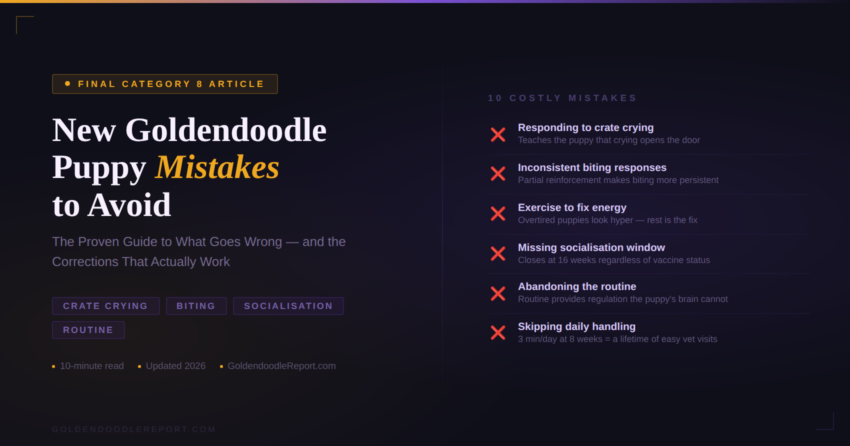
The new goldendoodle puppy mistakes that cause the most lasting problems are: responding to crate crying, using exercise to manage energy, inconsistent responses to biting, skipping the socialisation window, removing the routine when it feels mechanical, over-exciting the puppy at reunions, and expecting the puppy to grow out of problems without consistent management. All are correctable. None require starting over — they require changing one specific behaviour on the owner’s side.
For the complete first-year guide see The Real Goldendoodle Puppy Guide — From Pickup Day to the End of Year One. For exercise-specific mistakes see Goldendoodle Puppy Exercise Mistakes: The Proven Guide to What Causes Harm and What Does Not.
🔍 Quick Diagnosis — Which Mistakes Apply to You Right Now?
- Puppy cries in the crate and you go back in: You are teaching the puppy that crying produces you. This is the single most common crate training mistake and the one that takes longest to undo
- Biting is not decreasing week on week: Your response to biting is inconsistent. The puppy is receiving different signals on different occasions and cannot learn from them
- Puppy is hyperactive and nothing seems to work: Almost certainly overtiredness, not under-exercise. The instinctive response — more exercise — makes it worse
- Your puppy ignores you in new environments: Socialisation happened too late or not at all during the critical window. Recall reliability in distraction is a socialisation product, not a training one
- The routine has slipped and everything feels harder: The routine is not the problem — the slipping is. Puppies regulated by a consistent schedule behave measurably better than those on a fluid one
📖 Real Scenario
Week three. The puppy has been crying in the crate for 25 minutes. The owner has checked — the puppy is not hungry, not wet, not in pain. They know they should hold the boundary. At minute 26 they open the door. The puppy immediately stops crying and wags their tail. The owner feels relieved. What actually happened: the puppy just learned that 26 minutes of crying reliably opens the crate door.
Tomorrow night it will be 26 minutes again. The night after, longer. Within a week the crying intensifies because the puppy has learned that persistence works. The owner did not make a cruel decision — they made the most natural human response to a distressed animal. But the puppy is not distressed. They are training their owner. Understanding this one dynamic prevents the most exhausting part of the first month.
The Most Damaging Goldendoodle Puppy Mistakes — And Why They Feel Right
Mistake 1 — Responding to crate crying
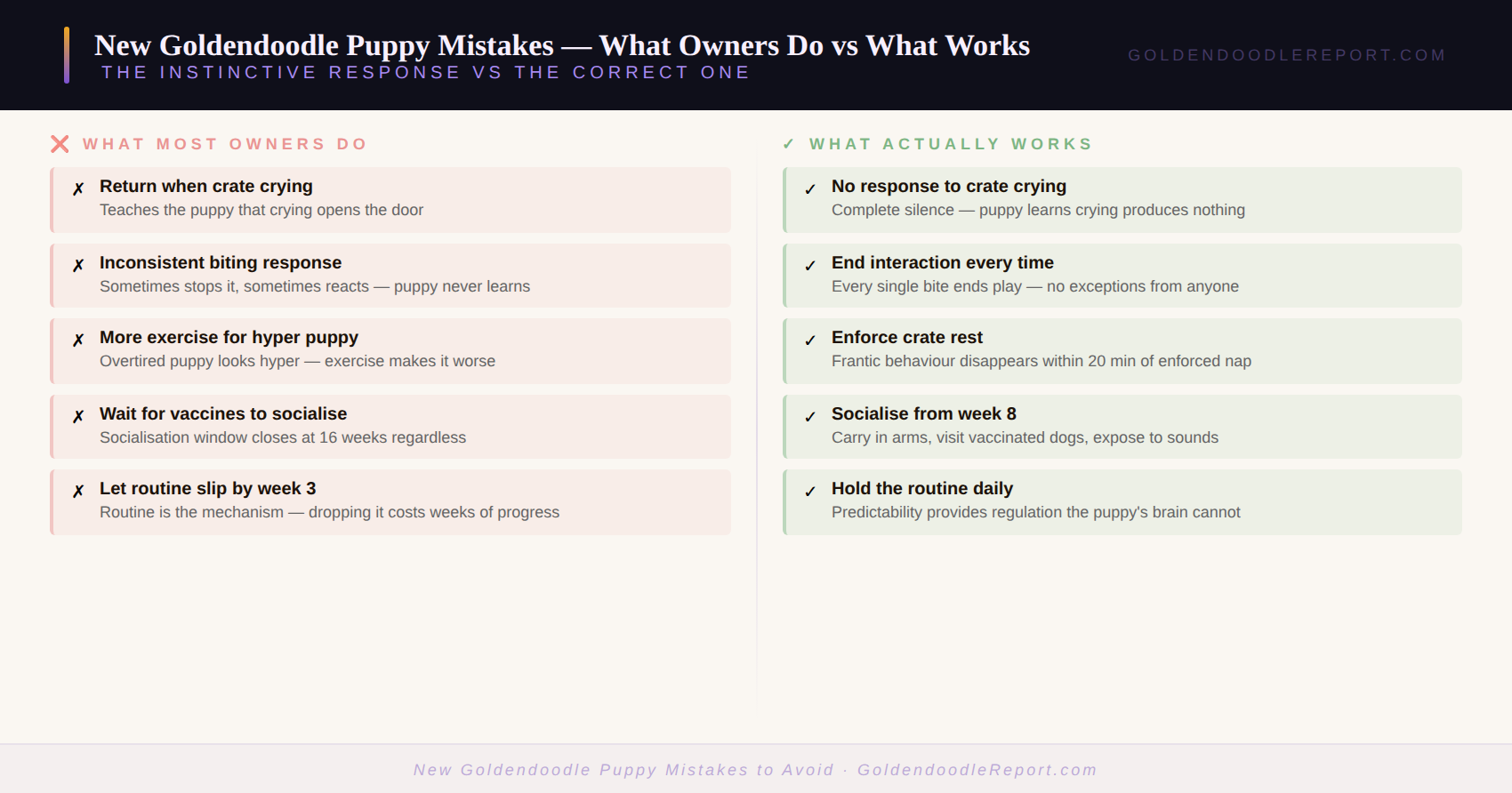
The crate crying mistake is the most universal new owner error and the one with the most predictable escalation pattern. When a puppy cries in the crate and the owner returns — even to check, even to reassure, even to say “shush” through the door — the puppy receives confirmation that crying works. Every return is a partial reinforcement of the crying behaviour, and partial reinforcement is the most powerful behaviour-maintenance pattern in learning science.
The reason it feels wrong to ignore it is that crying sounds like distress. In most cases it is not — it is communication. A puppy who has been checked, is not hungry, not wet, not in pain, and is crying in a properly introduced crate is almost always protesting the boundary, not experiencing genuine distress. The two sound identical which is why the mistake is so common.
The correction: Once you have confirmed the puppy is physically fine, do not return. Not at all. Not to check. Not to say anything. Every absence of response teaches the puppy that crying produces nothing. Most puppies settle within 5–20 minutes when the owner genuinely does not respond. The first few nights are hard. By night five most puppies cry for significantly less time. By night ten most puppies have stopped entirely.
The crate must be introduced gradually before this boundary becomes necessary — a puppy who has been given time to associate the crate with positive experiences settles faster than one for whom the crate appeared suddenly. See Goldendoodle Puppy First Night at Home for the full first night protocol.
Mistake 2 — Inconsistent responses to biting
Biting management fails almost exclusively because of inconsistency — not because the method is wrong, but because it is not applied every single time. An owner who ends the interaction when teeth touch skin 80% of the time and reacts, laughs, or lets it continue the other 20% is producing a puppy who bites persistently. The 20% of occasions where biting gets a response is enough to maintain the behaviour indefinitely.
The counterintuitive element is that reacting — even negatively — counts as a response. A puppy who bites and gets a yelp, a “no,” or a push away has received attention and sensory feedback from the bite. For a social animal who is using biting as engagement, any response is more rewarding than no response at all.
The correction: Every single time teeth touch skin, interaction ends immediately and completely. No yelp, no “no,” no eye contact. Turn away, stand up, or leave the room. The puppy receives silence and an ended interaction — the opposite of what biting is designed to produce. Applied every single time without exception, this produces measurable reduction in biting frequency within 2–3 weeks. Applied most of the time, it produces no reliable change at all.
See Goldendoodle Puppy Biting Phase Guide for the complete management approach.
Mistake 3 — Using exercise to manage energy or behaviour
When a Goldendoodle puppy is biting hard, cannot settle, and seems to have boundless energy, the instinct is to take them for a longer walk or a run. This is one of the most counterproductive responses available. As covered in the exercise mistakes guide, a puppy who is biting hard and cannot settle is almost always overtired — past their awake window — not under-exercised. Adding physical stimulation to an overtired puppy intensifies the cortisol spike driving the behaviour and makes it significantly worse.
Additionally, using exercise as a response to frantic behaviour teaches the puppy that frantic behaviour produces outdoor activity. Over time this creates an association that maintains the exact behaviour the owner is trying to stop.
The correction: Enforce a crate rest period. Even a puppy who is protesting the crate will typically calm down within 15–20 minutes of being placed in it during an overtiredness episode. The frantic behaviour almost always disappears after a genuine rest. Mental stimulation — a short training session, a sniff game, a puzzle feeder — addresses energy more efficiently than physical exercise without loading developing joints or reinforcing the frantic behaviour pattern.
See Goldendoodle Puppy Exercise Mistakes and Goldendoodle Exercise Needs by Age.
Mistake 4 — Missing the socialisation window
The socialisation window — the developmental period between approximately 3 and 16 weeks during which positive associations with new experiences form most easily and most durably — is the most time-sensitive aspect of raising a Goldendoodle puppy. It closes whether or not the owner uses it. Owners who wait until the puppy is fully vaccinated before beginning socialisation — typically around 16 weeks — have missed the window entirely.
The most common version of this mistake is not deliberate — it happens because the advice to wait for full vaccination is correct in one sense (public ground carries disease risk) but creates a false binary. The alternative to full outdoor access is not no socialisation — it is controlled socialisation. A puppy carried in arms in a shopping area, visiting the homes of vaccinated dogs, riding in the car, being introduced to sounds and surfaces in the garden, attending a properly run puppy class — all of this is available before full vaccination and all of it fills the socialisation window with positive associations that have lasting effect.
The correction: Begin deliberate socialisation from the day the puppy arrives home at 8 weeks. Do not wait for vaccination completion. Use the window intelligently — controlled environments, positive-only exposure, never pushing through a fear response. Every week inside the window that passes unused is a week of neural plasticity for positive association formation that cannot be recovered.
See Goldendoodle Puppy Socialisation Checklist and Goldendoodle Puppy Fear Stages.
Mistake 5 — Abandoning the routine when it feels mechanical
Most owners establish a reasonable routine in the first week and then let it slip by week three or four. The puppy seems more settled, the schedule feels rigid, and life gets in the way. The routine becomes approximate — meals at roughly the same time, naps when the puppy seems tired, toilet trips when remembered.
The consequence is gradual but significant. A puppy on a consistent predictable schedule has lower baseline anxiety, toilet trains faster, settles more reliably, and responds better to training than one on a fluid schedule. The predictability itself is what provides the regulation — the puppy knows what is coming and their nervous system is not in a low-level state of uncertainty all day.
The correction: The routine is not optional structure — it is the mechanism. Hold it even on days when it feels unnecessary. The puppy who has been on a consistent schedule for four weeks and then loses it for three days shows measurably more anxious and frantic behaviour within 24–48 hours of the change. The parents who held the routine through the hard weeks are the ones who report the puppy “suddenly became so much easier” at week six — the routine did that, not time.
See the full routine guides by age: Goldendoodle Puppy Routine by 8 Weeks and Goldendoodle Puppy Routine by 10 Weeks.
Mistake 6 — Over-exciting the puppy at reunions
The way an owner greets their puppy after any absence — even 10 minutes — teaches the puppy how to manage arousal at transitions. An owner who returns home with high-pitched excited greetings, immediate rough play, and peak emotional engagement is teaching the puppy that human arrivals are extremely high-arousal events. This produces a puppy who screams, jumps, bites, and cannot settle every time a person enters the room — because that is the template they were given.
This mistake feels like affection. It is. But the puppy does not experience it as affection — they experience it as a signal that the arrival of a human means immediate high-arousal engagement is expected and appropriate.
The correction: Return home calmly. No high-pitched voice, no immediate play, no eye contact until the puppy is calm. The puppy who learns that human arrivals produce calm, matter-of-fact interaction has a lower arousal baseline at all transitions. This single change produces measurably calmer behaviour in new environments, with visitors, and during training — because the puppy’s arousal regulation is practised dozens of times per day every time someone enters or leaves the room.
Mistake 7 — Expecting problems to resolve without management
The most optimistic and most common new owner belief is that the biting, the jumping, the pulling, the crying will resolve naturally as the puppy gets older. Some of it does. Most of it does not — it intensifies, because an unmanaged behaviour that is repeatedly rewarded through engagement becomes more deeply established with every repetition.
A puppy who jumps up and receives eye contact, a pushed-away hand, or a verbal response has been rewarded for jumping. At 10 weeks this looks manageable. At 6 months it is a dog who bowls over children and knocks over elderly visitors. The behaviour did not get worse — it was consistently practised and rewarded for six months and is now deeply established.
The correction: Every behaviour you do not want to see at 12 months needs to be managed consistently from the first week it appears. The window for shaping behaviour is early and the cost of management is low when the puppy weighs 6kg. The cost of correcting an established behaviour in a 30kg dog is significantly higher in time, effort, and often professional training fees.
Mistake 8 — Letting the puppy set the terms of interaction
A puppy who decides when play starts, when it ends, when they get picked up, and when they are put down is a puppy who is learning that they control social interactions with humans. This sounds harmless at 8 weeks. At 12 months it is a dog who resource-guards, resists handling, and becomes aggressive when interactions end on the owner’s terms rather than their own.
The issue is not dominance — it is the absence of clear, consistent communication about how interactions work. A puppy who always experiences interactions as initiated and ended by the human learns a fundamentally different relationship dynamic than one who sets the terms themselves.
The correction: Initiate play — do not simply respond to the puppy demanding it. End play before the puppy disengages — put the toy away while the puppy is still interested, not after they have walked away. When picking up the puppy, do so before they ask to be picked up. These small structural choices made consistently over weeks build a puppy who is comfortable with humans controlling the terms of interaction — which is the foundation of every handling, veterinary, and grooming experience for the rest of their life.
Mistake 9 — Delaying the first vet visit
Many new owners schedule the first vet visit to coincide with the first vaccination appointment at 10–12 weeks. The correct timing is within 72 hours of bringing the puppy home. Health issues from the breeder — intestinal parasites, congenital problems, early infections, undisclosed conditions — are present from day one and are significantly easier and cheaper to address when identified early. A puppy who appears completely healthy can be carrying conditions that a vet would detect on examination.
The first vet visit also serves a socialisation function. A puppy who visits the vet at 8–9 weeks — calmly, positively, with treats — builds an early association with veterinary handling that affects every subsequent vet visit for life. A puppy whose first vet visit is at 12 weeks during a vaccination injection has a significantly different first experience.
See Goldendoodle Puppy First Vet Visit for what to bring and what to expect. For authoritative guidance on puppy behavioural development and what constitutes normal vs concerning behaviour, see the AVMA puppy care guidance.
Mistake 10 — Skipping handling habituation
Daily handling of paws, ears, mouth, and tail from the first week home is one of the most important and most skipped aspects of early puppy raising. It takes 3 minutes per day. The payoff is a dog who accepts veterinary examination, grooming, nail trimming, and ear cleaning without restraint or distress for their entire life.
The puppy who was never systematically handled as a young puppy becomes the adult dog who needs sedation for nail trims, who bites the groomer, and who requires a second person to hold them at vet examinations. These are not temperament problems — they are the result of a missing 3 minutes per day in weeks 8–16.
The correction: Start today. Touch every paw, press every toe pad, lift both ear flaps, open the mouth and touch the gums, run your hands the full length of the tail and under the belly. Reward generously after each area. Do this daily. By week four the puppy accepts all of it without withdrawal — which means every professional who handles this dog for the rest of their life will have a significantly easier time.
See Goldendoodle Puppy First Bath Guide and Goldendoodle Puppy Checklist.
Why These New Goldendoodle Puppy Mistakes Feel Right — The Developmental Reasoning
💡 Information Gain — Why the Correct Response Is Usually the Counterintuitive One
Every mistake on this list has one thing in common: the instinctive human response and the response that produces a well-behaved dog point in opposite directions. Understanding why resolves the discomfort of doing the counterintuitive thing.
- Puppies communicate through consequence, not intention: A puppy cannot understand that you are comforting them because you care — they understand that crying produced your return. Every behaviour that reliably produces a consequence is a behaviour that is being trained, whether the owner intends to train it or not
- Partial reinforcement is more powerful than consistent reinforcement: A behaviour that is rewarded sometimes — not always — is more persistent than one rewarded every time. This is why inconsistent biting responses produce more stubborn biting than consistent ones, and why giving in occasionally to crate crying produces worse crying than giving in every time
- The socialisation window does not wait: Neural plasticity for positive association formation has a biological timeline. It does not respond to the owner’s schedule or the vaccination timetable. The window opens at 3 weeks and closes at 16 weeks regardless of what the owner does or does not do during it
- Routine provides regulation that the puppy’s own nervous system cannot yet provide: A puppy’s prefrontal cortex — the region governing impulse control and emotional regulation — is not functionally mature. External predictability in the schedule provides the regulatory structure the puppy’s own brain cannot yet supply. This is why consistent routine produces calmer puppies — it is not discipline, it is neurological scaffolding
New Goldendoodle Puppy Mistakes — Self-Audit Checklist
Run this against your current behaviour — be honest
- ☐ When the puppy cries in the crate, I do not return unless I have specific reason to believe something is physically wrong
- ☐ Every single time teeth touch skin, interaction ends — no exceptions, no yelps, no eye contact
- ☐ When the puppy is frantic or bitey, my first response is to check the awake window and enforce rest — not to add exercise
- ☐ I have been deliberately exposing the puppy to new sounds, surfaces, people, and environments since week 8
- ☐ The daily routine — meal times, nap times, toilet times — has been consistent this week without significant deviation
- ☐ When I come home, I greet the puppy calmly rather than with high-pitched excitement and immediate rough play
- ☐ I initiate and end play sessions rather than responding to the puppy demanding them
- ☐ I have visited the vet within the first week and am up to date on vaccination and deworming
- ☐ I handle the puppy’s paws, ears, and mouth daily with treats
- ☐ I am not waiting for behaviours I do not want to “sort themselves out” — I am managing them consistently now
Any box you cannot tick is the correction that will produce the biggest improvement in your puppy’s behaviour right now.
Your Action Plan — Correcting New Goldendoodle Puppy Mistakes
- Run the self-audit above today. Identify which boxes you cannot tick. Those are your priorities — not the ones you are already doing correctly.
- Pick the single most impactful unchecked item and fix it first. Do not try to change everything simultaneously. One consistent change applied for a week produces measurable results. Ten simultaneous changes applied inconsistently produce nothing.
- Restore the routine if it has slipped. Today, not next week. Write down the meal times, nap times, and toilet times and hold them for seven days. The behavioural improvement in week two of a restored routine is usually visible enough to motivate continuing.
- Introduce or re-introduce daily handling. 3 minutes per awake session. Paws, ears, mouth, tail, belly. Reward after each area. Do this every single day — the consistency matters more than the duration.
- Change how you greet your puppy. From today, every return home is calm, matter-of-fact, and low-arousal. No exception for “just this once” — exceptions are what the puppy learns from.
- Contact your vet if the first visit has not happened. Book it today. Do not wait for the vaccination appointment if the puppy has been home for more than 72 hours already.
⏱ What to Expect When You Make These Corrections
- Crate crying: Most puppies reduce crying duration within 3–5 nights of consistent non-response. Some resolve faster, some take longer. The key is no exceptions
- Biting: Noticeable reduction in frequency within 2 weeks of completely consistent interaction-ending responses. The first few days may feel worse before it improves — this is normal extinction behaviour
- Routine restoration: Behavioural improvement typically visible within 48–72 hours of a restored consistent schedule. The puppy settles faster, bites less at the end of awake windows, and accepts naps more readily
- Handling habituation: Most puppies accept full body handling without withdrawal within 5–7 days of daily practice. The difference in their veterinary and grooming behaviour will be visible within weeks
- Friction point: The hardest corrections are the ones that require the owner to feel like they are being unkind in the short term — not responding to crying, ending play before the puppy is ready. The discomfort is real. The payoff is a puppy who is significantly easier to live with within two weeks
✅ Your Next Step
Run the self-audit. Identify your single highest-priority unchecked item. Fix that one thing consistently for seven days before adding another. The owners who make the most visible progress are not the ones who change everything at once — they are the ones who change one thing completely and then move to the next. For the full first-year guide see The Real Goldendoodle Puppy Guide — From Pickup Day to the End of Year One.
✅ Signs You Are Getting It Right
- Crate settling time is reducing week on week — the puppy goes down with less protest each time
- Biting frequency is visibly lower at weeks 10–12 compared to weeks 8–9 with consistent management
- The puppy greets your return with calm tail wagging rather than screaming, jumping, and biting
- Paw, ear, and mouth handling is accepted without withdrawal or escalation
- The puppy self-settles during family time rather than demanding constant interaction — a sign that the routine is providing the regulation it is supposed to
🩺 When to Seek Professional Help
- Biting that draws blood consistently or is accompanied by stiff body posture, hard staring, or growling — this is not normal puppy biting and warrants assessment by a certified clinical animal behaviourist
- Extreme fear responses to normal stimuli that do not improve after 2–3 weeks of careful positive exposure
- Complete inability to settle in the crate after 3–4 weeks of consistent management — may indicate anxiety that needs professional assessment
- Any health symptoms — lethargy, appetite loss, digestive problems, limping — contact your vet promptly
See Goldendoodle Puppy First Vet Visit for health symptom guidance.
🔑 Key Takeaways
- The most damaging new goldendoodle puppy mistakes all share one characteristic — they feel like the right response in the moment. The correct approach is consistently counterintuitive, which is why so many owners make the same mistakes
- Puppies learn from consequence not intention — every behaviour that reliably produces a response is a behaviour being trained, whether the owner means to train it or not
- Partial reinforcement maintains behaviour more powerfully than consistent reinforcement — inconsistency in biting responses, crate responses, and jumping responses produces more persistent problem behaviour than giving in every time
- The socialisation window closes at 16 weeks regardless of vaccination status — deliberate positive exposure must begin at 8 weeks, not after the vaccination course is complete
- Daily handling habituation — 3 minutes per day touching paws, ears, and mouth — is the highest-return investment available in the first 8 weeks. The payoff is a lifetime of easier veterinary and grooming experiences
- Run the self-audit. Fix one thing at a time. Hold the routine. The owners who struggle most are those who try to change everything simultaneously and change nothing completely
📚 Continue Learning
- Goldendoodle Puppy Biting Phase Guide — the complete biting management method
- Goldendoodle Puppy First Night at Home — the crate protocol that works from night one
- Goldendoodle Puppy Socialisation Checklist — how to use the window before it closes
- Goldendoodle Puppy Fear Stages — understanding both fear periods and how to handle them
- Goldendoodle Puppy Routine by 8 Weeks — the routine that underpins everything
- Goldendoodle Puppy Exercise Mistakes — the physical mistakes covered separately in full
- First Week With a Goldendoodle Puppy — day-by-day guidance for the hardest week
- When Do Goldendoodle Puppies Calm Down? — the realistic timeline for when things get easier
↑ Back to: The Real Goldendoodle Puppy Guide — From Pickup Day to the End of Year One | Goldendoodle Puppy Guide — All Articles
Frequently Asked Questions
What are the most common new goldendoodle puppy mistakes?
The ten most damaging new goldendoodle puppy mistakes are: responding to crate crying, inconsistent biting responses, using exercise to manage energy, missing the socialisation window, abandoning the routine, over-exciting the puppy at reunions, expecting problems to resolve without management, letting the puppy set interaction terms, delaying the first vet visit, and skipping daily handling habituation. All are correctable once identified — the key is applying the correction consistently rather than occasionally.
Why does my Goldendoodle puppy keep crying in the crate even after weeks?
Persistent crate crying after weeks of effort almost always means the response has been inconsistent — the puppy has learned that crying eventually produces a return, so they continue until it does. The fix is genuine non-response for as many consecutive nights as it takes. Even one occasion of returning after extended crying resets the learning and teaches the puppy that longer crying works. Start the non-response protocol again and hold it without exception. Most puppies resolve within 3–7 nights of completely consistent non-response.
My Goldendoodle puppy’s biting is getting worse not better — what am I doing wrong?
Worsening biting despite management almost always indicates inconsistency in the response. Check whether every person who interacts with the puppy is applying the same response — biting management fails when one family member ends the interaction and another laughs or reacts. Also check whether the response itself is clean — any vocalisation, eye contact, or physical contact when ending the interaction counts as a response and partially reinforces the bite. The response must be complete silence and complete disengagement every single time from every person in the household.
Is it too late to socialise my Goldendoodle puppy if they are already 14 weeks?
At 14 weeks you have approximately 2 weeks of the optimal socialisation window remaining. Use every day of it deliberately — one new positive experience per day minimum. After 16 weeks, socialisation does not stop but it requires more repetitions and more careful management to build associations that would have formed easily at 10 weeks. A puppy at 14 weeks who begins intensive, positive, controlled socialisation immediately is in a significantly better position than one who receives no further deliberate exposure. Start now regardless of age. See Goldendoodle Puppy Socialisation Checklist.
How long does it take to correct new goldendoodle puppy mistakes?
The correction timeline depends entirely on how consistently the new approach is applied. Crate crying: 3–7 nights of consistent non-response. Biting reduction: 2–3 weeks of completely consistent interaction-ending. Routine effects: visible within 48–72 hours of restoration. Handling acceptance: 5–7 days of daily practice. The corrections are fast when applied completely. They take indefinitely when applied inconsistently — because partial reinforcement maintains the old behaviour against the correction.
Should I get professional help with my Goldendoodle puppy?
A good puppy class in the socialisation window is valuable for almost every new owner — it provides structured socialisation, basic training in a distraction environment, and often the most practical guidance available on exactly the mistakes in this guide. Professional help from a certified clinical animal behaviourist is warranted for biting that draws blood consistently, extreme fear responses that do not improve with careful positive exposure, or any behaviour that feels unsafe. Do not wait too long to seek help if something is genuinely not improving — the earlier a behaviour pattern is addressed professionally, the easier and cheaper it is to resolve.
Disclaimer: The information in this article is provided for general educational purposes only. King James Adjei is a researcher and enthusiast, not a veterinarian or certified behaviourist. For health concerns, symptoms, or behaviour issues that may indicate a medical or welfare problem, always consult a qualified veterinarian or certified professional.