Affiliate Disclosure: Some links in this guide are affiliate links. If you purchase through them, we may earn a small commission at no extra cost to you. Read our full affiliate disclaimer here.
By King James Adjei — Researcher and Goldendoodle enthusiast, founder of GoldendoodleReport.com. Every guide on this site is carefully researched and written to give owners reliable, clearly organised information — updated regularly and honest about uncertainty. → About this site
📖 7-minute read | Last updated April 2026 | Reviewed for accuracy
Finding out your Goldendoodle needs to be shaved because of matting is one of the most difficult moments for an owner — and one of the most misunderstood. Many owners feel guilty when a groomer recommends a shave-down, as if it reflects a failure of care. The reality is more nuanced. Shaving a severely matted Goldendoodle is not a punishment or a last resort of poor ownership — it is sometimes the most humane outcome available, and understanding why helps owners make the right decision without guilt and without delay.
👤 Who This Guide Is For
- Your groomer has recommended a shave-down and you want to understand whether it is necessary
- Your Goldendoodle has significant matting and you are trying to decide between shaving and attempting to brush it out
- You want to understand what a shave-down involves and what to expect afterward
- You want to prevent reaching this point again after the current situation is resolved
⚡ Quick Summary
Shaving a matted Goldendoodle is the correct decision when mats are at skin level, covering large areas, or causing the dog discomfort. Attempting to brush or force through severe mats causes significant pain and potential skin damage — shaving humanely removes the mat and allows the coat to regrow cleanly. Shaving should always be done by a professional groomer, not at home. After a shave-down, the coat typically regrows to full length in 3 to 6 months with consistent grooming. The prevention protocol — daily line brushing — is what prevents a return to the same situation.
✅ Quick Answer — When to Shave vs When to Try Brushing
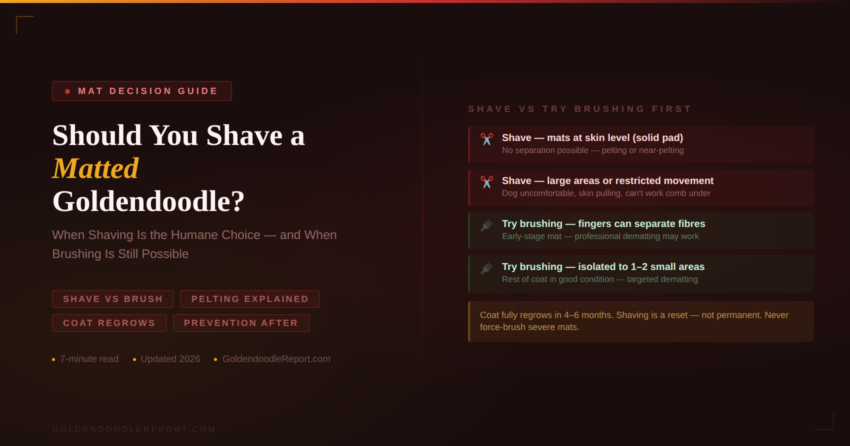
- Shave: Mats are at skin level and feel like a solid, compressed pad
- Shave: Mats cover large areas or multiple body sections
- Shave: The dog is visibly uncomfortable — skin pulling, restricted movement
- Shave: The groomer cannot safely work a clipper or comb under the mat
- Try brushing first: Mats are loose and fingers can begin to separate fibres
- Try brushing first: Mats are isolated to one or two small areas only
- Never: Force-brush or rip through severe mats — this causes pain and injury
For mat removal technique on early-stage mats see How to Remove Mats Safely. For prevention going forward see Goldendoodle Matting Prevention.
When Shaving Is the Right Decision
The key question when facing a matted Goldendoodle is not whether shaving feels like giving up — it is whether attempting to brush the coat out would cause more suffering than shaving it off. When mats have reached a certain stage, the answer is always yes.
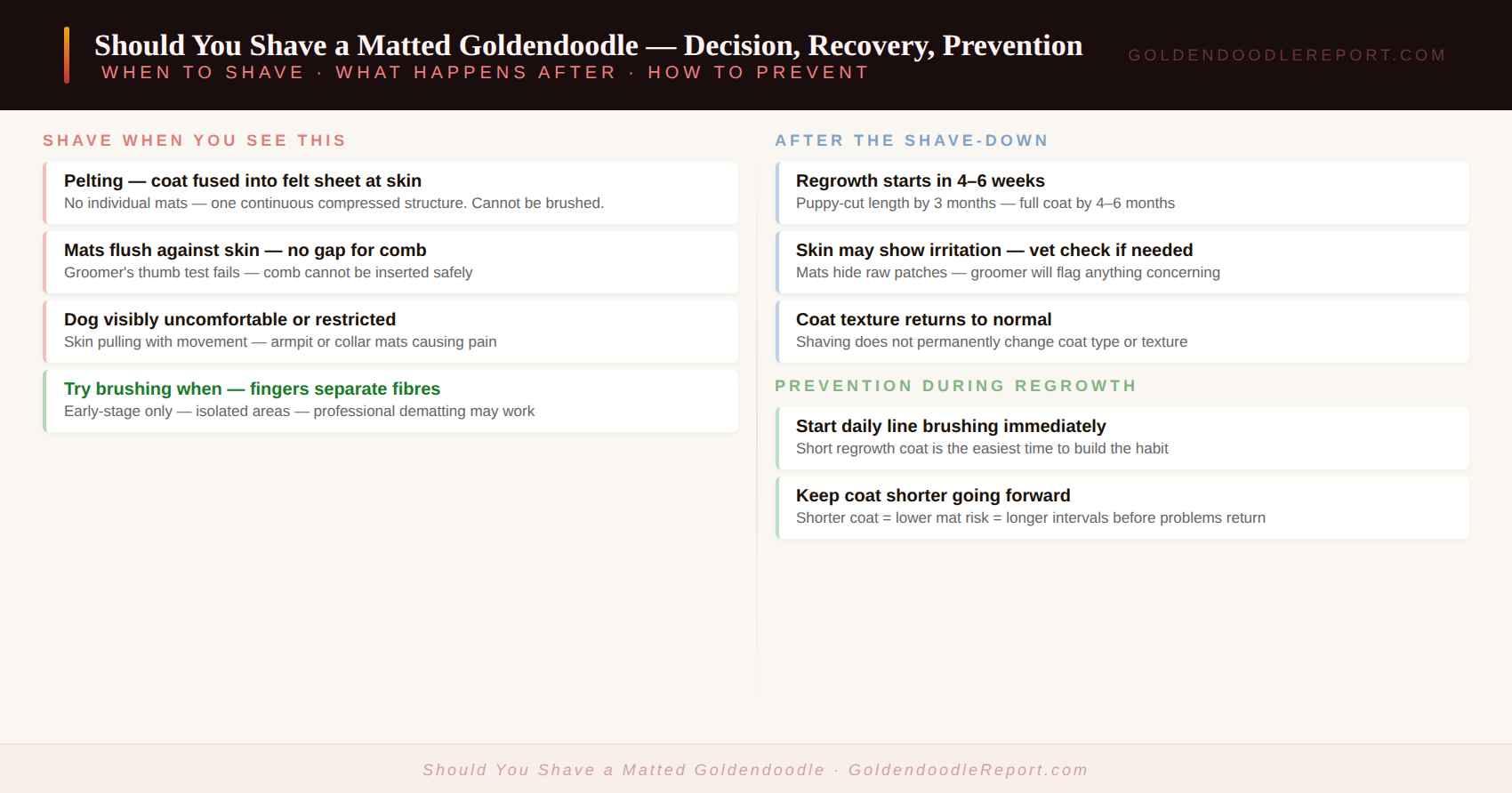
Pelting — the most severe mat stage. When mats across multiple areas have compressed into a continuous sheet of tangled coat that sits against the skin like felt, the condition is called pelting. A pelted coat is not a collection of individual mats — it is a single integrated structure that has fused the coat from skin to surface across a large area. No amount of brushing, detangling spray, or patience resolves pelting. The only humane option is removal with clippers. Attempting to brush through a pelted coat causes intense pain and is not a legitimate alternative.
Skin-level mats that restrict movement. When mats form in high-friction areas — under the front legs, between the back legs, at the collar — and are left to develop, they eventually pull the skin taut with every movement the dog makes. A dog with significant armpit mats experiences pain every time they take a step. A dog with collar mats has their neck movement restricted. These mats cannot be safely worked through from above — the clipper must go between the mat and the skin to remove it safely, which requires professional skill.
Any mat where the groomer cannot safely work a comb underneath it. Professional groomers use the thumb test — pressing a thumb between the mat and the skin to check whether there is enough space to work safely. If the mat is sitting flush against the skin with no separation, the comb cannot be inserted without the risk of cutting the skin. In this case, shaving is the only safe option.
When Shaving Is Not Necessary
Not every mat requires a full shave-down. Some owners hear the word “matted” from a groomer and assume the entire coat must go — this is not always the case.
If the mats are isolated to one or two small areas and the rest of the coat is in good condition, the groomer may be able to remove only the matted sections while leaving the surrounding coat intact. This is common for dogs who have developed localised matting behind the ears or under the collar but whose overall coat has been reasonably well maintained.
If the mats are in early stage — loose enough that fingers can begin to separate the fibres — the correct approach is careful professional dematting rather than shaving. Early-stage mats can be worked through with patience, the right tools, and detangling products. See How to Remove Mats Safely and How to Detangle a Goldendoodle Coat for the correct technique.
The distinction between a mat that can be worked through and one that must be shaved is tactile — and a professional groomer’s assessment is the most reliable guide. If a groomer recommends shaving, take the recommendation seriously. It means the mats have progressed beyond the stage where attempting to brush them out is humane.
What a Shave-Down Involves
A shave-down means removing the entire coat — or the affected sections — with clippers set to a very short length, typically a number 10 blade which leaves approximately 1.5mm of coat. This removes the mats entirely by cutting below them rather than trying to work through them.
The process requires skill because severely matted coats present specific risks. The skin beneath a mat is often irritated, sometimes raw, and occasionally has developed hot spots — areas of localised skin infection. The groomer works carefully to avoid cutting the skin, which becomes increasingly difficult when mats are sitting flush against it. This is why professional shave-downs should never be attempted at home — the risk of cutting skin that has been pulled up into the mat structure is significant without professional training and proper equipment.
After a shave-down, the skin is exposed and often looks different from what owners expect. The coat may have been hiding redness, irritation, or raw patches that now become visible. If significant skin irritation is present, a vet check is appropriate — the groomer will typically flag this.
What Happens After the Shave-Down
The coat regrows. This is the most important thing for owners to understand. A shave-down is not permanent damage — it is a reset. The Goldendoodle coat regrows from the follicle and will return to its normal length and texture over time.
Typical regrowth timeline: the coat begins to grow visibly within 4 to 6 weeks. A puppy-cut length is typically reached by 3 months. Full length is usually restored by 4 to 6 months depending on the individual dog’s growth rate and the season.
The regrowth period is the critical window for establishing the prevention habits that avoid a return to the same situation. A coat growing back from a shave-down is shorter and easier to manage than a full coat — this is the ideal time to establish daily brushing as a habit before the coat reaches the length at which matting becomes a risk again. See Goldendoodle Matting Prevention for the complete prevention protocol.
Preventing It from Happening Again
A shave-down resolves the immediate problem — it does not change the underlying coat type that created the conditions for matting. A curly-coated Goldendoodle who was shaved due to matting has the same curly coat growing back, with the same matting risk, unless the grooming routine changes.
The three changes that prevent a return to significant matting are consistent and correct — not consistent alone. Many owners who have experienced a shave-down resume brushing after the event but return to surface brushing rather than line brushing — and the cycle repeats. The technique matters as much as the frequency.
Daily line brushing using a slicker brush and metal comb quality check reaches the skin where mats form. Professional grooming at the correct interval for the coat type prevents the accumulation that home brushing cannot fully address. And the coat length chosen at grooming appointments affects maintenance difficulty — a shorter coat maintained at every 4 to 6 week appointment is significantly easier to keep mat-free than a long coat maintained at 8 to 10 week intervals. For the complete prevention system see Goldendoodle Matting Prevention and How to Line Brush a Goldendoodle.
For authoritative guidance on dog grooming see the AKC dog grooming guide.
🩺 A Note on Owner Guilt
Severe matting can develop quickly — particularly during the puppy coat transition, after illness when grooming is disrupted, or during periods of life when routine maintenance becomes difficult. It is not always the result of neglect. If your Goldendoodle needs a shave-down, the most useful response is not guilt — it is using the regrowth period to establish the prevention habits that prevent a recurrence. The coat grows back. The habits you build during regrowth are what determine whether you are in the same situation six months from now.
✅ Your Next Step
If you are currently dealing with a matted coat — book a professional grooming appointment today and let the groomer assess whether dematting or a shave-down is appropriate. Do not attempt to force-brush severe mats at home. If a shave-down is recommended, accept it. Use the regrowth period to build the daily brushing habit that prevents it recurring. For the complete grooming guide see Goldendoodle Grooming Guide.
🔑 Key Takeaways
- Shaving is the correct and humane decision when mats are at skin level, covering large areas, or causing the dog discomfort — not a failure of care
- Pelting — where the entire coat has fused into a felt-like sheet against the skin — cannot be brushed out and must be shaved
- Attempting to force-brush severe mats causes significant pain and potential skin damage — it is not a humane alternative to shaving
- Professional shave-downs should always be done by a groomer — never attempted at home — due to the risk of cutting skin hidden within the mat structure
- The coat fully regrows within 4 to 6 months — a shave-down is a reset, not permanent damage
- The regrowth period is the ideal time to establish daily line brushing as a habit before the coat reaches mat-risk length again
📚 Continue Learning
- Goldendoodle Grooming Guide — complete grooming authority guide
- Goldendoodle Matting Prevention — the prevention protocol that avoids reaching this point
- How to Remove Mats Safely — for early-stage mats that can still be worked through
- How to Detangle a Goldendoodle Coat — loose tangles before they become mats
- How to Line Brush a Goldendoodle — the technique that reaches where mats form
- How to Brush a Goldendoodle — complete brushing guide
- Goldendoodle Grooming Schedule — building prevention into a consistent routine
↑ Back to: Goldendoodle Grooming Guide | Goldendoodle Grooming — All Articles
Frequently Asked Questions
Should I shave my matted Goldendoodle?
If the mats are at skin level, covering large areas, causing the dog discomfort, or the groomer cannot safely work a comb underneath them — yes, shaving is the correct and humane decision. Attempting to force through severe mats causes significant pain and potential skin damage that is worse than the shave-down itself. If mats are early-stage and fingers can begin to separate the fibres, careful professional dematting may be possible — but this assessment should come from a professional groomer, not from a reluctance to shave.
Will my Goldendoodle’s coat grow back after shaving?
Yes — fully. The Goldendoodle coat regrows from the follicle and returns to its normal length and texture after a shave-down. Visible regrowth typically begins within 4 to 6 weeks. A puppy-cut length is usually reached by 3 months and full coat length by 4 to 6 months depending on the individual dog’s growth rate. The coat texture after regrowth is typically the same as before — occasional variation occurs but is not a reliable outcome of shaving.
Can I shave my matted Goldendoodle at home?
No — a matted shave-down should always be done by a professional groomer. Severely matted coats hide skin that has often become irritated, raw, or pulled up into the mat structure. Cutting through this without professional training and the correct equipment carries a significant risk of cutting the skin. A professional groomer has the experience to work safely around these conditions and will identify any skin issues that need veterinary attention.
How do I prevent my Goldendoodle from getting matted again after shaving?
Use the regrowth period to establish daily line brushing before the coat reaches mat-risk length. Line brushing — working from the skin outward in thin sections — is the only brushing technique that reaches the base layer where mats form. Surface brushing, which most owners use, misses this layer entirely. Additionally, maintain professional grooming at the correct interval for your dog’s coat type and keep the coat at a manageable length. The shorter the coat, the easier it is to maintain mat-free. See Goldendoodle Matting Prevention for the full protocol.
Disclaimer: The information in this article is provided for general educational purposes only. King James Adjei is a researcher and enthusiast, not a veterinarian or certified groomer. For significant matting or skin concerns, always consult a qualified professional groomer or veterinarian.