Affiliate Disclosure: Some links in this guide are affiliate links. If you purchase through them, we may earn a small commission at no extra cost to you. This does not influence our recommendations. Read our full affiliate disclaimer here.
By King James Adjei — Researcher and Goldendoodle enthusiast, founder of GoldendoodleReport.com. Every guide on this site is carefully researched and written to give owners reliable, clearly organised information. → About this site
🩺 Veterinary guidance note: Persistent loose stool, vomiting, or digestive symptoms lasting more than 48 hours require veterinary assessment. Many conditions that cause digestive upset in Goldendoodles — including parasites, infection, and inflammatory bowel disease — cannot be resolved through diet alone. This guide covers dietary management of confirmed sensitive stomachs, not diagnosis of underlying conditions. Always rule out medical causes with your vet before attributing chronic digestive symptoms to diet.
📖 9-minute read | Last updated May 2026 | Reviewed for accuracy
✅ Quick Answer
The five food types that most consistently help Goldendoodles with sensitive stomachs are: (1) limited ingredient dry kibble with a single named protein and simple carbohydrate, (2) fresh-cooked diets with transparent, minimal ingredient lists, (3) hydrolysed protein prescription diets for confirmed intolerances, (4) bland whole-food diets (boiled chicken and rice) for acute flare-ups, and (5) probiotic-supplemented foods or foods with added prebiotic fibre. In all cases, the approach is the same: simplify the diet, eliminate artificial additives and complex ingredient lists, feed consistently at scheduled times, and never switch foods abruptly. Always rule out parasites, infection, and food allergy with your vet before assuming the cause is simply a sensitive stomach.
Finding the right goldendoodle sensitive stomach food is one of the most common challenges owners of this breed face. Goldendoodles are consistently reported by owners and breeders as one of the dog breeds most prone to digestive sensitivity. Loose stool, excess gas, intermittent vomiting, and reactions to food changes are common complaints — and the problem is often made worse by owners cycling through different foods searching for the solution, each change triggering a new round of digestive upset.
The good news is that most Goldendoodles with sensitive stomachs respond very well to dietary management once the right approach is applied consistently. The bad news is that “sensitive stomach” is a vague description that covers several different root causes — and the dietary solution that works depends on which cause is actually present.
This guide covers those causes, the five food approaches that have the strongest evidence for helping sensitive-stomached Goldendoodles, and the specific ingredients and practices that make digestive sensitivity worse.
👤 Who This Guide Is For
- Your Goldendoodle has frequent loose stool, gas, or digestive upset that your vet has assessed and found no underlying disease
- Your dog reacts badly to any food change with several days of digestive disturbance
- You have tried multiple foods and the digestive problems continue regardless of brand
- You want to understand what ingredients are most likely causing the problem and how to eliminate them systematically
📊 Quick Facts — Goldendoodle Digestive Sensitivity
- Goldendoodles inherit digestive sensitivity from the Poodle side — Poodles are known to have more reactive gastrointestinal systems than many other breeds, and this trait passes reliably to Goldendoodle offspring
- The most common dietary cause of loose stool in Goldendoodles is not poor food quality — it is overfeeding, irregular feeding times, or abrupt food changes
- Artificial additives — particularly artificial colours, artificial preservatives (BHA, BHT), and carrageenan — are disproportionately likely to trigger digestive reactions in sensitive dogs
- Probiotics and prebiotic fibre have solid evidence for improving stool consistency and reducing digestive incidents in dogs with sensitive gastrointestinal systems
- A Goldendoodle that has had loose stool for more than 48 hours, or that has blood in the stool, lethargy, or repeated vomiting, requires veterinary assessment — not a diet change
- Many owners inadvertently worsen sensitive stomach problems by switching foods too frequently — each change requires a 7–10 day transition and stacks digestive disruption on top of the existing sensitivity
📋 Table of Contents
- Sensitive Stomach vs Food Allergy — The Difference
- What Actually Causes Goldendoodle Digestive Sensitivity
- When It Is Not a Diet Problem
- Goldendoodle Sensitive Stomach Food: The 5 Types That Help
- Ingredients That Make It Worse
- Feeding Practices That Reduce Digestive Incidents
- Managing an Acute Flare — The Bland Diet Protocol
- Probiotics and Prebiotic Fibre
- How to Switch Foods Without Causing a Flare
- Frequently Asked Questions
Sensitive Stomach vs Food Allergy — The Difference
These two conditions are frequently confused but require different management. Getting the distinction right prevents months of misdirected dietary intervention.
Sensitive stomach / food intolerance is a non-immune digestive reaction. The gastrointestinal system does not tolerate certain ingredients well — producing loose stool, gas, vomiting, or bloating — but without activating the immune system. Symptoms are primarily digestive. There is typically no skin involvement (no itching, no ear infections, no paw chewing). Sensitive stomachs can be managed through careful diet selection without the need for a full veterinary elimination trial.
Food allergy is an immune-mediated reaction to a specific food protein. Symptoms primarily affect the skin — recurring itchy paws, ear infections, face rubbing, belly itching — often alongside digestive symptoms. A confirmed food allergy requires a veterinary-supervised 8–12 week elimination trial to diagnose and is a lifelong condition requiring strict ingredient avoidance.
If your Goldendoodle has digestive symptoms only — with no skin involvement — sensitive stomach management is the appropriate starting point. If skin symptoms are present alongside digestive symptoms, read our Goldendoodle Food Allergies guide first and discuss with your vet before making dietary changes.
📖 Real Scenario
A 3-year-old male Goldendoodle has soft stool 3–4 times per week. No vomiting, no skin symptoms, no ear infections. His owner has tried four different foods in eight months — each change causes 5–7 days of very loose stool before settling, and then the soft stool pattern returns anyway. The dog has been vet-checked twice; parasites and infection have been ruled out. The problem is not the foods themselves — it is the frequency of switching. Each new food triggers a new digestive adjustment period. The dog’s system never stabilises. The vet recommends choosing one limited ingredient food meeting the criteria below, transitioning slowly over 10 days, and staying on it for a minimum of 8 weeks before assessing. By week 6, stool is consistently firm. The food was not dramatically different from what the owner was already feeding — the consistency was the change that worked.
What Actually Causes Goldendoodle Digestive Sensitivity
Before adjusting diet, it helps to understand which of these common causes is most likely responsible — because the dietary fix differs by cause.
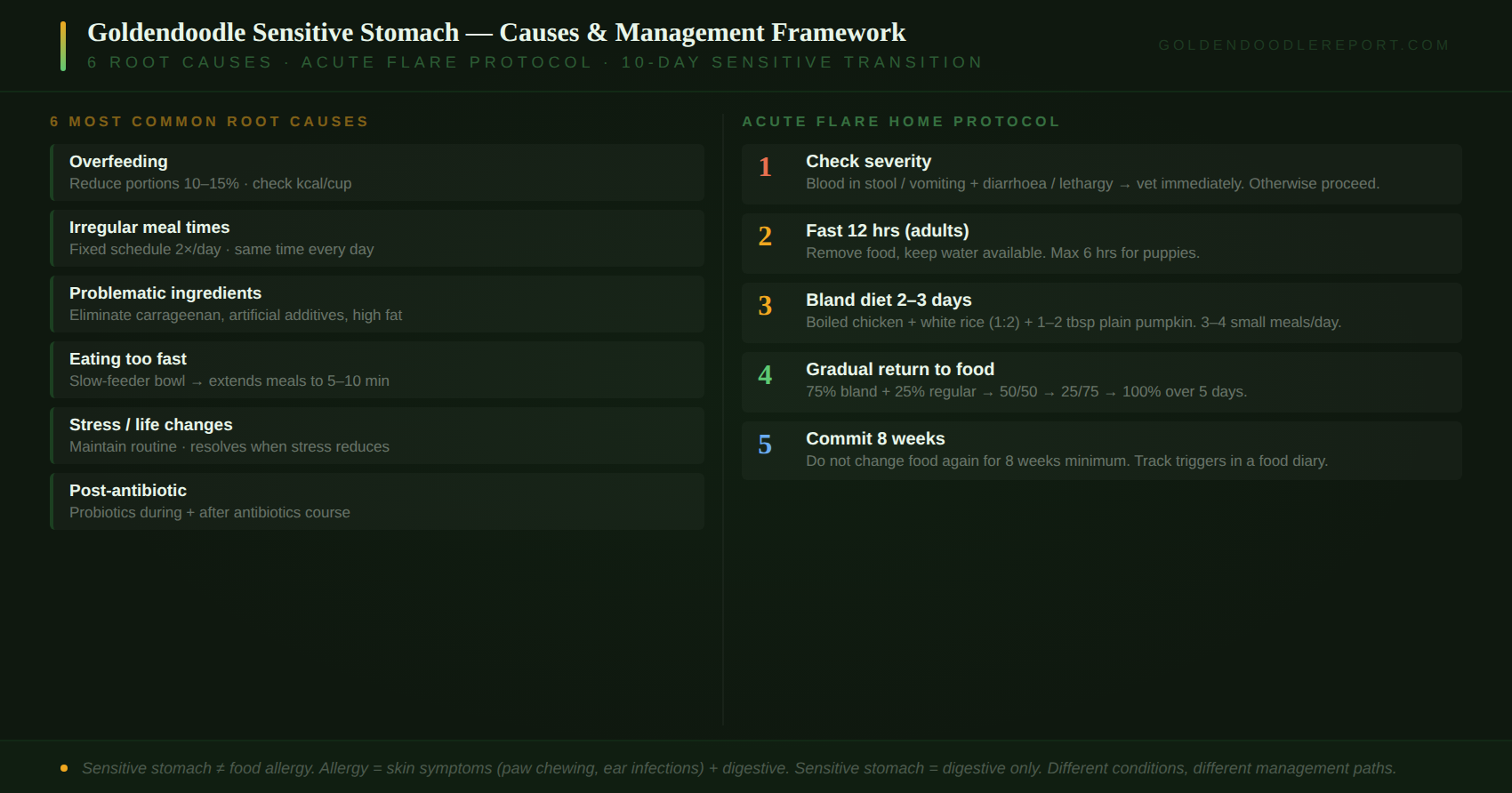
Cause 1 — Overfeeding
The most commonly overlooked cause of chronic loose stool in Goldendoodles. When food volume exceeds what the digestive system can efficiently process, the excess passes through incompletely digested — producing soft, bulky, or watery stools. If your Goldendoodle’s stool is consistently soft but formed (not liquid), reducing daily food by 10–15% often produces immediate improvement. See How Much to Feed a Goldendoodle for correct portion sizing.
Cause 2 — Irregular feeding schedule
Dogs have digestive cycles tied to meal timing. Inconsistent feeding times disrupt gastric acid secretion and gut motility, leading to irregular digestion and unpredictable stool quality. Goldendoodles are particularly reactive to schedule changes. A consistent twice-daily schedule at fixed times dramatically reduces digestive incidents in sensitive dogs. See Goldendoodle Feeding Schedule.
Cause 3 — Problematic ingredients
Certain ingredients commonly found in dog foods trigger digestive reactions in sensitive Goldendoodles even in foods that are otherwise high quality. These are covered in detail in the ingredients section below.
Cause 4 — Eating too fast
Goldendoodles that eat very quickly swallow large amounts of air alongside their food, contributing to gas, bloating, and incomplete chewing that increases digestive burden. A slow-feeder bowl addresses this directly and costs under $20. Standard Goldendoodles that eat rapidly also carry elevated bloat (GDV) risk from rapid eating.
Cause 5 — Stress and environmental changes
The gut-brain connection in dogs is well established. Major changes — a new home, a new pet, travel, boarding, construction noise, or household disruption — can trigger digestive upset in sensitive Goldendoodles through stress activation of the gut. Stress-related digestive upset typically resolves once the stressor is removed or the dog adapts. If digestive symptoms appeared alongside a significant life change, the cause may not be dietary at all.
Cause 6 — Post-antibiotic microbiome disruption
Antibiotics disrupt the gut microbiome — the community of beneficial bacteria that support healthy digestion. Many Goldendoodles develop loose stool during or after a course of antibiotics that resolves once the microbiome re-establishes. Probiotic supplementation during and after antibiotic courses significantly reduces this effect. Discuss with your vet before starting any probiotic alongside prescribed medication.
When It Is Not a Diet Problem — See Your Vet
Dietary management is appropriate for confirmed sensitive stomachs — not for diagnosing the cause of persistent digestive symptoms. See your vet before changing diet if any of the following apply:
🚨 Seek veterinary assessment if:
- Loose stool or diarrhoea has persisted for more than 48 hours without improvement
- There is blood or mucus in the stool
- Vomiting occurs alongside loose stool (dehydration risk — especially in puppies)
- The dog is lethargic, not eating, or showing signs of pain (hunched posture, reluctance to move)
- A puppy under 6 months has loose stool for more than 24 hours — puppies dehydrate faster than adults
- The dog has lost weight alongside digestive symptoms
- Symptoms recur despite correct dietary management over 8+ weeks
These signs indicate conditions — including parasites, parvovirus, haemorrhagic gastroenteritis, inflammatory bowel disease, pancreatitis, or intestinal obstruction — that require diagnosis and treatment, not diet changes.
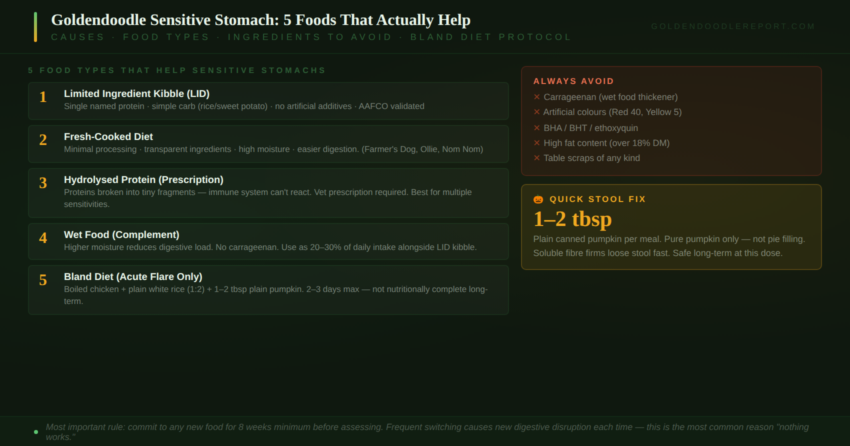
Goldendoodle Sensitive Stomach Food: The 5 Types That Help
Food Type 1 — Limited Ingredient Dry Kibble (LID)
A limited ingredient diet contains a deliberately short ingredient list: typically one named protein source, one or two carbohydrate sources, and essential fats and micronutrients. The fewer the ingredients, the easier it is to identify and eliminate a specific trigger, and the less overall burden on a sensitive digestive system.
What to look for:
- Single named protein as the first ingredient (salmon, duck, turkey, lamb — novel proteins are ideal)
- Simple carbohydrate — brown rice, sweet potato, or oatmeal
- No artificial colours, flavours, or preservatives
- No carrageenan, no unnamed “natural flavours”
- AAFCO validation for the correct life stage
- Grain-inclusive (for Goldendoodle cardiac reasons — see Best Food for Goldendoodles)
- Added prebiotic fibre or probiotic strains (beneficial for sensitive systems)
Best for: Long-term daily feeding once a trigger protein has been tentatively identified or when simplifying the diet is the primary goal. LID kibbles are the most practical and cost-effective solution for most owners.
Food Type 2 — Fresh-Cooked Diets
Commercially prepared fresh-cooked diets (subscription services such as The Farmer’s Dog, Ollie, or Nom Nom) are minimally processed, use human-grade ingredients, and have completely transparent ingredient lists. Many Goldendoodles with persistent digestive problems on kibble do significantly better on fresh-cooked food — the lower processing burden and higher moisture content reduce digestive stress.
What to look for: AAFCO-validated for complete and balanced nutrition, single primary protein option available, no artificial additives, ability to customise protein type if needed.
Best for: Owners with budget flexibility whose dogs have not responded to kibble changes. Fresh-cooked diets cost 2–4x more than quality kibble but produce measurable improvements in stool consistency for many sensitive Goldendoodles.
Food Type 3 — Hydrolysed Protein Prescription Diets
Available from your vet, hydrolysed protein diets break proteins into fragments too small for the digestive and immune systems to react to. They are the most reliable option when multiple protein sensitivities are suspected or when an elimination trial has been recommended. These require a vet prescription and are the most expensive option but eliminate the protein identification step.
Best for: Dogs with multiple food sensitivities or when the standard LID approach has not produced improvement after 8 weeks.
Food Type 4 — Wet Food (as a complement or primary)
Wet food has higher moisture content (70–80% vs 8–12% in kibble), which reduces the concentrated ingredient load per meal and supports hydration — particularly beneficial for sensitive dogs prone to digestive inflammation. Some sensitive Goldendoodles do better on a mixed diet of wet and dry rather than kibble alone.
What to look for: No carrageenan (a common thickener linked to digestive inflammation in sensitive dogs), named protein as first ingredient, AAFCO validation, no gravy recipes with unnamed flavour sources. Wet food alone is more expensive per calorie than kibble — using wet food as a 20–30% complement to kibble is a cost-effective middle ground.
Best for: Dogs that are reluctant eaters on kibble alone, or as a palatability enhancer that also adds moisture to reduce digestive burden.
Food Type 5 — Bland Diet for Acute Flare-Ups
When a sensitive-stomached Goldendoodle has an acute flare — sudden loose stool without the warning signs listed in the vet section above — a temporary bland diet allows the digestive system to settle before returning to normal feeding.
The standard bland diet protocol:
- Boiled plain chicken breast (no skin, no seasoning, no oil) + plain white rice in a 1:2 ratio (1 part chicken, 2 parts rice)
- Feed in small portions — split the daily amount across 3–4 meals rather than 2
- Plain canned pumpkin (not pie filling — pure pumpkin only) added at 1–2 tablespoons per meal adds soluble fibre that firms stool naturally
- Maintain this for 2–3 days until stool normalises
- Then transition back to the regular food gradually over 5–7 days
According to VCA Animal Hospitals, a home-prepared bland diet of boiled chicken and rice is not nutritionally complete and is deficient in more than 10 essential nutrients — making veterinary therapeutic GI diets a better option for extended use, with the home version reserved strictly as a short-term bridge.
⚠️ Bland diet is a short-term intervention only. Boiled chicken and rice is not nutritionally complete and cannot be fed as a long-term diet. It is appropriate for 2–5 days during an acute flare. If digestive symptoms have not significantly improved within 48–72 hours on a bland diet, consult your vet — the cause is likely not a simple digestive upset.
Ingredients That Make Sensitive Stomachs Worse
| Ingredient | Found In | Why It Causes Problems |
|---|---|---|
| Artificial colours (Red 40, Yellow 5, Blue 2) |
Budget kibbles, some wet foods, many treats | No nutritional purpose; associated with GI irritation in sensitive dogs; completely avoidable |
| Carrageenan | Wet foods and gravies as a thickener | Linked to intestinal inflammation in animal studies; best avoided for sensitive dogs |
| BHA / BHT / Ethoxyquin | Budget kibbles as synthetic preservatives | Synthetic preservatives that can irritate sensitive digestive systems; replaced by tocopherols in quality foods |
| High fat content (over 18% DM fat) |
Performance foods, some raw diets, fatty treats | High dietary fat causes loose stool in sensitive dogs; can trigger pancreatitis in susceptible individuals |
| Inulin / chicory root | Added as prebiotic in some premium kibbles | Beneficial for most dogs but can cause excessive gas and loose stool in sensitive individuals — paradoxically, a “gut health” ingredient that worsens symptoms in some dogs |
| Table scraps | Human food given as treats | Seasonings, fats, and novel ingredients in human food consistently trigger digestive upset in sensitive dogs; even small amounts undermine dietary management |
| Complex multi-protein foods | Premium “variety” kibbles with 5+ proteins | More ingredients means more potential triggers; for sensitive dogs, simplicity is more valuable than variety |
Feeding Practices That Reduce Digestive Incidents
Dietary content is only part of the picture. How and when you feed matters as much as what you feed for a sensitive-stomached Goldendoodle.
Practice 1 — Fixed meal times, every day
Feed at the same time every day — including weekends. Irregular feeding is one of the most consistent triggers for digestive irregularity in sensitive dogs. The digestive system prepares for meals at anticipated times; unexpected delays disrupt this preparation. For the complete scheduling guide: Goldendoodle Feeding Schedule.
Practice 2 — Correct portion size
Overfeeding is the number one overlooked cause of chronic loose stool. Every kibble has a different calorie density — always check kcal/cup and calculate portions accordingly rather than using a standard cup measurement across brands. How Much to Feed a Goldendoodle covers the full calculation method.
Practice 3 — Slow feeder bowl
If your Goldendoodle empties their bowl in under 90 seconds, they are eating too fast. Rapid eating causes air ingestion, incomplete chewing, and increased digestive burden — all of which worsen digestive sensitivity. A slow-feeder bowl or puzzle feeder extends meal duration to 5–10 minutes, significantly reducing post-meal gas and loose stool in fast eaters.
Practice 4 — No food changes for minimum 8 weeks
The most self-defeating pattern with sensitive-stomached Goldendoodles is changing food every 2–4 weeks when improvement is slow. Every new food requires a 7–10 day transition and then a settling period. Commit to a minimum of 8 weeks on any new food before assessing whether it is working. Most owners who report “my dog doesn’t do well on any food” have not maintained any food for long enough to find out.
Practice 5 — Eliminate all treats during a food trial
Treats are the most common reason a sensitive stomach food trial fails to show improvement. If the kibble is simplified but daily treats contain artificial colours, multiple proteins, or high fat content, the dietary management is undermined. During an 8-week trial, remove all treats or replace them with approved single-ingredient options (plain freeze-dried chicken, small pieces of carrot, plain pumpkin) that match the dietary simplicity of the main food.
Managing an Acute Flare — Step by Step
Even a well-managed sensitive-stomached Goldendoodle will occasionally have an acute digestive flare — triggered by stress, an unavoidable food change, or an unknown cause. This protocol manages a non-emergency flare at home.
Step 1 — Assess severity (first 4 hours): Is there blood in the stool? Is the dog vomiting repeatedly? Is the dog lethargic or refusing water? Any of these → vet immediately. None of these → proceed with home management.
Step 2 — Short fast (12 hours for adults, maximum 6 hours for puppies): Remove food for 12 hours but maintain full water access. This allows the GI tract to settle. Never fast a puppy under 6 months for more than 6 hours — blood sugar risks apply.
Step 3 — Bland diet for 2–3 days: Boiled plain chicken breast and white rice (1:2 ratio), small portions 3–4 times per day. Add 1–2 tablespoons of plain canned pumpkin per meal if available — the soluble fibre firms stool rapidly.
Step 4 — Transition back (days 4–7): Gradually reintroduce the regular food by mixing 75% bland diet + 25% regular food, then 50/50, then 25/75, then full regular food over 4–5 days.
Step 5 — Identify the trigger: If flares are recurring, keep a food diary — what was eaten (including treats, table scraps, supplements) in the 24 hours before each flare. Patterns emerging across multiple flares identify the specific trigger.
Probiotics and Prebiotic Fibre — What the Evidence Says
Probiotics — live beneficial bacteria — and prebiotic fibre — which feeds those bacteria — have genuine evidence for improving digestive consistency in dogs with sensitive stomachs. They are not a substitute for appropriate food selection but they are a meaningful complement to it. Choosing a goldendoodle sensitive stomach food that already includes probiotic strains or prebiotic fibre removes the need for a separate supplement in many cases.
Probiotics
Probiotic supplements or probiotic-enriched foods help restore and maintain healthy gut microbiome balance, improve stool consistency, reduce recovery time after digestive flares, and buffer the microbiome disruption caused by antibiotics. Look for multi-strain products (at least 3–5 strains) with confirmed CFU counts. Saccharomyces boulardii — a beneficial yeast rather than a bacteria — is particularly well-supported for managing antibiotic-associated loose stool in dogs.
Prebiotic fibre
Soluble fibres — including beet pulp, psyllium husk, plain pumpkin, and cooked sweet potato — feed beneficial gut bacteria and directly improve stool quality. Many sensitive stomach kibbles include beet pulp for this reason. Adding plain canned pumpkin (1–2 tablespoons per meal) during a digestive flare is one of the fastest and safest interventions available to owners.
The inulin caveat
As noted in the ingredients section, inulin (chicory root) is a prebiotic fibre that works well for most dogs but causes gas and loose stool in some sensitive individuals. If a premium kibble containing inulin is not producing the expected improvement in stool quality, inulin sensitivity may be the issue — try a food formulated without it.
How to Switch Foods Without Causing a Flare
For sensitive-stomached Goldendoodles, the standard 7-day transition protocol is the minimum — 10 days is often better.
| Days | Old Food | New Food | Notes for Sensitive Dogs |
|---|---|---|---|
| Days 1–3 | 80% | 20% | Slower start than standard for sensitive dogs. Watch for any immediate reaction. |
| Days 4–6 | 60% | 40% | Some loose stool is expected. If very severe, slow down further — stay at 80/20 for another 2 days. |
| Days 7–8 | 40% | 60% | Stool should be improving. Add probiotic supplement if not already using one. |
| Days 9–10 | 20% | 80% | Final step before full transition. |
| Day 11+ | 0% | 100% | Transition complete. Maintain for minimum 8 weeks before assessing whether the food is working. |
Critical rule for sensitive dogs: If you encounter significant loose stool during the transition, slow down — do not abandon the new food. Reverting to the old food and starting again creates another round of digestive disruption. Reduce the new food percentage back one step and hold there for an extra 2–3 days before progressing.
🔑 Key Takeaways
- The right goldendoodle sensitive stomach food is not necessarily an expensive or exotic brand — it is a food that meets 4 core criteria: single named protein, simple carbohydrate, no artificial additives, and grain-inclusive
- Sensitive stomach and food allergy are different conditions — sensitive stomach causes digestive symptoms only; food allergy primarily causes skin symptoms alongside digestive ones. If skin is involved, see our Goldendoodle Food Allergies guide
- The most commonly overlooked cause of chronic loose stool in Goldendoodles is overfeeding or irregular feeding schedule — correct these before changing foods
- Frequent food switching makes sensitive stomach problems worse — every change triggers a new digestive adjustment period. Commit to one food for 8 weeks minimum
- Plain canned pumpkin (1–2 tablespoons per meal) is the fastest safe dietary intervention for firming loose stool during an acute flare
- Symptoms lasting more than 48 hours, blood in stool, vomiting alongside diarrhoea, or lethargy require veterinary assessment — not dietary changes
📚 More Goldendoodle Food & Nutrition Guides
- How Much to Feed a Goldendoodle: Amounts by Age + Weight
- Goldendoodle Feeding Schedule: Meal Timing by Age (2026)
- Best Food for Goldendoodles: What Vets Recommend (2026)
- Best Food for Adult Goldendoodles: Vet-Backed Guide (2026)
- Goldendoodle Food Allergies: Signs, Triggers + What to Feed
- Goldendoodle Weight Management: How to Help an Overweight Dog Safely — coming soon
- How Much Water Should a Goldendoodle Drink? — coming soon
Browse all guides: Goldendoodle Food & Nutrition category
🔗 Related Guides Across the Site
- Goldendoodle Puppy Deworming Guide — parasites as a cause of digestive upset
- Goldendoodle Puppy First Vet Visit — ruling out medical causes of digestive issues
- Why Is My Goldendoodle Always Hungry? — when hunger signals a digestive issue
- Do Goldendoodles Smell Bad? — digestive issues contributing to odour
- Goldendoodle Spring Allergies — distinguishing food from environmental triggers
- Goldendoodle Puppy Care Guide — digestive sensitivity in the first year
Frequently Asked Questions
Why does my Goldendoodle always have a sensitive stomach?
Goldendoodles inherit digestive sensitivity from the Poodle parent — Poodles are known for having more reactive gastrointestinal systems than many other breeds, and this trait passes reliably to Goldendoodle crosses. It is not a disease or deficiency — it is a breed characteristic that requires appropriate dietary management. The good news is that most Goldendoodles with sensitive stomachs respond very well once the right food is identified and fed consistently. The most common issue is not finding the right food but switching too frequently before any food has had time to work.
What is the best goldendoodle sensitive stomach food?
A limited ingredient dry kibble with a single named novel protein (salmon, duck, turkey, or lamb), a simple carbohydrate (brown rice or sweet potato), no artificial additives, and no carrageenan is the most practical starting point. Fresh-cooked diets from services like The Farmer’s Dog or Ollie are a premium alternative that many sensitive-stomached Goldendoodles tolerate better than kibble. The specific brand matters less than the ingredient simplicity and consistency of feeding. Whichever food you choose, commit to it for 8 weeks minimum before assessing whether it is working.
Is pumpkin good for Goldendoodles with sensitive stomachs?
Yes — plain canned pumpkin (pure pumpkin only, not pie filling which contains spices and sugar) is one of the most effective, safe, and affordable dietary interventions for loose stool in Goldendoodles. The soluble fibre in pumpkin absorbs excess water in the colon, firming stool naturally. One to two tablespoons per meal is the appropriate amount for most Goldendoodles. It can be added to regular food long-term without nutritional concern at these amounts. Note that pumpkin firms loose stool but does not address the underlying cause — if stool remains consistently soft despite pumpkin supplementation, review the primary food and feeding amounts.
Should I feed my sensitive-stomached Goldendoodle grain-free food?
No — grain-free is not recommended for Goldendoodles with sensitive stomachs, or for Goldendoodles generally. Grain allergies in dogs are uncommon; the most likely digestive triggers are proteins (chicken, beef) and artificial additives, not grains. Additionally, grain-free diets high in legumes have been associated with a potential dilated cardiomyopathy (DCM) risk in dogs — particularly relevant for Goldendoodles given their inherited cardiac predispositions. A grain-inclusive limited ingredient food is the better choice on both grounds.
How long does it take for a new food to work for a sensitive stomach?
Allow a minimum of 8 weeks after completing the food transition before assessing whether the new diet is working. The transition itself (10 days for sensitive dogs) involves expected digestive adjustment — this is not the food failing. After full transition, the digestive system needs 4–6 weeks to fully adapt to the new ingredient profile. Many owners abandon a new food at week 2–3 because the digestive adjustment is still ongoing. Mark 8 weeks from the end of your transition on the calendar and assess then — not before.
Can stress cause digestive problems in Goldendoodles?
Yes — the gut-brain connection in dogs is well established. Goldendoodles are emotionally sensitive dogs and respond to household stress, new environments, travel, boarding, and major routine changes with digestive upset. If your dog’s loose stool appeared alongside a significant life change — a new baby, a house move, the departure of another pet, or increased noise or disruption — stress is likely a contributing factor. Stress-related digestive upset typically resolves within 1–2 weeks of the stressor resolving or the dog adapting. Supporting the dog through the stressful period (maintaining routine, providing calm) is as important as dietary management during these episodes.
Disclaimer: The information in this article is provided for general educational purposes only. King James Adjei is a researcher and enthusiast, not a veterinarian or certified veterinary nutritionist. Persistent digestive symptoms in Goldendoodles require veterinary assessment to rule out underlying medical conditions. Do not use dietary management as a substitute for veterinary care when the warning signs described in this article are present. Always consult your veterinarian before making significant dietary changes for a dog with chronic health issues.