Affiliate Disclosure: Some links in this guide are affiliate links. If you purchase through them, we may earn a small commission at no extra cost to you. This does not influence our recommendations. Read our full affiliate disclaimer here.
By King James Adjei — Researcher and Goldendoodle enthusiast, founder of GoldendoodleReport.com. Every guide on this site is carefully researched and written to give owners reliable, clearly organised information. → About this site
🩺 Veterinary guidance note: Raw feeding requires careful nutritional planning to ensure the diet is complete and balanced. Poorly balanced raw diets have been documented to cause nutritional deficiencies — particularly in calcium, phosphorus, and key vitamins — especially in growing puppies. This guide provides an evidence-based overview of raw feeding, not a feeding prescription. Always work with a veterinary nutritionist before transitioning a Goldendoodle puppy or a dog with health conditions to a raw diet.
📖 9-minute read | Last updated May 2026 | Reviewed for accuracy
✅ Quick Answer
Raw diets can work for Goldendoodles — but they require significantly more planning, research, food safety discipline, and ideally veterinary nutritionist guidance than commercial diets. The two main approaches are BARF (Biologically Appropriate Raw Food — includes meat, bones, organs, and plant matter) and PMR (Prey Model Raw — meat, bones, and organs only, no plant matter). Both can produce good results in adults when nutritionally balanced. Neither is appropriate for puppies without veterinary nutritionist supervision — the calcium and phosphorus balance requirements for growing large-breed skeletons are difficult to maintain correctly in a raw format. The evidence on raw feeding as of 2026 is more nuanced than either enthusiastic proponents or dismissive critics suggest: some measures improve on raw diets, risks are real but manageable with correct protocols.
A raw diet for Goldendoodles is one of the most passionately debated topics in dog nutrition. Proponents claim transformative results — shinier coats, better digestion, more energy, cleaner teeth. Critics — including most mainstream veterinary organisations — point to bacterial contamination risks, nutritional imbalance in home-prepared diets, and the absence of long-term controlled trials.
The honest picture is more nuanced than either camp presents. Recent research — including a 2026 study from Leipzig University and the updated 2026 Raw Feeding Veterinary Society position statement — shows measurable differences in some health markers between raw-fed and kibble-fed dogs, while also confirming that the risks are real and the evidence for long-term clinical outcomes remains limited.
This guide presents the evidence as it stands in 2026 — without advocacy for either position — so that Goldendoodle owners can make an informed decision about whether raw feeding is right for their specific situation.
👤 Who This Guide Is For
- You are considering transitioning your Goldendoodle to a raw diet and want an honest assessment before deciding
- Your Goldendoodle has not thrived on kibble and you want to understand whether raw feeding might address the specific issues
- You have heard conflicting information about raw feeding and want the actual evidence rather than anecdotes
- You are already raw feeding and want to ensure your approach covers the most important nutritional and safety requirements
📊 Quick Facts — Raw Feeding and Goldendoodles
- A 2026 study published in BMC Veterinary Research (Leipzig University) found lower prevalence of obesity and nutritional imbalances in dogs fed raw meat-based diets compared to commercial complete diets — though the study noted methodological limitations
- Raw meat commonly carries Salmonella, Campylobacter, Listeria, and E. coli — dogs can shed these pathogens in their faeces without showing illness, creating a genuine household contamination risk, particularly relevant in homes with young children, elderly, or immunocompromised individuals
- Studies consistently find that a significant proportion of home-prepared raw diets are nutritionally incomplete — particularly deficient in calcium, phosphorus, zinc, copper, and certain vitamins when not formulated by a nutritionist
- Commercial frozen and freeze-dried raw diets that carry AAFCO validation offer a significantly safer starting point than home-prepared diets, as nutritional completeness has been independently verified
- The Goldendoodle’s inherited coat health and digestive sensitivity characteristics make dietary quality particularly visible — improvements in coat and stool consistency are among the first and most consistent reported benefits of raw feeding in this breed
📋 Table of Contents
- BARF vs PMR — The Two Main Approaches
- What the Research Actually Shows (2025–2026)
- Reported Benefits for Goldendoodles
- Real Risks — What They Are and How Serious
- Nutritional Balance — The Hardest Part
- Who Should Not Raw Feed
- Commercial Raw vs Home-Prepared
- How to Start Safely
- Cost of Raw Feeding a Goldendoodle
- Frequently Asked Questions
A Raw Diet for Goldendoodles: BARF vs PMR — The Two Main Approaches
Raw feeding broadly encompasses two philosophies with meaningfully different nutritional compositions.
BARF — Biologically Appropriate Raw Food
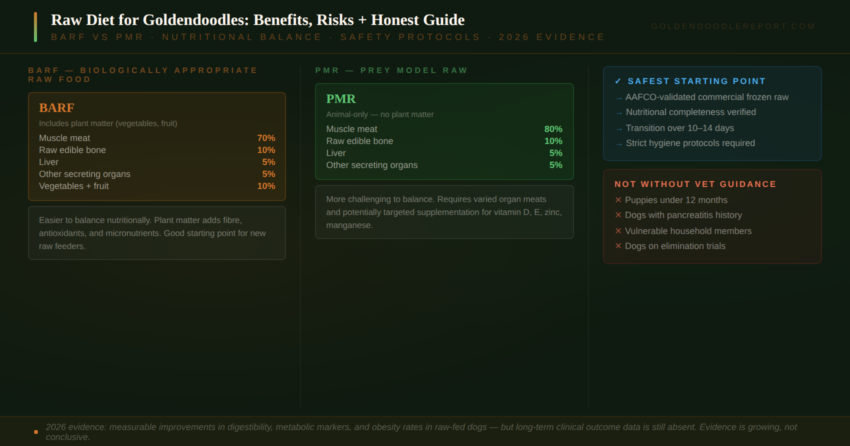
Popularised by Australian veterinarian Dr Ian Billinghurst in the 1990s, BARF includes raw meat, raw meaty bones, organ meat, and plant-based ingredients (vegetables, fruits, sometimes dairy and eggs). A standard BARF composition is approximately 70% muscle meat, 10% raw edible bone, 5% liver, 5% other secreting organs, and 10% vegetables and fruit.
BARF proponents argue that the plant matter provides fibre, antioxidants, and micronutrients that complement the animal-based components. The inclusion of plant ingredients makes BARF somewhat easier to nutritionally balance than PMR because more nutrient sources are available.
PMR — Prey Model Raw
Both approaches fall under what Wikipedia describes as raw feeding — a practice that has raised ongoing debate around nutrient balance, foodborne illness risk, and whether dogs require the plant-based components that distinguish BARF from PMR.
PMR attempts to replicate what a dog would eat consuming whole prey in the wild. The standard PMR ratio is 80% muscle meat, 10% raw edible bone, 5% liver, and 5% other secreting organs. No plant matter is included — proponents argue that dogs are obligate or near-obligate carnivores and do not require plant-based nutrition.
PMR is nutritionally more challenging to balance correctly precisely because of the limited ingredient range. Getting the right calcium-to-phosphorus ratio from bone alone, and ensuring adequate zinc, manganese, vitamin D, and vitamin E, requires careful sourcing of varied organ meats and may still require targeted supplementation.
Commercial raw (pre-prepared)
A third option sits between home-prepared raw and kibble: commercially prepared frozen or freeze-dried raw diets from specialist manufacturers. These use raw or minimally processed ingredients but are formulated to AAFCO nutritional standards, removing the primary concern about home-prepared raw diets (nutritional incompleteness). They cost more than home-prepared raw but significantly less than the time and expertise required to balance a home diet correctly.
📖 Real Scenario
A 3-year-old Standard Goldendoodle has had soft stool and a dull coat despite multiple kibble changes over 18 months. The owner transitions to a commercially prepared frozen BARF raw diet after consulting their vet. After 6 weeks: stool consistency has improved significantly, coat texture noticeably softer and shinier. The dog’s vet notes BCS has improved from 5 to 4.5 (slightly leaner). The owner attributes the improvement to the raw diet. However, the vet notes that the simultaneous switch to a more structured feeding schedule and elimination of all table scraps — both occurring alongside the diet change — may also have contributed. This is the interpretive challenge with raw feeding anecdotes: multiple variables change at once, making it difficult to isolate what actually drove the improvement. The outcome is positive; the cause is genuinely uncertain.
What the Research Actually Shows (2025–2026)
The evidence base for raw feeding has grown meaningfully in the last two years. The honest summary as of mid-2026:
What the evidence supports
- Digestibility differences: Controlled comparisons report measurable differences in apparent digestibility and faecal characteristics between dogs fed raw and ultra-processed kibble diets. Raw-fed dogs in multiple studies showed smaller, firmer faecal output — consistent with higher nutrient absorption.
- Metabolic markers: A 2025 DogRisk study in 46 dogs found that kibble-fed dogs showed increased long-term blood sugar, elevated blood lipids, and weight gain over time, while raw-fed dogs showed decreases in these markers alongside lower triglyceride-glucose index — a recognised marker of insulin resistance.
- Lower obesity rates: The 2026 Leipzig University study found lower prevalence of obesity in raw-fed dogs compared to commercial complete diet-fed dogs. The authors noted this does not establish causation — diet self-selection, owner behaviour, and other factors may contribute.
- Gut microbiome differences: Observational studies report differences in microbiome composition and inflammatory markers between raw-fed and kibble-fed dogs. The clinical significance of these differences for long-term health outcomes is not yet established.
What the evidence does not yet support
- Long-term controlled trials demonstrating reduced disease incidence or extended lifespan in raw-fed versus kibble-fed dogs do not yet exist
- The improved metabolic and digestibility markers seen in studies are “intermediate measures rather than validated clinical endpoints” — as the Raw Feeding Veterinary Society’s 2026 position statement explicitly notes
- Claims that raw feeding reverses or prevents specific diseases (cancer, autoimmune conditions, allergies) are not supported by controlled evidence
The nutritional imbalance problem
Multiple independent analyses of home-prepared raw diets consistently find nutritional deficiencies — particularly in calcium, phosphorus, zinc, copper, vitamin D, and vitamin E. A study published in the Journal of Nutritional Science found that over 60% of home-prepared raw diet recipes were deficient in at least one essential nutrient. This is the primary legitimate concern raised by veterinary nutritionists — not that raw feeding is inherently dangerous, but that most home-prepared raw diets are nutritionally incomplete without expert formulation.
Reported Benefits for Goldendoodles Specifically
The following benefits are most consistently reported by Goldendoodle owners transitioning to raw feeding. They are observations, not controlled outcomes — but the pattern is consistent enough to be worth noting:
- Improved coat quality: The most frequently and consistently reported benefit. Goldendoodles fed raw diets — particularly those with varied protein sources and organ meats high in fat-soluble vitamins — often show noticeable coat lustre improvements within 6–10 weeks. The naturally occurring fatty acid profile in raw meat may contribute, alongside the absence of high-heat processing that degrades nutrients in kibble.
- Firmer, smaller stools: Consistent with the research — raw diets typically produce smaller, firmer, less odorous stools due to higher digestibility and lower indigestible filler content. Owners dealing with chronic loose stool on kibble frequently report significant improvement on raw.
- Dental health: Raw meaty bones provide mechanical cleaning that is more effective than most commercial dental chews. Dogs fed raw bones regularly tend to develop less tartar than kibble-only dogs, though professional dental assessment remains important regardless of diet.
- Improved digestion in sensitive dogs: Some Goldendoodles that have not thrived on any kibble — even limited ingredient diets — do significantly better on raw feeding. The elimination of rendered proteins, artificial additives, and high-heat processing removes many common digestive irritants simultaneously.
Real Risks — What They Are and How Serious
Bacterial contamination — the primary concern
Raw meat routinely carries pathogenic bacteria including Salmonella, Campylobacter, Listeria, and E. coli. Dogs have a shorter, more acidic digestive tract than humans, offering some natural protection — but they do not eliminate pathogens completely. A dog fed raw meat can shed Salmonella in their faeces for weeks without showing any illness.
The household contamination risk is the more significant concern: contaminated surfaces, bowls, and dog faeces in the home and garden create exposure pathways for household members. This risk is substantially higher in homes with:
- Children under 5 years
- Elderly household members (over 65)
- Immunocompromised individuals (chemotherapy patients, HIV, organ transplant recipients)
- Pregnant women
In these household contexts, raw feeding carries risks that may outweigh potential benefits and should be discussed carefully with both a veterinarian and the relevant human healthcare provider.
Nutritional imbalance
As discussed above — home-prepared raw diets without expert formulation are frequently nutritionally incomplete. This is most dangerous in growing puppies (where calcium-phosphorus imbalance causes developmental bone disease) and least dangerous in healthy adults fed a varied diet with appropriate organ inclusion. Commercial raw products validated to AAFCO’s nutritional adequacy standards eliminate this risk.
Bone hazards
Raw meaty bones — a central component of most raw diets — carry choking and obstruction risk. Whole bones should always be appropriately sized (larger than the dog can swallow whole), fed under supervision, and never cooked. Poultry bones (chicken, turkey) are softer and more appropriate than large weight-bearing bones (femurs, knuckle bones), which are hard enough to fracture teeth.
Pancreatitis risk
High-fat raw diets — particularly those heavy in pork, lamb, or fatty trimmings — can trigger pancreatitis in susceptible dogs. Goldendoodles have moderate pancreatitis risk due to their Golden Retriever genetics. A raw diet for a Goldendoodle should use lean muscle meats as the primary component, not high-fat cuts.
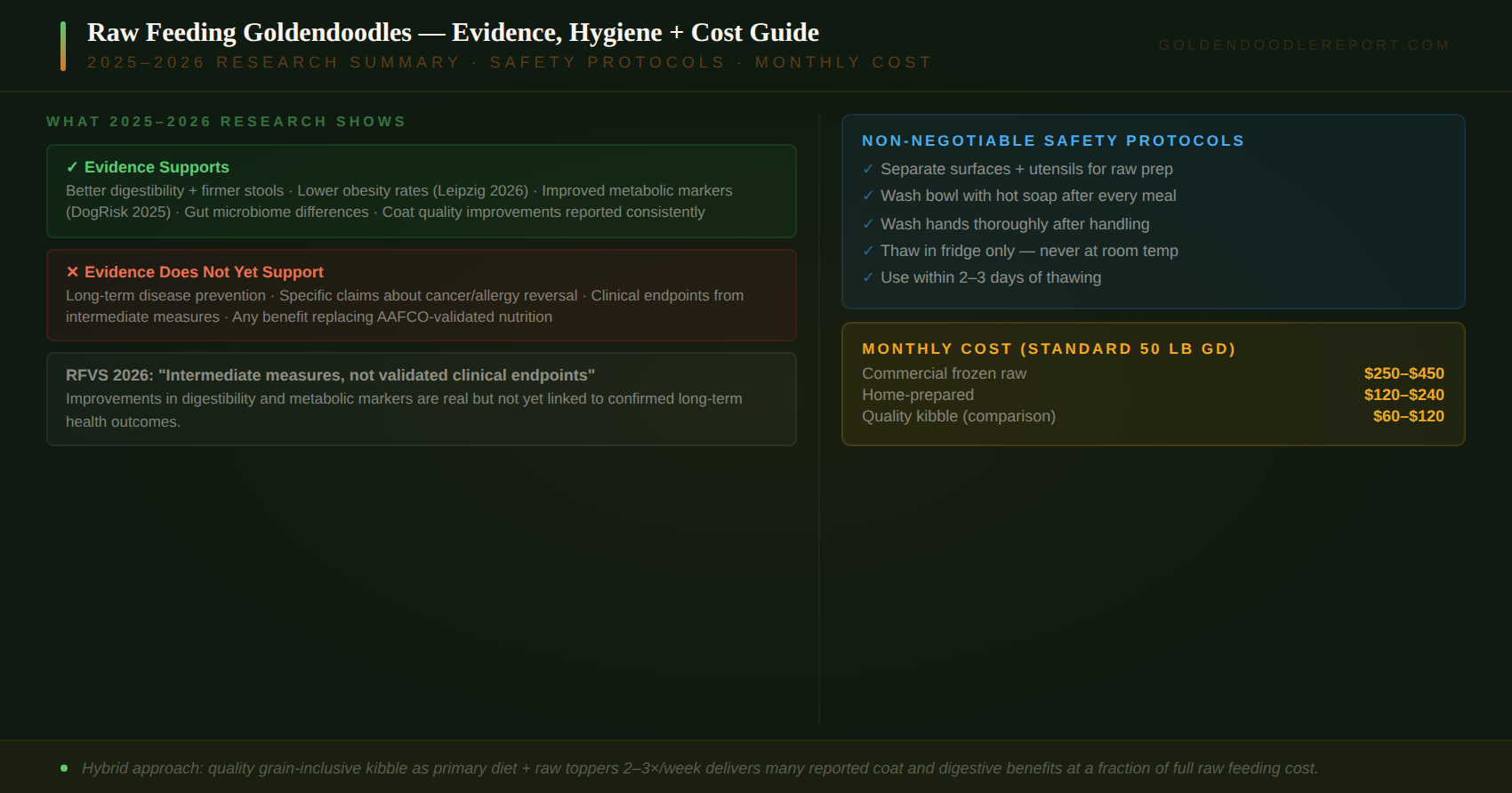
⚠️ Bacterial safety protocols — non-negotiable if raw feeding: Wash all preparation surfaces, bowls, and utensils with hot soapy water after every meal. Do not allow the dog to lick faces or food preparation surfaces after eating. Wash hands thoroughly after handling raw meat and after cleaning the dog’s bowl. Store raw food frozen and thaw in the refrigerator — never at room temperature. Dispose of unused raw food within 2–3 days of thawing.
Nutritional Balance — The Hardest Part
Getting a raw diet nutritionally complete and balanced for an adult Goldendoodle requires understanding and addressing several specific nutrient concerns:
Calcium and phosphorus
The correct Ca:P ratio for adult dogs is approximately 1.2:1 to 1.4:1. Raw meat alone is high in phosphorus and low in calcium — raw meaty bones provide the calcium counterbalance. If bone content is too low, the diet becomes phosphorus-heavy and calcium-deficient. If bone content is too high, hypercalcaemia risk emerges. Getting this ratio correct is the most critical nutritional challenge in raw feeding and the most common point of failure in home-prepared diets.
Essential vitamins
Vitamin D is not abundant in most raw muscle meat — liver and certain fish are better sources. Vitamin E is important for Goldendoodle coat health and immune function — raw muscle meat is not a reliable source. A varied diet including fish, eggs, and appropriate organ meats improves the vitamin profile significantly, but some raw diets still require targeted supplementation.
Zinc and manganese
Deficiency in zinc and manganese is a known issue in poorly varied raw diets. These minerals are found in higher concentrations in organ meats (liver, kidney, pancreas) and seafood. Including these sources regularly rather than relying on muscle meat alone addresses the gap.
The practical solution
For owners who want to raw feed without nutritionist consultation, starting with a commercially prepared AAFCO-validated frozen raw diet removes the primary nutritional balance risk while maintaining most of the raw feeding characteristics. Once comfortable with raw feeding principles, a transition toward home-prepared can be made with appropriate guidance. This is the lowest-risk starting point recommended by the Raw Feeding Veterinary Society’s 2026 position statement.
Who Should Not Raw Feed Without Expert Guidance
Raw feeding is not appropriate for every Goldendoodle or every household without additional precautions or veterinary nutritionist involvement:
- Goldendoodle puppies (under 12 months): The calcium-phosphorus balance requirements during rapid growth are precise and critical. Incorrectly balanced raw diets during puppyhood cause developmental orthopedic disease. If raw feeding a puppy, a AAFCO-validated commercial raw product is the only appropriate starting point — not home-prepared raw. See our Best Puppy Food for Goldendoodles guide for the large-breed puppy formula requirements.
- Households with vulnerable members: As described above — young children, elderly, immunocompromised, or pregnant individuals in the household significantly change the risk calculus. Discuss with relevant healthcare providers.
- Dogs with confirmed pancreatitis history: High-fat raw diets are a pancreatitis trigger. If your Goldendoodle has a pancreatitis history, any raw diet must be carefully managed for fat content — discuss with your vet specifically.
- Dogs with confirmed food allergies on elimination trials: Raw feeding during an active elimination trial introduces uncontrolled variables. Complete the trial on a controlled diet before considering a raw transition.
- Dogs on immunosuppressive medication: Immunosuppressed dogs are less able to handle bacterial loads in raw meat. The risk-benefit balance shifts unfavourably.
Commercial Raw vs Home-Prepared
| Factor | Commercial Raw (AAFCO-validated) | Home-Prepared Raw |
|---|---|---|
| Nutritional completeness | ✅ Validated — AAFCO statement present | ❌ Frequently incomplete without expert formulation |
| Bacterial safety | Lower risk — commercial handling and HPP processing options available | Higher risk — relies entirely on owner hygiene discipline |
| Convenience | Moderate — requires freezer space, thawing planning | Low — significant sourcing, preparation, and storage commitment |
| Cost | High — typically 2–4x the cost of quality kibble | Variable — can be cheaper with bulk sourcing but time-intensive |
| Ingredient control | Moderate — limited to manufacturer’s formulations | Full — complete control of protein sources and ingredients |
| Appropriate for puppies | Only AAFCO-validated large breed puppy formula products | Not recommended without veterinary nutritionist supervision |
How to Start Safely — The Recommended Approach
Step 1 — Vet consultation first
Before transitioning, have a vet consultation to confirm your Goldendoodle is a suitable candidate — ruling out the conditions listed above (pancreatitis history, current illness, age under 12 months, household vulnerability). Discuss the transition plan.
Step 2 — Start with AAFCO-validated commercial raw
Choose a frozen or freeze-dried commercial raw product with an AAFCO nutritional adequacy statement. This removes the nutritional balance risk while you learn the principles of raw feeding. Quality commercial raw brands to look for include those meeting WSAVA manufacturer criteria (veterinary nutritionist on staff, own manufacturing facilities, feeding trial evidence).
Step 3 — Transition gradually over 10–14 days
Goldendoodles have sensitive digestive systems. Transition from current food to raw over 10–14 days: 80/20 → 60/40 → 40/60 → 20/80 → 100% raw. Expect loose stool during the first week as the gut microbiome adjusts — this is expected and not a reason to stop.
Step 4 — Implement strict hygiene protocols
As described in the safety section — separate preparation surfaces and utensils, daily bowl washing, hand washing, careful faeces disposal. These are not optional.
Step 5 — Monitor and assess at 8 weeks
At 8 weeks: assess body condition score (the BCS assessment method is in our How Much to Feed a Goldendoodle guide), coat quality, stool consistency, and energy levels. Schedule a vet check to confirm blood values are normal on the new diet.
Cost of Raw Feeding a Goldendoodle
Raw feeding is significantly more expensive than quality kibble for most owners. The cost varies by approach:
- Commercial frozen raw: Typically $8–$15 per day for a Standard Goldendoodle (45–65 lbs). Approximately $250–$450 per month. 2–4x the cost of quality kibble.
- Home-prepared raw (sourced yourself): $4–$8 per day for a Standard Goldendoodle if sourcing meat efficiently through butchers, farmers markets, and bulk buying. Time cost is significant — typically 1–2 hours per week for preparation and sourcing.
- Freeze-dried raw: The most expensive option — $15–$25 per day for a Standard Goldendoodle fed freeze-dried as a complete diet. More practical as a topper to kibble rather than a full diet replacement.
For owners whose primary motivation is coat quality and digestive improvement — the two most consistently reported benefits for Goldendoodles — a hybrid approach (quality grain-inclusive kibble supplemented with raw toppers 2–3 times per week) may deliver meaningful improvements at a fraction of the cost of full raw feeding. See our Best Food for Goldendoodles guide for the complete food type comparison.
🔑 Key Takeaways
- Raw feeding can work well for adult Goldendoodles — but it requires genuine commitment to nutritional balance, food hygiene, and veterinary oversight that kibble feeding does not
- The 2025–2026 research evidence shows meaningful differences in some health markers (digestibility, metabolic indicators, obesity rates) in raw-fed versus kibble-fed dogs — but long-term clinical outcome data is still absent
- The biggest risk in raw feeding is not bacterial contamination (manageable with protocols) but nutritional imbalance in home-prepared diets — particularly calcium-phosphorus ratio errors
- AAFCO-validated commercial raw products are the safest starting point — they maintain the core raw feeding characteristics while ensuring nutritional completeness has been independently verified
- Puppies, dogs with pancreatitis history, and households with vulnerable members require specific precautions or should not raw feed without veterinary nutritionist involvement
- The most consistently reported benefits for Goldendoodles specifically are coat quality improvement and firmer stools — both visible within 6–10 weeks of a well-managed transition
📚 More Goldendoodle Food & Nutrition Guides
- Best Food for Goldendoodles: What Vets Recommend (2026)
- Best Food for Adult Goldendoodles: Vet-Backed Guide (2026)
- Best Puppy Food for Goldendoodles: Large vs Small Breed
- Goldendoodle Food Allergies: Signs, Triggers + What to Feed
- Goldendoodle Sensitive Stomach: 5 Foods That Actually Help
- Can Goldendoodles Eat Chicken? What’s Safe + What to Avoid
- Grain-Free Food for Goldendoodles: Honest Assessment — coming soon
Browse all guides: Goldendoodle Food & Nutrition category
🔗 Related Guides Across the Site
- Goldendoodle Coat Types Explained — how diet affects coat texture and health
- Goldendoodle Matting Prevention — coat health and nutrition connection
- Why Is My Goldendoodle Shedding So Much? — when diet changes reduce shedding
- Goldendoodle Puppy Care Guide — first-year nutrition including why raw requires extra caution
- Goldendoodle Puppy Deworming Guide — parasite management alongside raw feeding
Frequently Asked Questions
Is a raw diet good for Goldendoodles?
It can be — with appropriate planning, nutritional balance, and food safety discipline. The evidence as of 2026 supports some measurable benefits (improved digestibility, metabolic markers, coat quality) for adult dogs on well-balanced raw diets. However, it requires significantly more effort than kibble feeding to implement correctly, and the risks — particularly nutritional imbalance in home-prepared diets and bacterial contamination in vulnerable households — are real. A well-chosen quality kibble from a WSAVA-meeting manufacturer remains an appropriate, evidence-supported alternative that requires far less from the owner. The question is whether the potential benefits for your specific dog outweigh the additional commitment required.
Can Goldendoodle puppies eat a raw diet?
Not without veterinary nutritionist supervision. Standard Goldendoodles are large breed dogs requiring a controlled calcium-to-phosphorus ratio during growth — the same reason large breed puppy kibble formulas exist. Incorrect Ca:P balance in a home-prepared raw diet during puppyhood causes developmental orthopedic disease. If you are committed to raw feeding a puppy, start with an AAFCO-validated commercial raw product specifically validated for “growth of large size dogs” — do not use a home-prepared raw diet for a growing Standard Goldendoodle puppy without having the recipe formulated by a board-certified veterinary nutritionist.
What raw meat is best for Goldendoodles?
For a BARF or commercial raw approach, variety is the most important principle — no single meat source provides complete nutrition. A rotation of chicken, turkey, beef, lamb, and fish covers a broad amino acid and fatty acid profile. Organs are essential — liver (from a variety of species) provides fat-soluble vitamins, and other secreting organs (kidney, pancreas, spleen) provide zinc, copper, and manganese. For the raw meaty bone component: chicken necks, chicken wings, and turkey necks are appropriately sized for most Goldendoodles and provide the calcium counterbalance to muscle meat’s phosphorus load.
How do I transition my Goldendoodle to a raw diet?
Transition over 10–14 days — more slowly than the standard 7-day kibble switch because raw feeding changes the digestive environment more fundamentally. Start at 80% current food and 20% raw, moving to 60/40 at day 3, 40/60 at day 7, 20/80 at day 10, and 100% raw from day 14. Expect loose stool in the first 7–10 days as the gut microbiome adjusts — this is normal. If severe vomiting or bloody stool occurs, slow the transition further and consult your vet.
Is raw feeding expensive for a Standard Goldendoodle?
Yes — commercial frozen raw typically costs $250–$450 per month for a Standard Goldendoodle, compared to $60–$120 per month for quality kibble. Home-prepared raw can be cheaper with efficient sourcing ($120–$240 per month) but requires significant time investment. A practical middle ground for owners who want raw benefits without full commitment: feed quality grain-inclusive kibble as the primary diet with raw toppers 2–3 times per week — this delivers some of the coat and digestive benefits at a fraction of the cost.
Disclaimer: The information in this article is provided for general educational purposes only. King James Adjei is a researcher and enthusiast, not a veterinarian or certified veterinary nutritionist. Raw feeding involves genuine nutritional and food safety risks — particularly for puppies, immunocompromised dogs, and households with vulnerable members. Always consult your veterinarian and consider working with a board-certified veterinary nutritionist before transitioning to a raw diet, particularly for puppies or dogs with existing health conditions.