Affiliate Disclosure: Some links in this guide are affiliate links. If you purchase through them, we may earn a small commission at no extra cost to you. This does not influence our recommendations. Read our full affiliate disclaimer here.
By King James Adjei — Researcher and Goldendoodle enthusiast, founder of GoldendoodleReport.com. Every guide on this site is carefully researched and written to give owners reliable, clearly organised information. → About this site
🩺 Veterinary guidance note: Food allergy diagnosis requires veterinary supervision. The symptoms of food allergies closely mimic environmental allergies, parasites, skin infections, and other medical conditions. Do not attempt to diagnose or treat food allergies based on symptoms alone — always work with your veterinarian to rule out other causes before beginning an elimination diet trial.
📖 9-minute read | Last updated May 2026 | Reviewed for accuracy
✅ Quick Answer
Goldendoodle food allergies most commonly present as persistent itchy skin (especially paws, ears, and belly), recurring ear infections, and digestive upset that does not resolve with treatment. The most common triggers are chicken protein, beef protein, and dairy — not grains. The only reliable way to confirm a food allergy is an 8–12 week veterinary-supervised elimination diet trial using a novel protein or hydrolysed protein food. Allergy testing and blood tests are not reliable for diagnosing food allergies in dogs and should not replace an elimination trial.
Food allergies are one of the most commonly misdiagnosed and over-diagnosed conditions in Goldendoodles. Because the symptoms — itchy skin, ear infections, loose stool — overlap with environmental allergies, seasonal allergies, parasites, and skin infections, many dogs are put on dietary restrictions that they do not actually need, while others with genuine food allergies continue eating the trigger food for months or years before the connection is identified.
This guide explains what food allergies actually are in dogs, what distinguishes them from food intolerance and environmental allergies, how they are properly diagnosed, and what to feed a Goldendoodle once a food allergy is confirmed.
👤 Who This Guide Is For
- Your Goldendoodle has persistent itchy skin, ear infections, or digestive problems that recur despite treatment
- Your vet has suggested a food allergy trial and you want to understand what is involved
- You have switched your Goldendoodle to a grain-free food believing grains cause allergies and want to understand whether this was the right choice
- Your Goldendoodle’s symptoms are seasonal — you want to understand the difference between food and environmental allergies
📊 Quick Facts — Goldendoodle Food Allergies
- True food allergies affect an estimated 1–2% of all dogs — far less common than environmental allergies, which affect approximately 10–15% of dogs
- According to VCA Animal Hospitals, the most common food allergens in dogs are proteins — particularly beef, chicken, dairy, and eggs — not grains or corn
- According to the Merck Veterinary Manual, the only reliable way to confirm a food allergy is a dietary elimination trial followed by a controlled dietary challenge — blood tests and skin tests are not reliable for food allergy diagnosis in dogs
- Food allergy symptoms in dogs are typically non-seasonal — if your Goldendoodle is worse only in spring and autumn, environmental allergies are far more likely than food allergies
- An elimination trial typically takes 8–12 weeks to show results — owners who stop after 2–3 weeks because they see no improvement have not conducted a valid trial
- Goldendoodles inherit skin and coat sensitivity from both Golden Retrievers (prone to environmental allergies) and Poodles (prone to skin reactions) — making accurate diagnosis especially important in this breed
📋 Table of Contents
- Food Allergy vs Food Intolerance — The Difference
- Food Allergy vs Environmental Allergy — How to Tell
- 7 Signs of Food Allergy in Goldendoodles
- Most Common Food Allergy Triggers
- The Grain Allergy Myth — What the Evidence Says
- How Vets Diagnose Food Allergies
- The Elimination Trial — Step by Step
- What to Feed a Goldendoodle with Food Allergies
- Long-Term Management
- Frequently Asked Questions
Food Allergy vs Food Intolerance — The Difference
These two terms are often used interchangeably but they describe different processes with different implications for diagnosis and management.
Food allergy
A true food allergy is an immune-mediated reaction. The immune system identifies a food protein as a threat and produces antibodies against it. Every subsequent exposure triggers an immune response — typically manifesting as skin symptoms (itching, inflammation, hives), ear symptoms (recurring infections), and sometimes gastrointestinal signs. Food allergies typically develop after a period of regular exposure to the trigger food — a dog can eat the same food for years before developing an allergy to one of its proteins.
Food intolerance
Food intolerance is a non-immune digestive reaction. The dog’s digestive system does not tolerate a particular ingredient — typically causing vomiting, loose stool, gas, or bloating — but without the immune activation of a true allergy. Food intolerance tends to resolve when the offending ingredient is removed and does not cause the systemic skin symptoms associated with a true allergy. Goldendoodles are prone to food intolerance due to their sensitive digestive systems.
The practical difference: if your Goldendoodle has recurring skin and ear symptoms alongside digestive upset, food allergy is more likely. If the symptoms are primarily digestive with no skin involvement, food intolerance or a food quality issue is more likely. Both require dietary investigation, but through different approaches.
📖 Real Scenario
A 2-year-old female Goldendoodle has had recurring ear infections three times in six months. Between infections she paws at her ears and rubs her face on the carpet. Her belly and paws are slightly pink and she chews her feet occasionally. The owner treats each ear infection with prescribed drops — the infection clears, then returns 6–8 weeks later. After the third infection the vet considers a food allergy trial.
The dog has been on the same chicken-based kibble for 18 months. After 10 weeks on a novel protein diet (duck and sweet potato), the ear infections stop and the face rubbing and paw chewing resolve almost completely. Chicken is reintroduced 3 weeks later. Within 5 days the paw chewing returns and an ear infection begins. Chicken allergy confirmed. This is a textbook food allergy presentation — and a chicken-based food is the most common trigger.
Food Allergy vs Environmental Allergy — How to Tell Apart
This distinction is the most important one for Goldendoodle owners, because the two conditions share almost identical symptoms but require completely different management. Treating an environmental allergy as a food allergy — or vice versa — means months of ineffective intervention.
| Feature | Food Allergy | Environmental Allergy (Atopy) |
|---|---|---|
| Seasonality | Year-round — not seasonal | Often seasonal (spring/autumn pollen) |
| Age of onset | Any age; often after 1–2 yrs on same food | Usually 1–3 years old; first exposure needed |
| Primary symptoms | Paws, ears, belly, face — itching year-round | Paws, groin, armpits — worse outdoors/seasonal |
| GI symptoms | Common — loose stool, vomiting, gas | Less common |
| Response to antihistamines | Poor response | Often partial response |
| Ear infections | Recurring, year-round | Possible but less consistently year-round |
| Diagnosis method | Elimination diet trial (8–12 weeks) | Intradermal skin test or serum allergy test |
The most reliable distinguishing question: Are the symptoms year-round and consistent, or are they significantly worse in spring and autumn? Year-round symptoms with no seasonal pattern point more strongly toward food. Symptoms that flare in spring and resolve in winter point strongly toward environmental (pollen, grass, dust mites).
For more on seasonal allergies specifically: Goldendoodle Spring Allergies.
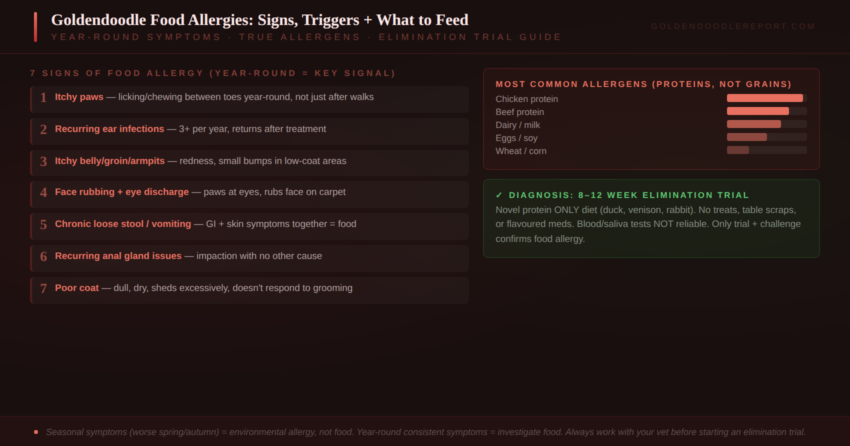
7 Signs of Food Allergy in Goldendoodles
These signs alone do not confirm a food allergy — they indicate that an allergy (food or environmental) is possible and warrants investigation. Always consult your vet before assuming food is the cause.
1. Persistent itchy paws — year-round
The single most consistent sign. Your Goldendoodle licks, chews, or gnaws at their paws repeatedly, especially between the toes. The skin between the toes may appear pink or red. Unlike seasonal pollen irritation (which gets on paws during walks and improves indoors), food allergy paw itching continues regardless of season, location, or whether the dog has been walked.
2. Recurring ear infections
Food allergy-related ear infections are characterised by recurrence — they respond to treatment, clear up, and return within 4–8 weeks without a new cause. The ear environment changes when the immune system is chronically activated: the inflammatory response alters the ear canal environment in ways that allow yeast (Malassezia) and bacteria to proliferate. Three or more ear infections in a year with no other identified cause is a strong food allergy indicator. For ear health management: Goldendoodle Ear Cleaning Guide and Goldendoodle Ear Infections and Grooming.
3. Itchy belly, groin, or armpits
Areas with less coat cover are often where allergic skin reactions are most visible. Redness, small bumps, or skin darkening in the belly, inner thighs, or armpits — combined with scratching — can indicate systemic allergic inflammation.
4. Face rubbing and eye discharge
Rubbing the face on furniture, carpet, or their own paws; frequent pawing at the eyes; and recurring eye discharge can indicate facial allergic reaction. For more on eye discharge specifically: Goldendoodle Eye Discharge Causes.
5. Chronic loose stool, vomiting, or excess gas
GI symptoms in combination with skin symptoms strengthen the case for food allergy over environmental allergy. Either symptom alone has many possible causes; together they suggest the trigger is ingested, not environmental.
6. Scooting, anal gland issues
Chronic anal gland impaction or expression needs in dogs with no other explained cause can be associated with food allergy — the GI inflammation affects the anal gland environment. This is a less well-known sign but reported consistently in food-allergic dogs.
7. Poor coat quality that does not respond to grooming changes
Dull, dry, brittle coat with excessive shedding that persists despite grooming improvements and product changes can have a dietary root — either nutritional inadequacy or inflammatory skin changes from allergy. See Why Is My Goldendoodle Shedding So Much?
Most Common Food Allergy Triggers in Dogs
According to VCA Animal Hospitals, the most common food allergens in dogs are proteins — particularly from dairy, beef, chicken, chicken eggs, soy, and wheat gluten. The Merck Veterinary Manual lists beef, chicken, eggs, corn, wheat, soy, and milk as the foods most often implicated in dog food allergies.
| Allergen | Frequency | Why So Common |
|---|---|---|
| Chicken protein | Very high | Found in the majority of mainstream dog foods — prolonged exposure increases sensitisation risk |
| Beef protein | High | Second most common protein in mainstream dog food; years of exposure builds sensitisation |
| Dairy (milk proteins) | High | Present in many treats, flavourings, and some wet foods |
| Eggs | Moderate | Increasingly common in premium dog foods as a protein source |
| Soy | Moderate | Present in many budget and mid-range kibbles as a protein supplement |
| Wheat/gluten | Lower than expected | Less common than popularly believed — grain allergies are rarer than protein allergies in dogs |
Key point for Goldendoodle owners: The most commonly fed proteins — chicken and beef — are also the most common allergens. A dog fed the same chicken-based food for 2–3 years has the highest theoretical risk of developing a chicken sensitisation. This is why novel protein diets (proteins the dog has never been exposed to) are used in elimination trials.
The Grain Allergy Myth — What the Evidence Says
Grain-free dog food became enormously popular in the 2010s partly on the belief that grains are a common allergen in dogs and that grain-free diets are inherently healthier or more “natural.” This belief is not supported by the evidence.
Grain allergies in dogs exist but are relatively uncommon. According to both VCA Animal Hospitals and the Merck Veterinary Manual, proteins — not carbohydrates — are the primary allergens in dog food. A dog diagnosed with a food allergy is far more likely to be reacting to chicken, beef, or dairy than to wheat or corn.
Additionally, the FDA investigated a potential link between grain-free diets high in legumes and dilated cardiomyopathy (DCM) in dogs from 2018 onwards. While the FDA ended public updates on this investigation in December 2022 noting the evidence was not sufficient to establish causation, major veterinary cardiology organisations still recommend caution with grain-free diets — particularly for breeds with cardiac predispositions. Goldendoodles carry an inherited risk of subvalvular aortic stenosis (SAS) from both parent breeds, making this recommendation directly applicable.
⚠️ If you switched to grain-free because of suspected allergies: The better approach is to identify the specific protein trigger through an elimination trial, then choose a grain-inclusive food that does not contain that protein. This addresses the actual allergy without introducing the grain-free DCM risk. Discuss this with your vet before switching.
How Vets Diagnose Food Allergies
What does NOT reliably diagnose food allergies
- Blood allergy tests (serum IgE tests): Research consistently shows these produce high rates of false positives and false negatives for food allergies in dogs. They cannot reliably identify which foods trigger allergic reactions. The Merck Veterinary Manual states that blood tests and skin tests are not reliable for food allergy diagnosis in dogs.
- Saliva tests: No validated scientific evidence supports saliva-based food allergy testing in dogs. These tests are commercial products without scientific validation.
- Hair analysis tests: Similarly unsupported by peer-reviewed evidence.
- Responding to a food switch: If a dog improves when switched from Food A to Food B, this confirms a problem with something in Food A — but it does not identify which ingredient, and improvement could be coincidental.
What DOES diagnose food allergies
The elimination diet trial followed by dietary challenge is the only validated method for diagnosing food allergies in dogs, according to both VCA Animal Hospitals and the Merck Veterinary Manual. It is time-consuming and requires strict adherence, but it is the only approach that produces a reliable diagnosis.
The Elimination Trial — Step by Step
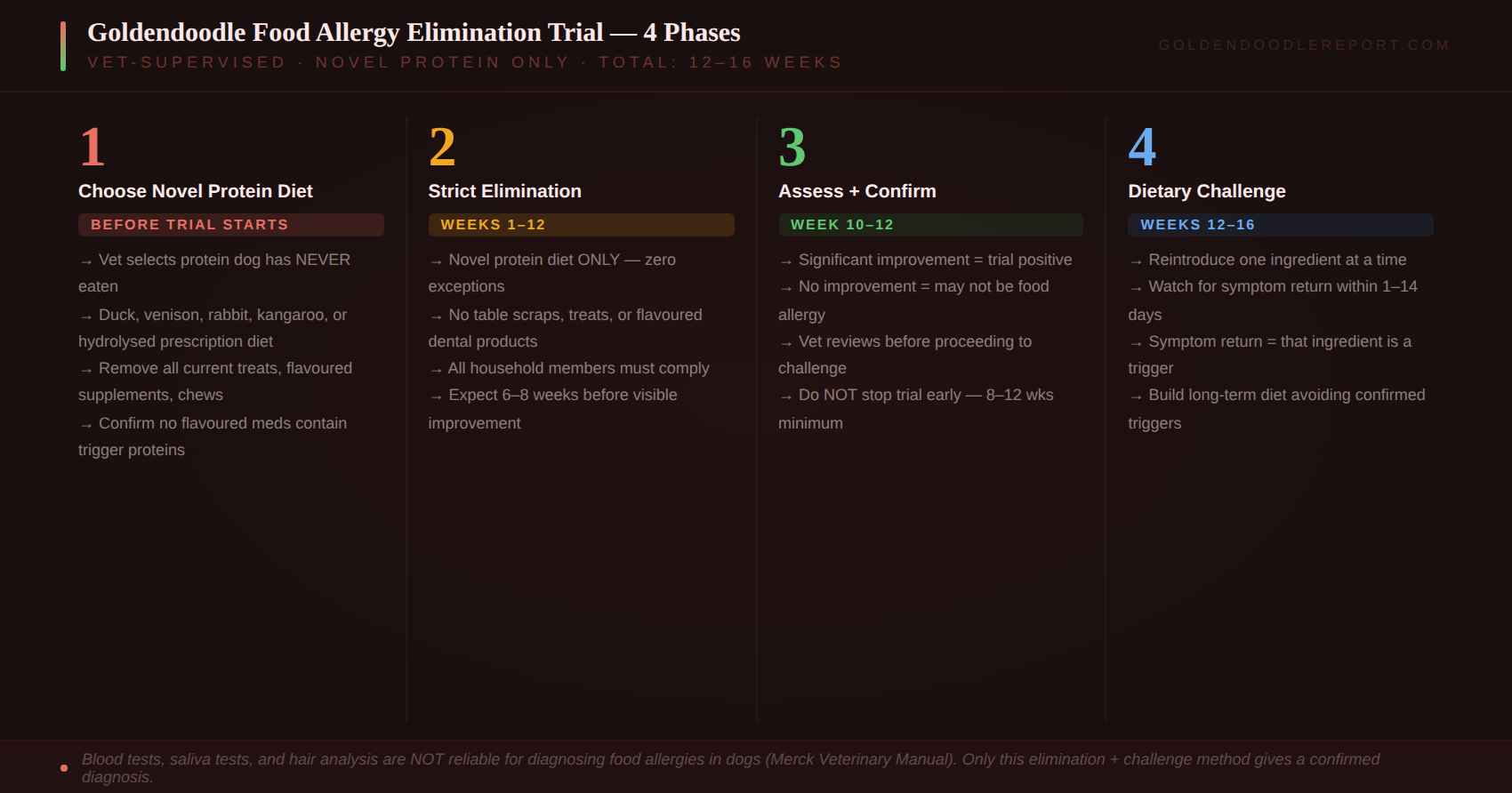
An elimination diet trial identifies food allergies by removing all potential allergens and then reintroducing them one at a time. It must be conducted under veterinary supervision. The information below is for understanding the process — not for conducting it independently.
Phase 1 — Choose the elimination diet (8–12 weeks)
The elimination diet must contain a protein source your Goldendoodle has never eaten before — called a novel protein. Common novel proteins include duck, venison, rabbit, kangaroo, and fish. Alternatively, a hydrolysed protein diet can be used — these are prescription foods in which the proteins are broken down into fragments too small for the immune system to recognise.
During the entire trial:
- Feed only the elimination diet — no treats, table scraps, or flavoured supplements
- Stop all flavoured medications if possible (flavoured chewable medications often contain beef or chicken)
- Use only unflavoured dental products
- Stop all chews, rawhides, and pig ears
- Ensure all household members are committed — one person giving a chicken treat undoes weeks of trial
Phase 2 — Observe and assess (8–12 weeks)
Skin and ear symptoms typically take 8–12 weeks to fully resolve after removing the trigger food — not 1–2 weeks. Many owners abandon the trial too early because they expect rapid improvement. If symptoms are significantly better at 8–12 weeks, the trial is considered positive and dietary challenge can begin.
Phase 3 — Dietary challenge (controlled reintroduction)
According to VCA Animal Hospitals’ elimination trial guidance, the challenge phase reintroduces individual ingredients one at a time, monitoring for symptom recurrence. Symptoms typically return within 1–14 days of reintroducing a trigger ingredient. This phase identifies the specific allergen(s) and allows the owner to build a long-term diet that avoids them precisely.
What to Feed a Goldendoodle with Confirmed Food Allergies
Once a specific allergen has been identified through a completed elimination and challenge trial, feeding an allergic Goldendoodle becomes straightforward: avoid the identified trigger protein and feed a diet that does not contain it.
Option 1 — Novel protein limited ingredient diet (LID)
A limited ingredient diet contains a single named protein source that the dog is not allergic to. For a Goldendoodle confirmed allergic to chicken, a duck-based or salmon-based LID that does not contain chicken is appropriate. Look for foods with short ingredient lists where every ingredient is identifiable — this reduces the risk of hidden allergens.
Important: Cross-contamination is a genuine issue. Some budget brands that claim to be single-protein actually process multiple proteins in the same facility. For severely allergic dogs, choose brands that explicitly certify no cross-contamination in their manufacturing process.
Option 2 — Hydrolysed protein prescription diet
Prescription hydrolysed protein diets (available from your vet) are the gold standard for dogs with multiple or unknown allergens. The proteins are broken into such small fragments that the immune system cannot identify them as threats. These are more expensive than standard LIDs but require no allergen identification — they work regardless of what the dog is allergic to.
Option 3 — Fresh-cooked diet with known ingredients
Fresh-cooked diets with single, identifiable ingredients can work well for allergic Goldendoodles. The key is knowing exactly what is in the food. Commercial fresh-cooked services (The Farmer’s Dog, Ollie, Nom Nom) allow you to choose protein types and have transparent ingredient lists. Ensure any fresh diet is AAFCO-validated for nutritional completeness.
What to look for on the label
- Single named protein source as the primary ingredient
- No “natural flavours” listed without specification — this can contain hidden proteins
- No “chicken fat” even if chicken protein is avoided — some severely allergic dogs react to fat from the trigger species
- AAFCO adult maintenance validation
- Grain-inclusive (for the cardiac reasons discussed across this category — see Best Food for Goldendoodles)
Long-Term Management of Food Allergies in Goldendoodles
Food allergies in dogs are lifelong conditions — they do not resolve with age or treatment. The only management strategy that works long-term is strict avoidance of the identified allergen(s).
Practical management tips
- Read every label every time you buy. Manufacturers change formulations without prominent notification. A food that was safe last year may have added chicken by-products to its new recipe.
- Have an approved treats list. Find 2–3 single-ingredient treats (freeze-dried duck, sweet potato chews) that are free from the trigger protein and stick to them.
- Inform all household members and regular dog-sitters. One person giving an unapproved treat can trigger a flare that takes weeks to resolve.
- Keep a symptom diary. If symptoms recur, a diary of recent food exposure (including treats, medications, table scraps) helps identify what triggered the flare.
- Annual vet review. Allergies can evolve — a dog that was only allergic to chicken may develop sensitivity to a second protein over time. Annual review allows diet adjustment.
Managing co-existing conditions
Many Goldendoodles with food allergies also have environmental allergies — the two conditions frequently co-exist. Managing only one while the other is active leads to partial improvement and confusion. Your vet may recommend treating both simultaneously with appropriate environmental allergy management alongside dietary change. For the environmental allergy picture: Goldendoodle Spring Allergies.
🔑 Key Takeaways
- True food allergies affect approximately 1–2% of dogs — symptoms that are seasonal or respond to antihistamines are more likely environmental allergies than food allergies
- The most common triggers are animal proteins — chicken and beef — not grains. Switching to grain-free does not address the most likely allergens and introduces DCM risk for Goldendoodles
- Blood tests, saliva tests, and hair tests are not reliable for diagnosing food allergies in dogs — only an 8–12 week veterinary-supervised elimination trial followed by dietary challenge gives a valid diagnosis
- Recurring year-round ear infections, persistent paw chewing, and itchy belly with no seasonal pattern are the three strongest food allergy indicators in Goldendoodles
- Once a trigger is identified, strict lifelong avoidance of that protein is the only reliable management — no medication, supplement, or treatment eliminates the need to avoid the allergen
- Always work with your vet — food allergy symptoms overlap with parasites, skin infections, and environmental allergies. Self-diagnosing and switching diets without guidance delays proper treatment
📚 More Goldendoodle Food & Nutrition Guides
- How Much to Feed a Goldendoodle: Amounts by Age + Weight
- Goldendoodle Feeding Schedule: Meal Timing by Age (2026)
- Best Food for Goldendoodles: What Vets Recommend (2026)
- Best Puppy Food for Goldendoodles: Large vs Small Breed
- Best Food for Adult Goldendoodles: Vet-Backed Guide (2026)
- Goldendoodle Sensitive Stomach: 5 Foods That Actually Help — coming soon
- Goldendoodle Weight Management: How to Help an Overweight Dog Safely — coming soon
Browse all guides: Goldendoodle Food & Nutrition category
🔗 Related Guides Across the Site
- Goldendoodle Spring Allergies — environmental vs food allergy triggers
- Goldendoodle Ear Cleaning Guide — routine ear care to reduce infection risk
- Goldendoodle Ear Infections and Grooming — the connection between grooming and ear health
- Preventing Ear Infections in Doodles — full prevention protocol
- Goldendoodle Eye Discharge Causes — when eye symptoms point to allergy
- Goldendoodle Tear Stains Guide — dietary contribution to tear staining
- Why Is My Goldendoodle Shedding So Much? — allergy as a cause of excessive shedding
- Do Goldendoodles Smell Bad? — skin infection and yeast as odour cause
Frequently Asked Questions
How do I know if my Goldendoodle has a food allergy?
The strongest indicators are: year-round itching (paws, ears, belly) that is not seasonal; recurring ear infections (3 or more per year with no other identified cause); loose stool or vomiting that persists alongside skin symptoms; and poor response to antihistamine treatment. However, these symptoms overlap with many other conditions. The only reliable way to confirm a food allergy is a veterinary-supervised 8–12 week elimination diet trial — symptoms alone are not sufficient for diagnosis. See your vet before changing your dog’s diet based on suspected food allergy.
What are Goldendoodles most commonly allergic to in food?
According to VCA Animal Hospitals and the Merck Veterinary Manual, the most common food allergens in dogs are animal proteins — particularly chicken, beef, dairy, and eggs. Chicken is the most frequently identified allergen in dogs because it is the most commonly used protein in mainstream dog foods, giving the immune system prolonged exposure. Grains are rarely the primary allergen — the widespread belief that grain-free foods reduce allergies is not supported by the veterinary evidence.
Can a food allergy develop to a food my Goldendoodle has eaten for years?
Yes — this is actually the typical pattern. Food allergies develop after a period of regular exposure to the trigger protein. The immune system gradually sensitises to the protein over months or years, then at some point begins producing an allergic response. A Goldendoodle that has eaten the same chicken-based food for two years without problems can develop a chicken allergy in year three. This is why novel protein (never-eaten-before) diets are used in elimination trials — using a familiar protein in the trial would defeat its purpose.
Can I do a food allergy trial at home without a vet?
You can begin dietary management at home but doing so without veterinary guidance risks misdiagnosis and delays appropriate treatment. Your vet needs to rule out other conditions (parasites, skin infections, environmental allergies, hormonal disorders) before a food allergy trial is appropriate. They also need to select the correct elimination diet for your specific dog and provide the challenge protocol. Attempting a food trial without ruling out other causes first — and without following the full challenge phase — produces unreliable results and commonly leads to unnecessary long-term dietary restrictions.
Is grain-free food better for Goldendoodles with allergies?
Not unless grains have been specifically identified as a trigger through a completed elimination trial — which is rare. Grain allergies exist but are uncommon compared to protein allergies. Switching to grain-free food without conducting a proper trial means removing an unlikely allergen while leaving the probable one (chicken or beef protein) in the diet. Additionally, grain-free diets have been associated with a potential DCM (dilated cardiomyopathy) risk in dogs — particularly relevant for Goldendoodles given their inherited cardiac predispositions. The better approach is to identify the specific trigger through a trial, then choose a grain-inclusive food that excludes that protein.
How long does a food allergy elimination trial take?
A minimum of 8 weeks, with 10–12 weeks being the standard recommendation. Skin allergy symptoms can take 6–8 weeks to fully resolve after removing the trigger food — owners who stop the trial after 2–3 weeks because they see no improvement have not given the trial enough time to work. The entire trial, including the dietary challenge phase for identifying specific allergens, typically takes 3–4 months when conducted properly. This is a significant commitment, but it is the only approach that produces reliable results.
Disclaimer: The information in this article is provided for general educational purposes only. King James Adjei is a researcher and enthusiast, not a veterinarian or certified veterinary nutritionist. Food allergy diagnosis must be conducted under veterinary supervision — the symptoms described overlap with many other conditions that require different treatment. Do not begin an elimination diet trial without first consulting your veterinarian to rule out other causes of your dog’s symptoms.