Affiliate Disclosure: Some links in this guide are affiliate links. If you purchase through them, we may earn a small commission at no extra cost to you. This does not influence our recommendations. Read our full affiliate disclaimer here.
By King James Adjei — Researcher and Goldendoodle enthusiast, founder of GoldendoodleReport.com. Every guide on this site is carefully researched and written to give owners reliable, clearly organised information. → About this site
🩺 Veterinary guidance note: Before beginning a weight loss programme for your Goldendoodle, have your vet confirm overweight status and rule out underlying conditions — including hypothyroidism and Cushing’s disease — that cause weight gain independently of diet. Significant calorie restriction without veterinary supervision can cause nutritional deficiency and muscle loss. This guide covers dietary weight management for otherwise healthy overweight Goldendoodles.
📖 9-minute read | Last updated May 2026 | Reviewed for accuracy
✅ Quick Answer
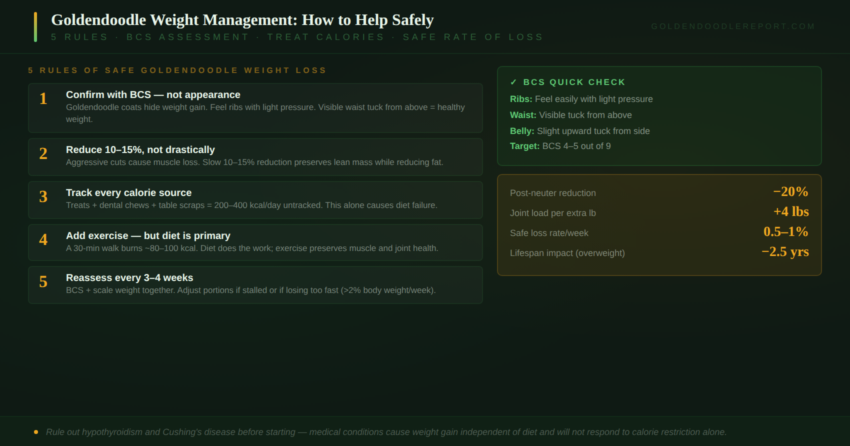
The five rules for safe Goldendoodle weight management are: (1) confirm overweight status using body condition scoring — not just visual appearance, which is unreliable under a thick coat; (2) reduce daily food by 10–15%, not dramatically — rapid calorie restriction causes muscle loss; (3) account for all treats in the daily calorie budget — treats are the most commonly untracked source of excess calories; (4) increase structured daily exercise gradually alongside dietary reduction; and (5) reassess body condition every 3–4 weeks and adjust portions — do not set and forget. Never reduce food by more than 20% without veterinary guidance.
Effective goldendoodle weight management starts with recognising a problem most owners miss entirely. Overweight Goldendoodles are far more common than most owners realise. The breed’s thick, fluffy coat masks weight gain effectively — a Goldendoodle can carry 5–8 lbs of excess weight without it being visually obvious, even to owners who see them every day. By the time weight gain becomes visually noticeable on a Goldendoodle, it is typically already a significant health concern.
An estimated 56% of pet dogs in the United States are overweight or obese. Goldendoodles are particularly vulnerable because they are food-motivated, rarely self-regulate, and two of the most common life events for this breed — neutering and reduced activity as they mature — both reduce calorie needs without owners adjusting portions to match.
The good news is that weight management in Goldendoodles responds well to the right approach. The bad news is that the wrong approach — cutting food too aggressively, exercising without dietary adjustment, or cycling through diet foods without a protocol — either produces no results or produces results at the cost of muscle mass.
👤 Who This Guide Is For
- Your vet has told you your Goldendoodle needs to lose weight and you want a practical protocol
- You suspect your Goldendoodle is overweight but are not sure how to assess it accurately
- Your Goldendoodle was recently spayed or neutered and you want to prevent the typical post-neuter weight gain
- Your Goldendoodle is gaining weight despite not changing their diet — you want to understand why
📊 Quick Facts — Goldendoodle Weight and Health
- Every extra pound of body weight adds approximately 4 lbs of additional mechanical stress to a dog’s joints during normal movement — making excess weight the leading preventable cause of early joint disease in Standard Goldendoodles
- Overweight dogs have a median lifespan 2.5 years shorter than dogs maintained at healthy weight, according to a landmark study of over 50,000 dogs across 12 breeds
- Spayed and neutered Goldendoodles require approximately 20–25% fewer calories than intact dogs — the most commonly missed dietary adjustment, responsible for gradual weight gain in thousands of dogs per year
- Treats account for an average of 30–40% of daily calorie intake in dogs whose owners do not track them — the most common unrecognised cause of weight gain in dogs otherwise fed correct main meal portions
- Safe weight loss in dogs is 1–2% of body weight per week maximum — faster loss causes muscle loss alongside fat loss, which worsens long-term metabolic function
- Hypothyroidism — a common hormonal condition in middle-aged dogs — can cause weight gain independent of diet; this must be ruled out by your vet before dietary management begins
📋 Table of Contents
- Is My Goldendoodle Actually Overweight?
- Why Goldendoodles Gain Weight
- Health Risks of Excess Weight
- The 5 Rules of Safe Goldendoodle Weight Management
- How to Calculate the Right Calorie Reduction
- The Treat Problem — and How to Fix It
- Exercise and Weight Loss
- Do Weight Management Foods Actually Work?
- How to Track Progress Correctly
- Preventing Weight Gain — Before It Starts
- Frequently Asked Questions
Is My Goldendoodle Actually Overweight?
Visual assessment is unreliable for Goldendoodles. Their thick, often curly coats conceal body shape so effectively that dogs at BCS 7/9 (clearly overweight) can look completely normal to their owners. Body condition scoring by feel is the correct method.
The body condition score (BCS) assessment — 30 seconds
According to Wikipedia’s overview of body condition scoring, the method was originally developed for livestock and later adapted for companion animals as a standardised way to assess fat coverage without relying on breed-specific weight charts alone.
Step 1 — Feel the ribs: Place both hands flat on either side of your dog’s ribcage and apply light, even pressure. You should feel individual ribs fairly easily — like running your fingers over the back of your hand. If you have to press firmly to feel ribs, or cannot feel them clearly at all, your dog is overweight. If ribs are immediately prominent without any pressure and visible from a distance, underweight.
Step 2 — Check the waist from above: Look directly down at your dog from above. There should be a clear inward tuck behind the ribcage before the hindquarters — a visible waist. If the back appears rectangular, straight, or wider at the hindquarters than the ribcage, the dog is carrying excess weight in the abdominal area.
Step 3 — Check the abdominal tuck from the side: Looking at your dog from the side, the belly should tuck upward noticeably behind the ribcage. A sagging, pendulous belly indicates overweight. A severely tucked belly indicates underweight.
Target BCS: 4–5 on a 9-point scale. BCS 6 = mildly overweight and action warranted. BCS 7 = moderately overweight and weight loss required. BCS 8–9 = significant obesity and veterinary supervision necessary.
📖 Real Scenario
A 4-year-old Standard Goldendoodle weighs 68 lbs at his annual vet visit. His ideal weight is 55–58 lbs. His owner has never considered him overweight — his coat is full and his energy seems normal. The vet demonstrates the BCS assessment: ribs require firm pressure to feel, no visible waist from above, flat abdominal profile from the side. BCS 7/9. The 10–13 lb excess weight has been accumulating gradually since he was neutered at 18 months — approximately 1.5 lbs per year over 3 years, invisible under his coat. The vet recommends a 6-month weight loss programme targeting 0.5–1 lb per week, achieved through a 15% calorie reduction and structured daily walks. Three months in, weight is 62 lbs and BCS has improved to 6. Six months in, 57 lbs and BCS 5.
Why Goldendoodles Gain Weight
Reason 1 — Post-neuter metabolic reduction (most common)
Spaying and neutering reduces resting metabolic rate by approximately 20–25%. If food portions are not reduced at the time of neutering, the dog is in calorie surplus from the day of the procedure onward. Over months, this surplus accumulates as fat. This is the most common single cause of adult Goldendoodle weight gain and the most preventable.
Reason 2 — Untracked treats and extras
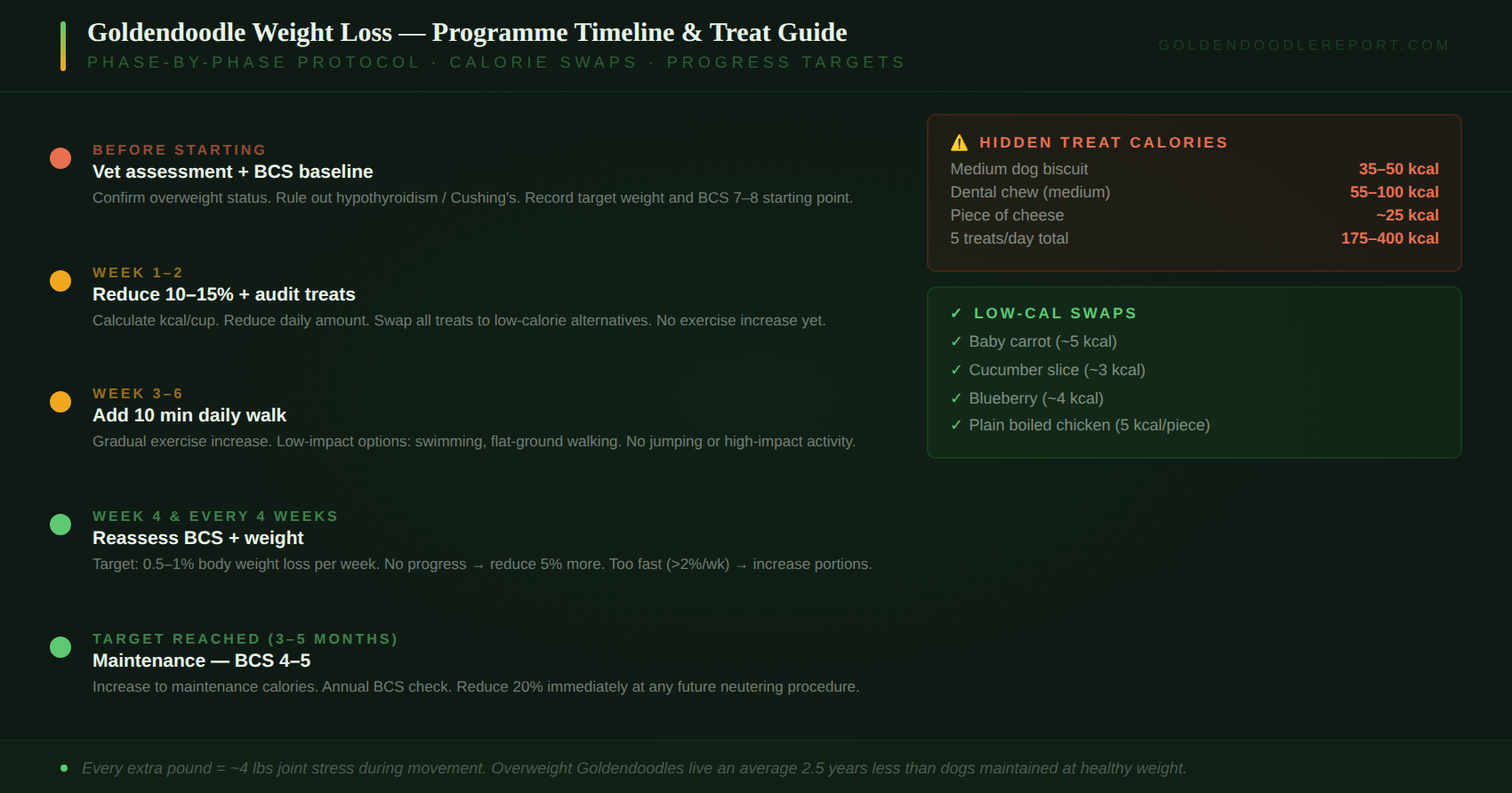
Most owners who report feeding “correct portions” have not accounted for treats, training rewards, table scraps, dental chews, and flavoured supplements. A medium-sized dog biscuit contains 30–50 kcal. A dental chew contains 50–100 kcal. Five treats per day — a modest amount for an owner who uses food in training — can add 200–400 kcal to a dog’s daily intake, representing 20–40% of maintenance requirements.
Reason 3 — Calorie-dense food with standard cup measurement
Owners who switch to a higher calorie-density food without recalculating portions are inadvertently overfeeding. A food at 490 kcal/cup fed at the same volume as a previous food at 340 kcal/cup delivers 44% more calories per cup. This is covered in detail in our How Much to Feed a Goldendoodle guide.
Reason 4 — Reduced activity with unchanged diet
Many Goldendoodles become less active between age 2 and 4 as adolescent energy naturally moderates. Owners who maintain the same portions through this transition without adjusting for the lower activity level end up overfeeding. The same dog needs fewer calories at age 3 than at age 1.
Reason 5 — Medical condition (thyroid, Cushing’s)
Hypothyroidism causes reduced metabolic rate and consequent weight gain independent of diet. Cushing’s disease (hyperadrenocorticism) causes a characteristic pot-bellied appearance alongside increased appetite and weight gain. Both are treatable medical conditions that present as weight management problems. This is why vet assessment before starting a dietary weight loss programme is not optional — dietary restriction will not work against an active hormonal condition.
Health Risks of Excess Weight in Goldendoodles
Overweight Goldendoodles face health consequences that are well-documented and directly linked to excess body fat — not just to age or genetics.
- Joint disease: Every excess pound adds approximately 4 lbs of mechanical load to joints during movement. Standard Goldendoodles already carry genetic predisposition to hip and elbow dysplasia — excess weight accelerates cartilage breakdown and significantly advances the timeline for clinical arthritis
- Reduced lifespan: Studies consistently show overweight dogs live 1.5–2.5 years less than dogs maintained at ideal weight — the equivalent of losing roughly 10–15% of the breed’s natural lifespan
- Increased anaesthetic risk: Overweight dogs carry significantly higher risk during surgery and anaesthesia procedures — relevant for a breed that may require orthopaedic surgery during their lifetime
- Diabetes: Obesity is a risk factor for insulin resistance and type 2 diabetes in dogs, particularly in middle-aged and older Goldendoodles
- Respiratory difficulty: Excess fat around the chest restricts full lung expansion, reducing exercise tolerance and quality of life
- Grooming complications: Overweight Goldendoodles cannot reach all areas of their coat to self-groom, accelerating matting and skin conditions between grooming appointments. For the coat-weight connection: Goldendoodle Matting Prevention
The 5 Rules of Safe Goldendoodle Weight Management
Rule 1 — Confirm with BCS before starting, not scale weight alone
Scale weight without BCS context is misleading. A 55 lb Standard Goldendoodle could be perfectly healthy or mildly underweight depending on their frame. A 45 lb Goldendoodle could be overweight for a smaller-framed dog. BCS is the correct starting point. Weigh your dog at the vet and record the BCS — then use both numbers to track progress together.
Rule 2 — Reduce by 10–15%, not dramatically
The target for safe calorie reduction is 10–15% below maintenance intake — not 25–30%, not halving the food. Aggressive restriction causes muscle catabolism (the body breaking down muscle for energy), which reduces lean mass, lowers metabolic rate, and makes long-term weight maintenance harder. Slow, steady reduction preserves muscle while reducing fat.
Rule 3 — Account for every calorie from every source
Treats, dental chews, training rewards, and flavoured supplements all count toward daily calorie intake. During a weight loss programme, calculate the calorie value of treats and subtract them from the main meal allowance — do not add them on top. Switching to lower-calorie treat options (carrot sticks, cucumber, plain air-popped popcorn — all safe for dogs in small amounts) helps significantly.
Rule 4 — Increase exercise alongside diet, not instead of it
Exercise alone rarely produces significant weight loss in dogs — the calorie expenditure from even a vigorous walk is modest relative to dietary reduction. But exercise is essential for preserving muscle mass during weight loss, maintaining joint health, and providing the dog with mental and physical enrichment. Both levers together produce better results than either alone. For the full exercise framework: Goldendoodle Exercise Needs by Age.
Rule 5 — Reassess every 3–4 weeks and adjust
A weight loss programme that worked for the first month may plateau. Reassess BCS and scale weight every 3–4 weeks. If progress has stalled, reduce the daily amount by a further 5–10% (provided veterinary guidance supports this). If the dog is losing weight faster than 1–2% of body weight per week, increase portions slightly — rapid loss indicates excessive restriction.
How to Calculate the Right Calorie Reduction
The calculation for a safe weight loss calorie target requires three pieces of information: the dog’s current weight, the dog’s target weight, and the kcal/cup of the food being fed.
Step 1 — Calculate maintenance calories at target weight
The resting energy requirement (RER) formula for dogs is: RER = 70 × (target weight in kg)0.75. For a neutered adult at moderate activity, multiply RER by 1.4 to get the daily energy requirement (DER).
Example: A Standard Goldendoodle currently 68 lbs (30.8 kg), target weight 57 lbs (25.9 kg).
- RER at target: 70 × (25.9)0.75 = 70 × 11.5 = 805 kcal/day
- DER (neutered, moderate activity): 805 × 1.4 = 1,127 kcal/day
- Weight loss intake: feed 80% of DER = approximately 900 kcal/day
Step 2 — Convert calories to daily cup amount
Divide the daily calorie target by the kcal/cup of the food being fed. If the food contains 380 kcal/cup: 900 ÷ 380 = 2.37 cups per day. Split across 2 meals = approximately 1 cup + 3 tablespoons per meal.
The simpler starting point
If the above calculation feels complex, use this practical starting point: find the current daily amount being fed (in kcal using the food’s kcal/cup value), then reduce by 15%. Monitor BCS every 3–4 weeks and adjust. For the complete portion calculation method: How Much to Feed a Goldendoodle.
The Treat Problem — and How to Fix It
Treats are the number one sabotage of Goldendoodle weight management programmes. Owners reduce main meal portions, see no progress after 4 weeks, and conclude that dietary management does not work — without realising that untracked treats are offsetting the entire calorie reduction.
How many calories treats actually add
| Treat Type | Approx. Calories | 5 per Day Adds |
|---|---|---|
| Medium dog biscuit | 35–50 kcal | 175–250 kcal/day |
| Dental chew (medium) | 55–100 kcal | 1 per day = up to 100 kcal |
| Training treat (pea-sized kibble) | 3–5 kcal each | 20 treats = 60–100 kcal |
| Baby carrot | ~5 kcal | 5 per day = 25 kcal |
| Piece of cheese (thumbnail size) | ~25 kcal | 3 per day = 75 kcal |
Low-calorie treat alternatives
Replace high-calorie treats with these during a weight loss programme — all are safe for dogs in moderate amounts:
- Baby carrots (5 kcal each, high fibre, dogs love them)
- Cucumber slices (3–5 kcal, high water content)
- Small pieces of plain cooked chicken breast (used in training — 5 kcal per pea-sized piece)
- Blueberries (4 kcal each, antioxidant-rich)
- Plain air-popped popcorn (4 kcal per cup — no salt, no butter, no flavouring)
⚠️ Treats should account for no more than 10% of daily calorie intake — during weight loss, aim for 5% or less. If you are using food rewards in training, reduce the main meal by the calorie equivalent of the training treats used that day. See our Goldendoodle Treats Guide — coming soon in this category — for a full low-calorie treat reference.
Exercise and Weight Loss
Exercise does not replace dietary reduction for weight loss — but it is an essential partner to it. Here is why both matter and how to increase exercise safely during weight loss.
Why exercise alone rarely produces weight loss
A 30-minute moderate walk burns approximately 80–100 kcal for a 50 lb dog. That is less than one small treat. To burn 1 lb of fat through exercise alone requires approximately 3,500 kcal of expenditure — the equivalent of 35 additional 30-minute walks. This is why dietary reduction is the primary lever for weight loss and exercise is the supporting lever for muscle preservation, joint health, and cardiovascular fitness.
Safe exercise progression for overweight Goldendoodles
Do not suddenly increase exercise intensity when beginning a weight loss programme. Overweight Goldendoodles have increased joint load and reduced cardiovascular fitness — sudden intense exercise causes injury risk and joint flares. Progress gradually:
- Weeks 1–2: Maintain current exercise routine. Do not add new activity until dietary adjustment has begun and the dog has adapted.
- Weeks 3–6: Add 5–10 minutes to daily walk duration. Low-impact options: swimming (excellent for overweight dogs — full-body exercise with no joint impact), gentle on-lead walking on flat ground.
- Weeks 7–12: As weight decreases and fitness improves, extend or intensify exercise. Two daily walks instead of one, or longer weekend walks.
- Avoid: High-impact activities (jumping, fetch on hard surfaces, rough play) until the dog has lost at least 50% of excess weight and BCS has improved to 6 or below.
For the complete exercise guide by age and size: Goldendoodle Exercise Needs by Age.
Do Weight Management Dog Foods Actually Work?
Weight management or “light” dog foods are formulated with reduced calorie density — typically 15–20% fewer kcal per cup than standard adult formulas. They achieve this through higher fibre content (which adds volume without calories, helping the dog feel full) and reduced fat.
When they help
Weight management foods are useful for dogs that show significant hunger signs on reduced portions of standard food — restlessness, food-seeking behaviour, persistent begging. The higher volume at lower calories helps the dog feel satisfied on the appropriate calorie intake.
When they are not necessary
For many overweight Goldendoodles, simply reducing the portion of their current quality adult food by 15% achieves the same calorie reduction without the expense or dietary change involved in switching foods. If the dog tolerates reduced portions well without significant hunger signs, a food switch is not required.
What to look for if choosing a weight management food
- AAFCO adult maintenance validation — some “light” foods are nutritionally incomplete
- Protein at 22%+ dry matter — adequate protein preserves muscle mass during weight loss
- Named animal protein as first ingredient — quality protein matters more during weight loss, not less
- Higher fibre content (4–8% crude fibre) — provides satiety without calories
- Same WSAVA manufacturer standards as any quality food
How to Track Progress Correctly
Tracking weight loss in Goldendoodles requires both scale weight and BCS — neither alone is sufficient.
Recommended tracking protocol
- Weigh every 2–3 weeks — ideally at the vet on a calibrated scale. Home scales are rarely accurate for dogs. Most vets will weigh without a full appointment if you ask.
- BCS assessment every 3–4 weeks — use the three-point feel assessment described above. Record the score alongside the weight.
- Target rate: 0.5–1% of body weight loss per week for Standard Goldendoodles; 0.3–0.5% for Minis (smaller dogs should lose weight more slowly). A 60 lb dog should lose approximately 0.3–0.6 lbs per week.
- If no progress after 4 weeks: Reduce daily intake by a further 5–10% and review whether all calorie sources (treats, supplements, table scraps) are being tracked.
- If losing more than 2% body weight per week: Increase portions by 5–10% — loss is too rapid and muscle mass is at risk.
Preventing Weight Gain Before It Starts
The most effective weight management is prevention. Three intervention points prevent the majority of adult Goldendoodle weight gain:
At neutering
Reduce daily food intake by 20–25% the week of neutering. Do not wait to see if the dog gains weight — by the time weight gain becomes measurable, the surplus has been accumulating for weeks. The reduction should happen immediately and be maintained unless body condition scoring suggests it is excessive.
At the puppy-to-adult food transition
Adult food is typically less calorie-dense than puppy food, but the transition is also the point where growth calorie demands drop significantly. Recalculate daily portions from scratch using the new food’s kcal/cup figure at the time of transition — do not assume the same cup volume applies. See Best Puppy Food for Goldendoodles for the transition timing guide.
Annual body condition assessment
Make BCS assessment part of the annual vet visit routine — not just scale weight. Most vets will perform BCS as part of a wellness exam. An annual BCS catches gradual weight gain at BCS 6 (easily managed) rather than at BCS 7–8 (requires a structured programme).
🔑 Key Takeaways
- Visual weight assessment is unreliable in Goldendoodles — their thick coats mask significant excess weight. Use body condition scoring by feel every time
- The most common cause of adult Goldendoodle weight gain is failure to reduce portions at neutering — reduce by 20–25% immediately, not reactively
- Safe weight loss rate is 0.5–1% of body weight per week — faster than this indicates excessive restriction and risks muscle loss
- Treats are the most commonly untracked source of excess calories — account for every calorie from every source, or the dietary reduction is undermined
- Exercise supports weight loss but does not replace dietary reduction — a 30-minute walk burns fewer calories than a single medium dog biscuit contains
- Rule out hypothyroidism and Cushing’s disease before starting a weight loss programme — these medical conditions cause weight gain independent of diet and will not respond to calorie restriction alone
📚 More Goldendoodle Food & Nutrition Guides
- How Much to Feed a Goldendoodle: Amounts by Age + Weight
- Goldendoodle Feeding Schedule: Meal Timing by Age (2026)
- Best Food for Goldendoodles: What Vets Recommend (2026)
- Best Food for Adult Goldendoodles: Vet-Backed Guide (2026)
- Goldendoodle Sensitive Stomach: 5 Foods That Actually Help
- Goldendoodle Treats Guide: Low-Calorie Options That Work — coming soon
- Best Senior Food for Goldendoodles — coming soon
Browse all guides: Goldendoodle Food & Nutrition category
🔗 Related Guides Across the Site
- Goldendoodle Exercise Needs by Age — safe exercise progression during weight loss
- Goldendoodle Matting Prevention — weight-coat health connection
- Why Is My Goldendoodle Always Hungry? — when hunger signals a weight management issue
- When Do Goldendoodle Puppies Calm Down? — activity reduction timing that requires diet adjustment
- Goldendoodle Puppy Exercise Mistakes — exercise safely during weight loss
- Do Goldendoodles Smell Bad? — weight and skin fold odour
Frequently Asked Questions
How do I know if my Goldendoodle is overweight?
Do not rely on visual assessment — Goldendoodle coats conceal weight gain effectively. Use body condition scoring: run your hands along the ribcage with light pressure. You should feel individual ribs easily. Looking from above, there should be a clear waist tuck behind the ribs. From the side, the belly should tuck upward. If you cannot feel ribs easily, or there is no visible waist, your dog is likely overweight. Confirm with your vet at the next appointment, who will assess BCS and scale weight together.
How much should I reduce my Goldendoodle’s food to help them lose weight?
Start with a 10–15% reduction from current daily intake. Calculate this using the kcal/cup figure on the food packaging — not just the cup volume. For a dog currently eating 3 cups per day at 380 kcal/cup (1,140 kcal total), a 15% reduction means 969 kcal/day, which is approximately 2.55 cups. Reassess body condition and scale weight every 3–4 weeks and reduce by a further 5–10% if there is no progress. Never reduce by more than 20% of current intake without veterinary guidance. See How Much to Feed a Goldendoodle for full portion calculations.
Why is my Goldendoodle gaining weight even though I feed the correct amount?
The most likely culprits are: untracked treats and dental chews (which can add 200–400 kcal per day), calorie-dense food fed at the same cup volume as a previous lower-density food, post-neuter metabolic reduction that was not matched by a dietary adjustment, or reduced activity as the dog matures. Rule out medical causes (hypothyroidism, Cushing’s disease) with your vet first, then audit every calorie source — including supplements, table scraps, and training rewards — before concluding that the meal portions are wrong.
How long does it take a Goldendoodle to lose weight?
Safe weight loss in dogs is 0.5–1% of body weight per week. A Standard Goldendoodle at 68 lbs needing to reach 57 lbs (11 lbs excess) should take approximately 11–22 weeks — roughly 3–5 months — to reach target weight at the safe rate. This feels slow but rapid weight loss causes muscle loss that is difficult to reverse. Use the 3–4 week reassessment cycle to confirm the programme is on track and adjust portions as needed throughout.
Can I use a weight management dog food instead of reducing portions?
Weight management foods can be helpful for dogs that show significant hunger signs on reduced portions of standard food — the higher fibre content helps the dog feel full on fewer calories. For dogs that tolerate reduced portions of a quality adult food without excessive hunger, a food switch is not necessary. If you do switch, recalculate the daily cup amount using the new food’s kcal/cup figure — do not feed the same volume as the previous food.
My Goldendoodle always begs for food even on a weight loss plan — what should I do?
Food-seeking behaviour during dietary restriction is normal and expected — Goldendoodles are food-motivated and will show hunger signals even when appropriately fed. Strategies that help: switch to low-calorie volume treats (carrots, cucumber) to address the begging behaviour without adding significant calories; split the daily food allowance across 3 small meals instead of 2 (same total calories, more frequent feeding occasions); use a slow-feeder bowl to extend meal duration; and maintain a consistent feeding schedule so the dog’s digestive clock is well-regulated. For more on the “always hungry” behaviour specifically: Why Is My Goldendoodle Always Hungry?
Disclaimer: The information in this article is provided for general educational purposes only. King James Adjei is a researcher and enthusiast, not a veterinarian or certified veterinary nutritionist. Before beginning a weight loss programme for your Goldendoodle, consult your veterinarian to rule out underlying medical conditions and to confirm the appropriate calorie restriction level for your specific dog’s health status. Do not implement aggressive calorie restriction without veterinary guidance.