Affiliate Disclosure: Some links in this guide are affiliate links. If you purchase through them, we may earn a small commission at no extra cost to you. This does not influence our recommendations. Read our full affiliate disclaimer here.
By King James Adjei — Researcher and Goldendoodle enthusiast, founder of GoldendoodleReport.com. Every guide on this site is carefully researched and written to give owners reliable, clearly organised information. → About this site
🩺 Veterinary guidance note: If your Goldendoodle has a diagnosed grain allergy or has been prescribed a specific diet by a veterinarian, follow your vet’s guidance over the general recommendations in this article. This guide addresses grain-free food as a category choice for a healthy dog without a diagnosed grain sensitivity — not a treatment plan for an existing medical condition.
📖 9-minute read | Last updated May 2026 | Reviewed for accuracy
✅ Quick Answer
Grain-free food for Goldendoodles is not the villain the 2018 headlines suggested — but it is also not risk-free, and the honest 2026 picture is more nuanced than either camp claims. The FDA’s investigation into diet-associated dilated cardiomyopathy (DCM) ended in December 2022 without establishing that grain-free diets cause the condition. What the data actually pointed to was legume-heavy formulations — peas, lentils, and other pulses used as a primary protein or starch source — which happen to appear far more often in grain-free recipes than in grain-inclusive ones. For Goldendoodles specifically, who inherit cardiac predispositions from both parent breeds, the more cautious and equally nutritious choice remains a grain-inclusive food with a named protein first. Grain-free is not inherently dangerous, but it removes a layer of caution for a breed that doesn’t need to take on any extra cardiac risk.
Grain-free food for Goldendoodles became one of the most polarising topics in dog nutrition after 2018, and most of what circulates online today is still built on a version of the story that was never fully accurate. Grain-free formulas were pulled from shelves, owners panic-switched diets overnight, and entire brands lost market share within months — all based on an FDA investigation that, years later, ended without ever establishing that grain-free food causes heart disease in dogs.
That does not mean the concern was invented from nothing, and it does not mean grain-free food is automatically safe either. The real story is more specific and more useful than either extreme: the issue was never “grain-free” as a category — it was the heavy use of legumes as a substitute for grain, which happens to occur disproportionately in grain-free recipes. This guide walks through what the FDA investigation actually found, what has changed since, and how to make a genuinely informed decision for your Goldendoodle rather than following outdated headlines in either direction.
👤 Who This Guide Is For
- You are considering a grain-free food for your Goldendoodle and want the current evidence, not 2018 headlines
- Your Goldendoodle is currently on grain-free food and you want to know whether to switch
- You suspect a grain sensitivity and want to understand when grain-free is actually the right medical choice
- You want to understand what the FDA investigation actually concluded, since most online summaries are outdated or incomplete
📊 Quick Facts — Grain-Free Food and Canine DCM
- The FDA formally ended public updates on its DCM investigation in December 2022, stating that adverse event reports alone do not establish a causal relationship between diet and the disease
- The FDA has explicitly confirmed that reports of non-hereditary DCM were associated with both grain-free and grain-containing diets — the pattern was never exclusive to grain-free food
- Non-soy legume ingredients (peas, lentils, other pulses) appeared high in the ingredient list of most reported cases — and these ingredients are used in significantly greater proportion in grain-free formulas than in grain-inclusive ones
- Genetic grain allergies in dogs are uncommon; true diagnosed grain intolerance is far rarer than the grain-free marketing boom of the 2010s suggested
- Taurine — an amino acid tied to heart muscle function — appears to be part of the mechanism in some legume-heavy diets, though not every DCM case showed low taurine levels, and not every low-taurine dog developed DCM
🔍 Quick Diagnosis — Which Situation Are You In?
- If your Goldendoodle is currently on a well-formulated grain-free food with no symptoms → there is no established evidence requiring an urgent switch; read the “Ingredients That Matter” section below to confirm the formula is low-legume-concentration, then discuss with your vet at the next routine visit
- If you suspect a grain allergy because of skin or digestive symptoms → grain-free is unlikely to be the fix; animal proteins are the far more common trigger. See Goldendoodle Food Allergies for the correct elimination process first
- If you’re choosing a food for a new puppy and considering grain-free → default to grain-inclusive; there is no clear nutritional upside to grain-free for a healthy puppy, and it removes one layer of theoretical cardiac risk during the highest-growth period
- If your Goldendoodle has an existing cardiac diagnosis or murmur → this is a conversation for your vet or a veterinary cardiologist specifically, not a general guide — taurine testing and an echocardiogram may be appropriate before any diet decision
📋 Table of Contents
- The FDA Investigation — What Actually Happened
- What the Data Actually Showed
- Legumes, Not Grains — The More Precise Concern
- Why This Matters More for Goldendoodles
- Who Might Still Reasonably Choose Grain-Free
- What to Look For If You Choose Grain-Free Anyway
- The Grain-Inclusive Alternative
- Switching Away From Grain-Free Safely
- Frequently Asked Questions
The FDA Investigation — What Actually Happened
Understanding grain-free food for Goldendoodles requires understanding the timeline accurately, because most sources online still repeat only the alarming first half of the story.
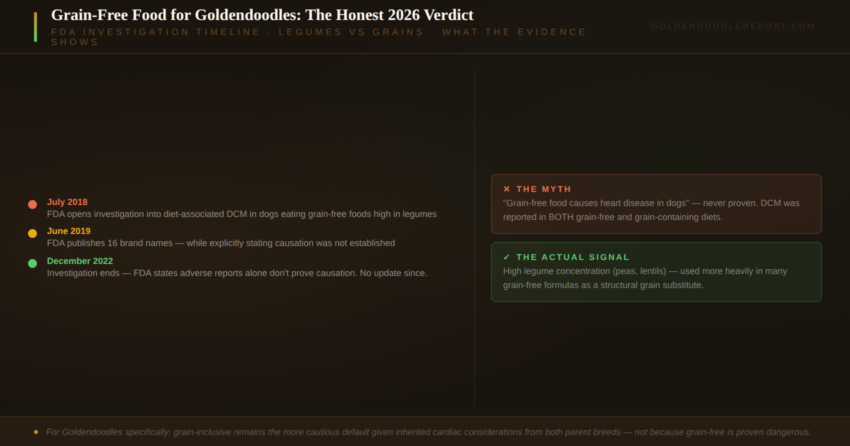
July 2018 — the investigation opens
The FDA’s Center for Veterinary Medicine announced it was investigating reports of canine dilated cardiomyopathy (DCM) in dogs eating certain pet foods, many labelled grain-free, containing a high proportion of peas, lentils, other legume seeds, and potatoes. Notably, the case reports included breeds not previously known to be genetically predisposed to DCM — which is what triggered concern in the first place.
June 2019 — the brand list
The FDA published a list of 16 brands most frequently named in adverse event reports, while explicitly stating it had not established causation. This list caused significant market disruption and consumer alarm, and was later criticised by veterinary nutritionists for implying risk without adequate evidence to support singling out specific brands.
2020–2022 — the picture gets more complicated
A Kansas State University scientific forum in September 2020 examined potential causes of non-hereditary DCM without reaching a firm conclusion. Reports to the FDA declined significantly from 2020 onward, and the agency itself noted the pattern was consistent with reports clustering around its own announcements rather than a genuine ongoing outbreak.
December 2022 — investigation ends without proof of causation
According to the FDA’s own published Q&A on the investigation, the agency quietly ended routine updates, stating that adverse event numbers, by themselves, do not supply sufficient data to establish a causal relationship with any specific product. As of 2026, no updated investigation has reopened, and no causal mechanism between grain-free food as a category and DCM has ever been established.
📖 Real Scenario
A Standard Goldendoodle owner switched away from a grain-free food to a grain-inclusive one immediately after reading a 2019 news article, without consulting their vet or reviewing the actual ingredient list of either food. Two years later, at a routine appointment, the vet reviewed both labels side by side. The grain-free food the dog had been eating listed chicken as the first ingredient with a modest amount of peas well down the ingredient list — a well-formulated food, not a legume-heavy one. The grain-inclusive replacement the owner switched to, chosen mostly because it said “with wholesome grains” on the front of the bag, was a lower-quality formula overall. The lesson here isn’t that grain-free is safe or unsafe as a blanket rule — it’s that the actual ingredient list matters far more than the marketing label on the front of the bag, in either direction.
What the Data Actually Showed
The FDA’s own July 2019 update quantified the pattern precisely: of the diets reported in DCM cases, more than 90% were grain-free, 93% contained peas and/or lentils, and 42% contained potatoes or sweet potatoes. These numbers are the actual data behind the headlines — and they immediately clarify the more precise concern: it was never grain-free as a category so much as the specific combination of peas and lentils appearing at high frequency across the reported diets.
The FDA’s own published Q&A on the investigation is more measured than most secondary sources suggest. Two points are worth stating precisely, because they are the most commonly misrepresented:
- DCM was reported in dogs on both grain-free and grain-containing diets. The pattern was never exclusive to the grain-free category — this is stated explicitly in the FDA’s own materials, not a claim from grain-free advocates.
- Legumes and pulses have been used safely in pet food for years with no prior evidence that they are inherently dangerous. The concern was specifically about the proportion used in some formulations — legumes as a primary ingredient rather than a minor one — not their presence at any level.
The FDA also never conducted or published a controlled study proving causation. What exists is a correlational signal from adverse event reports — a legitimate reason to investigate further, but not the same thing as established scientific proof, which the agency itself acknowledged when it ended the investigation.
Legumes, Not Grains — The More Precise Concern
The single most important correction to the popular narrative around grain-free food for Goldendoodles is this: grains were never the protective factor, and legumes were never uniquely tied to the grain-free label. The actual pattern in the data was about ingredient proportion, specifically legume concentration — and grain-free formulas simply tend to use legumes more heavily as a substitute for the starch and binding function that grains normally serve in kibble production.
Why legumes ended up concentrated in grain-free formulas
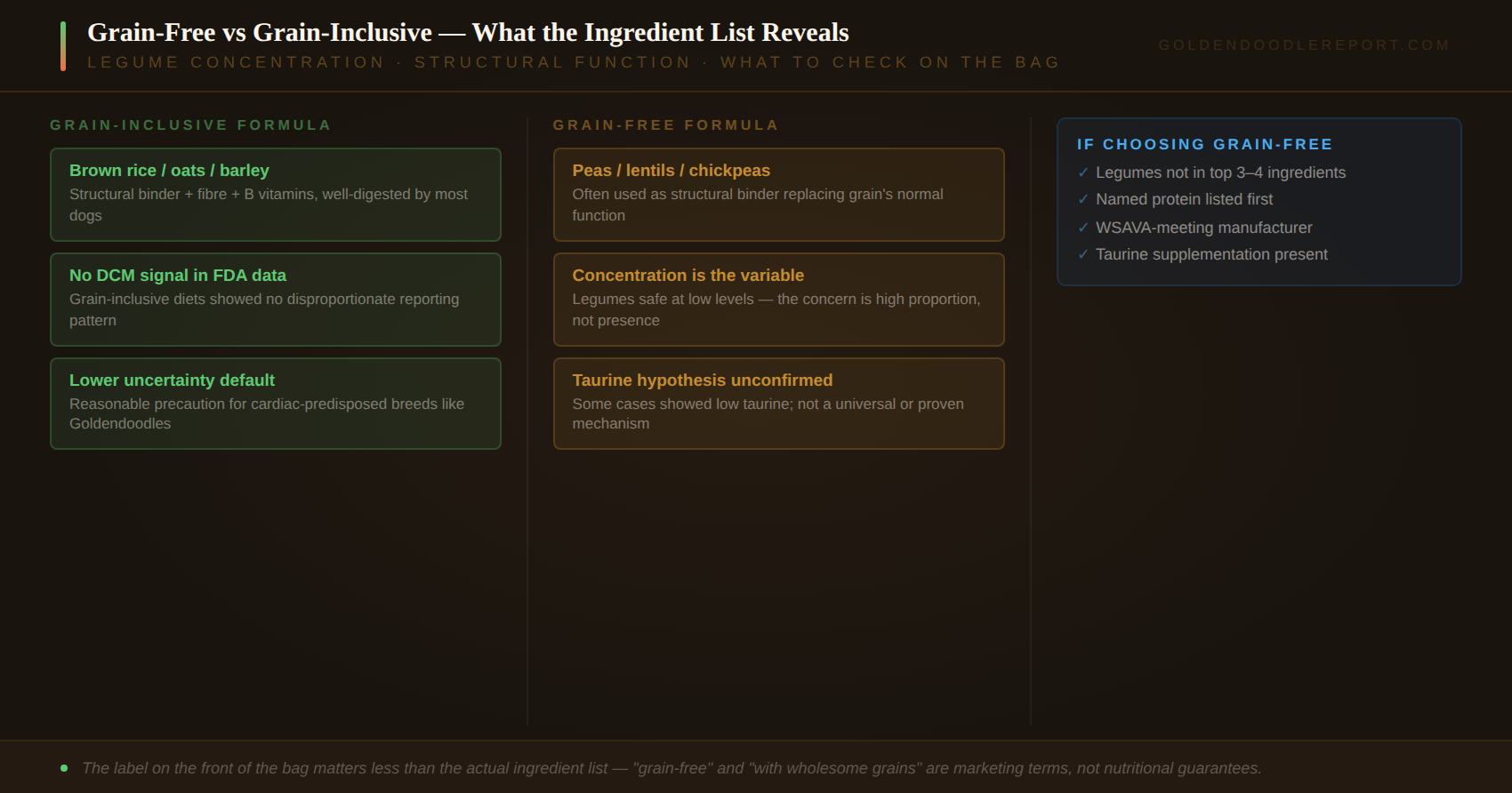
Kibble requires some kind of starchy binder to hold its shape during manufacturing. In a grain-inclusive food, that role is filled by rice, oats, or barley. When a formula removes grains entirely, something has to replace that structural function — and legumes (peas, lentils, chickpeas) became the default substitute across much of the industry, particularly in budget and mid-tier grain-free products racing to meet consumer demand for the category.
The taurine hypothesis
Taurine is an amino acid important for heart muscle function, and its deficiency is one proposed contributor to dilated cardiomyopathy, a disease broadly characterised by a weakened, enlarged heart that struggles to pump blood effectively. Dogs can normally synthesise their own taurine and have no strict dietary requirement for it — unlike cats. The working hypothesis in some of the reported DCM cases is that high legume content may interfere with taurine synthesis or absorption in a subset of dogs, though this has not been confirmed as a universal mechanism. Some dogs diagnosed with diet-associated DCM had low blood taurine; others did not. This inconsistency is part of why the FDA could not establish a single, reliable causal pathway.
A 2023 controlled 28-day feeding trial published in a peer-reviewed veterinary journal moved beyond correlational adverse-event reports and directly tested the mechanism. Researchers fed healthy Beagles — a breed with no known DCM predisposition — a grain-based diet, a whole-lentil grain-free diet, and a wrinkled-pea grain-free diet, in sequence. After 28 days on the pea-based diet, the dogs showed measurably reduced stroke volume and cardiac output, along with an increase in NT-proBNP, a blood marker used clinically to detect early heart strain.
These changes were subclinical — the dogs showed no visible symptoms — but they were real, measurable, and occurred in dogs with no genetic reason to develop DCM. The lentil-based diet did not produce the same changes, which suggests the specific legume matters, not simply “legume content” as a blanket category. This is one of the few controlled experiments in this area, rather than an observational adverse-event report, and it meaningfully supports the legume-concentration hypothesis over either a blanket “grain-free is fine” or “grain-free is dangerous” position.
Why This Matters More for Goldendoodles Specifically
Goldendoodles are not a breed with an established, direct link to diet-associated DCM specifically — but they do carry inherited cardiac considerations from both parent breeds that make caution reasonable rather than alarmist.
- Golden Retriever lineage: Golden Retrievers have a documented predisposition to subvalvular aortic stenosis (SAS), a congenital heart defect distinct from DCM but relevant to overall cardiac risk awareness in the breed
- Poodle lineage: Standard Poodles have their own set of cardiac considerations tracked by breed health organisations, adding a second inherited factor into the Goldendoodle’s genetic mix
- Hybrid vigor works both ways: Crossbred dogs often benefit from reduced expression of breed-specific conditions, but this is not a guarantee, and inherited cardiac risk factors from both parent lines remain present in the gene pool
Given this background, choosing a grain-inclusive food with a named protein first is a reasonable, low-cost precaution — not because grain-free food has been proven to cause heart disease in Goldendoodles, but because there is no compelling nutritional advantage to grain-free food for a healthy dog without a diagnosed grain sensitivity, and removing one variable of uncertainty costs nothing when an equally good grain-inclusive alternative exists.
Who Might Still Reasonably Choose Grain-Free
Grain-free food for Goldendoodles is not universally wrong for every dog — there are legitimate, narrower reasons some owners choose it:
- Diagnosed grain allergy or intolerance: True grain allergies in dogs are uncommon but real. If your vet has confirmed a specific grain sensitivity through an elimination trial, a well-formulated grain-free food chosen with your vet’s input is medically appropriate.
- Specific digestive conditions: Some individual dogs genuinely digest certain grain-free formulations better, independent of any DCM concern — this is an individual response, not a breed-wide pattern.
- A grain-free food with a low, verified legume proportion: Not all grain-free foods are legume-heavy. Some well-formulated grain-free recipes use sweet potato, tapioca, or other lower-legume-density carbohydrate sources as the primary structural ingredient instead.
In each of these cases, the deciding factor is the actual ingredient list and legume proportion — not the “grain-free” label on the front of the bag.
What to Look For If You Choose Grain-Free Anyway
| Criterion | What to Check |
|---|---|
| Legume position in ingredient list | Peas, lentils, or chickpeas should not appear among the first 3–4 ingredients |
| Named protein first | A named animal protein (chicken, salmon) should be the first ingredient, not a legume or protein concentrate |
| Manufacturer transparency | Brands employing a full-time veterinary nutritionist and conducting feeding trials (WSAVA criteria) have stronger formulation oversight |
| Taurine supplementation | Some manufacturers now voluntarily supplement taurine in grain-free formulas as a precaution |
| Veterinary cardiac screening | If continuing grain-free long-term, periodic cardiac screening (auscultation at annual visits) provides reassurance regardless of diet |
The Grain-Inclusive Alternative
For most Goldendoodle owners without a diagnosed grain sensitivity, a grain-inclusive food remains the simpler, equally nutritious, and more cautious default. Whole grains like brown rice, oats, and barley are well-digested by the vast majority of dogs, provide genuine nutritional value (fibre, B vitamins, steady energy release), and carry no documented DCM signal in the FDA’s own data.
This is not a claim that grain-inclusive food is inherently superior in every respect — it is simply the lower-uncertainty choice when no medical reason favours grain-free specifically. For the complete framework on evaluating any Goldendoodle food regardless of grain content: Best Food for Goldendoodles.
For puppies specifically, the same reasoning applies with added weight, since large breed puppy formulas overwhelmingly favour grain-inclusive recipes: Best Puppy Food for Goldendoodles. For adult maintenance nutrition: Best Food for Adult Goldendoodles.
⚠️ Grain allergy is rarer than grain-free marketing implies. If you suspect your Goldendoodle has a food sensitivity, the far more common culprits are specific animal proteins (chicken, beef) — not grains. Switching to grain-free without a confirmed diagnosis often fails to resolve the actual issue while removing a nutritionally sound ingredient category for no benefit. If you suspect a genuine sensitivity, see our Goldendoodle Food Allergies guide for the correct elimination trial process.
Switching Away From Grain-Free Safely
If you decide to move your Goldendoodle from a grain-free to a grain-inclusive food, do it gradually rather than reactively — panic-switching overnight based on a headline is exactly the pattern that caused unnecessary digestive upset for many dogs during the 2018–2019 media cycle.
- Days 1–2: 75% current food, 25% new grain-inclusive food
- Days 3–4: 50% / 50%
- Days 5–6: 25% current food, 75% new food
- Day 7+: 100% new food
Mild loose stool during the first few days is normal. For the complete transition protocol and troubleshooting: Best Food for Goldendoodles.
💡 What This Guide Adds That Most Others Don’t
Most grain-free content online falls into one of two camps: alarmist “grain-free will kill your dog” pieces built on the 2018 headlines alone, or dismissive “the FDA never proved anything so don’t worry” pieces that stop at the same point. Neither cites the actual 2023 controlled feeding trial that moved this question from correlation to a real, measured physiological effect — nor the FDA’s own exact ingredient-proportion statistics. This guide closes that gap: the honest position is neither panic nor dismissal, but a specific, evidence-grounded reason to prefer grain-inclusive food for a cardiac-predisposed breed without needing to believe grain-free is inherently dangerous.
⏱️ What to Expect If You Switch
A grain-inclusive switch, done over 7 days per the protocol above, typically produces mild loose stool for 2-4 days as the gut microbiome adjusts — this is expected, not a sign the new food disagrees with your dog. Full digestive settling usually takes 2-3 weeks. There is no coat, energy, or digestive “improvement” to expect specifically from removing grain-free food, since the switch is a precautionary measure, not a treatment for an existing problem — if your Goldendoodle was healthy on grain-free, expect them to remain equally healthy on a quality grain-inclusive equivalent, just with one less variable of theoretical cardiac risk.
✅ Your Next Step
If you’re currently evaluating grain-free against grain-inclusive options for your Goldendoodle, the most useful next read is Best Food for Goldendoodles — it lays out the complete brand-evaluation framework (AAFCO validation, named protein, manufacturer transparency) that applies regardless of which side of the grain-free question you land on.
🔑 Key Takeaways
- Grain-free food for Goldendoodles was never proven to cause DCM — the FDA ended its investigation in December 2022 without establishing causation, and DCM was reported in both grain-free and grain-inclusive diets
- The actual signal in the data pointed to high legume concentration, not the absence of grain itself — legumes are simply used more heavily in many grain-free formulas as a structural substitute for grain
- Goldendoodles carry inherited cardiac considerations from both Golden Retriever and Poodle lineage, making grain-inclusive food a reasonable, low-cost precaution rather than a proven necessity
- True diagnosed grain allergies in dogs are uncommon — if you suspect a food sensitivity, animal proteins are the far more likely trigger, not grains
- If choosing grain-free anyway, check legume position in the ingredient list, prioritise a named protein first, and choose a WSAVA-meeting manufacturer
- Switch food gradually over 7 days regardless of direction — panic-switching based on headlines causes more immediate digestive harm than most grain-free formulas themselves
📚 More Goldendoodle Food & Nutrition Guides
- Best Food for Goldendoodles: What Vets Recommend (2026)
- Best Puppy Food for Goldendoodles: Large vs Small Breed
- Best Food for Adult Goldendoodles: Vet-Backed Guide (2026)
- Goldendoodle Food Allergies: Signs, Triggers + What to Feed
- Goldendoodle Sensitive Stomach: 5 Foods That Actually Help
- Raw Diet for Goldendoodles: Benefits, Risks + Honest Guide
- Best Senior Food for Goldendoodles — coming soon
Browse all guides: Goldendoodle Food & Nutrition category
🔗 Related Guides Across the Site
- Goldendoodle Puppy First Vet Visit — discussing diet and cardiac screening with your vet early
- Goldendoodle Puppy Care Guide — first-year nutrition decisions including grain choice
- Do Goldendoodles Smell Bad? — how diet composition affects digestion and odour
- Why Is My Goldendoodle Always Hungry? — when hunger points to a nutrient gap rather than diet type
Frequently Asked Questions
Is grain-free food bad for Goldendoodles?
Not definitively — the FDA never established that grain-free food causes heart disease in dogs, and its investigation ended in December 2022 without proving causation. What the data did show was that non-soy legume ingredients used in high concentration appeared disproportionately in the diets of dogs that developed diet-associated DCM, and grain-free formulas tend to use legumes more heavily as a structural substitute for grain. For Goldendoodles specifically, who carry inherited cardiac considerations from both parent breeds, a grain-inclusive food remains the more cautious default choice — not because grain-free has been proven dangerous, but because there is no clear nutritional advantage to grain-free for a healthy dog, making the extra caution essentially free.
Did the FDA ban grain-free dog food?
No. The FDA has never recalled or banned grain-free dog food, and at no point recommended dietary changes based on the investigation. The agency investigated a correlational signal in adverse event reports, published brand names associated with those reports in 2019 (a decision later criticised by veterinary nutritionists for implying unproven risk), and ended the investigation in December 2022 stating that adverse event numbers alone do not establish causation.
What ingredients should I avoid in grain-free food for a Goldendoodle?
If choosing a grain-free food, check that peas, lentils, and other legumes do not appear among the first 3–4 ingredients — a low legume position suggests the formula isn’t using pulses as its primary structural or protein ingredient. Prioritise a named animal protein (chicken, salmon, turkey) as the first ingredient, and favour manufacturers that employ a full-time veterinary nutritionist and conduct AAFCO feeding trials, which indicates stronger formulation oversight.
My Goldendoodle has been on grain-free food for years with no problems — should I switch?
Not necessarily out of alarm. If your dog has been eating a well-formulated grain-free food (named protein first, legumes not concentrated at the top of the ingredient list) with no digestive or cardiac symptoms, there is no established evidence requiring an immediate switch. That said, if you want to remove even the theoretical uncertainty, transitioning to a comparable grain-inclusive food over 7 days is a reasonable, low-risk precaution — discuss with your vet at your next routine visit, particularly if your Goldendoodle is due for a cardiac auscultation as part of standard senior monitoring.
Does my Goldendoodle actually have a grain allergy?
True grain allergies in dogs are uncommon. If you suspect a food sensitivity, animal proteins (chicken and beef most commonly) are statistically far more likely culprits than grains. A confirmed grain allergy requires a veterinary-supervised elimination trial — not just symptom improvement after switching to a grain-free brand, which could be explained by many other formulation differences between the old and new food. See our Goldendoodle Food Allergies guide for the correct diagnostic process.
Disclaimer: The information in this article is provided for general educational purposes only. King James Adjei is a researcher and enthusiast, not a veterinarian or certified veterinary nutritionist. The FDA’s investigation into diet-associated DCM did not establish causation and this article reflects the evidence as understood as of 2026. Always consult your veterinarian regarding your Goldendoodle’s specific dietary needs, particularly if a cardiac or digestive condition has been diagnosed.