Affiliate Disclosure: Some links in this guide are affiliate links. If you purchase through them, we may earn a small commission at no extra cost to you. This does not influence our recommendations — we only suggest foods that meet the standards described in this guide. Read our full affiliate disclaimer here.
By King James Adjei — Researcher and Goldendoodle enthusiast, founder of GoldendoodleReport.com. Every guide on this site is carefully researched and written to give owners reliable, clearly organised information. → About this site
🩺 Veterinary guidance note: This guide provides general evidence-based information on Goldendoodle nutrition. Always consult your veterinarian before switching your dog’s diet, especially for puppies, senior dogs, or dogs with known health conditions. Your vet can confirm the right food type and portion for your specific dog.
📖 10-minute read | Last updated May 2026 | Reviewed for accuracy
✅ Quick Answer
The best food for Goldendoodles is a high-quality dry kibble or fresh-cooked diet that meets AAFCO nutritional standards for your dog’s life stage, with a named animal protein as the first ingredient, appropriate calcium-to-phosphorus ratio for large breeds, and no artificial preservatives or low-quality fillers. For Standard Goldendoodle puppies, a large breed puppy formula is essential. For adults, a mid-range to premium kibble from a brand with a strong safety track record covers the vast majority of dogs well. Fresh-cooked and raw options can also work but require more research, cost, and handling care.
The pet food market is enormous, deliberately confusing, and full of marketing language designed to make every bag look like the best choice. Words like “holistic,” “grain-free,” “ancestral,” and “biologically appropriate” are marketing terms with no legal definition — they tell you nothing meaningful about whether the food is actually good for your Goldendoodle.
This guide strips out the marketing and focuses on what actually matters: the criteria veterinary nutritionists use to evaluate dog food quality, what those criteria mean specifically for Goldendoodles, and what to look for and avoid at every life stage.
👤 Who This Guide Is For
- You are choosing the first food for a new Goldendoodle puppy
- You want to switch your adult Goldendoodle to a better food and need to know what “better” actually means
- Your dog has skin issues, digestive problems, or poor coat condition and you want to understand whether diet could be contributing
- You have heard conflicting advice about grain-free, raw, or fresh food and want an honest evidence-based overview
📊 Quick Facts — Goldendoodle Nutrition
- The AAFCO (Association of American Feed Control Officials) nutritional adequacy statement is the single most important thing to check on any dog food label — if it is absent, the food has not been validated as complete and balanced
- The FDA investigated a potential link between grain-free diets and dilated cardiomyopathy (DCM, a form of heart disease) in dogs from 2018 onwards — the investigation is ongoing and inconclusive, but major veterinary cardiology bodies recommend caution with grain-free foods for breeds with cardiac predispositions
- Goldendoodles inherit cardiac risk from both the Golden Retriever and Poodle sides — specifically subvalvular aortic stenosis (SAS) — making the grain-free DCM question particularly relevant for this breed
- Standard Goldendoodle puppies fed adult or small-breed puppy food face elevated risk of developmental orthopedic disease due to incorrect calcium-to-phosphorus ratios for large breed growth
- The World Small Animal Veterinary Association (WSAVA) publishes guidelines for evaluating pet food manufacturers — they recommend buying from companies that employ veterinary nutritionists and conduct feeding trials
📋 Table of Contents
- What Goldendoodles Specifically Need From Their Food
- How to Read a Dog Food Label
- Food Types Compared: Dry, Wet, Fresh, Raw
- Best Food for Goldendoodle Puppies
- Best Food for Adult Goldendoodles
- Best Food for Senior Goldendoodles
- The Grain-Free Question
- Ingredients and Practices to Avoid
- How to Switch Foods Safely
- Food and Coat Quality
- Frequently Asked Questions
What Goldendoodles Specifically Need From Their Food
Most dog food advice is generic — it applies broadly to all breeds. Goldendoodles have several specific characteristics that make certain nutritional considerations more important for them than for average dogs.
Joint health — particularly for Standards
Standard Goldendoodles are a large breed with genetic predisposition to hip and elbow dysplasia inherited from both Golden Retrievers and Poodles. During puppyhood, controlled calcium and phosphorus levels in large breed puppy food directly influence how quickly and evenly the skeleton grows. Too much calcium during growth has been linked to developmental orthopedic disease. In adult and senior dogs, foods with added glucosamine and chondroitin support joint cartilage maintenance. This is not optional for large Goldendoodles — it is a meaningful preventive measure.
Coat health — omega-3 and omega-6 fatty acids
Goldendoodle coats require consistent dietary fatty acid support to maintain their characteristic texture and reduce shedding. Omega-3 fatty acids (particularly EPA and DHA from marine sources) reduce skin inflammation and support coat shine. Omega-6 fatty acids support the skin barrier. Foods with fish meal or fish oil as a listed ingredient typically deliver better fatty acid profiles than foods relying entirely on plant-based fat sources like sunflower oil. Poor coat condition — dull, dry, brittle, or excessively shedding — is one of the earliest visible signs of nutritional inadequacy.
Cardiac considerations — the SAS factor
Goldendoodles inherit a genetic predisposition to subvalvular aortic stenosis (SAS) from both parent breeds. Given the FDA’s ongoing investigation into a potential link between grain-free diets high in legumes and dilated cardiomyopathy, major veterinary cardiology organisations currently recommend choosing foods that use grains rather than large quantities of legumes (peas, lentils, chickpeas) as their primary carbohydrate source. This does not mean all grain-free foods are dangerous — the evidence is not conclusive — but for a breed with existing cardiac risk, grains-included diets represent the more cautious choice.
Sensitive digestion
Goldendoodles are known for having relatively sensitive digestive systems. Abrupt food changes, foods with multiple novel protein sources, foods with artificial additives, and foods with low-quality fillers all commonly trigger loose stool, excessive gas, and digestive discomfort in this breed. Choosing a food with a limited, clearly identifiable ingredient list reduces digestive incidents significantly.
📖 Real Scenario
A 3-year-old Standard Goldendoodle has been on a well-known grain-free kibble for 18 months. His coat is dull and he sheds more than his owner expected. His stool is consistently loose 2–3 days per week. His vet finds no parasites or illness. The owner switches to a mid-range grain-inclusive kibble from a brand that employs veterinary nutritionists and uses fish meal as a secondary protein source. Within 6 weeks: coat noticeably softer and shinier, shedding reduced, stool consistently firm. No medication, no supplements — just a better-matched diet. This outcome is common when owners move from heavily marketed grain-free foods to evidence-based alternatives.
How to Read a Dog Food Label
Most owners read marketing copy on the front of the bag. The information that actually matters is on the back, in a format designed to be confusing. Here are the five things to look for.
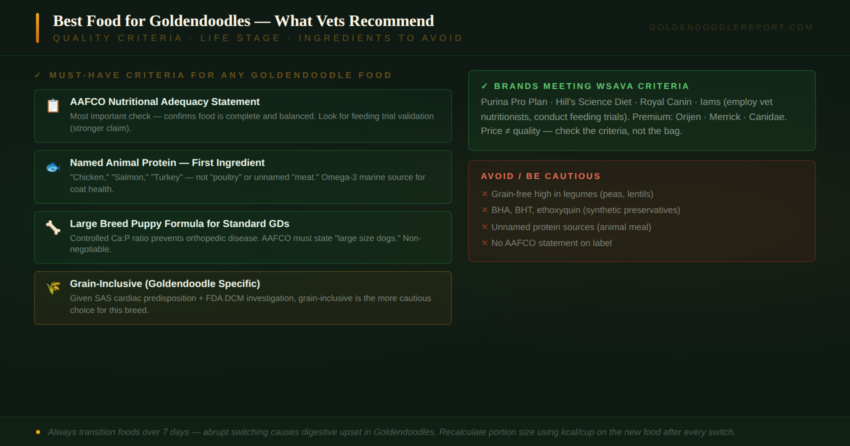
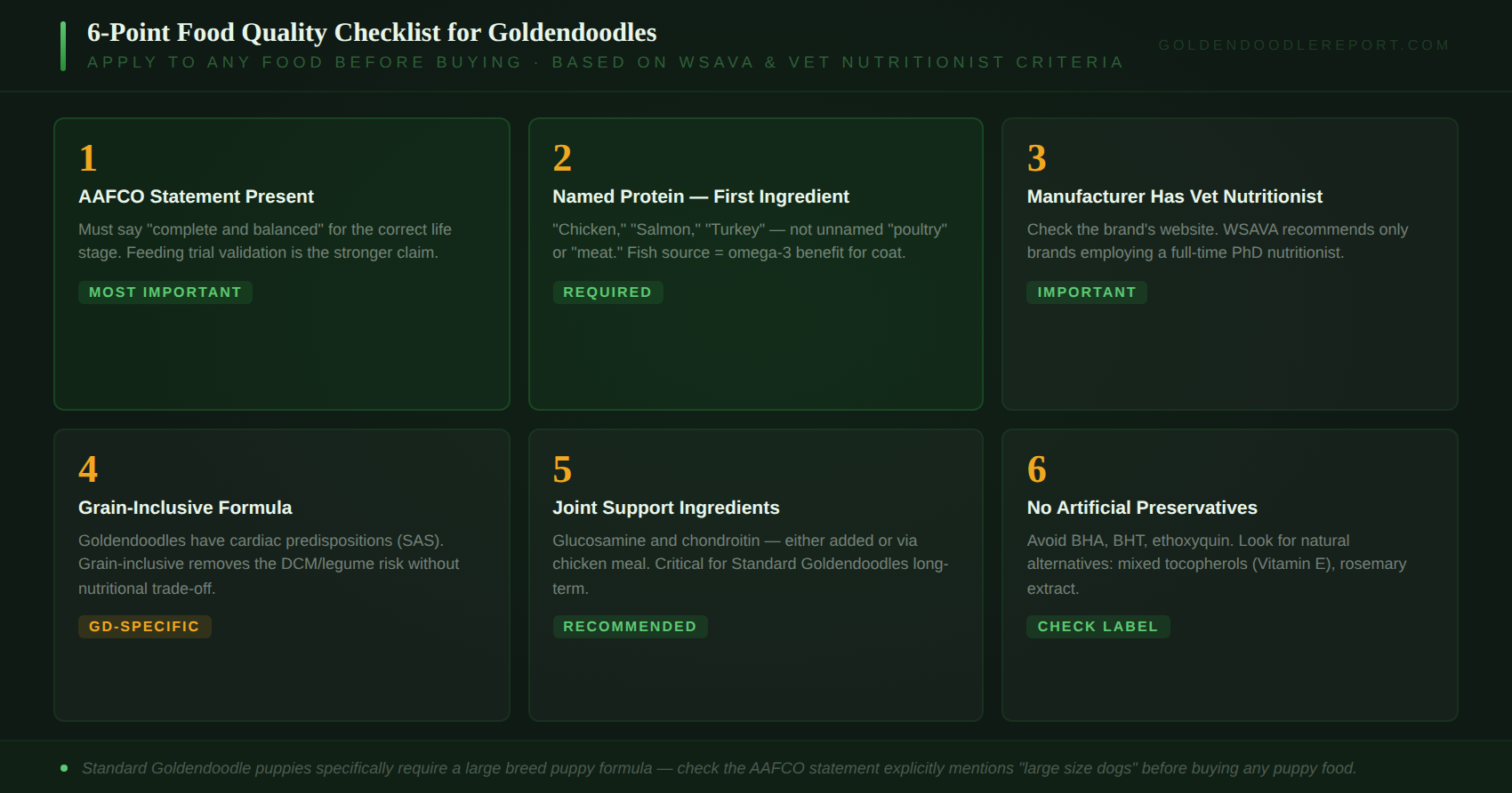
1. The AAFCO nutritional adequacy statement
This is the most important line on any dog food label. It will say either:
- “Complete and balanced nutrition for [life stage] as established by AAFCO nutrient profiles” — the food meets minimum standards mathematically
- “Complete and balanced nutrition for [life stage] as substantiated by animal feeding tests using AAFCO procedures” — the food has been tested in actual animals, which is the stronger claim
- “Formulated to meet the nutritional levels established by the AAFCO” — also acceptable
If there is no AAFCO statement at all, do not feed the food as a primary diet. If it says “for intermittent or supplemental feeding only,” it is a treat or topper, not a complete diet.
2. The first five ingredients
Ingredients are listed by weight before cooking. A named animal protein should be first — “chicken,” “beef,” “salmon,” “lamb.” “Chicken meal” is also acceptable and is actually more protein-dense per gram than whole chicken (which contains a lot of water). “Meat by-products” without specifying the species is a lower-quality ingredient but not inherently dangerous. What you do not want first: corn syrup, sugar, unnamed animal fat, or a list that is predominantly grains before any protein appears.
3. The guaranteed analysis
This shows minimum protein, minimum fat, maximum fibre, and maximum moisture. For adult Goldendoodles: protein should be at least 22–26%, fat at least 12–16%. For puppies: protein 28–32%, fat 17–22%. These are minimums — quality matters more than raw percentages.
4. The manufacturer’s information
Look for a brand that has a physical address listed, employs a veterinary nutritionist (this information is usually on their website), and conducts their own feeding trials rather than relying entirely on contract manufacturers. The WSAVA guidelines recommend specifically asking manufacturers: Do you employ a full-time veterinary nutritionist? Do you conduct feeding trials? Do you have quality control protocols at your own manufacturing facilities?
5. Calorie content (kcal/cup)
This is essential for portion control — see our How Much to Feed a Goldendoodle guide for why this number matters more than the cup measurement. It is usually listed near the feeding guidelines on the back of the bag or on the manufacturer’s website.
Food Types Compared: Dry, Wet, Fresh, Raw
| Food Type | Pros | Cons | Best For |
|---|---|---|---|
| Dry Kibble | Convenient, cost-effective, long shelf life, wide range of options, AAFCO-validated | Highly processed, low moisture content, quality varies enormously between brands | Most owners — best balance of convenience, cost and proven nutrition |
| Wet / Canned | Higher moisture aids hydration, often more palatable, less processed than kibble | More expensive per calorie, shorter shelf life once opened, can cause loose stool in sensitive dogs | Senior dogs, dogs with poor hydration, picky eaters, as a mixer with kibble |
| Fresh-Cooked | Minimally processed, human-grade ingredients, easy for sensitive stomachs, high palatability | Expensive (2–4x cost of quality kibble), requires refrigeration, subscription model | Owners with budget and dogs with sensitive digestion or poor kibble tolerance |
| Raw (BARF) | Minimal processing, some dogs do very well on it, enthusiastic owner community | Bacterial contamination risk (Salmonella, Listeria), difficult to balance nutritionally, not recommended for immunocompromised dogs or households with young children | Only with veterinary guidance and strict food-safety protocols. Not recommended as a first diet choice. |
The honest verdict: A high-quality dry kibble from a reputable manufacturer is the right choice for the vast majority of Goldendoodle owners. Fresh-cooked diets (from brands like The Farmer’s Dog, Ollie, or Nom Nom) are a legitimate premium alternative for owners who have the budget and a dog with digestive issues that persist on kibble. Raw feeding requires significant research, strict food-safety discipline, and ideally veterinary nutritionist input — it is not a shortcut to better nutrition and carries real risks if done incorrectly.
Best Food for Goldendoodle Puppies
Puppy food is not just a marketing category — the nutritional profile genuinely differs from adult food in ways that matter for growing Goldendoodles.
Standard Goldendoodles (expected adult weight over 40 lbs)
Must be fed a large breed puppy formula. This is non-negotiable. Large breed puppy formulas have controlled calcium and phosphorus levels that prevent excessively rapid bone growth, which reduces the risk of developmental orthopedic disease including hip dysplasia, osteochondrosis, and hypertrophic osteodystrophy. A Standard Goldendoodle fed a regular puppy formula, or worse an adult formula, during the growth phase faces meaningfully elevated risk of these conditions.
What to look for in a large breed puppy formula:
- AAFCO statement specifically mentioning “growth of large size dogs” or “all life stages including growth of large size dogs”
- Calcium between 0.7–1.2% on a dry matter basis
- Named animal protein as the first ingredient
- DHA listed (supports brain and vision development)
- No grain-free formulation (for cardiac risk reasons noted above)
Mini Goldendoodles (expected adult weight under 30 lbs)
Can use a standard puppy formula or a small breed puppy formula. The large breed calcium restriction is not required for small dogs. Prioritise: named protein first, AAFCO validation, DHA listed, reputable manufacturer with feeding trial evidence.
For portion guidance alongside food choice: How Much to Feed a Goldendoodle and Goldendoodle Feeding Schedule. For the full first-year care context: Goldendoodle Puppy Care Guide.
⚠️ When to transition from puppy to adult food: Mini Goldendoodles: 12 months. Medium Goldendoodles: 12–15 months. Standard Goldendoodles: 15–18 months. Do not rush this — continuing puppy food slightly past the transition point is less harmful than switching to adult food too early and cutting off the nutritional support for growing joints and bones.
For detailed best puppy food recommendations by brand: see our Best Puppy Food for Goldendoodles guide — coming soon in this category.
Best Food for Adult Goldendoodles (1–7 Years)
Once a Goldendoodle has finished growing, the nutritional priorities shift from supporting rapid development to maintaining optimal body condition, joint health, coat quality, and digestive health across a long active life.
What to prioritise in adult food
- Named animal protein as the first ingredient: Chicken, beef, lamb, salmon, turkey. Not “poultry” (unnamed) or “meat meal” (unnamed species)
- Grain-inclusive: Brown rice, oats, barley, or other whole grains as a carbohydrate source. Given Goldendoodle cardiac predispositions, grains-included is the more cautious choice
- Omega-3 source: Fish meal, fish oil, or flaxseed listed in the ingredients. This is the most direct dietary contributor to coat quality
- Glucosamine and chondroitin: Either added or naturally present through the inclusion of chicken meal or other bone-containing ingredients. Supports joint cartilage in Standard Goldendoodles
- AAFCO validation for adult maintenance
- Reputable manufacturer: Brand employs board-certified veterinary nutritionist, conducts feeding trials, has transparent manufacturing practices
Brands consistently recommended by veterinary nutritionists
Veterinary nutritionists most consistently point to brands that meet WSAVA criteria — meaning they employ a full-time PhD nutritionist, publish research, and conduct feeding trials. Brands that consistently meet these criteria include Hill’s Science Diet, Royal Canin, Purina Pro Plan, and Iams. These are not the most glamorous brands, but they have the strongest evidence base for nutritional completeness and safety.
Premium brands that also meet WSAVA standards and provide high-quality ingredients include Orijen, Acana, Merrick, and Canidae — though the cost is significantly higher. The key is not the price point but whether the manufacturer meets the WSAVA criteria outlined above.
Important: This guide does not affiliate-link to specific food brands because the best food for your specific Goldendoodle depends on their size, activity level, sensitivities, and your budget. The framework above allows you to evaluate any food against consistent criteria.

Best Food for Senior Goldendoodles (7+ Years)
Senior dogs face a different nutritional challenge than adults: they typically need fewer calories (to prevent weight gain as activity decreases), but they need the same or higher protein levels (to maintain muscle mass that tends to decline with age), plus more support for joints and digestion.
What changes in a senior Goldendoodle’s diet
- Calories: Reduce by 10–20% from adult maintenance amounts — but achieved by choosing a lower-density food, not by reducing high-quality protein
- Protein: Should remain at 25%+ on a dry matter basis — contrary to older thinking, high protein does not damage healthy kidneys in older dogs
- Joint support: Higher glucosamine and chondroitin — more important as cartilage breaks down with age
- Digestibility: Senior digestive systems are less efficient — higher digestibility foods (often with prebiotics and probiotics) reduce digestive burden
- Antioxidants: Support cognitive function and immune health in older dogs
Not every dog over 7 needs a “senior” labelled food — some active 8-year-old Goldendoodles do fine on a high-quality adult food at slightly reduced portions. The BCS assessment is the real guide. For detailed senior food recommendations: see our Best Senior Food for Goldendoodles guide — coming soon in this category.
The Grain-Free Question — An Honest Answer
Grain-free dog food became enormously popular from around 2010–2018, driven by the belief that grains are unnecessary fillers or allergens in dog food. The reality is more nuanced.
What the FDA investigation found: From 2018, the FDA began investigating reports of dilated cardiomyopathy (DCM) — an enlarged, weakened heart — in dogs eating grain-free diets high in legumes (peas, lentils, chickpeas, potatoes). The investigation found a statistical association but has not established a definitive causal mechanism. As of 2026, the investigation remains open and inconclusive.
What veterinary cardiologists recommend: Major veterinary cardiology organisations, including the Cummings School of Veterinary Medicine, currently advise caution with grain-free diets — particularly for breeds with known cardiac predispositions. This applies directly to Goldendoodles given their inherited SAS risk from both parent breeds.
Are grains bad for dogs? No. Dogs digest grains well. Grain allergies exist but are rare — chicken, beef, and dairy are far more common allergens than wheat or corn. The belief that grains are inherently harmful to dogs is not supported by evidence.
The honest recommendation for Goldendoodles: Choose a grain-inclusive food from a quality manufacturer unless your vet has specifically identified a grain sensitivity in your dog. The grain-free DCM risk may be small, but for a breed with existing cardiac predisposition, avoiding that risk costs nothing.
⚠️ Exception: If your Goldendoodle has been on a grain-free food and is doing well — good coat, healthy weight, normal stool, no cardiac signs — do not panic-switch overnight. Discuss the transition with your vet, particularly if your dog is over 5 years old, and transition gradually over 7–10 days.
Ingredients and Practices to Avoid
Ingredients to avoid or be cautious about
- BHA, BHT, ethoxyquin: Synthetic preservatives with questionable long-term safety profiles. Look for foods using natural preservatives like mixed tocopherols (Vitamin E) and rosemary
- Artificial colours (Red 40, Yellow 5, Yellow 6, Blue 2): No nutritional benefit and no reason to include in dog food except to appeal to owners
- Unnamed protein sources (“animal meal,” “poultry meal,” “meat by-products”): Cannot verify species or quality. Named sources (chicken meal, turkey meal) are far preferable
- Corn syrup, sugar, or sweeteners: Occasionally appear in wet foods and treats to increase palatability — no nutritional role
- Excessive legumes as primary carbohydrate: Specifically in grain-free formulations — the DCM association concern (noted above)
- Carrageenan: A thickener found in some wet foods, linked to digestive inflammation in some studies — avoidable without sacrificing quality
Practices to avoid
- Buying based on marketing language alone: “Holistic,” “natural,” “ancestral recipe,” “raw-inspired” are unregulated terms. Check the AAFCO statement and ingredient list instead
- Frequent food switching: Goldendoodles have sensitive digestive systems. Switching foods every month “for variety” consistently triggers digestive upset. Choose a food that works and stay on it
- Buying from brands without a veterinary nutritionist: Check the manufacturer’s website. If they cannot confirm a PhD in veterinary nutrition or animal nutrition is involved in formulation, be cautious
- Judging quality by price: Expensive does not mean nutritionally superior. Some mid-price brands meet WSAVA criteria; some premium brands do not
How to Switch Foods Safely
Switching a Goldendoodle’s food abruptly almost always causes digestive upset — loose stool, vomiting, gas, or food refusal. The transition protocol below prevents this in the vast majority of cases.
| Days | Old Food | New Food | Notes |
|---|---|---|---|
| Days 1–2 | 75% | 25% | Watch for any immediate digestive reaction |
| Days 3–4 | 50% | 50% | Mild loose stool is common — expected |
| Days 5–6 | 25% | 75% | Stool should begin firming up |
| Day 7+ | 0% | 100% | Full transition complete. Recheck kcal/cup and adjust portion |
If your dog shows significant vomiting, bloody stool, complete food refusal, or lethargy during the transition — stop and consult your vet. Mild digestive adjustment is expected; significant distress is not.
After switching: Always recalculate daily portions using the new food’s kcal/cup figure. A common mistake is feeding the same cup volume as before — if the new food is more calorie-dense, the dog will gain weight. See our How Much to Feed a Goldendoodle guide for the full recalculation method.
Food and Coat Quality — The Direct Link
Goldendoodle coat quality is one of the most direct visible indicators of nutritional status. Owners often pursue grooming solutions for coat problems that are actually dietary in origin.
Signs that diet may be affecting your Goldendoodle’s coat:
- Dull, dry, brittle coat that lacks the characteristic Goldendoodle softness
- Excessive shedding beyond what is normal for the coat type
- Flaky skin or dandruff-like debris visible through the coat
- Coat that mats easily and frequently despite regular brushing
- Persistent skin itching not explained by seasonal allergies or parasites
What to check first: Ensure the diet contains adequate omega-3 fatty acids from a marine source. Adding a fish oil supplement (EPA/DHA) can improve coat quality within 6–8 weeks in dogs on omega-3 deficient diets. However, address the base diet first — supplementing on top of a poor diet is less effective than improving the diet itself.
For more on coat health and what affects it: Goldendoodle Coat Types Explained, Goldendoodle Matting Prevention, and Why Is My Goldendoodle Shedding So Much?
🔑 Key Takeaways
- The AAFCO nutritional adequacy statement is the most important thing to check on any dog food — if it is absent, the food has not been validated as nutritionally complete
- Standard Goldendoodle puppies must be fed a large breed puppy formula — the controlled calcium-to-phosphorus ratio is critical for healthy skeletal development and cannot be substituted
- Choose grain-inclusive foods for Goldendoodles given their inherited cardiac predispositions and the ongoing FDA investigation into grain-free diets and DCM
- The brands most consistently recommended by veterinary nutritionists are not always the most expensive or glamorous — they are the ones that employ full-time veterinary nutritionists and conduct feeding trials
- Poor coat quality — dull, dry, excessive shedding — is often a dietary signal. Check omega-3 content of the food before assuming it is a grooming problem
- Never switch foods abruptly — always transition over 7 days and recalculate portion sizes using the new food’s kcal/cup figure after switching
📚 More Goldendoodle Food & Nutrition Guides
- How Much to Feed a Goldendoodle: Amounts by Age + Weight
- Goldendoodle Feeding Schedule: Meal Timing by Age (2026)
- Best Puppy Food for Goldendoodles: Large vs Standard Breed Formulas — coming soon
- Goldendoodle Food Allergies: Signs, Triggers + What to Feed Instead — coming soon
- Goldendoodle Sensitive Stomach: 5 Foods That Actually Help — coming soon
- Goldendoodle Weight Management: How to Help an Overweight Dog Safely — coming soon
- Best Senior Food for Goldendoodles — coming soon
Browse all guides: Goldendoodle Food & Nutrition category
🔗 Related Guides Across the Site
- Goldendoodle Coat Types Explained — how diet affects coat texture and health
- Goldendoodle Matting Prevention — the weight and coat health connection
- Why Is My Goldendoodle Shedding So Much? — when shedding signals nutritional issues
- Goldendoodle Spring Allergies — distinguishing food allergies from environmental ones
- Goldendoodle Puppy Care Guide — complete first-year overview including nutrition
- Goldendoodle Puppy First Vet Visit — confirm food choice at the first appointment
- Goldendoodle Puppy Deworming Guide — parasites as a cause of poor nutrition absorption
- Why Is My Goldendoodle Always Hungry? — when it is about food quality, not quantity
Frequently Asked Questions
What is the best dog food brand for Goldendoodles?
The most consistently recommended brands by veterinary nutritionists are those that meet WSAVA criteria — employing a full-time veterinary nutritionist, conducting feeding trials, and maintaining transparent quality control. Brands that consistently meet these criteria include Purina Pro Plan, Hill’s Science Diet, and Royal Canin. Premium alternatives meeting WSAVA criteria include Orijen, Merrick, and Canidae. The right choice also depends on your dog’s size, age, activity level, and any sensitivities — discuss with your vet for a personalised recommendation.
Is grain-free food bad for Goldendoodles?
Not definitively — but for Goldendoodles specifically, the more cautious choice is grain-inclusive. The FDA investigation into a possible link between grain-free diets high in legumes and dilated cardiomyopathy (DCM) remains open and inconclusive. Goldendoodles inherit cardiac predispositions (subvalvular aortic stenosis) from both parent breeds. Given this, choosing a high-quality grain-inclusive food removes a potential risk without any trade-off in nutrition quality.
Do Goldendoodles need special food?
Standard Goldendoodles as puppies need a large breed puppy formula specifically. This is the most important “special” requirement. For adults, the key criteria are quality ingredients, AAFCO validation, omega-3 content for coat health, and glucosamine/chondroitin for joint support — all available in mainstream quality dry foods without needing a specialist product.
How do I know if a food is making my Goldendoodle’s coat worse?
Diet-related coat issues typically show as: dull, dry coat lacking lustre; excessive shedding; flaky skin; coat that mats more easily than usual. These signs usually develop gradually over weeks to months. If a coat was in good condition and worsened after a food switch, the new food is the likely cause. Check the omega-3 content (marine sources), check the protein level, and compare the AAFCO validation status of the old and new foods. A vet or veterinary nutritionist can help identify whether the issue is nutritional.
Can I feed my Goldendoodle home-cooked food?
Home-cooked diets can work but are extremely difficult to balance nutritionally without professional input. Studies have found that the majority of home-cooked recipes — even those from reputable sources — lack essential nutrients when fed as a complete diet. If you want to feed home-cooked food, consult a board-certified veterinary nutritionist who can formulate a complete, balanced recipe for your specific dog. Feeding a vaguely balanced home-cooked diet as the sole nutrition source is riskier than it appears.
My Goldendoodle has a sensitive stomach — what food is best?
For sensitive digestion, prioritise: limited ingredient diets with a single named protein source, grain-inclusive formulas, foods free of artificial additives and colours, and foods with a prebiotic or probiotic included. Avoid frequently switching foods. Fresh-cooked diets (from subscription services like The Farmer’s Dog) often work well for sensitive-stomached Goldendoodles. For full guidance: see our Goldendoodle Sensitive Stomach guide — coming soon in this category. Always rule out medical causes (parasites, food allergies, inflammatory bowel disease) with your vet before attributing digestive issues solely to diet.
Disclaimer: The information in this article is provided for general educational purposes only. King James Adjei is a researcher and enthusiast, not a veterinarian or certified veterinary nutritionist. Dog food recommendations and nutritional guidance change as research evolves — always consult your veterinarian or a board-certified veterinary nutritionist for advice specific to your dog. Do not change your dog’s diet based solely on this guide without veterinary consultation, particularly if your dog has existing health conditions.