Affiliate Disclosure: Some links in this guide are affiliate links. If you purchase through them, we may earn a small commission at no extra cost to you. This does not influence our recommendations. Read our full affiliate disclaimer here.
By King James Adjei — Researcher and Goldendoodle enthusiast, founder of GoldendoodleReport.com. Every guide on this site is carefully researched and written to give owners reliable, clearly organised information. → About this site
🩺 Veterinary guidance note: This guide provides general evidence-based nutritional guidance for healthy adult Goldendoodles aged 1–7 years. Dogs with diagnosed conditions — allergies, joint disease, heart disease, kidney disease, obesity — may require a prescription or therapeutic diet. Always confirm dietary choices with your veterinarian, particularly after any health diagnosis.
📖 9-minute read | Last updated May 2026 | Reviewed for accuracy
✅ Quick Answer
The best food for an adult Goldendoodle (1–7 years) is a high-quality grain-inclusive dry kibble or fresh-cooked diet with a named animal protein as the first ingredient, an omega-3 source from marine ingredients for coat health, and glucosamine and chondroitin for joint support — validated by an AAFCO statement for adult maintenance. For Standard Goldendoodles specifically, joint support ingredients matter from the start of adulthood, not just in old age. For all Goldendoodles, the grain-free DCM question makes grain-inclusive formulas the more cautious choice given the breed’s cardiac predispositions.
Choosing the best food for adult Goldendoodles is the most consequential nutritional decision of your dog’s life — the adult maintenance phase, from the end of the growth period until around age 7, is the longest nutritional chapter your dog will experience. It is also the phase where owners most often make the biggest mistakes: feeding too much, feeding a food with the wrong nutrient balance for an active large breed, or choosing based on marketing claims rather than evidence.
The goal during this phase is straightforward: maintain ideal body condition, support joint health before problems develop, keep the coat in good condition, and avoid nutritional choices that add risk for a breed already predisposed to certain health conditions. This guide covers exactly how to do that.
👤 Who This Guide Is For
- Your Goldendoodle has finished the puppy phase (12–18 months) and you are choosing their first adult food
- You want to review whether your adult Goldendoodle’s current food is meeting their maintenance needs
- Your dog’s coat quality has declined, they are gaining weight, or their energy has changed and you suspect diet may be contributing
- You are comparing food options and want criteria beyond marketing language to evaluate them against
📊 Quick Facts — Adult Goldendoodle Nutrition
- The adult maintenance phase spans the longest period of a Goldendoodle’s life — approximately 6 years for Standards and 8 years for Minis — making food quality a genuine long-term health investment
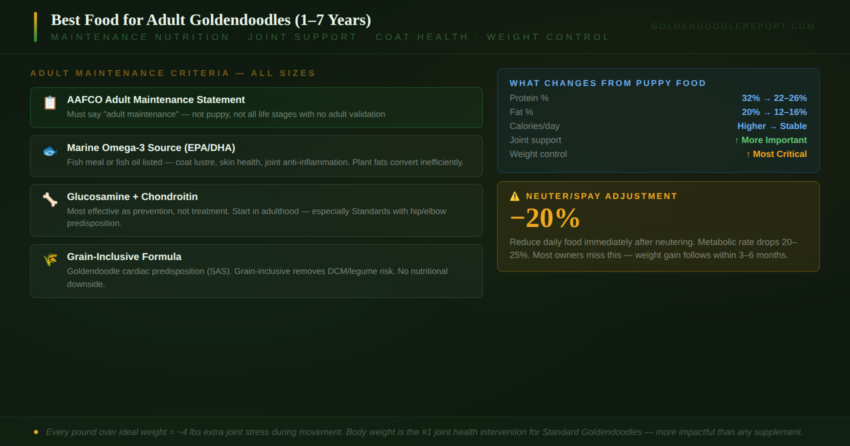
- Spayed and neutered Goldendoodles typically require 20–25% fewer calories than intact dogs of the same size and activity level — the single most commonly missed dietary adjustment in adult Goldendoodles
- Coat quality improvement from a dietary change typically takes 6–8 weeks to become visible — owners who switch foods expecting immediate coat results often revert prematurely
- Glucosamine and chondroitin supplementation or dietary inclusion has the strongest evidence for joint health maintenance when started before clinical signs of joint disease develop, not after
- The most common cause of early-onset joint disease in adult Goldendoodles is not age — it is overweight, which is almost entirely a dietary management issue
📋 Table of Contents
- What Changes When the Puppy Phase Ends
- 4 Key Criteria: Best Food for Adult Goldendoodles
- How Nutritional Needs Differ by Size
- Adjusting for Activity Level and Neutering
- Diet and Coat Quality
- Diet and Joint Health
- Weight Management in Adult Goldendoodles
- Dry Kibble vs Fresh vs Wet — What Works Best
- What to Look for in a Brand
- Signs Your Adult Goldendoodle Needs a Food Change
- Frequently Asked Questions
What Changes When the Puppy Phase Ends
The transition from puppy to adult food is not just a label change — it marks a genuine shift in nutritional requirements. Understanding what changes and what stays the same prevents the most common adult feeding mistakes.
What decreases
- Calorie requirements per pound of body weight — rapid growth has ended; energy needs stabilise at maintenance levels
- Protein as a percentage of total intake — drops from 28–32% (puppy) to 22–26% (adult maintenance)
- Fat percentage — drops from 17–22% (puppy) to 12–16% (adult), reducing calorie density appropriately
- Meal frequency — from 3 meals per day to 2 meals per day (already transitioned by ~6 months; adult food reinforces 2-meal structure)
What stays important or increases
- Omega-3 fatty acids — now working to maintain rather than develop the coat; still essential for skin and joint inflammation management
- Joint support — glucosamine and chondroitin become increasingly relevant during adulthood as cumulative wear on joints begins
- Digestive support — adult Goldendoodles retain their sensitive digestion; dietary consistency and digestibility remain priorities
- Appropriate calorie control — the risk of overweight increases sharply after neutering and as activity naturally moderates in mid-adulthood
📖 Real Scenario
A 2-year-old female Standard Goldendoodle was spayed at 18 months. Her owner continued feeding the same portions she received during the puppy-to-adult transition. At her 2-year vet check, the vet notes she is at body condition score 6/9 — mildly overweight. Nothing in her diet has changed. What happened: spaying reduced her calorie requirement by approximately 20–25%, but her intake stayed the same.
Over 6 months she gained 6 lbs — not visible to her owner because of her thick coat but detectable on BCS assessment. Her vet recommends reducing daily food by 20% or switching to a lower-calorie-density adult food. Within 3 months she is back to BCS 5. The lesson: neutering requires an immediate dietary reassessment, not a “wait and see” approach.
4 Key Criteria: Best Food for Adult Goldendoodles
When evaluating the best food for adult Goldendoodles, these criteria provide an objective framework beyond brand names and marketing language.
| Criterion | Target | Why It Matters for Goldendoodles |
|---|---|---|
| AAFCO — adult maintenance | Statement present for “adult maintenance” | Confirms food meets minimum validated nutritional standards |
| Protein (dry matter) | 22–26% minimum | Supports muscle maintenance without excess calorie load |
| Fat (dry matter) | 12–16% | Energy source + fat-soluble vitamin absorption; lower than puppy phase |
| Omega-3 (marine source) | Fish meal or fish oil listed | Coat lustre, skin health, anti-inflammatory support for joints |
| Glucosamine + chondroitin | Added or from chicken meal | Joint cartilage maintenance — most effective as prevention, not treatment |
| Grain-inclusive | Rice, oats, barley present | DCM/cardiac risk reduction for breed with SAS predisposition |
| Named protein first | Chicken, beef, salmon, turkey | Quality protein source; verifiable species |
| Vet nutritionist manufacturer | PhD nutritionist employed full-time | WSAVA quality standard — most reliable indicator of consistent formulation |
How Nutritional Needs Differ by Size
The adult Goldendoodle’s size continues to matter for food selection, though the differences are less acute than during the puppy phase.
Standard Goldendoodles (45–80 lbs)
Large body mass means more joint load across a lifetime. Joint support ingredients — glucosamine and chondroitin — become especially relevant during the adult phase for Standard Goldendoodles. Bloat risk remains relevant for Standards throughout adulthood: 2 meals per day, no vigorous exercise within 60–90 minutes of feeding, and a slow-feeder bowl if eating rapidly. Foods marketed as “large breed adult” formulas typically include both joint support and a calorie profile appropriate for larger body mass — a sensible choice for Standard Goldendoodles.
Mini Goldendoodles (15–30 lbs)
Smaller dogs tend to have higher metabolic rates per pound and can tolerate a slightly higher calorie density per cup without weight gain. However, the same WSAVA-meeting brand criteria apply regardless of size. Small breed adult formulas with smaller kibble pieces are worth considering for Minis, though many do perfectly well on standard adult formulas.
Medium Goldendoodles (30–45 lbs)
A standard adult formula from a reputable manufacturer typically meets medium Goldendoodle needs well. A large breed adult formula can also work — the joint support ingredients are beneficial at this size, and the calorie profile is appropriate for 30–45 lb dogs with moderate activity levels.
Adjusting for Activity Level and Neutering
The same food at the same portion can be ideal for one adult Goldendoodle and cause obesity in another, depending on activity level and reproductive status. These are the two most important individual adjustments.
Activity level
- Low activity (under 30 minutes exercise daily, mostly indoor): reduce daily amount by 10–15% from feeding guide recommendation
- Moderate activity (30–60 minutes daily walks and play): use feeding guide amounts as starting point, then adjust based on BCS
- High activity (agility, regular hiking, 60+ minutes vigorous daily exercise): increase by 15–25%
Spayed and neutered Goldendoodles
This is the most commonly missed adjustment. Spaying and neutering reduces resting metabolic rate by approximately 20–25%. If you continue feeding the same amount after neutering, your Goldendoodle will gradually gain weight — usually over 3–6 months, slowly enough that owners often miss it until the vet flags it.
At the time of neutering (or immediately after): reduce daily food intake by 20%, switch to a lower calorie-density adult food, or both. Reassess body condition score 6 weeks later. See our How Much to Feed a Goldendoodle guide for the BCS assessment method.
⚠️ Neutering and food adjustment — do it on the day, not later. Most owners intend to “watch and see” after neutering. The problem is that gradual weight gain over months is easy to miss — especially under a Goldendoodle’s thick coat. Build the 20% reduction into your feeding routine the week you bring your dog home from the procedure. It is far easier to maintain healthy weight than to reduce it once gained.
Diet and Coat Quality in Adult Goldendoodles
The adult Goldendoodle coat — whether wavy or curly — requires consistent dietary fatty acid support to maintain its characteristic texture. Many owners attribute coat problems to grooming frequency when the root cause is nutritional.
Signs the diet is affecting coat quality
- Dull coat lacking the characteristic Goldendoodle sheen
- Dry, brittle texture that breaks rather than bends
- Excessive shedding beyond what is normal for the coat type
- Flaky skin visible at the skin surface
- Coat that tangles and mats significantly faster than expected
What to check in the food
The omega-3 profile is the most direct dietary lever for coat quality. According to Wikipedia’s overview of omega-3 fatty acids, the marine-sourced forms EPA and DHA are far more bioavailable to dogs than ALA, the plant-based form found in flaxseed and sunflower oil. Foods with fish meal or fish oil as a named ingredient deliver EPA and DHA directly — the marine-sourced omega-3s with the strongest evidence for skin and coat health. Foods relying entirely on plant fats provide omega-6 but deliver omega-3 as ALA, which converts to EPA/DHA inefficiently in dogs.
If coat quality is poor and the food does not list a marine omega-3 source, switching to a food with fish meal or fish oil — or adding a fish oil supplement at the appropriate dose (ask your vet) — typically shows visible improvement within 6–8 weeks.
For more on coat health: Goldendoodle Coat Types Explained, Goldendoodle Matting Prevention, and Why Is My Goldendoodle Shedding So Much?
Diet and Joint Health — Starting Early
Standard Goldendoodles inherit genetic predisposition to hip and elbow dysplasia from both Golden Retriever and Poodle bloodlines. Most owners think of joint support as a senior dog concern. Veterinary orthopaedic specialists increasingly recommend starting dietary joint support during adulthood — before clinical signs develop — because joint cartilage maintenance is far more effective than cartilage repair.
Glucosamine and chondroitin in adult food
Many quality large breed adult kibbles include added glucosamine (typically 400–600 mg/kg) and chondroitin sulphate. According to VCA Animal Hospitals, glucosamine acts as a mild anti-inflammatory that helps joints produce cartilage components, while chondroitin inhibits destructive enzymes and promotes cartilage production. The evidence for dietary glucosamine is not as strong as for supplement doses, but it is a reasonable baseline support alongside a healthy body weight — which is by far the most important joint health factor.
Body weight is the primary joint health lever
Every additional pound of body weight adds approximately 4 lbs of additional joint stress during normal movement. A Standard Goldendoodle that is 8 lbs overweight is experiencing the joint equivalent of carrying a 32 lb extra load. Maintaining ideal body weight throughout adulthood is the single most effective joint health intervention available — more impactful than any supplement or food ingredient. This is precisely why the best food for adult Goldendoodles is not defined by a single “joint” ingredient, but by an overall formula that supports easy, sustainable weight management.
For the connection between weight and joint health, and how to assess body condition: How Much to Feed a Goldendoodle (BCS assessment section).
Weight Management in Adult Goldendoodles
Adult Goldendoodles are prone to weight gain for two reasons: they are enthusiastic eaters who rarely self-regulate, and their neutering-related metabolic reduction is often not matched by a dietary adjustment. The health consequences of sustained overweight in this breed are significant — accelerated joint wear, reduced exercise tolerance, increased cardiac load, and shortened lifespan.
Assessing whether your Goldendoodle is at a healthy weight
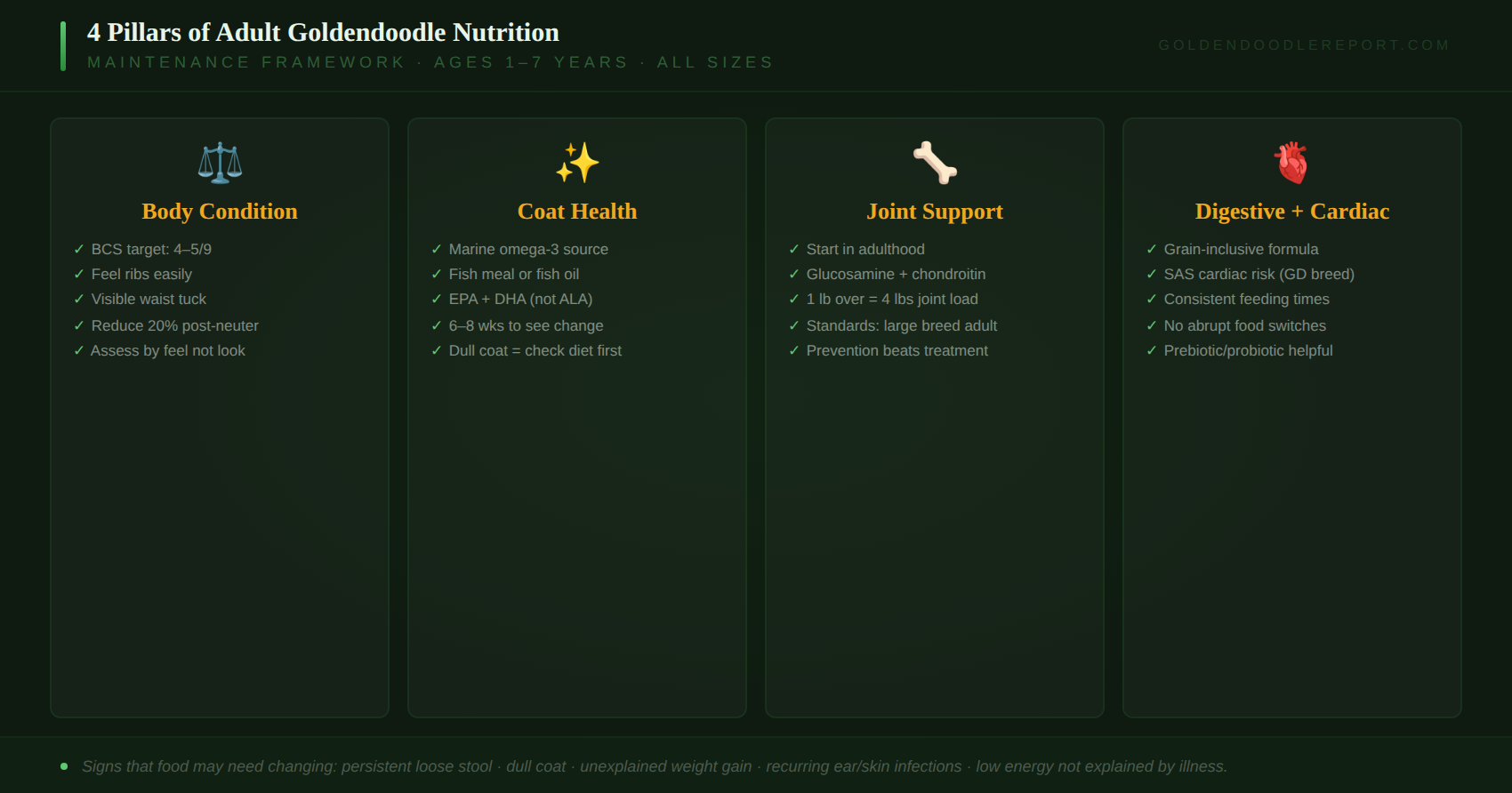
Body condition scoring is the most accurate method — the scale runs from 1 (severely underweight) to 9 (obese), with 4–5 being the healthy target. Run both hands along your dog’s ribcage with light pressure. You should feel individual ribs easily without pressing hard. Looking from above, there should be a clear waist tuck behind the ribcage. From the side, a slight abdominal tuck should be visible.
Goldendoodles’ thick coats mask weight gain visually. Always assess by feel, not appearance.
If your Goldendoodle is overweight
- Reduce daily food by 10% and reassess BCS after 3–4 weeks
- Switch to a lower calorie-density adult food rather than feeding very small portions of a high-density food
- Account for all treats in the daily calorie budget — treats are commonly the untracked source of excess calories
- Do not attempt more than 1–2% body weight loss per week — rapid weight loss in dogs causes muscle loss alongside fat loss
For detailed guidance: see our Goldendoodle Weight Management guide — coming soon in this category.

Dry Kibble vs Fresh vs Wet — What Works Best for Adults
The food type question for adult Goldendoodles has the same honest answer as for all life stages: a high-quality dry kibble from a WSAVA-meeting manufacturer is the right starting point for the vast majority of dogs. It is convenient, cost-effective, nutritionally validated, and has the strongest long-term safety track record.
When wet food or fresh food makes sense for adults
- Picky eaters: Some adult Goldendoodles go through phases of food disinterest — mixing a small amount of wet food into kibble typically resolves this without requiring a full diet change
- Poor hydration: Adult dogs who drink little water benefit from the moisture content of wet or fresh foods, which can reduce urinary tract and kidney strain
- Persistent digestive sensitivity: Some adults with chronic loose stool do significantly better on fresh-cooked diets (The Farmer’s Dog, Ollie, Nom Nom) — the minimal processing reduces the digestive burden
- Performance or working dogs: Goldendoodles used in competitive agility, therapy work, or very high-intensity activity may benefit from performance-formulated fresh or high-protein kibble
What to avoid regardless of food type
- Grain-free formulas high in legumes (peas, lentils as primary carbohydrates)
- Foods without AAFCO adult maintenance validation
- Foods from brands without a veterinary nutritionist on staff
- Frequent food switching — Goldendoodle digestive sensitivity means change should be deliberate and gradual, not reactive
What to Look for in a Brand
Three questions from the WSAVA Global Nutrition Guidelines that every owner should ask of any brand they are considering when choosing the best food for adult Goldendoodles:
- Do you employ a full-time board-certified veterinary nutritionist (PhD or DACVN)? If the answer is no or unclear, find a different brand.
- Do you conduct AAFCO feeding trials or rely only on nutrient profile calculations? Feeding trials are the stronger standard — the AAFCO statement wording tells you which applies.
- Do you manufacture your own food or use contract manufacturers? Brands that own their manufacturing facilities have more consistent quality control than those that outsource production.
Brands that consistently meet all three criteria and are widely recommended by veterinary nutritionists include: Purina Pro Plan, Hill’s Science Diet, Royal Canin, and Iams in the mainstream tier; Orijen, Acana, Merrick, and Canidae in the premium tier. All offer grain-inclusive adult formulas appropriate for Goldendoodles.
For the complete brand evaluation framework: Best Food for Goldendoodles.
Signs Your Adult Goldendoodle Needs a Food Change
Not every adult Goldendoodle will thrive on the same food. These are the signs that indicate the current diet may not be the right fit — and that it may be time to look for a better best food for adult Goldendoodle option:
- Persistent loose stool or gas despite consistent feeding — suggests the food’s ingredient profile is not well-tolerated by this dog’s digestive system
- Declining coat quality — dullness, brittleness, increased shedding or matting — often points to inadequate omega-3 content
- Gradual weight gain despite consistent portions — may indicate the food is more calorie-dense than the label suggests, or that the dog’s metabolism has changed (especially post-neutering)
- Low energy or lethargy not explained by illness or life changes — protein or calorie inadequacy, though rare in dogs on AAFCO-validated foods
- Itchy skin, paw licking, recurring ear infections — possible dietary allergy or sensitivity. See our Goldendoodle Food Allergies guide — coming soon in this category
- Food refusal lasting more than 48 hours — rule out illness first (vet visit), then consider that the food palatability may have declined (stale food, reformulation, or the dog has simply habituated to it)
When changing food, always use the 7-day transition protocol: 75/25 → 50/50 → 25/75 → 100% new food. Recalculate daily portions using the new food’s kcal/cup figure. For the complete transition protocol: Best Food for Goldendoodles.
🔑 Key Takeaways
- The best food for adult Goldendoodles meets 4 core criteria: AAFCO adult maintenance validation, named animal protein first, marine omega-3 source listed, and grain-inclusive formula
- Spaying or neutering reduces calorie requirement by 20–25% — adjust food portions immediately at the time of the procedure, not months later when weight gain has already occurred
- Body weight is the single most important joint health factor for Standard Goldendoodles — every pound over ideal weight adds approximately 4 lbs of joint stress during movement
- Coat quality problems in adult Goldendoodles are often dietary in origin — check the omega-3 source in the food before assuming it is a grooming issue
- Grain-inclusive adult formulas from brands meeting WSAVA criteria represent the best evidence-based choice for adult Goldendoodles given the breed’s cardiac predispositions
- Signs that a food change is needed include: persistent loose stool, declining coat quality, weight gain on consistent portions, and recurring skin or ear issues — always rule out medical causes with your vet first
📚 More Goldendoodle Food & Nutrition Guides
- How Much to Feed a Goldendoodle: Amounts by Age + Weight
- Goldendoodle Feeding Schedule: Meal Timing by Age (2026)
- Best Food for Goldendoodles: What Vets Recommend (2026)
- Best Puppy Food for Goldendoodles: Large vs Small Breed
- Goldendoodle Food Allergies: Signs, Triggers + What to Feed Instead — coming soon
- Goldendoodle Weight Management: How to Help an Overweight Dog Safely — coming soon
- Best Senior Food for Goldendoodles — coming soon
Browse all guides: Goldendoodle Food & Nutrition category
🔗 Related Guides Across the Site
- Goldendoodle Coat Types Explained — how diet affects adult coat texture and health
- Goldendoodle Matting Prevention — the weight and coat health connection
- Why Is My Goldendoodle Shedding So Much? — when shedding signals nutritional issues
- Goldendoodle Spring Allergies — distinguishing food vs environmental triggers
- Why Is My Goldendoodle Always Hungry? — when it is behaviour, not inadequate food
- Do Goldendoodles Smell Bad? — how diet contributes to odour issues
- Goldendoodle Exercise Needs by Age — how activity level affects adult calorie requirements
Frequently Asked Questions
When should I switch my Goldendoodle from puppy food to adult food?
Mini Goldendoodles (15–30 lbs): at 10–12 months. Medium Goldendoodles (30–45 lbs): at 12–15 months. Standard Goldendoodles (45–80 lbs): at 15–18 months. The switch should happen over 7 days — 75% old/25% new, progressing to 100% new food by day 7. Always recalculate daily portions using the new food’s kcal/cup after switching — adult food is typically less calorie-dense than puppy food, which changes the appropriate cup volume.
How much should I feed my adult Goldendoodle per day?
It depends on their size, the calorie density of the specific food, and their activity level. As a general starting point using food at approximately 380 kcal/cup: Mini (15–25 lbs) needs 1–1¾ cups/day; Medium (30–45 lbs) needs 2–2¾ cups/day; Standard (45–65 lbs) needs 2¾–3½ cups/day. Always check the kcal/cup on your specific food and use body condition scoring to confirm the amount is right for your individual dog. Full portion guide: How Much to Feed a Goldendoodle.
Is grain-free food OK for adult Goldendoodles?
The more cautious recommendation for Goldendoodles specifically is grain-inclusive. The FDA investigation into a possible link between grain-free diets high in legumes and dilated cardiomyopathy (DCM) remains ongoing. Goldendoodles inherit cardiac predispositions (subvalvular aortic stenosis, SAS) from both parent breeds. Given this, choosing a grain-inclusive food removes a potential risk with no nutritional downside. For the full grain-free discussion: Best Food for Goldendoodles.
My adult Goldendoodle has been gaining weight — what should I do?
First, confirm the weight gain is real using body condition scoring (not just visual assessment — Goldendoodle coats mask weight gain). Then check: has the dog been recently spayed or neutered? Has activity decreased? Are treats being accounted for? As a first step, reduce daily food by 10% and reassess BCS in 3–4 weeks. If weight gain persists, switch to a lower calorie-density adult food. For detailed guidance: see our Goldendoodle Weight Management guide — coming soon in this category.
Should I add supplements to my adult Goldendoodle’s food?
If feeding an AAFCO-validated food from a reputable manufacturer, additional supplementation is generally not necessary and risks over-supplementation of certain nutrients. The exception is omega-3 fatty acids — if the food does not list a marine omega-3 source and your dog’s coat quality is poor, a fish oil supplement at your vet’s recommended dose is a reasonable addition. Joint supplements (glucosamine/chondroitin) may be worth discussing with your vet for Standard Goldendoodles over 4–5 years old, particularly if showing any early stiffness.
How do I know if my adult Goldendoodle’s food is the right quality?
When evaluating the best food for adult Goldendoodles, check four things: (1) AAFCO adult maintenance statement present on the bag, (2) named animal protein as the first ingredient, (3) the manufacturer employs a full-time veterinary nutritionist (check their website), and (4) the food is grain-inclusive. If all four are met, it is a quality food. Marketing language (“holistic,” “ancestral,” “natural”) tells you nothing — focus on these four criteria. For the complete evaluation framework: Best Food for Goldendoodles.
Disclaimer: The information in this article is provided for general educational purposes only. King James Adjei is a researcher and enthusiast, not a veterinarian or certified veterinary nutritionist. Goldendoodles with diagnosed health conditions including allergies, joint disease, heart disease, kidney disease, or obesity may require a therapeutic diet — always follow your veterinarian’s specific guidance. Do not make significant dietary changes for a dog with known health conditions without veterinary consultation.