Affiliate Disclosure: Some links in this guide are affiliate links. If you purchase through them, we may earn a small commission at no extra cost to you. This does not influence our recommendations. Read our full affiliate disclaimer here.
By King James Adjei — Researcher and Goldendoodle enthusiast, founder of GoldendoodleReport.com. Every guide on this site is carefully researched and written to give owners reliable, clearly organised information. → About this site
🩺 Veterinary guidance note: Puppy nutrition during the growth phase directly affects skeletal development and long-term joint health. The food type (large breed vs standard puppy formula) is a medical decision, not just a marketing one. Always confirm your choice with your vet at the first puppy appointment.
📖 9-minute read | Last updated May 2026 | Reviewed for accuracy
✅ Quick Answer
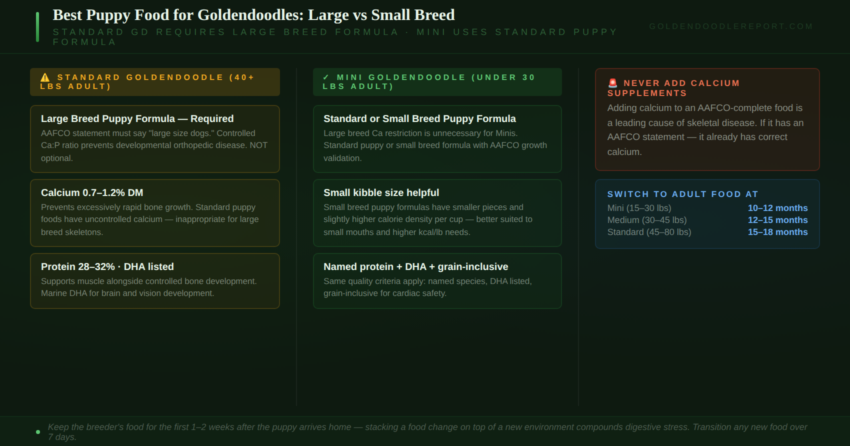
Standard Goldendoodles (expected adult weight over 40 lbs) must be fed a large breed puppy formula — not a regular puppy food. The AAFCO statement must specifically mention “large size dogs.” This is not a preference; it is a health requirement. Mini Goldendoodles (under 30 lbs adult) can use a standard or small breed puppy formula. In both cases: named animal protein as the first ingredient, DHA listed, grain-inclusive formula, and AAFCO validation are the non-negotiables. Feed the same brand the breeder used for the first 1–2 weeks to avoid digestive upset during the adjustment period.
Finding the best puppy food for Goldendoodles comes down to one critical factor most first-time owners miss: matching the formula to the dog’s expected adult size. The single most common feeding mistake made with Goldendoodle puppies is using the wrong food type for the dog’s size. A Standard Goldendoodle fed regular puppy food — or worse, adult food — during the growth phase faces a meaningfully elevated risk of developmental orthopedic disease. This is not a minor quality difference between premium and budget brands. It is a structural difference in the food’s calcium and phosphorus levels that directly affects how the skeleton develops.
At the same time, a Mini Goldendoodle does not need a large breed formula and may actually be over-restricted on certain nutrients if fed one. The breed name “Goldendoodle” covers dogs that will range from 15 to 80 lbs at adulthood — they are not the same dog nutritionally during puppyhood.
This guide separates the two size categories clearly, explains what each needs and why, and gives you a framework for evaluating any puppy food against the criteria that matter.
👤 Who This Guide Is For
- You are getting a puppy and want to know how to choose the best puppy food for Goldendoodles before it arrives
- Your breeder sent your puppy home on a food and you want to know whether it is appropriate
- You have a Standard Goldendoodle on regular puppy food and want to know if you need to switch
- You are unsure whether your Goldendoodle counts as “large breed” for food purposes
📊 Quick Facts — Goldendoodle Puppy Nutrition
- Large breed dogs fed excessive calcium during growth face elevated risk of developmental orthopedic disease — the AAFCO large breed formula requirement exists specifically to prevent this
- DHA (docosahexaenoic acid) is an omega-3 fatty acid critical for brain and vision development in puppies — it should be listed on any quality puppy food
- A Standard Goldendoodle puppy requires approximately twice the calories per pound of body weight compared to an adult of the same size
- The transition window from puppy to adult food is one of the highest-risk periods for weight gain — many Goldendoodles gain excess weight when owners continue puppy food past 15–18 months or switch adult portions without recalculating
- Most reputable breeders use one of a handful of veterinarian-endorsed puppy foods — matching that food for the first 1–2 weeks avoids stacking a dietary change on top of the stress of a new home
📋 Table of Contents
- Why Your Goldendoodle’s Adult Size Changes Everything
- Standard Goldendoodles: Large Breed Puppy Formula
- Mini Goldendoodles: Standard Puppy Formula
- What to Look For in the Best Puppy Food for Goldendoodles
- What to Avoid
- Should You Keep Using the Breeder’s Food?
- How Much to Feed a Goldendoodle Puppy
- When to Switch to Adult Food
- How to Transition Puppy Foods
- Coat Development and Puppy Nutrition
- Frequently Asked Questions
Why Your Goldendoodle’s Adult Size Changes Everything
The word “Goldendoodle” refers to a cross between a Poodle and a Golden Retriever, but the Poodle parent can be a Standard, Miniature, or Toy Poodle — producing adult dogs that vary enormously in size. This matters for puppy food selection because the growth rate and skeletal development timeline differ significantly between a 20 lb adult and a 65 lb adult.
The calcium-phosphorus ratio problem
During rapid growth, large breed dogs are uniquely vulnerable to the effects of excess dietary calcium. Unlike small dogs, large breed puppies cannot adequately regulate how much calcium they absorb from food — their absorption mechanism is passive rather than demand-driven. When calcium intake is high, large breed puppies absorb and deposit more calcium than the skeletal development timeline requires. This can cause abnormally rapid bone growth, leading to developmental orthopedic diseases including osteochondrosis, hypertrophic osteodystrophy, and worsened hip dysplasia outcomes.
Large breed puppy formulas are specifically formulated with controlled calcium levels (typically 0.7–1.2% dry matter basis) to prevent this. Standard adult puppy foods are formulated for the average dog — their calcium levels are appropriate for small dogs but potentially harmful for large breed puppies fed over extended periods.
Determining which category your Goldendoodle falls into
| Goldendoodle Type | Expected Adult Weight | Puppy Food Required | AAFCO Statement Must Include |
|---|---|---|---|
| Mini Goldendoodle | 15–30 lbs | Standard or small breed puppy formula | “Growth” or “All life stages” |
| Medium Goldendoodle | 30–45 lbs | Large breed puppy formula recommended | “Large size dogs” in growth statement |
| Standard Goldendoodle | 45–80 lbs | Large breed puppy formula — required | “Large size dogs” — non-negotiable |
If you are unsure what size your puppy will be at adulthood, ask the breeder for the parents’ weights and a growth projection. Your vet can also assess growth plate development at the first appointment and advise on food type. For the full first puppy vet visit: Goldendoodle Puppy First Vet Visit.
📖 Real Scenario
A Standard Goldendoodle puppy comes home at 8 weeks on a well-known standard puppy food chosen by the breeder. The owner reads online that the food is well-reviewed and continues it for the full 12 months. At 10 months the puppy starts showing intermittent lameness in the left hind leg. X-rays reveal osteochondrosis of the left stifle (knee). The vet asks about diet history. The food was nutritionally complete but not formulated for large breed growth — its calcium content was appropriate for small dogs, not for a 55 lb growing dog. This is not a rare outcome. It is one of the most common preventable developmental orthopedic conditions in large breed puppies, and diet is a contributing factor.
Standard Goldendoodles: Large Breed Puppy Formula
The best puppy food for Goldendoodles in the Standard size category is always a large breed formula. If your Goldendoodle is expected to reach 40 lbs or more at adulthood, you must feed a large breed puppy formula from the time they arrive home until they are fully grown — typically 15–18 months for Standards.
What the AAFCO statement must say
According to the Association of American Feed Control Officials (AAFCO), which sets the nutritional standards for commercial pet food, look for one of these exact formulations on the label:
- “Complete and balanced nutrition for growth of large size dogs (70 lbs or more as an adult)”
- “Complete and balanced for all life stages including growth of large size dogs”
If the AAFCO statement says “for all life stages” without mentioning large size dogs, it is not a large breed formula. If it says “for growth” without the large size qualification, it is not a large breed formula. Do not assume — read the exact wording.
Nutrient criteria for large breed puppy formulas
- Calcium: 0.7–1.2% dry matter (DM) — controlled to prevent excessive skeletal growth rate
- Phosphorus: Calibrated to maintain appropriate Ca:P ratio (typically 1.1:1 to 1.8:1)
- Protein: 28–32% DM — to support muscle development alongside controlled bone growth
- Fat: 12–18% DM — adequate for energy without promoting obesity
- DHA: Listed — supports brain and vision development
- Grain-inclusive: Given Goldendoodle cardiac predispositions (see our Best Food for Goldendoodles guide for the grain-free DCM discussion)
Brands consistently meeting large breed puppy criteria
Veterinary nutritionists consistently recommend brands that employ full-time PhD nutritionists and conduct feeding trials (WSAVA criteria). For large breed puppy formulas, the following brands consistently meet these criteria: Hill’s Science Diet Large Breed Puppy, Purina Pro Plan Large Breed Puppy, Royal Canin Large Breed Puppy. These are not exciting brand names, but they have the best safety and efficacy track records for large breed puppy development.
Mini Goldendoodles: Standard Puppy Formula
The best puppy food for Goldendoodles in the Mini size category is a standard or small breed puppy formula — not a large breed formula. Mini Goldendoodles (expected adult weight under 30 lbs) do not need a large breed formula and may actually be over-restricted on certain nutrients if fed one. Large breed formulas intentionally restrict calcium — this restriction is beneficial for large dogs but unnecessary and potentially marginal for small dogs who have a more regulated calcium absorption mechanism.
What to look for in a Mini Goldendoodle puppy food
- AAFCO statement for growth (without large dog restriction requirement)
- Named animal protein as first ingredient
- DHA listed — still important for brain development in small dogs
- Small breed or toy/mini formula consideration: Some brands offer small breed puppy formulas with smaller kibble size and slightly higher calorie density per cup — useful for Minis who need more calories per pound of body weight than larger dogs
- Grain-inclusive (same cardiac reasoning applies regardless of size)
For Mini Goldendoodle portion guidance: How Much to Feed a Goldendoodle — the puppy table includes Mini-specific weight ranges.
What to Look For in the Best Puppy Food for Goldendoodles
Regardless of size, these 6 criteria apply when evaluating the best puppy food for Goldendoodles. A food that clears all 6 boxes meets the standard recommended by the World Small Animal Veterinary Association (WSAVA) Global Nutrition Guidelines — the most widely cited international framework for evaluating commercial pet food quality.
| Criterion | What It Means | Where to Check |
|---|---|---|
| AAFCO statement | Correct life stage + size category validated | Back of bag — small print near feeding guidelines |
| Named protein first | “Chicken,” “Salmon” — named species, not “poultry” | Ingredient list — first ingredient |
| DHA listed | Brain and vision development — essential for puppies | Ingredient list or nutrient highlights |
| Vet nutritionist on staff | Brand employs PhD nutritionist full-time (WSAVA criterion) | Manufacturer’s website |
| Feeding trials conducted | Food tested in real animals, not just calculated | AAFCO statement wording or manufacturer site |
| Grain-inclusive | Brown rice, oats, barley present — not legume-heavy | Ingredient list — first 5–10 ingredients |
What to Avoid in Goldendoodle Puppy Food
- Regular adult food — nutritionally imbalanced for puppies in protein, fat, calcium, and calorie density. Not a cost-saving measure worth the risk.
- Regular puppy food for Standard Goldendoodles — as explained above, the calcium levels are inappropriate for large breed growth
- Grain-free formulas — the DCM/legume risk is relevant for puppies as well as adults, particularly given Goldendoodle cardiac predispositions
- Supplements added on top of a complete puppy food — adding calcium supplements to an already AAFCO-complete large breed formula raises calcium to potentially harmful levels. Do not supplement unless your vet specifically directs you to
- Homemade diets as the sole puppy diet — puppy nutritional requirements are more precise than adult requirements. The vast majority of homemade recipes lack essential nutrients for puppies unless formulated by a board-certified veterinary nutritionist
- Frequent brand switching — Goldendoodle puppies have sensitive digestive systems. Find a food that meets the criteria and stay on it through the puppy stage
🚨 Do not add calcium supplements to a complete puppy food. This is one of the most well-documented causes of developmental orthopedic disease in large breed puppies. If a food is AAFCO-validated as complete and balanced, it already contains appropriate calcium. Adding more causes over-supplementation. The only exception is if your veterinarian specifically prescribes a supplement for a diagnosed deficiency.
Should You Keep Using the Breeder’s Food?
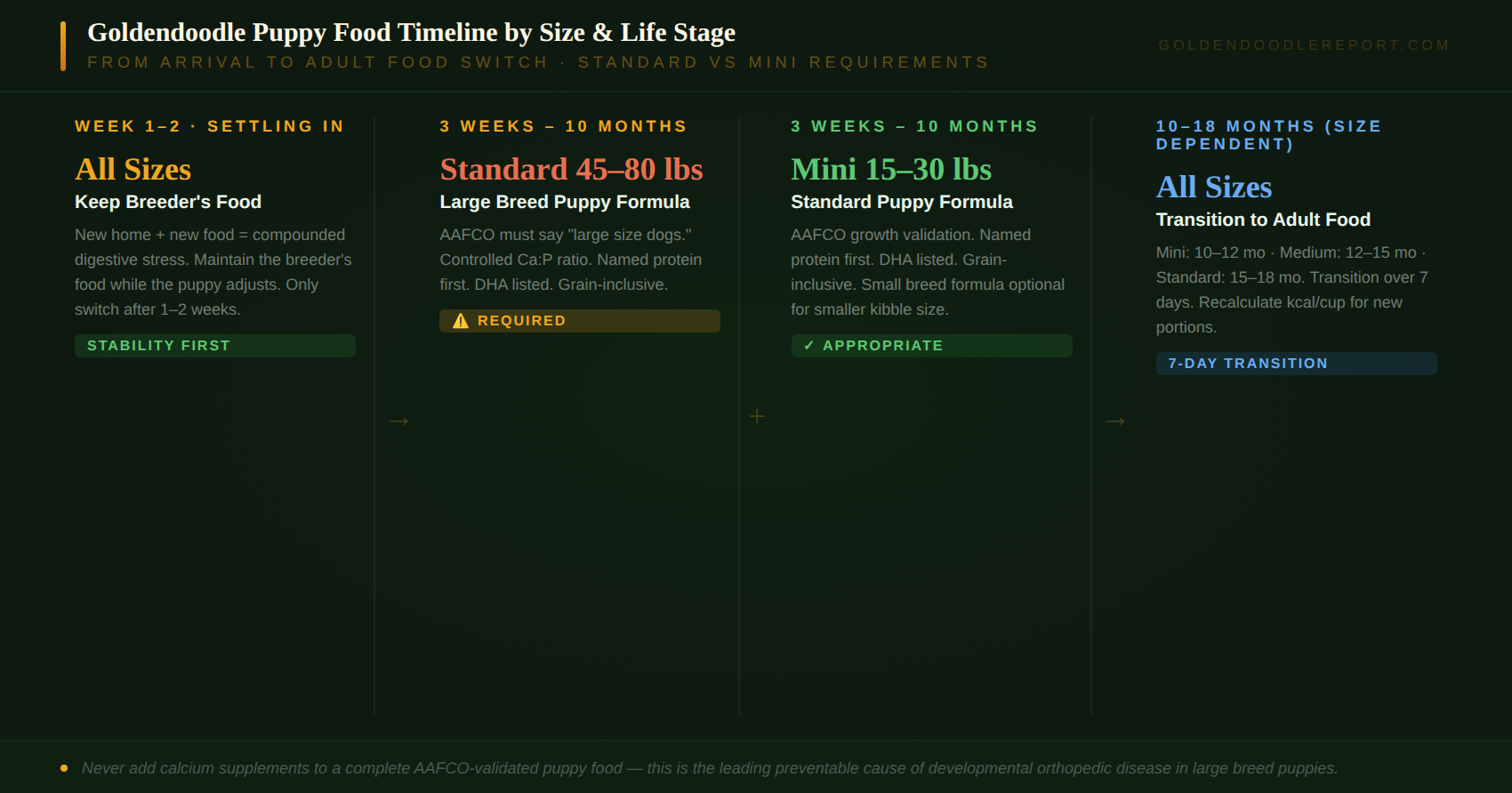
Most reputable breeders send puppies home on a good quality puppy food and include a supply of it or a food type recommendation. The standard guidance is to continue the breeder’s food for at least the first 1–2 weeks before making any changes.
Why this matters: A puppy that is simultaneously adjusting to a new home, new people, new sleeping arrangements, and new food is being asked to cope with too many changes at once. The digestive upset from a food change (loose stool, vomiting, food refusal) adds stress at an already stressful time. Keeping the food consistent removes one variable from the adjustment period.
When you should switch despite the breeder’s food:
- The breeder used a regular puppy food for your Standard Goldendoodle — after the 1–2 week settling period, switch to a large breed formula
- The food does not have an AAFCO nutritional adequacy statement
- The food is grain-free and you prefer to follow the more cautious guidance for Goldendoodles
- Your vet identifies a specific concern with the food at the first appointment
For the full puppy settling-in context: First Week With a Goldendoodle Puppy and Goldendoodle Puppy First Night at Home.
How Much to Feed a Goldendoodle Puppy
The amount to feed depends on the puppy’s current weight, the food’s calorie density, and their age. General starting points:
- 8–12 weeks: ¾–1¼ cups per day (at ~380–400 kcal/cup), split across 3–4 meals
- 3–6 months: 1–2½ cups per day depending on size, 3 meals
- 6–12 months: 1½–3½ cups per day depending on size, transitioning to 2 meals
Always check the kcal/cup on your specific food — calorie density varies by up to 65% between brands at the same cup volume. For the full portion guide with size-specific tables: How Much to Feed a Goldendoodle.
For daily timing and meal frequency: Goldendoodle Feeding Schedule.
When to Switch from Puppy to Adult Food
Switching too early means cutting off the nutritional support for a still-growing skeleton. Switching too late means continuing a higher-calorie, higher-protein puppy food to an adult dog that no longer needs those levels — contributing to weight gain.
| Size | Switch to Adult Food At | Sign They’re Ready |
|---|---|---|
| Mini (15–30 lbs) | 10–12 months | Weight has plateaued for 4+ weeks |
| Medium (30–45 lbs) | 12–15 months | Vet confirms growth plates closing on X-ray |
| Standard (45–80 lbs) | 15–18 months | Weight plateaued, growth plates closed (vet confirmed) |
⚠️ Do not start the transition during a stressful period — new home, illness, travel, or a major routine change. Wait for a settled 2-week window and follow the 7-day transition protocol. Recalculate portions using the adult food’s kcal/cup figure immediately after switching — puppy food is more calorie-dense per cup than most adult foods. See our How Much to Feed a Goldendoodle guide for adult portion calculation.
How to Transition Between Puppy Foods or to Adult Food
Whether switching brands of puppy food or transitioning to adult food, use the same 7-day protocol:
- Days 1–2: 75% old food, 25% new food
- Days 3–4: 50% old food, 50% new food
- Days 5–6: 25% old food, 75% new food
- Day 7+: 100% new food
Mild loose stool on days 2–4 is expected. Persistent diarrhoea, vomiting, or food refusal beyond day 5 suggests the new food is not agreeing with your puppy — pause and consult your vet. For the full transition guide and what to watch for: Best Food for Goldendoodles.
Coat Development and Puppy Nutrition
Goldendoodle puppies go through a coat transition between approximately 6 and 18 months — the soft puppy coat gives way to the adult coat with its characteristic wavy or curly texture. During this transition, the diet plays a direct role in how the adult coat develops.
Omega-3 fatty acids — specifically DHA and EPA from marine sources — support the development of the skin barrier and coat texture during this critical window. A puppy food that lists fish meal or fish oil as an ingredient typically delivers a better omega-3 profile than one relying entirely on plant-based fats. A Goldendoodle puppy fed a diet deficient in omega-3s during the coat transition period often develops a dull, dry adult coat that is harder to maintain and more prone to matting.
For more on coat development and what affects it long-term: Goldendoodle Coat Types Explained. For how coat care and grooming fit into the puppy stage: Goldendoodle Puppy First Grooming Guide.
🔑 Key Takeaways
- The best puppy food for Goldendoodles in the Standard size category (40+ lbs adult) is always a large breed formula — the AAFCO statement must explicitly mention “large size dogs.” This is a health requirement, not a marketing preference
- Mini Goldendoodles (under 30 lbs adult) can use a standard or small breed puppy formula — the large breed calcium restriction is unnecessary and potentially limiting for small dogs
- Never add calcium supplements to a complete AAFCO-validated puppy food — this is one of the leading causes of developmental orthopedic disease in large breed puppies
- Keep your puppy on the breeder’s food for the first 1–2 weeks after arriving home — transitioning food during the already-stressful settling-in period compounds digestive and behavioural adjustment
- Switch to adult food at 10–12 months (Mini), 12–15 months (Medium), or 15–18 months (Standard) — not all at once, but over 7 days with a gradual mix
- Omega-3 fatty acids in puppy food directly affect coat development during the 6–18 month transition period — fish meal or fish oil as a listed ingredient significantly improves adult coat quality
📚 More Goldendoodle Food & Nutrition Guides
- How Much to Feed a Goldendoodle: Amounts by Age + Weight
- Goldendoodle Feeding Schedule: Meal Timing by Age (2026)
- Best Food for Goldendoodles: What Vets Recommend (2026)
- Goldendoodle Food Allergies: Signs, Triggers + What to Feed Instead — coming soon
- Goldendoodle Sensitive Stomach: 5 Foods That Actually Help — coming soon
- Goldendoodle Weight Management: How to Help an Overweight Dog Safely — coming soon
Browse all guides: Goldendoodle Food & Nutrition category
🔗 Related Guides Across the Site
- Goldendoodle Puppy Care Guide — complete first-year care including nutrition
- Goldendoodle Puppy First Vet Visit — confirm food choice at the first appointment
- First Week With a Goldendoodle Puppy — keeping the breeder’s food during settling in
- Goldendoodle Puppy First Night at Home — managing the first days including feeding
- Goldendoodle Puppy Growth Stages — the growth timeline that determines when to switch foods
- Goldendoodle Coat Types Explained — how puppy nutrition affects adult coat development
- Goldendoodle Puppy First Grooming Guide — grooming in context of the puppy stage
- Goldendoodle Puppy Deworming Guide — parasites interfering with nutrient absorption
Frequently Asked Questions
Does my Goldendoodle puppy need large breed puppy food?
If your Goldendoodle is expected to reach 40 lbs or more at adulthood — which includes all Standard Goldendoodles and most Mediums — yes, a large breed puppy formula is required. The AAFCO statement on the bag must mention “large size dogs.” This is a structural nutritional requirement related to calcium levels during skeletal development, not a premium upsell. Mini Goldendoodles under 30 lbs do not need a large breed formula. When in doubt, the best puppy food for Goldendoodles of uncertain adult size is always a large breed formula — the controlled calcium cannot harm a medium dog, but uncontrolled calcium can harm a large one.
What if I am not sure whether my Goldendoodle is mini or standard?
Ask your breeder for the parents’ weights — this gives the most accurate prediction of adult size. If either parent is a Standard Poodle or the dog is expected to exceed 40 lbs, use a large breed puppy formula. If genuinely unsure, err toward the large breed formula — the controlled calcium levels are not harmful to a medium-sized dog, but the uncontrolled calcium in a standard formula can be harmful to a large breed puppy. Your vet can also assess growth trajectory at the first appointment.
Can I feed my puppy the same food as my adult Goldendoodle?
No. Adult food does not meet the nutritional requirements for growing puppies — particularly in protein, fat, and the specific nutrient ratios needed for rapid development. Puppies fed adult food consistently show slower growth, weaker immune response, and in large breeds, potential calcium-related skeletal issues. Keep puppies on an appropriate puppy food until the adult size transition point.
Is raw food safe for Goldendoodle puppies?
Raw diets are not recommended for puppies without explicit veterinary nutritionist guidance. Puppies have developing immune systems that are more vulnerable to bacterial contamination (Salmonella, Listeria, E. coli) found in raw meat. The nutritional balance of raw diets is also harder to maintain for rapidly growing puppies than for adults. If you are committed to raw feeding, consult a board-certified veterinary nutritionist before starting and follow strict food-safety protocols throughout.
How long should I feed puppy food?
Mini Goldendoodles: 10–12 months. Medium Goldendoodles: 12–15 months. Standard Goldendoodles: 15–18 months. The transition should happen over 7 days — not abruptly. Your vet can confirm the right timing based on growth plate assessment at routine appointments. When in doubt, extending the puppy food phase by 1–2 months is less harmful than switching too early.
Should I add omega-3 supplements to my puppy’s food?
If the best puppy food for Goldendoodles you have chosen already contains fish meal or fish oil and is AAFCO-validated, additional supplementation is typically not necessary. If the food relies entirely on plant-based fat sources without marine omega-3s, a small amount of fish oil (ask your vet for the appropriate dose for your puppy’s weight) can improve coat development during the 6–18 month coat transition period. Do not add omega-3 supplements without confirming dosage — too much can cause digestive upset and may interfere with fat-soluble vitamin absorption at very high doses.
Disclaimer: The information in this article is provided for general educational purposes only. King James Adjei is a researcher and enthusiast, not a veterinarian or certified veterinary nutritionist. Puppy nutritional requirements are precise and size-dependent — always confirm food type and portion guidance with your veterinarian at the first puppy appointment. Do not add supplements to a complete AAFCO-validated puppy food without veterinary instruction.