Affiliate Disclosure: Some links in this guide are affiliate links. If you purchase through them, we may earn a small commission at no extra cost to you. This does not influence our recommendations. Read our full affiliate disclaimer here.
By King James Adjei — Researcher and Goldendoodle enthusiast, founder of GoldendoodleReport.com. Every guide on this site is carefully researched and written to give owners reliable, clearly organised information. → About this site
🩺 Veterinary guidance note: Sudden changes in water intake — significantly more or less than usual — can indicate underlying medical conditions including diabetes, kidney disease, Cushing’s disease, and urinary tract infections. If your Goldendoodle’s drinking habits change noticeably without an obvious cause (heat, exercise, diet change), consult your vet. This guide covers normal hydration ranges and common influencing factors, not diagnosis of medical conditions.
📖 7-minute read | Last updated May 2026 | Reviewed for accuracy
✅ Quick Answer
A healthy Goldendoodle should drink approximately 1 ounce (30 ml) of water per pound of body weight per day under normal conditions. A 50 lb Standard Goldendoodle needs roughly 50 oz (about 1.5 litres) daily. A 20 lb Mini Goldendoodle needs approximately 20 oz (about 600 ml). These are baseline figures — actual needs increase significantly during hot weather, after exercise, when eating dry kibble, and during illness. Puppies and nursing dogs need proportionally more. Fresh water should be available at all times and the bowl refilled and cleaned daily.
How much water should a Goldendoodle drink each day? More than most owners realise — water is the most important nutrient your Goldendoodle consumes every day — more essential than protein, fat, or any vitamin. Even mild dehydration (as little as 2% below optimal hydration) impairs cognitive function, physical performance, and digestive efficiency in dogs. Yet water intake is one of the most overlooked aspects of canine nutrition.
Most owners know they should provide fresh water at all times. Fewer know how much their specific dog should actually be drinking, what factors significantly change that amount, what the warning signs of dehydration look like, or when drinking more than usual signals a health problem rather than just a thirsty dog.
This guide covers all of it — with specific daily amounts for every Goldendoodle size, the factors that change those amounts, and a practical checklist for assessing hydration at home.
👤 Who This Guide Is For
- You want to know if your Goldendoodle is drinking the right amount each day
- Your Goldendoodle seems to drink very little and you are concerned about dehydration
- Your Goldendoodle is drinking noticeably more than usual and you want to know if this is a concern
- You have a new puppy and want to understand their water needs from day one
📊 Quick Facts — Goldendoodle Hydration
- Water makes up approximately 60–70% of an adult dog’s body weight — maintaining this balance is critical for organ function, temperature regulation, and nutrient transport
- Dogs lose water through panting, urination, defecation, and evaporation — panting is by far the most significant source of water loss, which is why hot weather and exercise dramatically increase intake needs
- Dogs fed exclusively dry kibble typically drink more water than dogs fed wet food or fresh-cooked diets — wet food is approximately 70–80% water and contributes meaningfully to daily hydration
- Puppies under 3 months need proportionally more water than adults — approximately 0.5 oz per pound per half-day, or roughly twice the adult rate per pound of body weight
- Polydipsia (excessive thirst) — drinking significantly more than the 1 oz/lb/day baseline — is one of the most reliable early indicators of diabetes, kidney disease, Cushing’s disease, and several other medical conditions in dogs
📋 Table of Contents
- Daily Water Amounts by Weight and Size
- Factors That Increase Water Needs
- Puppy Water Requirements
- Signs of Dehydration
- The Home Dehydration Test
- When Too Much Water Is a Warning Sign
- My Goldendoodle Won’t Drink — What to Do
- Water Quality and Bowl Hygiene
- How Food Type Affects Water Intake
- Frequently Asked Questions
How Much Water Should a Goldendoodle Drink? Amounts by Weight and Size
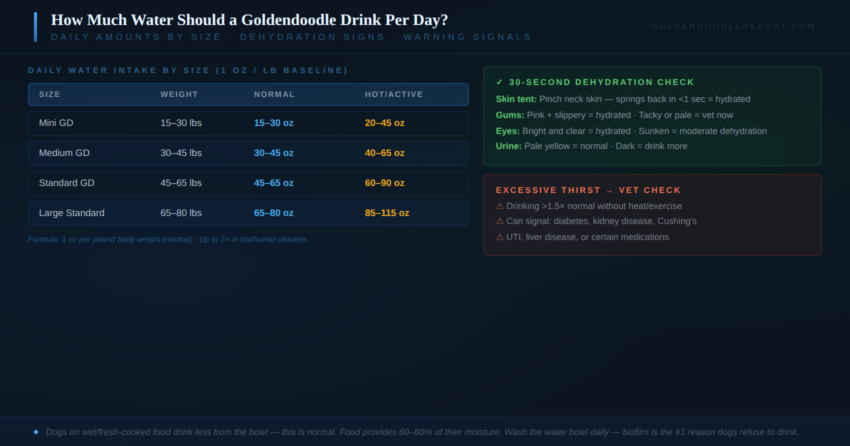
The standard veterinary guideline for healthy adult dogs is approximately 1 oz (30 ml) of water per pound (0.45 kg) of body weight per day under normal conditions (moderate temperature, moderate activity, dry food diet).
| Goldendoodle Size | Adult Weight | Daily Water (Normal) | Daily Water (Hot / Active) |
|---|---|---|---|
| Mini Goldendoodle | 15–30 lbs | 15–30 oz (450–900 ml) | 20–45 oz (600 ml–1.3 L) |
| Medium Goldendoodle | 30–45 lbs | 30–45 oz (900 ml–1.3 L) | 40–65 oz (1.2–1.9 L) |
| Standard Goldendoodle | 45–65 lbs | 45–65 oz (1.3–1.9 L) | 60–90 oz (1.8–2.7 L) |
| Large Standard | 65–80 lbs | 65–80 oz (1.9–2.4 L) | 85–115 oz (2.5–3.4 L) |
Important context: These are daily baseline targets, not fixed requirements. A dog’s actual intake will fluctuate based on the factors below. What matters is that fresh water is available at all times and that you develop a sense of your dog’s normal drinking pattern — which allows you to notice deviations that may warrant attention.
📖 Real Scenario
A 55 lb Standard Goldendoodle lives in Accra, Ghana where temperatures regularly reach 32°C (90°F). His owner reads the “1 oz per pound” baseline — 55 oz per day — and notes that the dog drinks considerably more than this on hot afternoons. Is this a problem? No. In tropical heat, a large-breed dog’s water needs can increase by 50–100% above the baseline. The dog is regulating temperature through panting, which creates significant water loss. The appropriate response is to ensure the water bowl is large enough, refilled frequently, and that shade and rest are available. The baseline is a guide for normal conditions — hot climates and active dogs regularly and appropriately exceed it.
Factors That Increase Water Needs
Hot weather and humidity
Dogs cool themselves almost entirely through panting — they have very limited ability to sweat. Panting evaporates large amounts of water from the respiratory tract. In hot or humid conditions, water needs can increase by 50–100% above the baseline. During Ghanaian dry season peaks or any period of sustained heat above 28°C (82°F), ensure water is available in multiple locations and check the bowl frequently. See our Goldendoodle Summer Care Guide for full heat management including hydration.
Exercise
A 30-minute vigorous walk or play session significantly increases water needs. Offer water before, during (for sessions over 20 minutes), and after exercise. Do not wait for the dog to show thirst signals — by the time a dog is visibly thirsty, mild dehydration has already begun. For exercise guidance across ages: Goldendoodle Exercise Needs by Age.
Dry kibble diet
Dry kibble contains approximately 8–12% moisture — far less than the natural prey diet or fresh food. Dogs on an exclusive dry kibble diet must obtain the majority of their daily water from their bowl. Dogs eating fresh-cooked or wet food receive substantial moisture from their food and typically drink less from their bowl — this is normal and not a concern.
Illness and fever
Fever, vomiting, and diarrhoea all increase water loss significantly. A dog recovering from illness, or showing signs of illness, should have water available at all times and intake monitored carefully. Vomiting and diarrhoea together can cause rapid dehydration — particularly dangerous in puppies. For digestive illness: Goldendoodle Sensitive Stomach Food.
Pregnancy and nursing
Pregnant Goldendoodles in the third trimester and nursing mothers need significantly more water than their normal baseline — nursing mothers can require 2–3x their normal intake to support milk production. Ensure constant, unrestricted access during these periods.
High-sodium or high-protein foods
Foods high in salt or protein require more water for processing and elimination. Table scraps — particularly processed human food — are disproportionately high in sodium and will increase a dog’s thirst noticeably. This is one of several reasons table scraps are not appropriate for Goldendoodles.
Puppy Water Requirements
Puppies have different hydration needs than adults and carry higher dehydration risk for several reasons: their bodies contain a higher proportion of water, they regulate temperature less efficiently, and they lose water faster relative to body size.
Very young puppies (under 3–4 weeks)
Puppies under weaning age obtain all their water from mother’s milk. They should not be given separate water during this period unless specifically directed by a vet.
Weaning to 12 weeks
Once puppies begin eating solid food (typically from 3–4 weeks), fresh water should be available in a shallow bowl they can access without risk of falling in. The water requirement is approximately ½ oz per pound of body weight every half day — more frequent, smaller amounts than adults. A 10 lb puppy needs approximately 10 oz (300 ml) total per day, preferably accessed across 3–4 water sessions.
3–6 months
Puppies in this phase should have constant water access. They will drink frequently and in small amounts relative to their size. Do not restrict water access except for 1–2 hours before bedtime to reduce overnight accidents during toilet training — even then, ensure they have a full drink before the overnight water restriction.
⚠️ Never restrict water to manage toilet training accidents in puppies. Restricting water causes dehydration in young puppies, which is dangerous. The correct approach to overnight accidents is taking the puppy out immediately before bed, not restricting their water intake. See Goldendoodle Puppy Sleep Schedule for the full overnight routine.
For the complete puppy first-year care context including feeding and water: Goldendoodle Puppy Care Guide.
Signs of Dehydration in Goldendoodles
According to Wikipedia’s overview of dehydration, even mild fluid loss impairs circulatory and organ function before more visible symptoms appear — which is why early signs are easy to miss in a well-coated breed like the Goldendoodle.
Dehydration in dogs progresses in stages — mild dehydration is difficult to detect visually but has measurable effects on function. Moderate and severe dehydration show clear physical signs. Learn these so you can act early rather than only when the situation is serious.
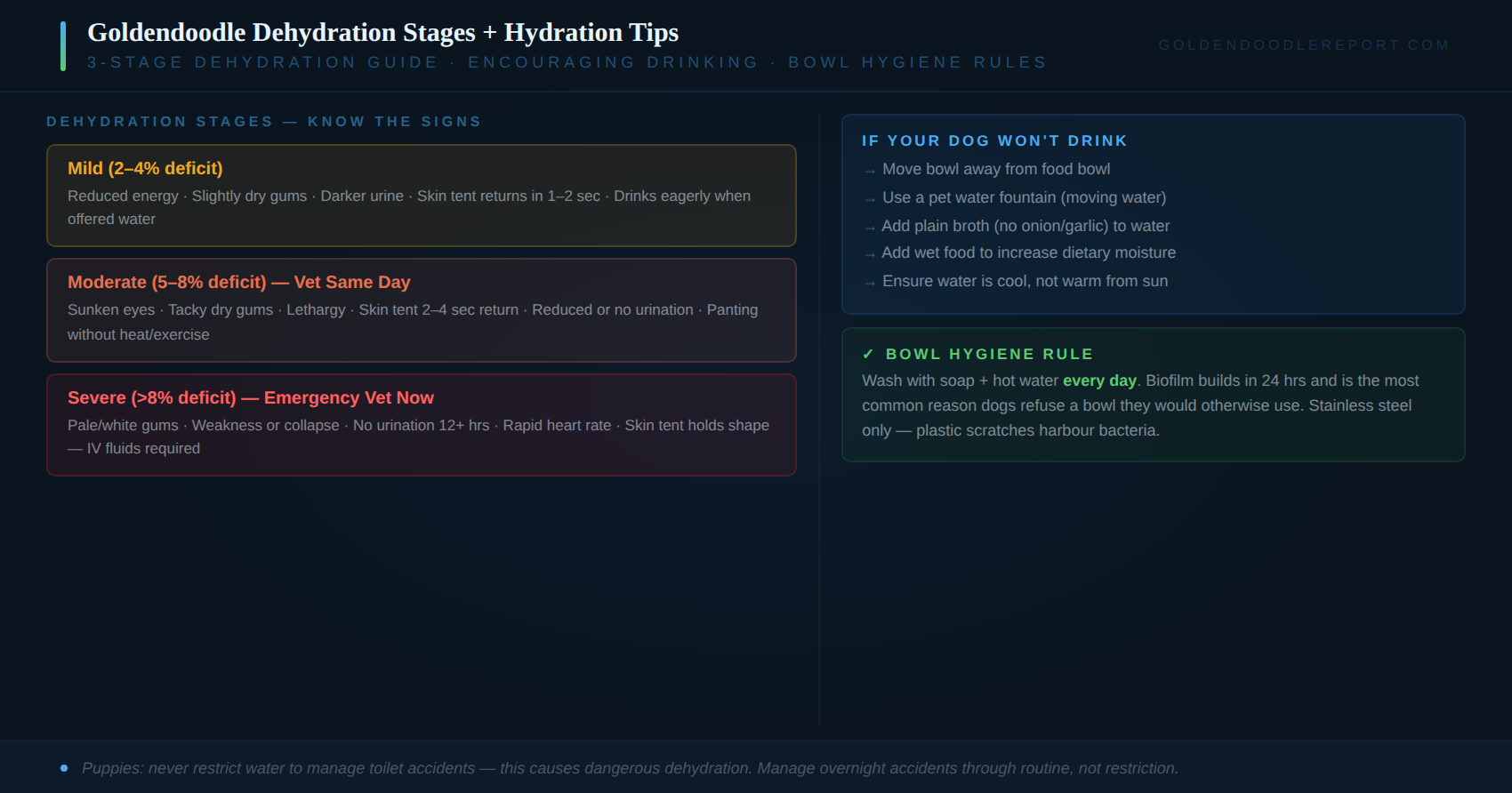
Mild dehydration (2–4% fluid deficit)
- Slightly reduced energy and enthusiasm
- Decreased skin elasticity (see the skin tent test below)
- Gums appear slightly less moist than usual
- Urine darker yellow than normal
- Drinking more than usual when water is offered
Moderate dehydration (5–8% fluid deficit)
- Clearly sunken eyes
- Dry, tacky gums (should be slippery and moist)
- Skin tent test shows slow return (more than 2 seconds)
- Lethargy and reluctance to move
- Panting without corresponding heat or exercise
- Reduced or absent urination
🚨 Seek veterinary care immediately if:
- Gums appear white, pale, or bluish
- The dog is weak, wobbly, or unable to stand
- There has been no urination in 12+ hours
- The dog has been vomiting or has had diarrhoea for more than 24 hours
- Skin tent test shows return time of more than 3–4 seconds
- A puppy under 6 months shows any signs of moderate dehydration
Severe dehydration in dogs is life-threatening and requires intravenous fluids at a veterinary clinic. Home water provision is not adequate treatment for severe dehydration.
The Home Dehydration Tests
Two simple tests can give you a quick dehydration assessment at home in under 30 seconds.
Test 1 — Skin tent test
Gently pinch a small fold of skin on the back of the neck or between the shoulder blades and release it. In a well-hydrated dog, the skin springs back immediately — within half a second. In a mildly dehydrated dog, the return takes 1–2 seconds. In a moderately dehydrated dog, the skin may hold the tent shape for 2–4 seconds or more. Practice this on a healthy, well-hydrated dog so you know what the normal baseline feels and looks like for your specific dog.
Test 2 — Gum moisture test
Press a finger gently against your Goldendoodle’s upper gum and remove it. The gums should be pink and slippery — like touching the inside of your own cheek. A healthy gum should return to pink colour within 2 seconds after pressing (capillary refill time). Pale, tacky, dry, or slow-returning gums indicate dehydration or circulatory problems requiring veterinary assessment.
When Too Much Water Is a Warning Sign
Excessive thirst — polydipsia — is defined as drinking more than approximately 100 ml per kg of body weight per day (about 1.5 oz per pound). This is roughly 50% above the standard baseline.
A dog drinking more than usual on a hot day, after exercise, or when transitioning to dry food is not a concern. A dog consistently drinking significantly more than their established normal pattern, particularly without an obvious environmental cause, warrants veterinary assessment.
Medical conditions associated with excessive thirst
- Diabetes mellitus: Increased thirst and urination are the hallmark early signs. Golden Retrievers — one of the Goldendoodle’s parent breeds — carry elevated diabetes risk. If your Goldendoodle is drinking and urinating significantly more than usual, diabetes is one of the first conditions your vet will test for.
- Kidney disease: Impaired kidneys cannot concentrate urine effectively, causing increased water loss and compensatory increased drinking. Particularly common in older Goldendoodles. See Merck Veterinary Manual’s overview of kidney disease in dogs for more detail.
- Cushing’s disease (hyperadrenocorticism): Excess cortisol production causes increased thirst, increased urination, pot-bellied appearance, and coat changes. Middle-aged to older dogs.
- Liver disease: Impaired liver function affects fluid balance and can increase thirst.
- Urinary tract infection (UTI): UTIs cause frequent drinking and urination, often with straining or discomfort during urination.
- Hypercalcaemia: Elevated blood calcium causes increased thirst — relevant context because inappropriate calcium supplementation in dogs (sometimes done by well-meaning owners) can cause this.
- Certain medications: Corticosteroids (prednisolone, dexamethasone) cause dramatically increased thirst and urination — this is an expected side effect, not a new health problem.
The key rule: If your Goldendoodle’s drinking pattern changes significantly without a clear cause (hot weather, increased exercise, food change), book a vet appointment. A urine test and basic blood panel can identify or rule out the most common causes quickly.
My Goldendoodle Won’t Drink — What to Do
Some Goldendoodles are naturally less enthusiastic drinkers than others. If your dog consistently meets the baseline intake and shows no dehydration signs, low-average intake is not a concern. If intake appears genuinely low and dehydration signs are present, these approaches help.
Practical strategies to encourage drinking
- Move the bowl location. Some dogs avoid drinking near their food bowl — in the wild, water near food could be contaminated by rotting food. Try placing the water bowl in a different room or hallway.
- Use a water fountain. Many dogs prefer moving water to still water — a pet water fountain keeps water aerated and at a consistent level and temperature. This is a practical solution for persistent reluctant drinkers.
- Offer wet food or fresh-cooked food. Dogs eating wet or fresh food receive substantial moisture from their diet and typically drink less from their bowl — this is fine. Adding wet food or a topper to dry kibble increases dietary moisture intake.
- Add plain water or low-sodium broth to food. A small amount of warm water mixed into dry kibble softens the food and adds moisture. Unsalted, unseasoned chicken or beef broth (no onion, no garlic) added to the water bowl can encourage some reluctant drinkers.
- Ensure cleanliness. Dogs will refuse water that smells stale or of bowl residue. Wash the water bowl daily with soap and rinse thoroughly. Many dogs refuse water from a bowl they would drink without hesitation from a clean bowl.
- Check water temperature. Most dogs prefer cool to room-temperature water. Very cold water (ice water) is acceptable but not all dogs like it. Water that has been sitting in a hot bowl in sunlight is typically refused.
⚠️ If your Goldendoodle has suddenly stopped drinking (not just drinking less but actively refusing water for more than 12 hours), this is a medical emergency — consult your vet immediately. Sudden complete water refusal alongside lethargy can indicate severe illness, obstruction, or toxic ingestion.
Water Quality and Bowl Hygiene
Water quality matters — both for intake and for health. These are the practical hygiene standards for Goldendoodle water provision.
Bowl material
Stainless steel bowls are the best choice — they do not harbour bacteria in microscopic scratches the way plastic bowls do, do not leach chemicals, and are easy to clean and sterilise. Ceramic bowls are acceptable if uncracked (cracks harbour bacteria). Plastic bowls are the most problematic — the small scratches that accumulate with use collect bacteria and can cause contact dermatitis around the muzzle (facial acne) in some dogs. If your Goldendoodle has recurring redness around the muzzle, switching from plastic to stainless steel is the first step.
Cleaning frequency
Wash the water bowl daily with dish soap and hot water, rinse thoroughly. Biofilm — the slippery coating that forms on bowl surfaces — builds up quickly and harbours bacteria that affect water taste and quality. Most dogs that seem to “not like water” are actually responding to biofilm contamination. A stainless steel bowl washed daily and refilled with fresh water eliminates this problem.
Water source
Municipal tap water in most regions is safe for dogs. Filtered or refrigerator-chilled water is fine — many dogs prefer it slightly cool. Avoid giving dogs water from decorative ponds, stagnant puddles, or standing outdoor water sources, which can harbour leptospira bacteria and toxic algae.
How Food Type Affects Water Intake
The relationship between food moisture content and bowl water consumption is important for interpreting whether your Goldendoodle is drinking the right amount.
| Food Type | Moisture Content | Effect on Bowl Drinking |
|---|---|---|
| Dry kibble | 8–12% | Dog must drink full daily requirement from bowl |
| Wet/canned food | 70–80% | Dog drinks noticeably less from bowl — normal |
| Fresh-cooked diet | 60–75% | Reduced bowl drinking — food provides significant moisture |
| Raw diet | 65–70% | Reduced bowl drinking — similar to fresh-cooked |
If your Goldendoodle transitions from dry kibble to wet or fresh food and appears to drink significantly less from their bowl, this is expected and not a concern — total hydration (food moisture + bowl water) is actually higher on wet food diets, which benefits kidney function and urinary health.
For how food type relates to overall nutrition: Best Food for Goldendoodles: What Vets Recommend.
🔑 Key Takeaways
- The baseline guideline is 1 oz (30 ml) of water per pound of body weight per day — a 50 lb Goldendoodle needs approximately 50 oz (1.5 litres) under normal conditions
- Hot weather, exercise, dry food, illness, and nursing all significantly increase water needs — the baseline can double in hot tropical conditions
- Dogs eating wet food or fresh-cooked diets drink less from their bowl — this is not dehydration, it is appropriate compensation for dietary moisture
- Never restrict water access in puppies to manage toilet training — the correct solution is a better toilet routine, not restricted hydration
- Consistently drinking significantly more than the 1 oz/lb/day baseline without an obvious cause (heat, exercise) warrants veterinary assessment — it can signal diabetes, kidney disease, or Cushing’s disease
- Wash the water bowl daily — biofilm builds up quickly, affects taste, and is the most common reason dogs refuse to drink from a bowl they would otherwise use willingly
📚 More Goldendoodle Food & Nutrition Guides
- How Much to Feed a Goldendoodle: Amounts by Age + Weight
- Goldendoodle Feeding Schedule: Meal Timing by Age (2026)
- Best Food for Goldendoodles: What Vets Recommend (2026)
- Goldendoodle Sensitive Stomach: 5 Foods That Actually Help
- Goldendoodle Weight Management: How to Help Safely (2026)
- Goldendoodle Treats Guide — coming soon
Browse all guides: Goldendoodle Food & Nutrition category
🔗 Related Guides Across the Site
- Goldendoodle Summer Care Guide — hydration in hot weather
- Goldendoodle Rainy Season Care — seasonal care including water hygiene
- Goldendoodle Exercise Needs by Age — water needs post-exercise
- Goldendoodle Puppy Care Guide — puppy hydration in context of first-year care
- Goldendoodle Puppy Sleep Schedule — overnight water management
- Goldendoodle Puppy First Vet Visit — discussing hydration at the first appointment
- Do Goldendoodles Like Water? — breed-level relationship with water
- Why Is My Goldendoodle Sleeping So Much? — lethargy as a dehydration sign
Frequently Asked Questions
How much water does a Goldendoodle need per day?
The standard guideline is approximately 1 oz (30 ml) of water per pound of body weight per day under normal conditions. A 50 lb Standard Goldendoodle needs roughly 50 oz (1.5 litres) daily. A 20 lb Mini Goldendoodle needs approximately 20 oz (600 ml). These amounts increase significantly during hot weather, after exercise, and when eating dry kibble exclusively. Fresh water should always be freely available — the goal is unrestricted access rather than precisely measured intake.
My Goldendoodle barely drinks water — is this normal?
It depends on what they eat. Dogs eating wet food or fresh-cooked diets receive substantial moisture from their food and drink noticeably less from their bowl — this is normal and actually indicates good overall hydration. If your Goldendoodle eats dry kibble and drinks very little, check for dehydration signs (skin tent test, gum moisture test) and consider whether the bowl is clean, freshly refilled, and positioned away from the food bowl. If genuine dehydration signs are present, consult your vet.
My Goldendoodle is drinking much more water than usual — should I be worried?
Occasional increases due to hot weather, exercise, or a salty treat are normal. If your Goldendoodle is consistently drinking significantly more than their usual pattern without an obvious environmental cause — over several days or a week — book a vet appointment. Sudden, sustained increases in thirst are associated with diabetes, kidney disease, Cushing’s disease, urinary tract infection, and liver disease, all of which are more treatable when caught early. A urine test is usually the first diagnostic step.
Should I restrict my puppy’s water overnight to prevent accidents?
No. Restricting water in puppies causes dehydration, which is dangerous — especially in young dogs whose hydration reserves are smaller. The correct approach to overnight accidents is taking the puppy out immediately before the last sleep period and managing the overnight routine through toilet training methods rather than water restriction. Water restriction during the day is never appropriate for any age of dog. See Goldendoodle Puppy Sleep Schedule for the overnight routine.
Can my Goldendoodle drink too much water?
In rare cases, dogs can develop water intoxication (hyponatraemia) from drinking excessive amounts very rapidly — most commonly associated with intense water play or dogs that gulp large amounts during exercise. Normal drinking throughout the day does not cause water intoxication. The more relevant concern is that consistently excessive thirst signals a medical condition rather than the drinking itself causing a problem. If your dog seems unable to stop drinking or drinks in extreme quantities, consult your vet.
What type of water is best for Goldendoodles?
Clean municipal tap water is appropriate in most regions. Filtered water is fine if preferred. The most important factors are cleanliness of the bowl (washed daily), freshness of the water (refilled regularly), and appropriate temperature (cool to room temperature — not hot from sitting in sunlight). Avoid letting your dog drink from stagnant outdoor water sources, puddles, or decorative ponds, which can contain harmful bacteria and blue-green algae toxins.
Disclaimer: The information in this article is provided for general educational purposes only. King James Adjei is a researcher and enthusiast, not a veterinarian. Changes in water intake — particularly significant increases in thirst — can indicate serious medical conditions and require veterinary assessment. Do not use this guide to diagnose conditions in your dog. Always consult your veterinarian if you have concerns about your Goldendoodle’s hydration or health.