Affiliate Disclosure: Some links in this guide are affiliate links. If you purchase through them, we may earn a small commission at no extra cost to you. This does not influence our recommendations. Read our full affiliate disclaimer here.
By King James Adjei — Researcher and Goldendoodle enthusiast, founder of GoldendoodleReport.com. Every guide on this site is carefully researched and written to give owners reliable, clearly organised information. → About this site
🩺 Veterinary guidance note: This guide provides general evidence-based nutritional guidance for healthy senior Goldendoodles. Dogs with diagnosed conditions — kidney disease, heart disease, arthritis, diabetes, cognitive decline — may require a therapeutic diet specific to that condition. Always confirm senior dietary choices with your veterinarian, particularly at the twice-yearly senior wellness exams this life stage requires.
📖 10-minute read | Last updated May 2026 | Reviewed for accuracy
✅ Quick Answer
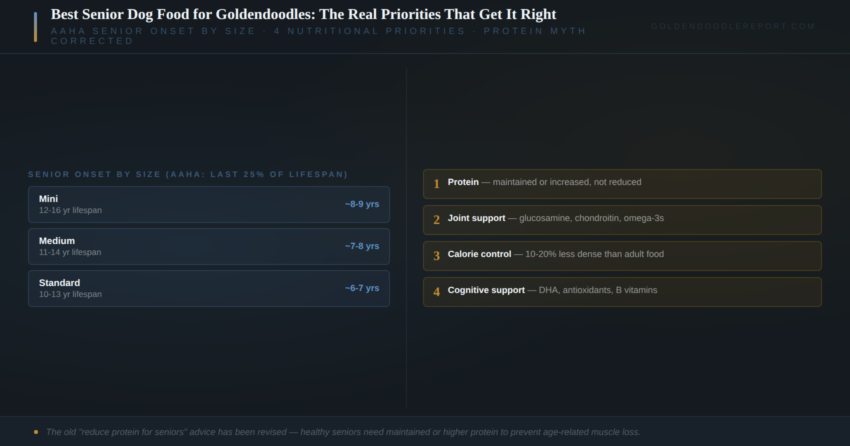
The best senior dog food for Goldendoodles balances four priorities: maintained or increased high-quality protein (not reduced — this old advice has been revised), joint-support nutrients (glucosamine, chondroitin, omega-3s), controlled calorie density to prevent weight gain as activity drops, and cognitive-support ingredients (DHA, antioxidants, B vitamins). When your Goldendoodle actually becomes “senior” depends on size far more than a fixed age — Standard Goldendoodles typically enter the senior stage around 6-7 years, while Minis often don’t reach it until 8-9, because veterinary guidelines define senior as the last 25% of a dog’s expected lifespan, not a universal birthday.
Finding the best senior dog food for Goldendoodles gets confusing fast, mostly because “senior” is one of the least standardised terms in pet food. Your Goldendoodle has started sleeping more, maybe slowing down on walks, and you’ve noticed the vet mentioning “senior wellness exams” at the last visit — but the bag of food in front of you doesn’t make clear what’s actually different about senior formulas, or whether your dog even needs to switch yet.
Part of the confusion is legitimate: there is no legal or universal definition of what makes a food “senior,” and the age at which dogs actually enter this life stage varies enormously by size — a distinction that matters more for Goldendoodles than almost any other breed, since the breed spans Mini to Standard with meaningfully different lifespans.
This guide covers exactly when your Goldendoodle becomes a senior by size, the four nutritional priorities that genuinely matter, a common piece of outdated advice you should ignore, and how to choose and transition to the right food.
👤 Who This Guide Is For
- Your Goldendoodle is showing early signs of slowing down — reduced energy, more sleep, a bit of stiffness after rest
- Your vet has mentioned senior wellness exams or senior nutrition at a recent appointment
- You’re unsure whether your Mini or Standard Goldendoodle actually counts as “senior” yet
- You want to know if switching foods now will actually help, or if it’s premature
📊 Quick Facts — Senior Goldendoodle Nutrition
- The American Animal Hospital Association’s Canine Life Stage Guidelines define senior as “the last 25% of estimated lifespan through end of life” — not a fixed age, which is why senior timing varies so much by size
- Caloric needs typically drop by 20-30% in senior dogs as activity and metabolism slow, making calorie-dense adult food a common cause of unintentional senior weight gain
- Modern veterinary nutrition guidance has specifically revised the old advice to cut protein for seniors — healthy senior dogs need maintained or higher protein to prevent age-related muscle loss (sarcopenia), not less
- Standard Goldendoodles (10-13 year typical lifespan) reach the senior stage around 6-7 years; Mini Goldendoodles (12-16 year typical lifespan) often don’t reach it until 8-9 years
- There is no legal definition of what qualifies a food as “senior” — the AAFCO life-stage categories are only Growth, Maintenance, and All Life Stages, meaning a bag labelled “senior” is a marketing category, not a regulated nutritional standard
🔍 Quick Diagnosis — Is It Time to Switch?
- If your Standard Goldendoodle is 6-7+ and showing any slowing down → likely entering the senior stage; discuss timing with your vet at the next check-up
- If your Mini Goldendoodle is under 8 with no signs of aging → probably still a mature adult; switching now may unnecessarily reduce calorie density for a dog that’s still active
- If your Goldendoodle of any size has a diagnosed condition (kidney, heart, joint disease) → this overrides age-based timing entirely; your vet will likely recommend a therapeutic diet specific to that condition rather than a standard “senior” formula
- If you’re not sure whether your dog is aging or just having an off week → track it for 2-3 weeks (energy, appetite, mobility) rather than reacting to a single day; isolated tired days are normal at any age
📋 Table of Contents
When Does a Goldendoodle Actually Become “Senior”?
Most articles about senior dog food give a single fixed age — “around 7 years” — regardless of the dog’s size. That number is a rough average, not a rule, and it’s built on a misunderstanding of how veterinary medicine actually defines the senior life stage.
According to the American Animal Hospital Association’s Senior Care Guidelines, the senior stage is defined as “the last 25% of estimated lifespan through end of life” — a proportion of expected life, not a specific birthday. This is precisely why a giant breed with a 7-year expected lifespan might be senior at 5, while a small breed expected to live 16 years might not be senior until 12.
What this means specifically for Goldendoodles
| Goldendoodle Size | Typical Lifespan | Approximate Senior Onset (last 25%) |
|---|---|---|
| Mini (15-30 lbs) | 12-16 years | ~8-9 years |
| Medium (30-45 lbs) | 11-14 years | ~7-8 years |
| Standard (45-80 lbs) | 10-13 years | ~6-7 years |
These are approximate windows, not exact cutoffs — a vet quoted by Forbes Vetted put it plainly: pet parents should watch their individual dog for signs of aging (reduced activity, sudden behaviour changes, stiffness, weight changes, altered appetite) rather than switching foods purely because a birthday arrived. If your Standard Goldendoodle is 6 and still keeping pace on hikes, there’s no rush. If your Mini is 7 and clearly slowing down, trust what you’re observing over the table above.
📖 Real Scenario
A Standard Goldendoodle owner switches to a “senior” formula at exactly 7 years old because the bag said so, without checking anything else. The new food has noticeably lower protein than the previous adult formula — a formulation choice based on the outdated “seniors need less protein” assumption. Over the following year, the dog’s muscle tone visibly declines, especially along the hindquarters, despite no change in activity level. At the annual exam, the vet flags early muscle wasting and recommends switching to a senior formula that maintains protein at adult-maintenance levels or higher, rather than reducing it. Within several months of increased dietary protein and continued regular exercise, muscle tone improves. The lesson: not every “senior” formula is formulated the same way, and the label alone doesn’t guarantee it reflects current nutritional guidance.
Best Senior Dog Food for Goldendoodles: The 4 Priorities
Once your Goldendoodle has genuinely entered the senior stage, the best senior dog food for Goldendoodles is defined by four specific nutritional priorities — not by the word “senior” printed on the bag.
| Priority | Target | Why It Matters |
|---|---|---|
| Protein | Maintained or increased — 25%+ dry matter from named sources | Prevents age-related muscle loss (sarcopenia); old “reduce protein” advice has been revised |
| Joint support | Glucosamine + chondroitin + omega-3s (EPA/DHA) | Cartilage maintenance and inflammation reduction — Standard Goldendoodles carry inherited joint risk from both parent breeds |
| Calorie control | 10-20% lower calorie density than adult formula | Caloric needs commonly drop 20-30% with reduced activity — unadjusted feeding causes senior weight gain, the single biggest preventable risk factor for arthritis and heart strain |
| Cognitive support | DHA, antioxidants (vitamin E, C), B vitamins | Supports brain function and may help slow age-related cognitive decline, which affects a meaningful proportion of dogs by their mid-to-late senior years |
The Protein Myth Vets Have Corrected
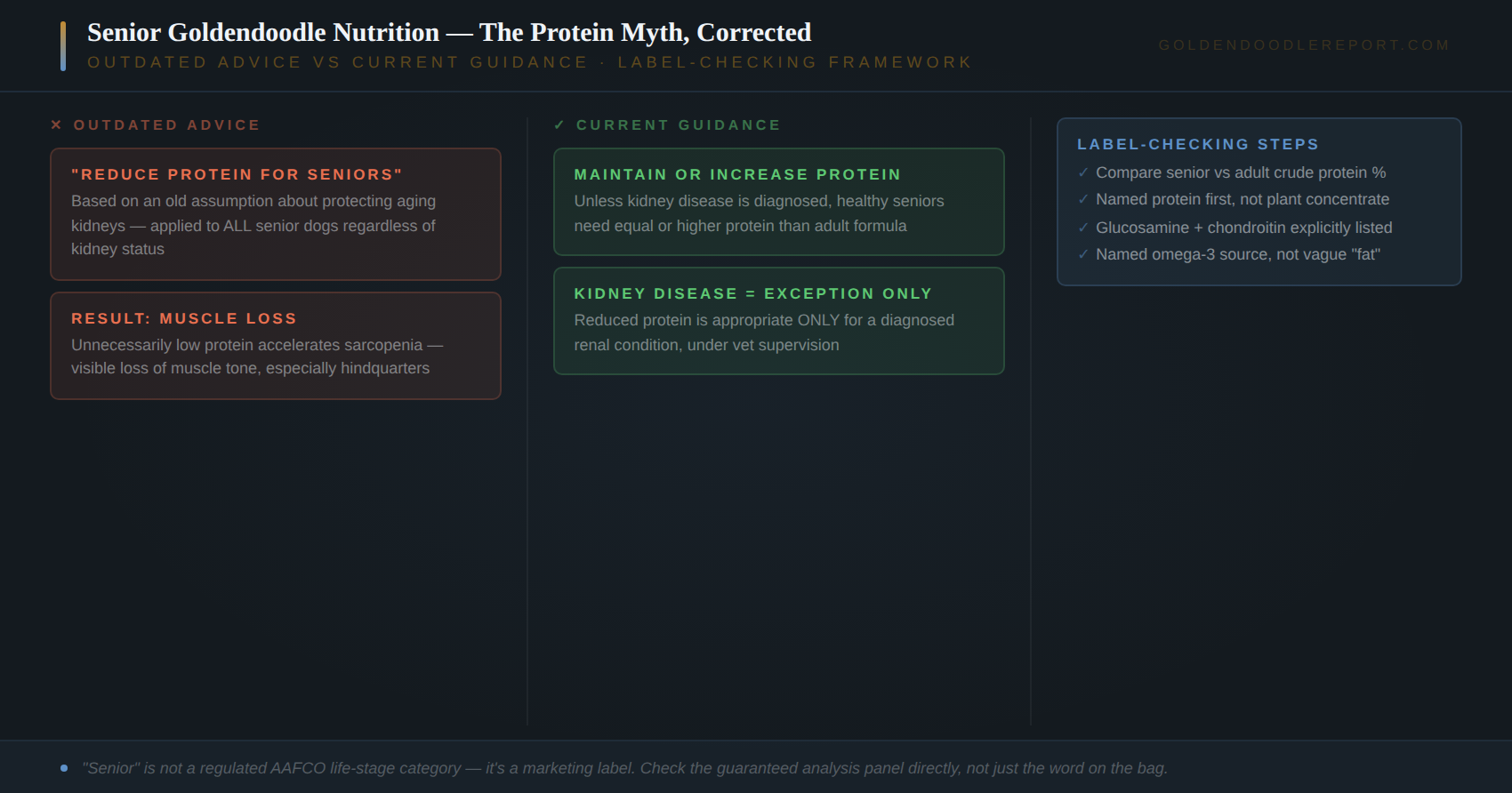
For years, conventional advice told owners to reduce protein in senior dogs to “protect aging kidneys.” This advice has been specifically revised by veterinary nutrition. Unless a dog has a diagnosed kidney condition requiring a therapeutic low-protein diet under veterinary supervision, healthy senior dogs need maintained or higher protein — not less — to counter sarcopenia, the natural age-related loss of muscle mass that accelerates once a dog enters the senior years.
The confusion likely stems from genuine kidney-disease diets, which do restrict protein for dogs with confirmed renal impairment — a completely different situation from a healthy ageing dog. If your senior Goldendoodle has no kidney diagnosis, a senior food that has quietly reduced its protein content compared to the adult version is working against your dog’s muscle maintenance, not for it. Check the guaranteed analysis on the bag directly rather than assuming “senior” automatically means appropriately formulated.
What to check on the label
- Compare the senior formula’s crude protein % directly against the adult formula from the same line — it should be equal or higher, not lower
- Confirm a named animal protein (chicken, salmon, turkey, lamb) is the first ingredient, not a plant protein concentrate used to inflate the protein percentage cheaply
- If your Goldendoodle has a diagnosed kidney condition, ignore this section entirely and follow your vet’s specific therapeutic diet recommendation instead
What Most People Get Wrong
- Switching purely on a birthday — as shown in the AAHA framework above, senior onset depends on expected lifespan, not a universal age. Switching too early wastes a still-appropriate adult formula; switching too late delays joint and calorie support your dog may already need.
- Assuming “senior” on the bag guarantees appropriate formulation — there is no legal definition of a senior dog food. AAFCO’s own life-stage categories are only Growth, Maintenance, and All Life Stages — “senior” is a marketing layer on top, meaning quality varies enormously between brands using the same word.
- Continuing adult-formula portions after switching to senior food — senior formulas are typically less calorie-dense by design; feeding the same cup measurement as before can still result in underfeeding if the switch isn’t paired with a portion recheck against the new kcal/cup value.
- Reducing protein preemptively — as covered above, this is outdated guidance for dogs without a kidney diagnosis and actively works against muscle maintenance.
- Ignoring joint support until stiffness is visible — glucosamine and chondroitin work best as ongoing maintenance started before clinical signs appear, not as a reactive treatment once a dog is already showing discomfort.
Brands That Meet the Criteria
Applying the WSAVA manufacturer standard used throughout this site — a full-time veterinary nutritionist on staff, AAFCO feeding trials rather than formulation-only validation, and consistent quality control — the following senior formulas are widely recognised by veterinary panels as meeting the four priorities above: Hill’s Science Diet Adult 7+, Purina Pro Plan Bright Mind (specifically formulated with added cognitive-support nutrients), and Royal Canin Ageing 10+ for late-senior dogs. For owners preferring fresh-cooked options, veterinarian-formulated fresh diets are increasingly recommended for senior dogs specifically for their higher digestibility and typically higher, not lower, protein content.
Whichever brand you choose, confirm directly on the guaranteed analysis panel that protein is maintained or increased relative to the adult formula, and that glucosamine, chondroitin, and a named omega-3 source are explicitly listed — not implied by a “supports joint health” marketing claim alone.
How to Switch to Senior Food
Senior digestive systems are typically more sensitive to abrupt food changes than younger adults. Use a longer transition window than the standard 7 days used at other life stages:
- Days 1-3: 75% current food, 25% senior food
- Days 4-6: 50% / 50%
- Days 7-9: 25% current food, 75% senior food
- Day 10+: 100% senior food
Watch for digestive upset during the transition; if symptoms appear, hold the current ratio for 3-4 extra days before continuing rather than pushing ahead on schedule. Recalculate daily portions using the new food’s kcal/cup value immediately after switching — see How Much to Feed a Goldendoodle for the full portion-calculation method.
When Standard Senior Food Isn’t Enough
A standard senior formula is designed for a healthy ageing dog — it is not a treatment for a diagnosed condition. Several situations call for a therapeutic diet instead of, or alongside, a standard senior food:
- Diagnosed kidney disease: requires a specific renal therapeutic diet with controlled (not just “senior-typical”) protein, phosphorus, and sodium levels — this is the one situation where reduced protein is genuinely appropriate, and only under veterinary guidance
- Diagnosed heart disease: may require sodium restriction and specific supplementation beyond what a standard senior formula provides
- Confirmed arthritis or significant joint disease: a prescription joint-support diet with therapeutic-level omega-3 dosing may outperform an over-the-counter senior formula’s more modest joint-support inclusion
- Cognitive dysfunction syndrome: some prescription diets are specifically formulated with higher-dose medium-chain triglycerides and antioxidants shown to support cognitive function beyond standard senior formula levels
If your Goldendoodle has any diagnosed condition, discuss the specific therapeutic diet options with your vet rather than relying on this general guide — a prescription diet tailored to the actual condition will outperform a well-formulated standard senior food for that specific issue.
⏱️ What to Expect After Switching
Expect mild digestive adjustment for the first 5-7 days of the transition — this settles on its own. Joint-support benefits from glucosamine and chondroitin typically take 6-8 weeks of consistent feeding to become noticeable, since cartilage maintenance is a gradual process, not an immediate effect. Weight management from the lower calorie density shows up over 4-8 weeks depending on your dog’s starting body condition. If you don’t see any change in energy, joint comfort, or weight trend within 10-12 weeks, revisit the food choice with your vet rather than assuming more time alone will fix it.
✅ Your Next Step
Check your Goldendoodle’s size against the senior-onset table above, then compare your current food’s guaranteed analysis against the 4 priorities in this guide — protein, joint support, calorie density, and cognitive nutrients. If your dog has any diagnosed condition, discuss therapeutic diet options at your next vet visit before making any change. For the portion recalculation once you’ve chosen a food: How Much to Feed a Goldendoodle.
🔑 Key Takeaways
- Senior onset is defined by the last 25% of expected lifespan (AAHA), not a fixed age — Standard Goldendoodles typically become senior around 6-7 years, Minis around 8-9
- The best senior dog food for Goldendoodles maintains or increases protein, adds joint support (glucosamine, chondroitin, omega-3s), controls calorie density, and includes cognitive-support nutrients
- The old advice to reduce protein in senior dogs has been specifically revised — healthy seniors need maintained or higher protein to prevent age-related muscle loss
- “Senior” is not a legally regulated AAFCO life-stage category — check the guaranteed analysis directly rather than trusting the label alone
- Diagnosed conditions (kidney, heart, joint disease, cognitive dysfunction) call for a therapeutic diet specific to that condition, not a standard senior formula
- Use a 10-day transition for senior food switches — longer than the standard 7-day protocol, since senior digestive systems are typically more sensitive
📚 More Goldendoodle Food & Nutrition Guides
- How Much to Feed a Goldendoodle: Amounts by Age + Weight
- Best Food for Goldendoodles: What Vets Recommend (2026)
- Best Food for Adult Goldendoodles: Vet-Backed Guide (2026)
- Goldendoodle Weight Management: How to Help Safely (2026)
- Goldendoodle Food Allergies: Signs, Triggers + What to Feed
- Grain-Free Food for Goldendoodles: The Real Evidence That Keeps Them Safe
- Goldendoodle Nutrition Guide (complete pillar) — coming soon
Browse all guides: Goldendoodle Food & Nutrition category
🔗 Related Guides Across the Site
- Goldendoodle Exercise Needs by Age — adjusting activity alongside diet as your dog ages
- Why Is My Goldendoodle Sleeping So Much? — distinguishing normal ageing from a health concern
- Goldendoodle Matting Prevention — coat changes that often accompany the senior years
- How Often to Groom a Goldendoodle — grooming frequency adjustments for senior dogs
Frequently Asked Questions
What is the best senior dog food for Goldendoodles?
The best senior dog food for Goldendoodles is whichever formula meets four specific priorities: maintained or increased protein from a named animal source, added joint-support nutrients (glucosamine, chondroitin, omega-3 fatty acids), controlled calorie density appropriate to reduced senior activity, and cognitive-support ingredients like DHA and antioxidants. Brands widely recognised by veterinary panels as meeting these criteria include Hill’s Science Diet Adult 7+, Purina Pro Plan Bright Mind, and Royal Canin Ageing 10+. The specific brand matters less than confirming these four priorities directly on the guaranteed analysis panel rather than trusting the word “senior” on the front of the bag.
At what age should I switch my Goldendoodle to senior food?
It depends on size, not a fixed age. Veterinary guidelines define senior as the last 25% of a dog’s expected lifespan — for a Standard Goldendoodle (10-13 year typical lifespan), that’s roughly 6-7 years; for a Mini Goldendoodle (12-16 year typical lifespan), it’s closer to 8-9 years. Rather than switching purely on a birthday, watch for actual signs of ageing — reduced energy, more sleep, stiffness after rest, subtle weight changes — and discuss timing with your vet at a routine check-up.
Do senior dogs really need less protein?
No — this is outdated advice that has been specifically revised by veterinary nutrition. Unless your Goldendoodle has a diagnosed kidney condition requiring a therapeutic low-protein diet under veterinary supervision, healthy senior dogs need maintained or higher protein, not less, to counter sarcopenia (age-related muscle loss). Some “senior” formulas still quietly reduce protein based on this outdated assumption — check the guaranteed analysis and compare it directly against the adult formula from the same product line before assuming a senior bag is appropriately formulated.
How much less should I feed my senior Goldendoodle?
Caloric needs typically drop by 20-30% in senior dogs due to reduced activity and a slowing metabolism, though the exact amount varies by individual dog. Rather than guessing, switch to a senior formula’s specific kcal/cup value and use body condition scoring to confirm the new portion is appropriate — a senior formula that is 15-20% less calorie-dense than the adult version, fed at a similar volume, often achieves the right calorie reduction automatically. See How Much to Feed a Goldendoodle for the full calculation method.
Is grain-free senior food okay for an older Goldendoodle?
The same cautious, evidence-based reasoning applies at the senior stage as at any other life stage — a grain-inclusive formula remains the more cautious default given Goldendoodles’ inherited cardiac considerations, particularly since senior dogs are already at a life stage where cardiac monitoring becomes more clinically relevant. See Grain-Free Food for Goldendoodles for the complete evidence-based discussion of this question.
Disclaimer: The information in this article is provided for general educational purposes only. King James Adjei is a researcher and enthusiast, not a veterinarian or certified veterinary nutritionist. Senior dogs with diagnosed health conditions including kidney disease, heart disease, arthritis, diabetes, or cognitive dysfunction require a therapeutic diet specific to that condition — always follow your veterinarian’s guidance rather than a standard senior formula for a diagnosed condition. Senior dogs should have veterinary wellness exams at least twice yearly.