Affiliate Disclosure: Some links in this guide are affiliate links. If you purchase through them, we may earn a small commission at no extra cost to you. Read our full affiliate disclaimer here.
By King James Adjei — Researcher and Goldendoodle enthusiast, founder of GoldendoodleReport.com. Every guide on this site is carefully researched and written to give owners reliable, clearly organised information — updated regularly and honest about uncertainty. → About this site
📖 15-minute read | Last updated April 2026 | Reviewed for accuracy
Goldendoodle grooming is one of the most misunderstood aspects of owning this breed. New owners are often surprised by how much maintenance a Goldendoodle coat requires — and experienced owners frequently discover they have been doing something wrong for years. The coat that makes a Goldendoodle so appealing — soft, low-shedding, often curly or wavy — is also the coat that mats most easily, requires the most consistent brushing, and demands the most from both the owner and the groomer. This guide covers everything: coat types, brushing, bathing, haircut styles, tools, professional grooming, costs, and the most common mistakes. Each section links to a deeper guide for owners who need more detail on a specific topic.
👤 Who This Guide Is For
- New Goldendoodle owners who want to understand what grooming involves before their first appointment
- Owners whose dog’s coat is matting and who need to understand why and how to address it
- Owners who want to groom their Goldendoodle at home and need to know where to start
- Anyone comparing professional grooming costs and trying to decide between a salon, mobile groomer, or DIY approach
- Owners preparing for a seasonal coat change or choosing a haircut style for the first time
⚡ Quick Summary
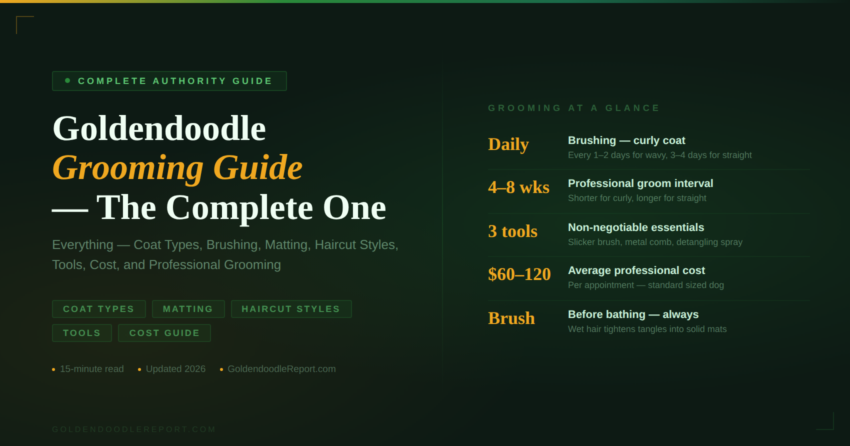
Goldendoodles need professional grooming every 6–8 weeks for wavy coats and every 4–6 weeks for curly coats, plus daily brushing at home between appointments. The coat type — straight, wavy, or curly — determines every grooming decision including frequency, tools, haircut style, and cost. Matting is the most common and most preventable grooming problem, caused almost entirely by inconsistent brushing. The three tools every Goldendoodle owner needs are a slicker brush, a metal comb, and a detangling spray. Everything else is optional.
✅ Quick Answer — The Goldendoodle Grooming Essentials
- How often to brush: Daily for curly coats, every 2–3 days minimum for wavy coats
- How often to bathe: Every 3–6 weeks depending on coat type and lifestyle
- How often to groom professionally: Every 4–8 weeks depending on coat type and chosen length
- Three essential tools: Slicker brush, metal comb, detangling spray
- Most common problem: Matting — prevented by consistent brushing, not by any product
- Average grooming cost: $60–$120 per professional appointment depending on size and coat
Goldendoodle Coat Types — Why Everything Starts Here

Every grooming decision — how often to brush, how often to bathe, which haircut to choose, which tools to buy, how much to budget — depends on the coat type. Goldendoodles come in three primary coat types and understanding which one your dog has is the foundation of everything else.
Straight coat
Straight-coated Goldendoodles have a flat, smooth coat that lies close to the body. They shed more than wavy or curly types and are the least prone to matting. Brushing every 3–4 days is typically sufficient. Professional grooming every 8–12 weeks. This is the lowest-maintenance Goldendoodle coat type and the least common in intentional Goldendoodle breeding.
Wavy coat
Wavy coats are the most common Goldendoodle coat type. They fall between straight and curly — loose waves that give the breed its characteristic soft, fluffy appearance. Wavy coats are moderate-shedding and moderately prone to matting, particularly behind the ears, under the legs, around the collar, and at the base of the tail. Brushing every 1–2 days is recommended. Professional grooming every 6–8 weeks. This is the coat type most people picture when they think of a Goldendoodle.
Curly coat
Curly coats are the highest-maintenance and the most popular among owners who chose Goldendoodles for their low-shedding properties. Tight curls trap loose hair rather than releasing it, which produces the low-shed quality but also creates the most matting risk. Daily brushing is non-negotiable. Professional grooming every 4–6 weeks. Curly-coated Goldendoodles left without daily brushing will develop mats within days — not weeks.
For a complete breakdown of all coat variations, how to identify your dog’s coat type, and how coat type changes from puppy to adult see Goldendoodle Coat Types Explained.
Brushing — The Foundation of Goldendoodle Grooming
Brushing is the single most important thing an owner can do for their Goldendoodle’s coat. It is more important than bathing, more important than professional grooming frequency, and more important than any product. A Goldendoodle who is brushed consistently and correctly will rarely develop mats. A Goldendoodle who is bathed and professionally groomed regularly but not brushed daily will mat regardless.
The correct brushing technique for a Goldendoodle is line brushing — working through the coat in sections from skin to tip rather than brushing only the surface layer. Surface brushing removes loose hair from the top of the coat but leaves the dense undercoat untouched, where mats form at the skin level. Line brushing reaches the mat formation zone.
The two tools required for effective brushing are a slicker brush and a metal comb. The slicker brush removes loose hair and works through surface tangles. The metal comb — run through the coat after every brushing session — is the quality check. If the comb runs freely from skin to tip without catching anywhere, the coat is mat-free. If it catches, there is a mat the brush did not reach.
For the complete step-by-step brushing method see How to Brush a Goldendoodle and How to Line Brush a Goldendoodle. For tool recommendations see Best Brush for Goldendoodles and Best Comb for Goldendoodles.
Matting — The Most Common Goldendoodle Grooming Problem
Matting is the most common and most preventable grooming problem in Goldendoodles. A mat is a tightly tangled section of coat that has compressed to the point where individual hairs can no longer be separated. Mats form fastest at friction points — behind the ears, under the front legs, around the collar, between the back legs, and at the base of the tail — because these are the areas where movement and contact repeatedly work the coat into tangles.
The key facts about matting every Goldendoodle owner needs to understand:
Mats form at the skin, not at the surface. The most damaging mats — and the ones most owners miss — are at skin level. They are invisible from above and can only be detected by pushing the coat aside and feeling for resistance at the base. By the time a mat is visible from the surface, it has typically been developing at the skin for days or weeks.
Mats cannot be bathed out. Bathing a matted coat worsens the matting — water causes the tangled fibres to tighten and compress further. A matted coat must be brushed out before bathing, not after.
Severe mats cannot be brushed out. A mat that has compressed to a solid felt-like mass at skin level cannot be separated with a brush or comb without causing significant pain and skin damage. The only humane solution is to shave it out. This is why prevention through consistent brushing is so important — once a mat reaches this stage, shaving is the only option.
For the complete mat prevention protocol see Goldendoodle Matting Prevention. For how to safely remove early-stage mats at home see How to Remove Mats Safely and How to Detangle a Goldendoodle Coat. For the shaving decision when mats are severe see Should You Shave a Matted Goldendoodle?
Bathing a Goldendoodle
Most Goldendoodles need bathing every 3–6 weeks depending on coat type, lifestyle, and how much time they spend outdoors. Curly-coated dogs bathed more frequently need more frequent professional grooming to compensate for the accelerated coat growth the bathing stimulates. Dogs who swim regularly or spend significant time outdoors may need bathing more frequently.
The most important bathing rule for Goldendoodles is to brush thoroughly before the bath — never after. Wet hair mats more tightly than dry hair, and bathing a coat that already has tangles will convert loose tangles into solid mats that require shaving to remove.
Shampoo selection matters for Goldendoodles. The coat — particularly curly types — needs moisture retention to stay manageable. Harsh shampoos that strip the coat’s natural oils produce a dry, frizzy coat that is significantly harder to manage and more prone to tangling. A moisturising shampoo formulated for dogs with long or curly coats is the right choice for most Goldendoodles.
Drying the coat completely after bathing is equally important. A damp coat left to air dry is a mat in progress — the coat dries in whatever position it settles, which is typically compressed and tangled. Blow-drying with a brush produces a properly dried, smooth coat. For the full bathing protocol see How to Bathe a Goldendoodle and How to Dry a Goldendoodle Coat. For shampoo and conditioner recommendations see Best Shampoo for Goldendoodles and Best Conditioner for Goldendoodles.
Goldendoodle Haircut Styles
The haircut style chosen for a Goldendoodle affects maintenance requirements, grooming frequency, and the dog’s comfort in different seasons. There are five primary Goldendoodle haircut styles, each with different maintenance implications.
Teddy bear cut
The most popular Goldendoodle haircut. The coat is left at a medium length — typically 1.5–3 inches — with a rounded face trim that gives the characteristic stuffed animal appearance. Requires professional grooming every 6–8 weeks and daily brushing at home. The most versatile cut — works year-round and suits all coat types. See Teddy Bear Cut Guide.
Puppy cut
A uniform length all over the body — typically 1–2 inches. Easier to maintain than the teddy bear cut because the shorter length reduces matting risk. Good choice for active dogs or owners who want lower maintenance between professional appointments. See Puppy Cut Guide.
Kennel cut
A short, practical cut — typically under 1 inch — that minimises grooming maintenance. Often chosen for summer or for dogs who spend significant time outdoors. Requires less frequent brushing and longer intervals between professional appointments. See Kennel Cut Guide.
Lion cut
A distinctive style where the body is shaved short while the head, mane area, and tip of the tail are left longer. Not appropriate for all coat types and not suitable for cold climates. See Lion Cut Guide.
Seasonal cuts
Many owners adjust their Goldendoodle’s coat length by season — shorter in summer for heat management, longer in winter for warmth. See Summer Goldendoodle Haircut Guide and Winter Goldendoodle Haircut Guide for the specific considerations by season.
For a complete overview of all available styles see Goldendoodle Haircut Styles and Short Goldendoodle Haircut Styles.
Professional Grooming — Frequency, Cost, and Choosing the Right Groomer
Professional grooming is not optional for Goldendoodles — it is a maintenance requirement. Even owners who brush daily and bathe at home need a professional groomer for haircuts, ear plucking, nail trimming, and the deep coat work that home brushing cannot fully replicate.
How often
Curly coats: every 4–6 weeks. Wavy coats: every 6–8 weeks. Straight coats: every 8–12 weeks. These frequencies assume consistent home brushing between appointments. A dog who is not brushed at home will need professional appointments more frequently — and will cost more at each one because the groomer must address matting that home brushing would have prevented. For a complete grooming schedule see Goldendoodle Grooming Schedule and How Often to Groom a Goldendoodle.
Cost
Professional Goldendoodle grooming typically costs $60–$120 per appointment for a standard-sized dog, depending on location, coat condition, and the groomer’s experience. Mini Goldendoodles typically cost $45–$80. Standard Goldendoodles may cost $80–$150. A dog brought in with significant matting will cost more — dematting fees are common and can add $20–$60 to the standard appointment cost. For full cost breakdowns see Goldendoodle Grooming Cost Guide and How Much Does Goldendoodle Grooming Cost?
Choosing a groomer
Not all groomers have experience with Goldendoodle coats. The combination of Poodle and Golden Retriever genetics produces a coat that behaves differently from either parent breed and requires specific handling — particularly around mat removal, line brushing, and the coat transition from puppy to adult coat. For how to find and evaluate the right groomer see How to Choose a Groomer for a Goldendoodle and What to Tell Your Groomer About Your Goldendoodle.
Professional vs DIY
Many owners successfully handle bathing and between-appointment brushing at home while relying on professional groomers for haircuts. Full DIY grooming — including haircuts — is possible with the right tools and technique but requires a meaningful investment in equipment and learning time. For a full comparison see Professional vs DIY Goldendoodle Grooming. For a comparison of salon vs mobile grooming see Mobile Groomer vs Salon Groomer for Goldendoodles.
Ears, Eyes, and Nails
Grooming extends beyond the coat. Goldendoodles have three additional maintenance areas that require regular attention — ears, eyes, and nails — each of which carries specific health implications if neglected.
Ears
Goldendoodles inherit the Poodle’s floppy, hair-filled ears — one of the breed’s highest health risk areas. Floppy ears trap moisture and restrict airflow, creating the warm, damp environment that bacterial and yeast infections thrive in. Ear infections are among the most common health problems in Goldendoodles and most are preventable through regular cleaning and careful drying after bathing and swimming.
Ear hair that grows inside the ear canal is a secondary issue — it can trap debris and moisture, though the practice of plucking it is debated among veterinarians and groomers. Some advocate removal to improve airflow; others argue that plucking creates micro-tears in the canal that increase infection risk. Discuss with your vet what is appropriate for your specific dog.
For the complete ear care protocol see Goldendoodle Ear Cleaning Guide. For ear infection prevention and recognition see Goldendoodle Ear Infections and Grooming and Preventing Ear Infections in Doodles. For ear cleaner recommendations see Best Ear Cleaner for Goldendoodles.
Eyes
Tear staining — the reddish-brown discolouration beneath the eyes — is common in Goldendoodles, particularly in lighter-coated dogs. It is caused by porphyrins in the tears oxidising on the coat when tear drainage is excessive or when the hair around the eyes holds moisture against the skin. Tear staining is primarily a cosmetic issue but can indicate underlying causes including blocked tear ducts, eye irritation, or diet-related factors.
Hair growing over the eyes is a separate issue — it affects the dog’s vision and comfort and requires regular trimming between grooming appointments in dogs with fast-growing facial hair. For tear stain management see Goldendoodle Tear Stains Guide and Best Wipes for Goldendoodle Tear Stains. For eye discharge causes see Goldendoodle Eye Discharge Causes. For trimming guidance see How to Trim Hair Around Goldendoodle Eyes and How to Clean Goldendoodle Eyes Safely.
Nails
Goldendoodle nails need trimming every 3–4 weeks. Overgrown nails affect the dog’s gait — when nails are long enough to touch the ground during normal standing, they push the toes upward and alter the foot’s natural position, which over time causes joint discomfort and changes the way the dog moves. Many owners can hear when their dog’s nails need trimming — a clicking sound on hard floors is the signal.
Many Goldendoodles are resistant to nail trimming, particularly if it was not introduced positively during puppyhood. A nail grinder is often better tolerated than clippers by sensitive dogs. For the complete nail care guide see Goldendoodle Nail Trimming Guide and How Often to Trim Goldendoodle Nails. For tool recommendations see Best Nail Grinder for Goldendoodles.
Essential Grooming Tools
The right tools make the difference between grooming that works and grooming that damages the coat or causes the dog distress. For Goldendoodles, three tools are non-negotiable and the rest are supplementary.
Slicker brush — the primary daily brushing tool. Flexible pins that penetrate the dense Goldendoodle coat without scratching the skin. The most important tool in the kit. See Best Brush for Goldendoodles.
Metal comb — the quality check after every brushing session. Run the fine-tooth section through the coat from skin to tip after brushing. If it catches, there is a mat the brush did not reach. Non-negotiable. See Best Comb for Goldendoodles.
Detangling spray — applied lightly to mat-prone areas before every brushing session. Reduces friction, makes brushing more comfortable, and significantly reduces the time and effort required to work through tangles. See Best Detangler Spray for Goldendoodles.
Additional tools for owners who groom at home: dematting comb for early-stage mat removal, clippers for home haircuts, a dog dryer for post-bath drying. For a complete tool checklist see Goldendoodle Grooming Tools Checklist. For individual tool recommendations see Best Dematting Tool for Goldendoodles, Best Clippers for Goldendoodles, and Best Dog Dryer for Goldendoodles. For authoritative guidance on dog coat care and grooming see the AKC dog grooming guide.
Home Grooming vs Professional Grooming — Understanding the Division
The most common misconception about Goldendoodle grooming is that professional grooming and home grooming are alternatives. They are not — they are complementary and both are necessary for most Goldendoodle owners.
Professional grooming handles the tasks that require skill, equipment, and experience: haircuts, scissor work around the face and paws, ear plucking if appropriate, and the deep coat work that home brushing cannot fully replicate. A professional groomer also provides a regular external assessment of the coat condition — a trained eye that catches early matting, skin issues, and coat changes that owners often miss.
Home grooming handles the daily maintenance that keeps the coat in the condition it needs to be in between professional appointments: brushing, combing, ear checking, drying after outdoor activity, and light trimming around the eyes between appointments if needed. A Goldendoodle who receives thorough home maintenance arrives at each professional appointment in good coat condition — which means the appointment is faster, less expensive, and more comfortable for the dog.
The daily home grooming routine for a Goldendoodle takes 5–15 minutes depending on coat type and length. Apply detangling spray lightly to the coat, work through with the slicker brush in sections from skin to tip, then run the metal comb through every brushed section to confirm the coat is mat-free to the skin. Pay specific attention to the high-risk areas — behind the ears, under the front legs, around the collar, between the back legs — because these are where matting develops fastest and the areas most likely to be skipped when brushing feels like it is going well.
Between professional appointments, many owners also trim the hair around the eyes, paws, and sanitary areas at home. Eye trims — clearing hair that has grown over the eyes — can be done with blunt-nosed grooming scissors every 2–3 weeks in fast-growing coats. For step-by-step guidance see How to Trim Hair Around Goldendoodle Eyes, How to Trim Goldendoodle Paw Pads, and How to Trim a Goldendoodle at Home.
Goldendoodle Puppy Grooming — Starting Right
The grooming habits and associations a Goldendoodle develops as a puppy follow them for life. A puppy who is handled daily, introduced to grooming tools positively, and given a calm first professional grooming experience becomes an adult dog who accepts grooming without distress. A puppy whose coat is ignored until it mats and who has a frightening first professional grooming experience becomes a dog who is difficult or impossible to groom without sedation.
Home preparation should begin the day the puppy arrives home — before the first professional appointment and before vaccinations are complete. Daily handling of paws, ears, and mouth, gentle brushing sessions with treats, and gradual introduction to grooming sounds build the positive associations that make every future grooming experience easier.
The first professional grooming appointment should happen at 12–16 weeks — inside the socialisation window — and should be an introduction groom only, not a full haircut. The goal is a positive experience, not a finished result.
The puppy coat transition — from soft puppy coat to adult coat — typically begins at 12–18 weeks and is the highest-risk matting period in a Goldendoodle’s life. During this transition, the double-layer of puppy coat and incoming adult coat creates rapid mat formation conditions. Daily brushing during this period is non-negotiable. See Goldendoodle Coat Blowing Guide for the full coat transition guide.
The Most Common Goldendoodle Grooming Mistakes
Most grooming problems in Goldendoodles trace back to a small number of consistent mistakes. Understanding them prevents the most common — and most expensive — grooming outcomes.
Surface brushing only. Brushing the top layer of the coat without reaching the skin leaves the dense undercoat untouched — where mats form. Line brushing, working in sections from skin to tip, is the only technique that reaches the mat formation zone.
Bathing before brushing. Bathing a coat with existing tangles converts loose tangles into solid mats. Always brush thoroughly before bathing.
Leaving the coat damp after bathing. A damp coat that air-dries will mat in the position it settles. Blow-dry with a brush after every bath.
Waiting too long between professional appointments. The longer the interval between professional grooms, the more matting accumulates and the more expensive and uncomfortable the appointment becomes. Sticking to the frequency appropriate for the coat type prevents this entirely.
Not introducing grooming positively during puppyhood. A puppy handled daily, brushed regularly from 8 weeks, and given a positive first professional grooming experience becomes a dog who accepts grooming calmly. A dog whose first grooming experience happens at 6 months during a full appointment is significantly harder to manage at the groomer.
For the complete grooming mistakes guide see Goldendoodle Grooming Mistakes to Avoid.
Keeping Your Goldendoodle Clean Between Grooming Visits
The period between professional grooming appointments is where most coat problems either develop or are prevented. An owner who brushes consistently, checks the high-risk matting areas regularly, and keeps the coat dry after outdoor activity will arrive at each grooming appointment with a dog in good coat condition. An owner who does none of these will arrive with a matted dog that costs more to groom and experiences more discomfort during the appointment.
The key between-appointment habits are daily or every-other-day brushing with the slicker brush and metal comb, checking behind the ears and under the legs after every outdoor trip, drying the coat after rain or swimming before the dog settles, and trimming around the eyes if hair is growing over them between appointments. For the full between-appointment protocol see How to Keep a Goldendoodle Clean Between Grooming Visits. For seasonal grooming planning see Goldendoodle Grooming Calendar by Season.
Goldendoodle Coat Smell — Why It Happens and How to Address It
A Goldendoodle that smells bad between baths is almost always a sign of one of three things: a coat that is not being dried properly after bathing or swimming, a skin condition producing excess oil or yeast, or an ear infection that the owner has not yet identified. The smell is not inherent to the breed — a well-maintained Goldendoodle coat with no underlying skin or ear issues should not have a strong odour between baths.
Post-bath smell — a wet dog odour that persists after the coat appears dry — is caused by microorganisms living naturally in the coat releasing compounds when water activates them. Thorough drying, including the use of a dog dryer rather than air-drying, significantly reduces this. For the complete guide to post-bath smell and what causes it see Why Does My Goldendoodle Smell After a Bath.
Goldendoodle Grooming at a Glance — Quick Reference
| Task | Straight Coat | Wavy Coat | Curly Coat |
|---|---|---|---|
| Brushing | Every 3–4 days | Every 1–2 days | Daily |
| Bathing | Every 4–6 weeks | Every 3–5 weeks | Every 3–4 weeks |
| Professional groom | Every 8–12 weeks | Every 6–8 weeks | Every 4–6 weeks |
| Nail trim | Every 3–4 weeks | Every 3–4 weeks | Every 3–4 weeks |
| Ear cleaning | Every 2–4 weeks | Every 2–4 weeks | Every 2–4 weeks |
| Eye area check | Weekly | Weekly | Weekly |
| Mat check | Weekly | Every brushing session | Every brushing session |
💡 The Goldendoodle Grooming Principle Every Owner Needs
Every grooming problem in Goldendoodles — matting, smell, skin issues, ear infections, expensive grooming appointments — is significantly more likely in dogs who are not brushed consistently at home. Professional grooming handles what home care cannot. Home care prevents the problems that make professional grooming painful, expensive, and necessary more frequently than it should be. The two work together. Neither replaces the other.
🔑 Key Takeaways
- Coat type determines everything — brushing frequency, bathing frequency, professional grooming intervals, tool choice, and haircut style all depend on whether your Goldendoodle has a straight, wavy, or curly coat
- Brushing is the foundation — a consistently brushed Goldendoodle rarely mats. A Goldendoodle that is not brushed daily or every other day will mat regardless of bathing frequency or professional grooming schedule
- Line brushing — working from skin to tip in sections — is the only technique that reaches the mat formation zone. Surface brushing leaves the dense undercoat untouched
- Always brush before bathing, never after — wet hair tightens existing tangles into solid mats
- The three essential tools are a slicker brush, a metal comb, and a detangling spray. Everything else is supplementary
- Professional grooming every 4–8 weeks is a maintenance requirement, not a luxury — the frequency depends on coat type and home brushing consistency
- Ears, eyes, and nails require regular attention separate from coat grooming — ear infections are among the most common preventable health problems in Goldendoodles
📚 Complete Goldendoodle Grooming Guide — All Articles
Coat Fundamentals
- Goldendoodle Coat Types Explained
- How to Brush a Goldendoodle
- How to Line Brush a Goldendoodle
- Goldendoodle Matting Prevention
- How to Detangle a Goldendoodle Coat
- How to Remove Mats Safely
- Should You Shave a Matted Goldendoodle?
Bathing and Drying
- How to Bathe a Goldendoodle
- How to Dry a Goldendoodle Coat
- How to Keep a Goldendoodle Clean Between Grooming Visits
- Why Does My Goldendoodle Smell After a Bath
Haircut Styles
- Goldendoodle Haircut Styles
- Teddy Bear Cut Guide
- Puppy Cut Guide
- Kennel Cut Guide
- Lion Cut Guide
- Short Goldendoodle Haircut Styles
- Summer Goldendoodle Haircut Guide
- Winter Goldendoodle Haircut Guide
Ears, Eyes and Nails
- Goldendoodle Ear Cleaning Guide
- Goldendoodle Ear Infections and Grooming
- Preventing Ear Infections in Doodles
- Goldendoodle Tear Stains Guide
- Goldendoodle Eye Discharge Causes
- How to Clean Goldendoodle Eyes Safely
- How to Trim Hair Around Goldendoodle Eyes
- How to Trim Goldendoodle Paw Pads
- Goldendoodle Nail Trimming Guide
- How Often to Trim Goldendoodle Nails
Professional Grooming
- How Often to Groom a Goldendoodle
- Goldendoodle Grooming Schedule
- Goldendoodle Grooming Cost Guide
- How Much Does Goldendoodle Grooming Cost?
- Professional vs DIY Goldendoodle Grooming
- Mobile Groomer vs Salon Groomer for Goldendoodles
- How to Choose a Groomer for a Goldendoodle
- What to Tell Your Groomer About Your Goldendoodle
- Goldendoodle Grooming Calendar by Season
Grooming Tools and Products
- Goldendoodle Grooming Tools Checklist
- Best Brush for Goldendoodles
- Best Comb for Goldendoodles
- Best Dematting Tool for Goldendoodles
- Best Clippers for Goldendoodles
- Best Dog Dryer for Goldendoodles
- Best Shampoo for Goldendoodles
- Best Conditioner for Goldendoodles
- Best Detangler Spray for Goldendoodles
- Best Grooming Table for Goldendoodles
- Best Nail Grinder for Goldendoodles
- Best Ear Cleaner for Goldendoodles
- Best Wipes for Goldendoodle Tear Stains
At-Home Grooming Techniques
- How to Trim a Goldendoodle at Home
- Goldendoodle Grooming Mistakes to Avoid
- Goldendoodle Coat Blowing Guide
↑ Back to: GoldendoodleReport.com Home | Goldendoodle Grooming — All Articles
Frequently Asked Questions
How often should a Goldendoodle be groomed professionally?
Curly-coated Goldendoodles need professional grooming every 4–6 weeks. Wavy-coated Goldendoodles need professional grooming every 6–8 weeks. Straight-coated Goldendoodles can go 8–12 weeks between appointments. These frequencies assume consistent daily or every-other-day home brushing between appointments. A dog who is not brushed at home will need more frequent professional appointments because the groomer must address matting that home care would have prevented.
What is the best haircut for a Goldendoodle?
The teddy bear cut is the most popular Goldendoodle haircut — medium length throughout with a rounded face — and suits most coat types and lifestyles. The puppy cut is lower maintenance and better for active dogs. The kennel cut is the shortest and easiest to maintain. The right choice depends on your dog’s coat type, your lifestyle, your climate, and how much time you can commit to home brushing between appointments. Longer cuts require more brushing. Shorter cuts require less but need more frequent professional appointments.
How do I prevent my Goldendoodle from matting?
Daily brushing with a slicker brush and metal comb is the only reliable mat prevention method. No shampoo, conditioner, or spray prevents matting — they make brushing easier but cannot substitute for it. Focus on the high-risk areas — behind the ears, under the front legs, around the collar, between the back legs, at the base of the tail — because these are where mats form first and fastest. Use the line brushing technique to reach the skin level where mats form, not just the surface. Run the metal comb through the coat after every brushing session to confirm the coat is mat-free all the way to the skin.
Can I groom my Goldendoodle at home?
Bathing, brushing, nail trimming, and basic maintenance between appointments can all be done at home with the right tools and technique. Full haircuts at home require more investment — quality clippers, scissors, and the skill to use them — but are achievable. Most owners find a combination works best: home bathing and daily brushing, with professional haircuts every 6–8 weeks. For home trimming guidance see How to Trim a Goldendoodle at Home. For the DIY vs professional comparison see Professional vs DIY Goldendoodle Grooming.
How much does it cost to groom a Goldendoodle?
Professional Goldendoodle grooming typically costs $60–$120 per appointment for a standard-sized dog. Mini Goldendoodles typically cost $45–$80. The cost varies by location, groomer experience, coat condition, and the specific services included. A dog brought in with significant matting will incur dematting fees on top of the standard appointment cost. Annual grooming costs for a standard Goldendoodle on a 6–8 week schedule typically run $500–$900. For a complete cost breakdown see How Much Does Goldendoodle Grooming Cost?
Why does my Goldendoodle smell after a bath?
Post-bath smell in Goldendoodles is caused by microorganisms — bacteria and yeast — that live naturally in the coat releasing odorous compounds when activated by water. The smell is more pronounced when the coat is not dried thoroughly — damp coat that air-dries leaves the microorganisms active longer and the compounds accumulate. Blow-drying the coat completely after every bath significantly reduces post-bath smell. Persistent smell despite thorough drying may indicate a skin condition, ear infection, or diet-related issue that warrants veterinary assessment. For the complete guide see Why Does My Goldendoodle Smell After a Bath.
Disclaimer: The information in this guide is provided for general educational purposes only. King James Adjei is a researcher and enthusiast, not a veterinarian or certified groomer. For health concerns or grooming questions specific to your dog’s condition, always consult a qualified veterinarian or professional groomer.